



By Jahid Hussain | Paradigm Media Networks Jahid Hussain is founder of Paradigm Media Networks, specializing in SEO and AI search strategy.
Search engines don’t just read anymore. They interpret.
If your content isn’t structured for that interpretation, it becomes invisible — not penalized, just skipped. Welcome to the era of LLM content optimization, where traditional SEO meets AI-driven search, and clarity beats keyword density.
Want the full framework? Read our Complete Guide to LLM SEO.
Quick Answer: LLM content optimization structures and enriches content so AI search systems — Google AI Overviews, ChatGPT, Perplexity — can accurately parse and cite it. It shifts the focus from keyword density to entity clarity, semantic structure, and answer-ready formatting, working alongside traditional SEO rather than replacing it.
What Is LLM Content Optimization?
LLM content optimization is the practice of structuring, enriching, and formatting web content so large language models — the systems behind Google AI Overviews, ChatGPT, and Perplexity — can accurately parse, understand, and cite it.
Traditional SEO focuses on keywords and backlinks. LLM optimization focuses on entity clarity, semantic structure, and answer-ready formatting — the signals AI systems actually use to decide what to summarize or cite as a source.
Why This Matters Now
- AI Overviews increasingly appear above traditional organic results
- Voice search relies entirely on LLM interpretation of your content
- Featured snippets require structured, entity-rich answers
- Your visibility now depends on how well AI understands your content — not just how often you repeat a keyword
Google’s own guidance confirms that existing SEO fundamentals continue to apply to AI features like AI Overviews and AI Mode — there’s no separate ranking system to game, but content still needs to meet a higher bar for clarity and structure to be surfaced.
Adaptation isn’t optional anymore. It’s the baseline.
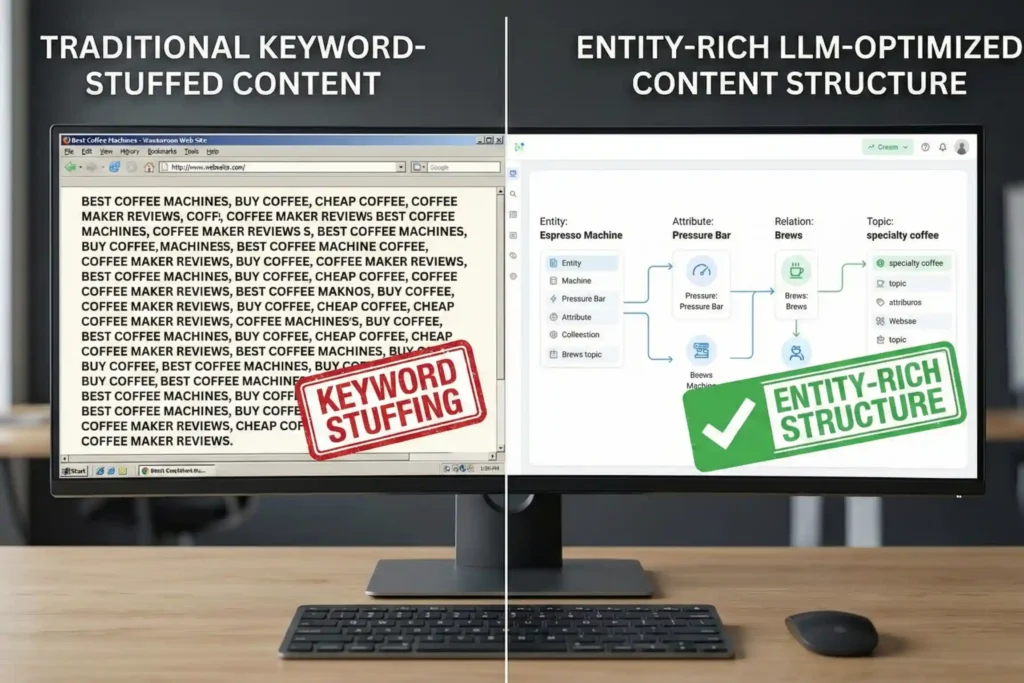
How AI Actually Interprets Content
AI search systems scan for entities, relationships, and patterns rather than phrases. A basic sentence like “our SEO services help you rank higher” gives a model nothing concrete to extract. A version like “our SEO services improve keyword rankings, organic click-through rate, and domain authority by targeting core entities like technical SEO and content strategy” gives the model clear entities and attributes to work with — and a reason to cite it.
Three practices drive this:
Entity mapping. Identifying the people, concepts, and tools a topic should logically include, and weaving them in naturally. More on this in our entity SEO for LLMs guide.
Semantic layering. Connecting each sentence to a broader concept so AI can place your content in the right topical context.
Context building. Providing the surrounding detail that signals genuine expertise rather than surface-level coverage.
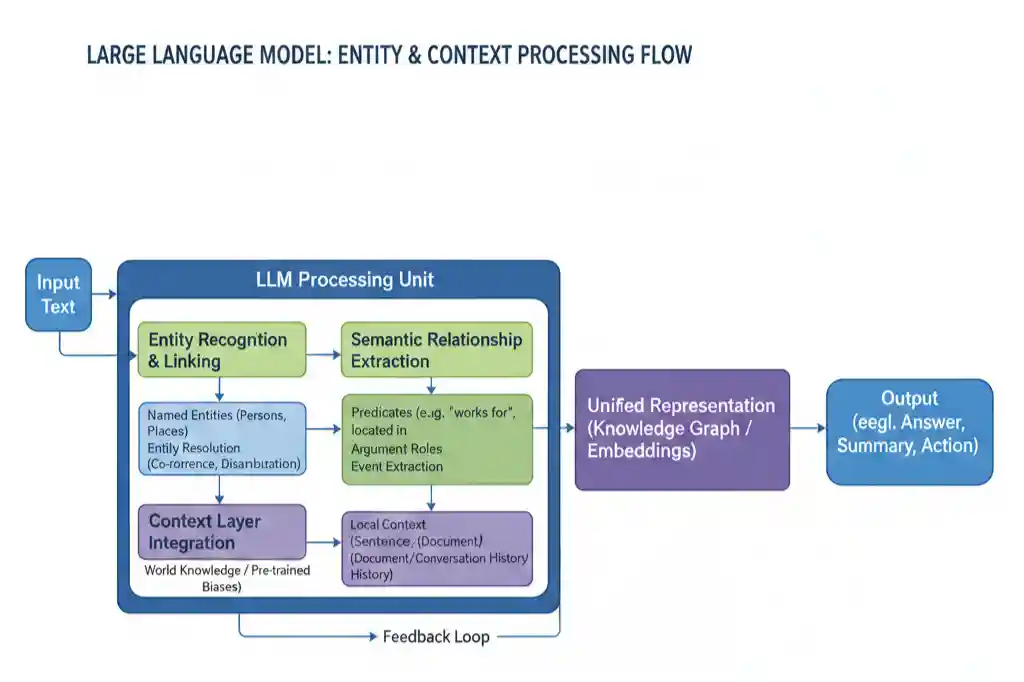
Structuring Content for Maximum AI Visibility
AI systems process enormous volumes of content and rely on structure to find what matters quickly.
Clear H2/H3 hierarchies so topic progression is unambiguous.
Short, scannable paragraphs built for answer extraction.
Lists and tables — models consistently favor structured data over dense prose.
Strategic internal linking that reinforces topical authority across a site.
Pair strong structure with focused LLM keyword research to identify the entities worth building content around in the first place.
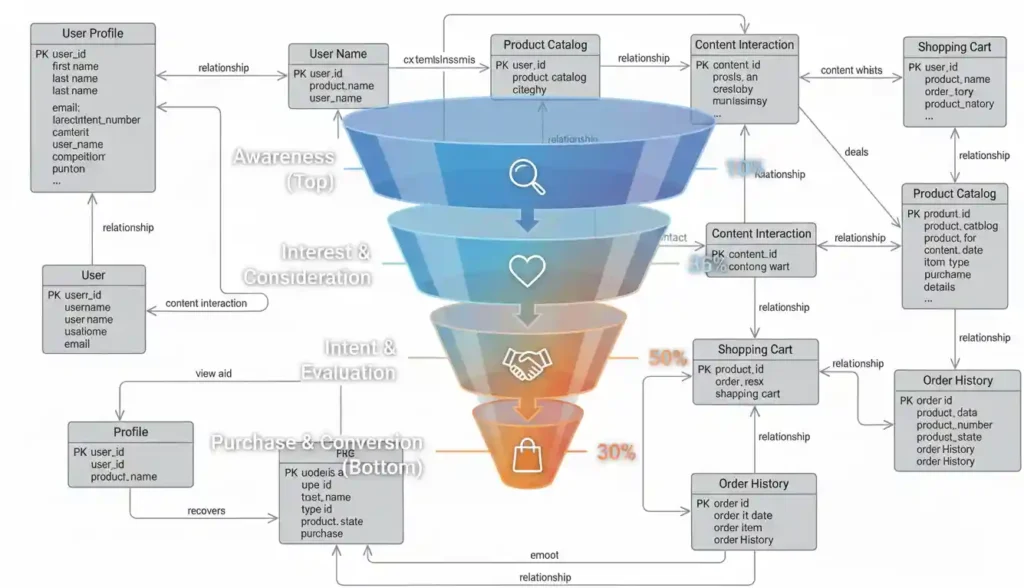
Content Depth: Why Thin Content No Longer Works
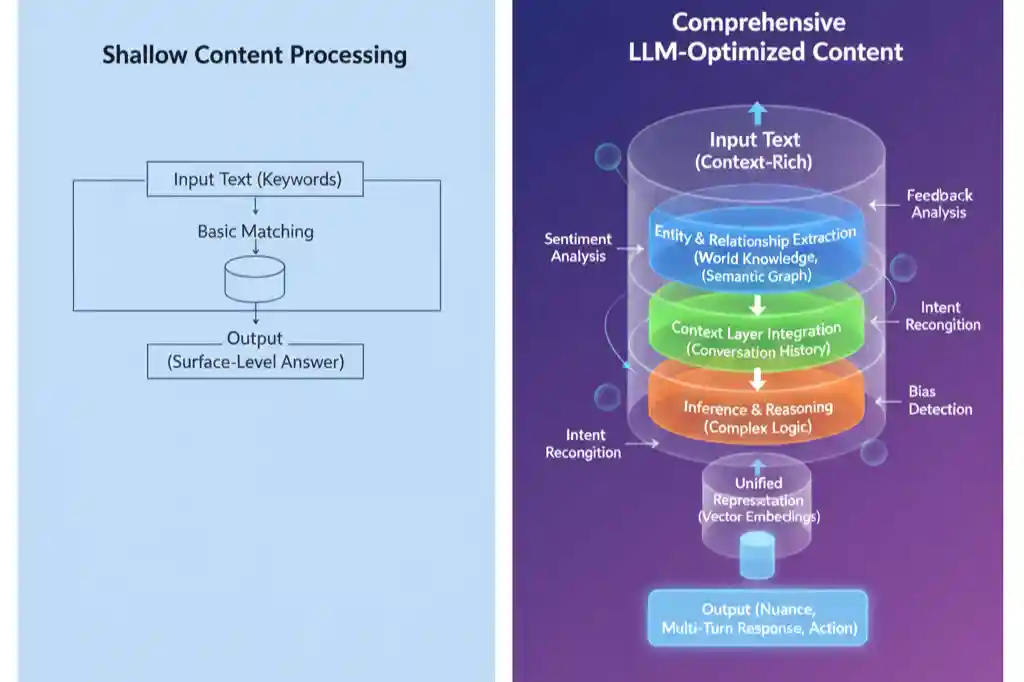
AI rewards depth — not length, depth. That means covering the subtopics and edge-case questions your competitors haven’t addressed, not padding a page with filler paragraphs.
Comprehensive LLM-ready content includes:
- Complete topical coverage of the core subject
- Supporting subtopics that add real layers of context
- Insights backed by data or direct experience
- Explicit connections between related concepts
Google refers to this as information gain — content that adds something new relative to what’s already ranking, rather than repeating it in different words. Google’s own documentation on helpful content is a useful reference point here.
Answer Engine Optimization (AEO)
AEO is about getting selected for voice assistants, featured snippets, and “People Also Ask” boxes. It requires a different discipline than general SEO writing:
- Front-load the answer. Put the direct answer in the first sentence of a section — snippet and voice systems typically extract the first 40-60 words.
- Use question-formatted subheadings. “Why Does Content Structure Matter for AI Search?” matches how people actually phrase voice queries; “Why Structure Matters” doesn’t.
- Keep answers self-contained. A snippet-worthy answer should make sense with no surrounding context.
- One question per section. Blending multiple questions into a single paragraph makes extraction harder and answers weaker.
Generative Engine Optimization (GEO)
GEO is about earning citations inside AI-generated answers — being the source ChatGPT, Perplexity, or Google AI Overviews actually reference, not just a page that ranks.
- Entity-first writing. Name the core people, tools, and concepts directly instead of relying on pronouns or vague references.
- Specificity over assertion. Claims supported by examples or named sources get cited more often than generic statements.
- Schema markup.
Article,FAQPage, andOrganizationschema give AI crawlers structured confirmation of what a page is and who’s responsible for it. See Google’s structured data documentation for implementation guidelines. - Visible freshness signals. A clearly displayed “last updated” date — not just one buried in metadata — signals currency to both readers and models.
- Consistency across related pages. If your site has multiple pages on the same topic cluster, keep definitions identical across them. Contradictory definitions on your own domain confuse entity resolution for AI crawlers.
How We Approach This at Paradigm Media Networks
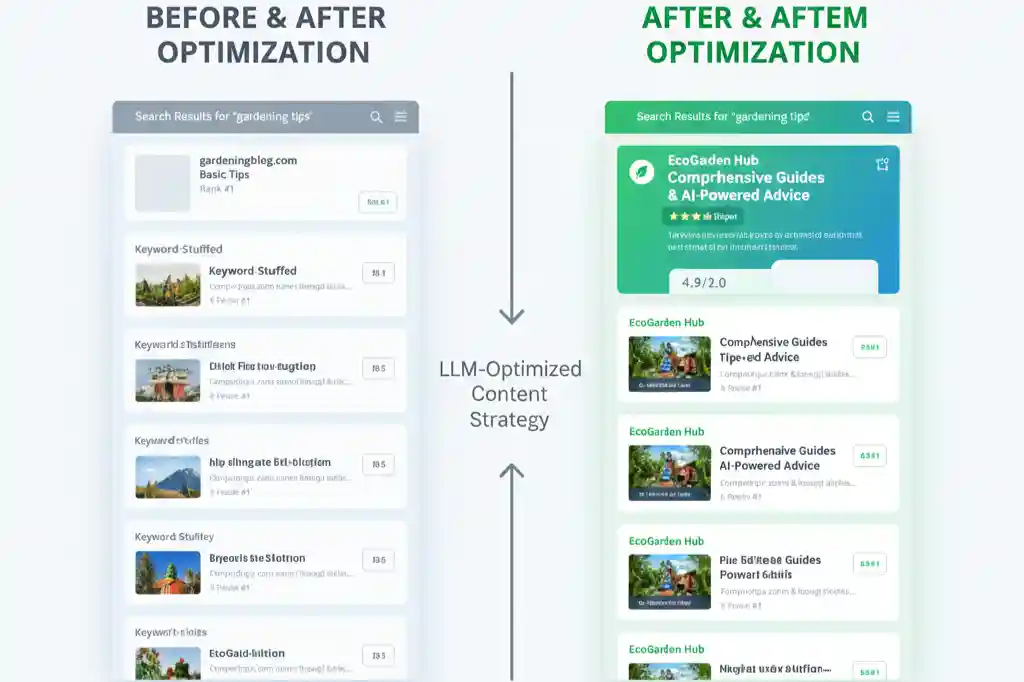
We combine entity mapping, semantic structuring, and schema implementation with a straightforward principle: content should be written for readers first and structured for AI second — never the reverse.
You can see examples of this approach applied to real client work on our portfolio page.
Key Takeaways
- LLM optimization builds on traditional SEO — it doesn’t replace it — by adding entity clarity and semantic structure on top of existing fundamentals.
- AI systems extract meaning from entities and relationships, not keyword repetition, so content should name concepts directly rather than relying on vague phrasing.
- Structure (clear headings, short paragraphs, lists, tables) determines how easily AI can extract and cite a section.
- Depth beats length: covering real subtopics and questions matters more than word count — this is what Google calls “information gain.”
- AEO (Answer Engine Optimization) targets snippets and voice search; GEO (Generative Engine Optimization) targets citations inside AI-generated answers. Both require front-loaded, self-contained answers.
- Schema markup and visible freshness signals (author, last-updated date) help AI crawlers confirm credibility and currency.
FAQs
What is LLM content optimization?
The process of structuring and enriching content so AI-powered search engines can accurately understand, categorize, and rank it — teaching machines to recognize genuine expertise rather than keyword repetition.
Does LLM content optimization replace traditional SEO?
No. It builds on traditional SEO. Core principles like site structure, page speed, and backlinks still matter; LLM optimization adds the entity and semantic layers AI systems use on top of that foundation.
How quickly will I see ranking improvements?
Most pages show measurable improvement within 30-90 days, depending on competition and existing content quality. Results vary by industry and starting point.
Why are entities so important in LLM optimization?
Entities are how AI understands context. Without clear entity signals, models struggle to categorize content accurately, which limits how often it gets surfaced or cited.
Can existing published content be optimized, or only new content?
Yes. Existing pages can be audited for entity gaps, restructured for clarity, and reformatted for AI extraction without a full rewrite in most cases.
What’s the difference between SEO and GEO?
SEO optimizes for ranking position in a traditional search results page. GEO optimizes for being cited or summarized directly inside an AI-generated answer — a different, more specific target.
Do I need LLM optimization if my content already ranks well on Google?
Ranking well today doesn’t guarantee visibility in AI Overviews or chat-based search, which use different extraction criteria. It’s worth auditing separately.
Ready to Optimize Your Content for AI Search?
Structure, entity clarity, and depth are the foundations — but applying them consistently across a site takes a deliberate process, not guesswork.
Visit our portfolio to see how this approach has been applied, or schedule a call to talk through your specific pages.