
LLM SEO Audit Checklist: 25 Checks to See Why AI Search Skips You
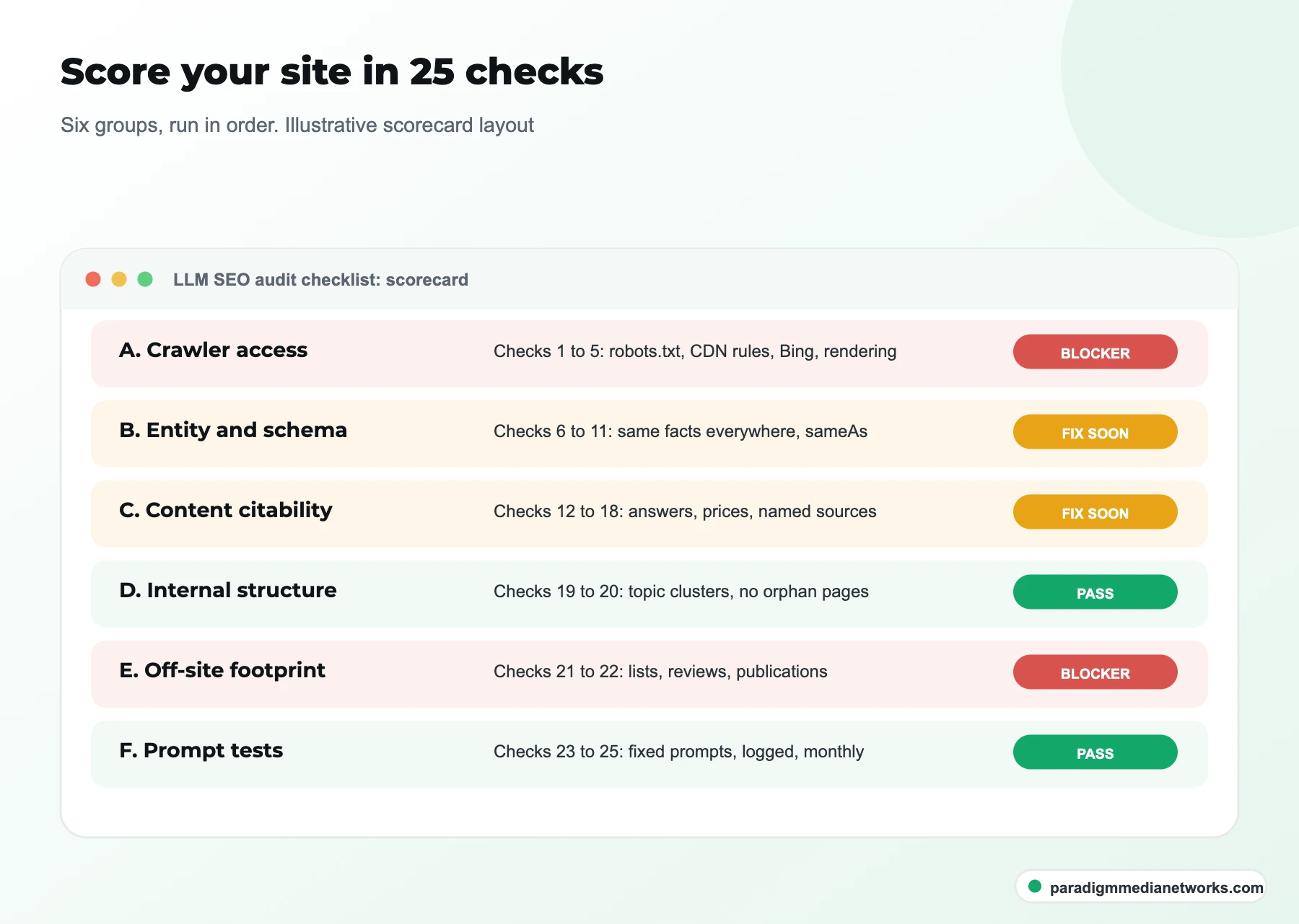
An LLM SEO audit checklist is a list of tests that shows whether AI answer engines like ChatGPT, Perplexity, Gemini and Google AI Overviews can reach, understand and cite your site. Work through these 25 checks in order: crawler access first, then entities and schema, content, off-site mentions, and finally live prompt tests.
✓ Free · No sign-up · Every check explained in plain English

Key takeaways
- Start with crawler access. If OAI-SearchBot or PerplexityBot cannot fetch your pages, nothing else on this list matters for those engines.
- Check below robots.txt too: CDN, firewall and security-plugin rules block AI crawlers more often than people expect, and they never show up in robots.txt.
- Most fixes are about clarity: the same facts about your business everywhere, direct answers, published prices and named sources.
- Google rankings help but are not enough. Ahrefs found about 38% of AI Overview citations came from top-10 pages in March 2026, down from about 76% in July 2025.
- Measure with a fixed prompt set, rerun monthly. One answer on one day tells you very little.
What is LLM SEO?
LLM SEO (large language model SEO) is the practice of making your brand easy for AI systems like ChatGPT, Gemini, Perplexity and Google AI Overviews to find, understand, trust and cite.
Traditional SEO earns a ranking on a results page; LLM SEO earns a mention or citation inside the AI's answer. The two work together: Google says optimising for its AI features is still SEO, and AI tools lean on pages that are crawlable, well structured and well referenced across the web. LLM SEO rests on four pillars:
- Entity clarity: consistent brand, service and location details everywhere you appear online.
- Answer-ready content: question headings with direct answers, lists and tables.
- Trust signals: named authors, sourced data, reviews and mentions on sites AI tools already cite.
- Technical access: AI crawlers allowed at robots.txt and CDN level, pages that load fast and render without scripts, and clean schema markup.
If you would rather have this handled as ongoing work, see our LLM SEO services. If you want the checks run for you once, with a competitor test, our fixed-fee LLM SEO audit covers everything below.
What is an LLM SEO audit, and how is it different from a traditional SEO audit?
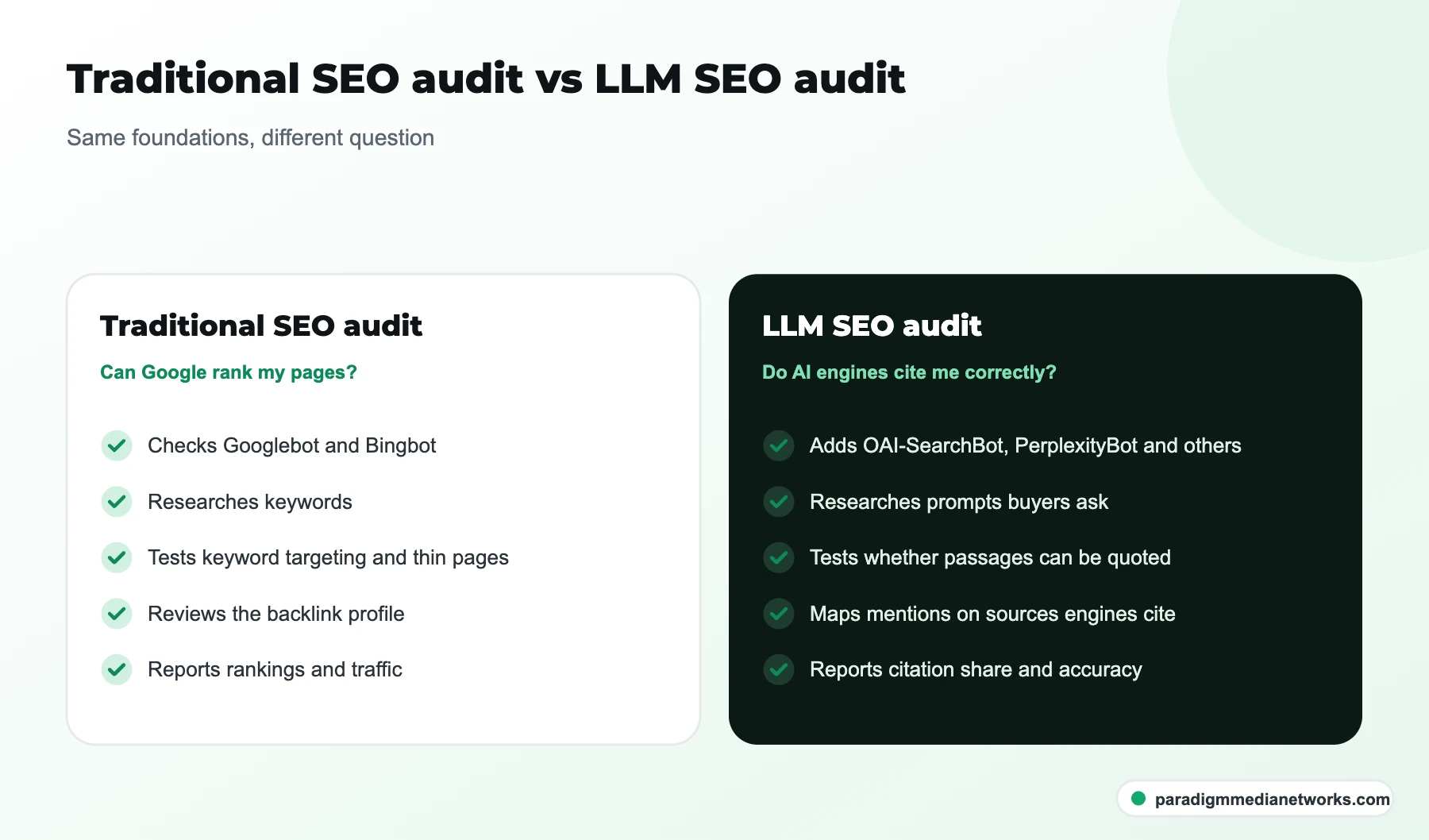
An LLM SEO audit tests how well AI systems understand, trust and recommend your brand, while a traditional SEO audit tests whether Google can crawl, index and rank your pages.

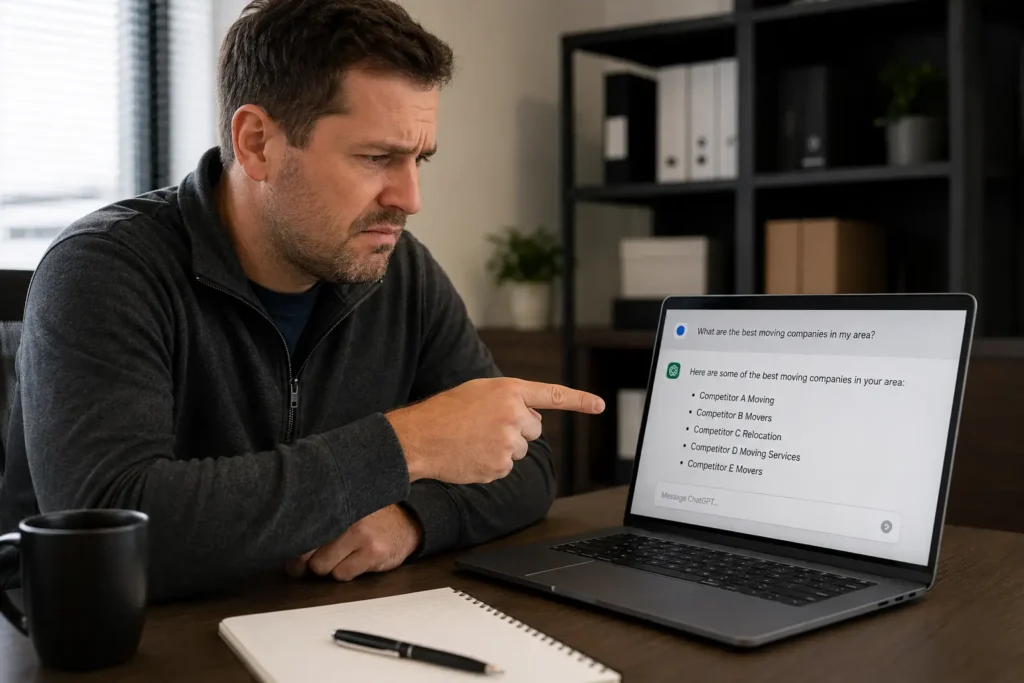
It looks at your site through the lens of large language models: semantic clarity, entity strength, factual consistency and whether AI engines can summarise your expertise accurately. It also tests how your brand appears when someone asks ChatGPT "who are the best [service] providers in [city]?" or asks Perplexity to compare you with a competitor.
Brands with strong technical SEO scores can still be missing from AI answers, because they were optimised for how crawlers index pages, not for how machines interpret and quote information.
What tools do you need before you start?
You need Search Console, Bing Webmaster Tools, a crawler, a schema validator, GA4 and logged-out browser sessions for each AI engine. Most of this is free.
- Google Search Console and Bing Webmaster Tools: indexing, sitemaps and the queries you already rank for.
- A site crawler such as Screaming Frog: status codes, noindex tags, canonicals and orphan pages.
- A schema validator: Google's Rich Results Test and the Schema.org validator.
- GA4 with an AI referral segment: sessions arriving from ChatGPT, Perplexity, Gemini and Copilot.
- Logged-out sessions for ChatGPT, Perplexity and Gemini, plus Google: for prompt tests that are not shaped by your own history.
- Optional: Ahrefs or Semrush for backlink and mention research.
The 25-point LLM SEO audit checklist
Run the checks in this order. Each group depends on the one before it: an engine has to reach your pages before it can understand them, and understand them before it can cite them.
A. Crawler access (checks 1 to 5)
- 1. Check robots.txt rules for each AI bot. Look for OAI-SearchBot (ChatGPT search), GPTBot (OpenAI training), PerplexityBot, Google-Extended and ClaudeBot. Blocking OAI-SearchBot or PerplexityBot removes you from those engines' search answers; blocking GPTBot or Google-Extended affects model training, not search.
- 2. Check CDN, firewall and security-plugin bot rules. Cloudflare bot modes, WAF rules and plugins such as Wordfence can block a crawler that robots.txt allows. Test from outside your network or check the firewall logs.
- 3. Verify Bing Webmaster Tools and submit your sitemap. Bing powers Microsoft Copilot, and OpenAI says ChatGPT search draws on third-party search providers.
- 4. Confirm key pages return 200 and show content without JavaScript. View the raw HTML of your homepage and top service pages. If the main copy only appears after scripts run, some AI fetchers will see an empty page.
- 5. Make sure no commercial page carries a noindex tag. A forgotten noindex on a service or pricing page hides it from search indexes that AI answers draw on.
B. Entity and schema (checks 6 to 11)
- 6. State who you are, what you do and who you serve in the first 100 words of your homepage. If a machine has to guess your category from the third paragraph, it will often guess wrong.
- 7. Use one consistent author identity on every post. Same name, same credentials, one bio and one author page.
- 8. Add Organization, Person and Article or Service schema. Validate it. Google says no special schema is needed for its AI features, so treat markup as a clarity signal, not a trick.
- 9. Keep your name, address, phone and market coverage identical everywhere. Across every page, every schema block and every profile.
- 10. Link your profiles with sameAs. Point your Organization markup at your LinkedIn, directory and social profiles so they resolve to one entity.
- 11. Check your presence on the reference sites engines use. LinkedIn, Crunchbase, Wikidata where you qualify, and the directories that matter in your industry.
C. Content citability (checks 12 to 18)
- 12. Put a direct answer under every H2. One or two sentences that make sense when lifted out on their own.
- 13. Publish prices or price ranges. Buying prompts ask about cost more than anything else, and engines skip pages that dodge it.
- 14. Use tables for comparisons and numbered steps for processes. Structured passages are easier to extract and quote accurately.
- 15. Cite named, checkable sources. Replace "studies show" with the organisation, the date and a link.
- 16. Show real case studies with real outcomes. Name the client where they allow it, and state the source and date range for every figure.
- 17. Show a visible, accurate last-updated date. On every page that carries facts, prices or statistics.
- 18. Treat FAQ markup as structure only. Keep FAQ answers word-for-word with the visible text. Do not add it expecting rich results.
D. Internal structure (checks 19 to 20)
- 19. Link related topics into clusters. Each guide should link to its hub page and its siblings with descriptive anchors.
- 20. Leave no money page orphaned. Every service and pricing page should be reachable within three clicks of the homepage.
E. Off-site footprint (checks 21 to 22)
- 21. Find the third-party sources engines cite in your category. Run your buyer prompts and list every review site, "best of" list, publication and forum thread that shows up as a source.
- 22. Check how those sources describe you. Missing is a gap. Wrong services, old prices or the wrong location are worse, because engines repeat them.
F. Prompt tests and measurement (checks 23 to 25)
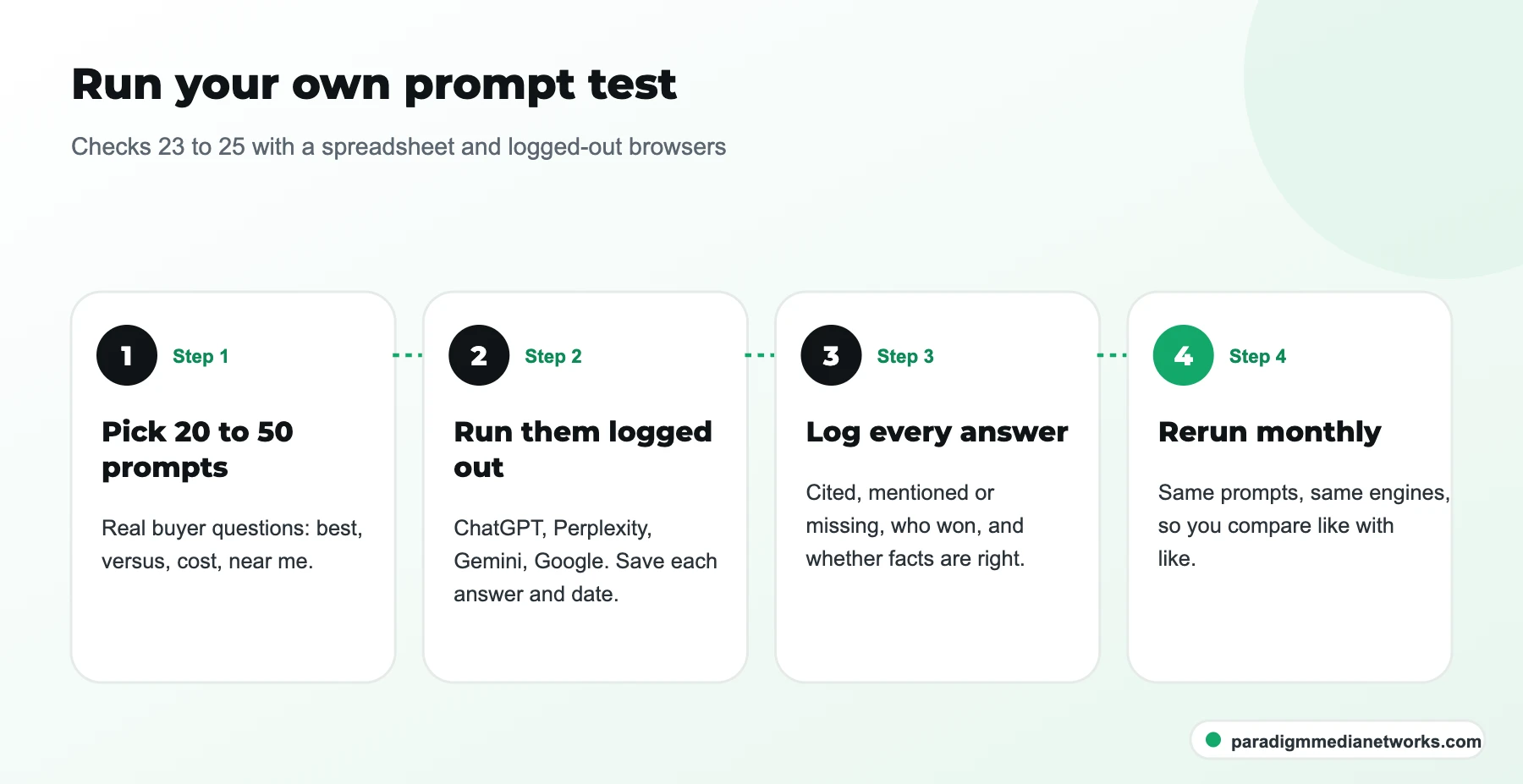
- 23. Ask ChatGPT, Perplexity, Gemini and Google AI Overviews about your category. Use a fixed set of 20 to 50 prompts, logged out, and save every answer with the date and engine.
- 24. Log citation share and answer accuracy. For each answer: are you cited, mentioned without a link, or missing, and is what the engine says about you correct?
- 25. Track AI referrals in GA4 and rerun monthly. Set up a segment for AI referral sources and rerun the same prompt set each month so you compare like with like.
How do entities and semantic structure affect AI visibility?
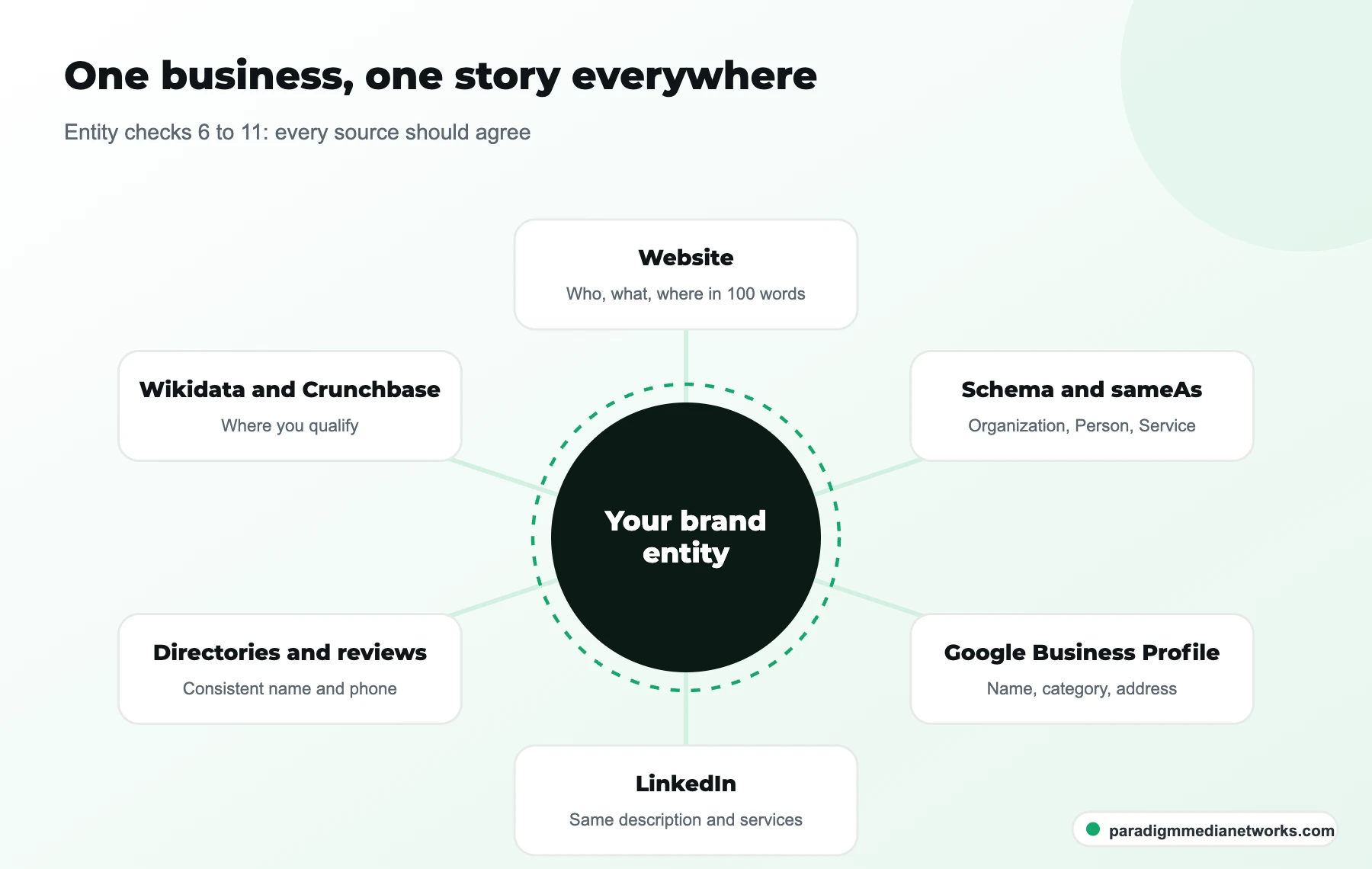
Entities are how AI systems understand the world. Your brand, your services and your locations are all entities, and if their details conflict across the web, engines either describe you wrongly or leave you out.
Checking entities means checking disambiguation (is "paradigm" your company or the general concept?), Knowledge Graph alignment, internal linking and external mentions. Every consistent connection makes it easier for an engine to say who you are with confidence.
| Signal | What it means |
|---|---|
| Entity strength | Does AI recognise your brand as a distinct, disambiguated entity with clear links to your services and industry? |
| Factual consistency | Is your information identical across your site, third-party listings and social profiles? |
| Topical depth | Does your content show genuine, first-hand expertise rather than surface-level coverage? |
| Semantic relationships | Does your content connect related concepts so AI understands the full scope of what you offer? |
Content quality sits on top of this. AI engines look for the same experience, expertise, authority and trust signals people do: first-hand knowledge, named and credentialed authors, and claims that can be checked against other sources. Vague statements, filler and ambiguous terms are where engines misread a page or skip it. If ChatGPT summarises your service wrongly, buyers hear the wrong thing before they ever visit your site. For page formats that pass this test, see our guide on how to structure content for LLMs, and for the entity side, our LLM entity SEO guide.
Which technical and schema elements matter?
Crawler access matters most, then clean Organization, Person and Article or Service schema. Google says no special AI schema and no llms.txt file is needed for its AI features.
Each AI crawler does a different job, so check them one by one rather than allowing or blocking "AI bots" as a group:
| Crawler | Owner | What it does |
|---|---|---|
| OAI-SearchBot | OpenAI | Crawls sites for ChatGPT search. OpenAI says sites that opt out will not be shown in ChatGPT search answers. |
| ChatGPT-User | OpenAI | Fetches live pages when a user asks ChatGPT about them. User-initiated, so OpenAI says robots.txt rules may not apply. |
| GPTBot | OpenAI | Collects content that may be used to train OpenAI models. Blocking it does not remove you from ChatGPT search. |
| PerplexityBot | Perplexity | Surfaces and links sites in Perplexity results. Follows robots.txt. |
| Perplexity-User | Perplexity | Fetches pages when a user asks a question. Generally ignores robots.txt. |
| Google-Extended | Controls use of content for Gemini models. Does not affect inclusion or ranking in Google Search. | |
| ClaudeBot | Anthropic | Crawler for Anthropic's models. Your call to allow or block. |
Sources: OpenAI crawler documentation, Perplexity crawler documentation, Google crawler documentation. ChatGPT search also draws on third-party search providers, which is why Bing Webmaster Tools is on the checklist.
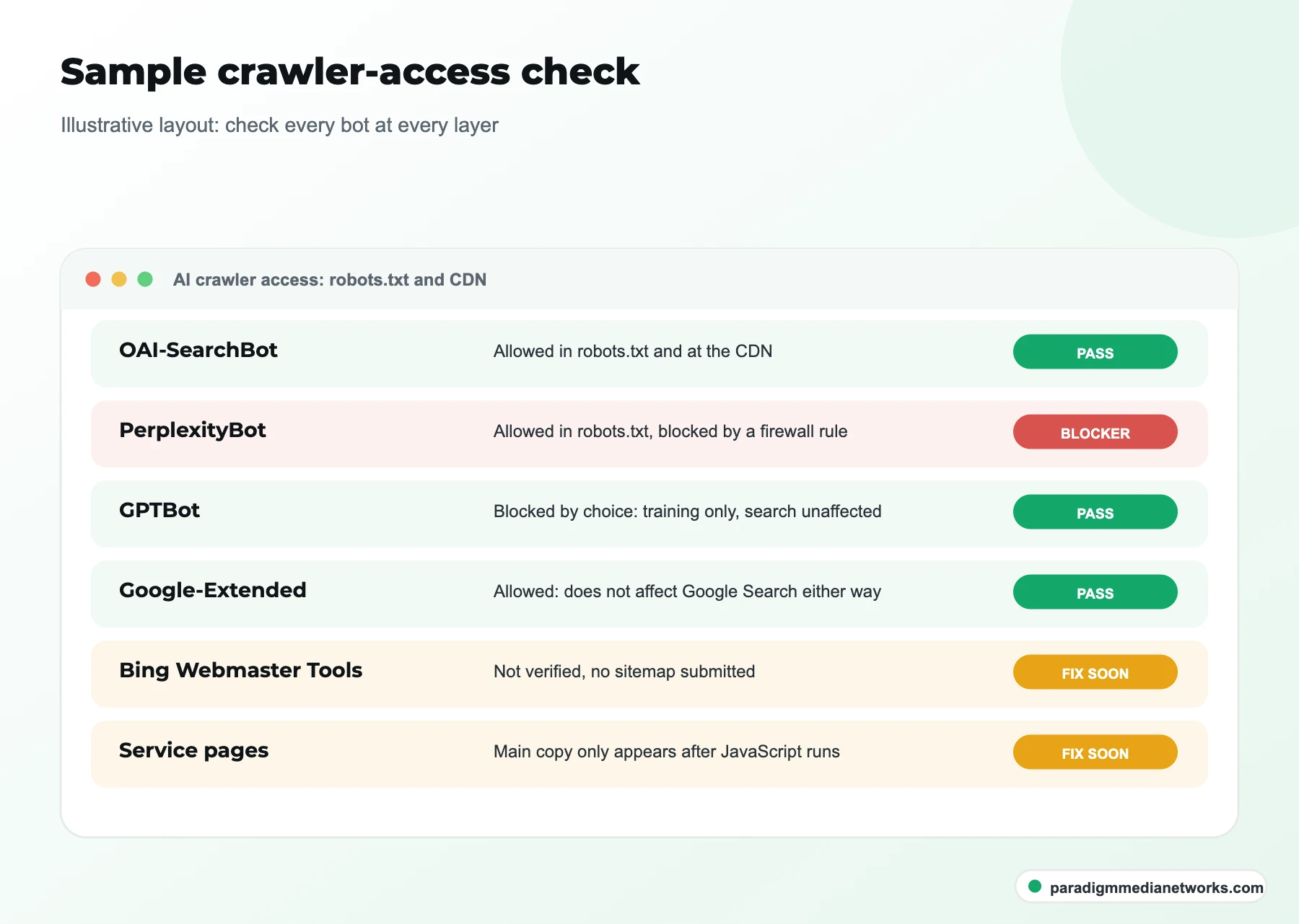
On schema, Organization, Person and Article or Service markup tell engines what each page represents. Many sites still run markup from years ago with broken sameAs links or the wrong organisation name, so validate it. Alt text and image relevance matter too, because AI systems read images as well as text. For a deeper walk-through, see our LLM technical SEO guide.
Where are the prompt gaps?
Prompt gaps are the buyer questions where AI engines recommend someone else. Traditional keyword research misses them because prompts are longer, conversational and often follow on from an earlier question.
Look for opportunity in:
- Long natural-language questions ("which [service] company in [city] is best for [situation]?")
- Follow-up prompt patterns ("what about cost?", "who else should I consider?")
- Entity-based commercial questions ("[your brand] vs [competitor]")
- Semantic keyword clusters around each service
Someone asking an assistant "who should I hire for SEO?" needs different content from someone typing "SEO services" into Google, and a complete strategy covers both. Our guide to LLM keyword research shows how to build the list.
How do I track and measure LLM SEO performance?
Track four things: citation share, mention share against competitors, answer accuracy and AI referral sessions in GA4. Measure them on the same fixed prompt set every month.
- Citation share: the share of answers that link to your domain as a source.
- Mention share: how often you are named, with or without a link, compared with your top competitors.
- Answer accuracy: whether engines describe your services, locations and prices correctly.
- AI referral sessions: visits from ChatGPT, Perplexity, Gemini and Copilot in a GA4 segment.
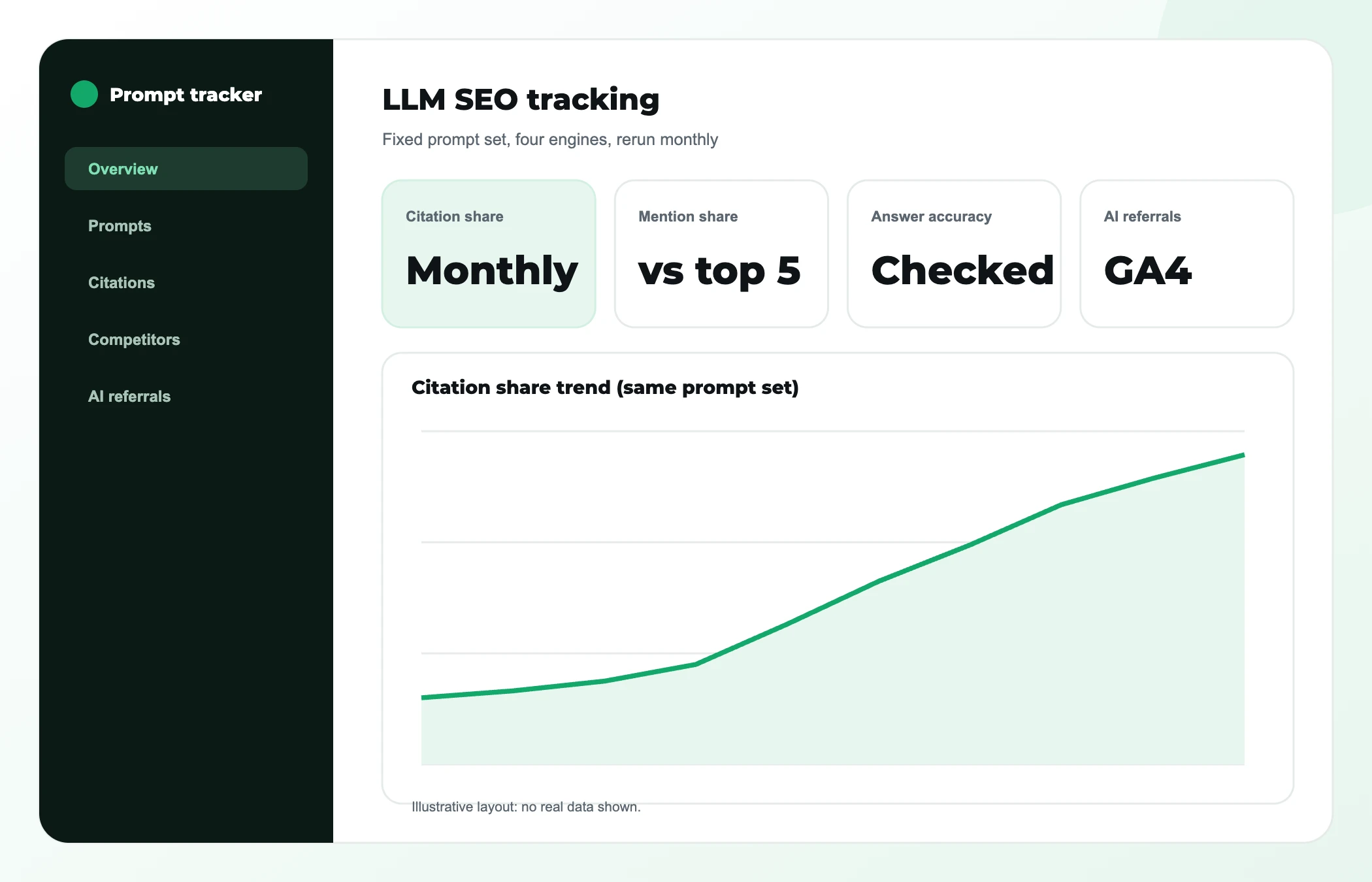
AI answers change from run to run and models update often, so one result on one day is noise. Keep the prompt set fixed, run it logged out, save every answer with the date and engine, and read the trend across months.
How do you make your brand citable by AI search engines?
Getting cited depends on six things you control: consistent entity signals, named sources, direct-answer formatting, structured data, crawler access and a presence on the third-party sources engines cite.
- Consistent entity signals: your brand name, founder, services and locations should read identically across your site, schema, Google Business Profile and social bios.
- Named, checkable sources: cite real data from named organisations instead of "studies show".
- Direct-answer formatting: short, standalone paragraphs that answer one question are far easier to extract and quote than long narrative prose.
- Structured data: Organization, Person and Article or Service schema confirm who you are in machine-readable form.
- Crawler access: OAI-SearchBot and PerplexityBot allowed at robots.txt and CDN level, Bing Webmaster Tools verified.
- Third-party presence: reviews, directories, comparison lists and community threads in your category, described accurately.
What are the most common mistakes?
Most mistakes come from checking one layer and assuming the rest is fine, or from treating a tactic as a shortcut.
- Checking robots.txt and stopping there. A CDN bot rule or security plugin can block the same crawler.
- Blocking GPTBot and thinking you have left ChatGPT search, or the reverse. Search runs on OAI-SearchBot; GPTBot is about training.
- Treating llms.txt as a fix. Google Search does not use it.
- Adding FAQ markup for rich results. Use it as structure that matches the visible text, nothing more.
- Testing prompts while logged in, once. Personal history shapes answers, and single runs vary. Use a fixed set, logged out, repeated.
- Letting business details drift. Two spellings of your name or an old address on a directory is enough to blur your entity.
When should you hand this to a specialist?
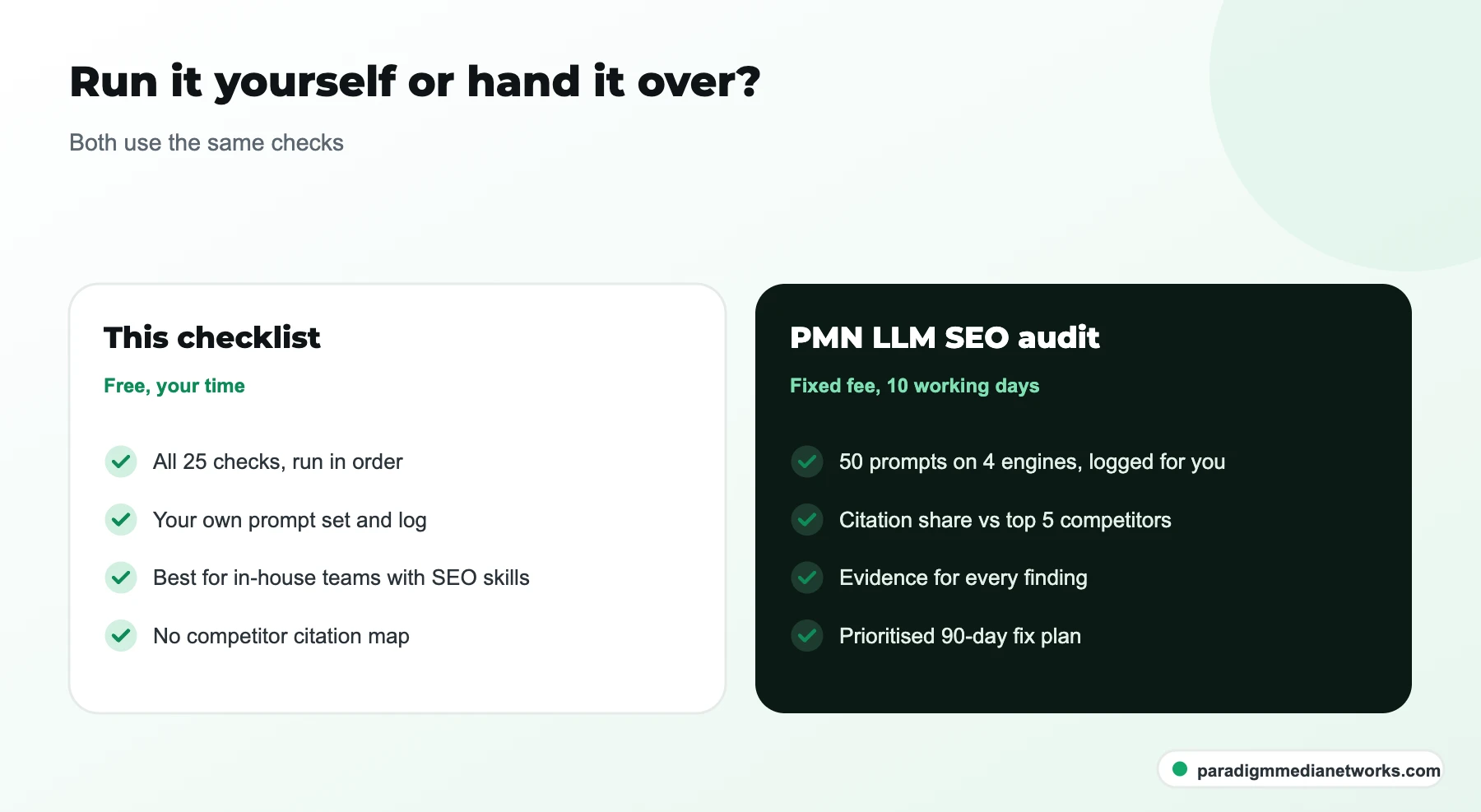
Run the checklist yourself if you have the time and the skills. Hand it over when you need a competitor comparison, evidence for every finding and a ranked fix plan your team can start on straight away.
The prompt tests are where most in-house teams run out of time: 50 prompts on four engines is 200 answers to run and log, before any analysis. A paid audit also adds a competitor citation map, which needs the same prompts scored for your top competitors.
Agencies that want to offer this to their own clients can resell it under their brand through our white-label GEO services.
LLM SEO audit checklist: frequently asked questions
How long does it take to audit a site for LLM readability yourself?
It depends on the size of the site. The crawler, schema and content checks are quick with the tools listed above. Prompt testing is the slow part: 20 prompts on four engines is 80 answers to run, read and log, and you need to repeat it to see a trend.
Do I need an llms.txt file?
Not for Google. Google states that Google Search does not use llms.txt or other AI-specific text files, and creating one will not help or hurt your Search visibility. You can still publish one for other AI tools, but it is not a fix for missing citations.
Should I block GPTBot?
That is a business choice. GPTBot collects content that may be used to train OpenAI models. Blocking it does not remove you from ChatGPT search answers; that is controlled by OAI-SearchBot. If you want to appear in ChatGPT search, keep OAI-SearchBot allowed.
How often should I rerun an LLM SEO check?
Rerun the prompt tests monthly and the full checklist every quarter, or after any site migration, redesign or CDN change. AI answers vary from run to run, so compare the same prompt set over time rather than reading one result.
Can agencies use LLM audits for SEO?
Yes. Agencies use LLM audits as paid discovery before a retainer, to find entity and schema gaps that also hurt classic SEO, and to find new prompt and topic ideas for content plans. If you want to resell one under your brand, see our white-label GEO services.

One team, one revenue number
Strategy is led by Jahid Hussain, founder of Paradigm Media Networks, with 7 years in growth marketing, SEO and performance marketing and an MBA in Marketing. SEO, AI search, paid media, content and web run as one system, so nobody hands you a report that contradicts another vendor’s.
- 500+ marketers trained and 30+ brands scaled
- Published results you can check: HVAC case study and Moving Hub case study
- Reporting on calls, leads and booked jobs, not just rankings
See where AI search stands on you
Start with the free AI Visibility Checker for a 15-signal score. Prefer to have every check run for you? Our fixed-fee LLM SEO audit adds a 50-prompt competitor test and a 90-day fix plan.
✓ Free 30-minute call · No pitch decks · Walk away with a real plan
What you walk away with
- A 0 to 100 AI visibility score from the free checker
- A fix list ordered by the points each change is worth
- A clear view of which checklist groups need work first
- On a call: a straight answer on whether you need help at all