



How to do SEO for HVAC companies is genuinely one of the most practical things an HVAC owner can learn. The foundations, your Google Business Profile, dedicated service pages, local citations, and a consistent review system, are all achievable without a marketing team or a technical background.
What kills most DIY attempts is not difficulty. It is doing things out of order. Spending three months writing blog posts before fixing your Google Business Profile is a real pattern we see. This guide gives you the correct sequence.
According to Marketing LTB’s 2026 HVAC Marketing Statistics report, HVAC companies with blogs generate 67% more monthly leads, and businesses ranking in the top three on Google capture 75% of all clicks. You do not need to be an expert to get there. You need a system.
What Competing Guides Are Getting Wrong
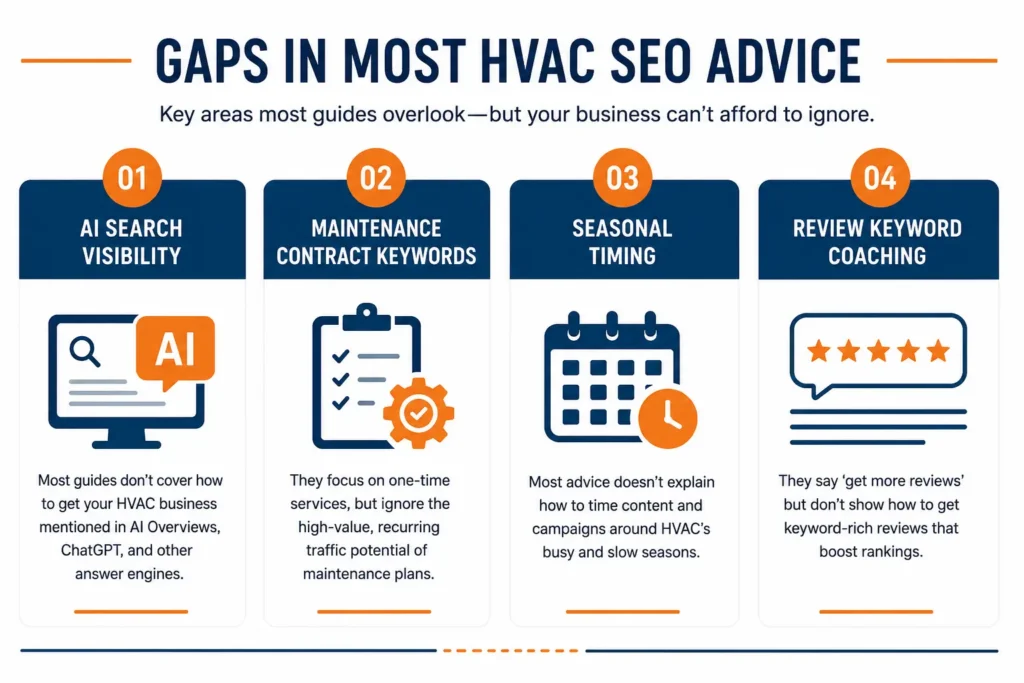
After reviewing the top five ranking articles for how to do SEO for HVAC companies, the same blind spots appear in all of them.
Maintenance contract keywords are almost never mentioned. Search volume for terms like “HVAC maintenance plan near me” is real, consistent, and low-competition. Every HVAC owner knows recurring contracts are the backbone of stable revenue. Almost no SEO guide targets those searches.
Seasonal content timing is explained backwards. Most guides say publish before the season. What they skip is the actual window: content published during the season has almost no chance of ranking in that season. Google needs 45 to 90 days. Your summer AC content should go live in March.
AI search is treated as a future concern. It is not. A 2026 BrightLocal survey cited by BDR found that 45% of consumers now use AI tools like ChatGPT and Google AI Mode to find local service providers, up from 6% the previous year. If your content is not structured for AI citations, you are already behind.
Step 1: Keyword Research That Finds Buyers, Not Browsers
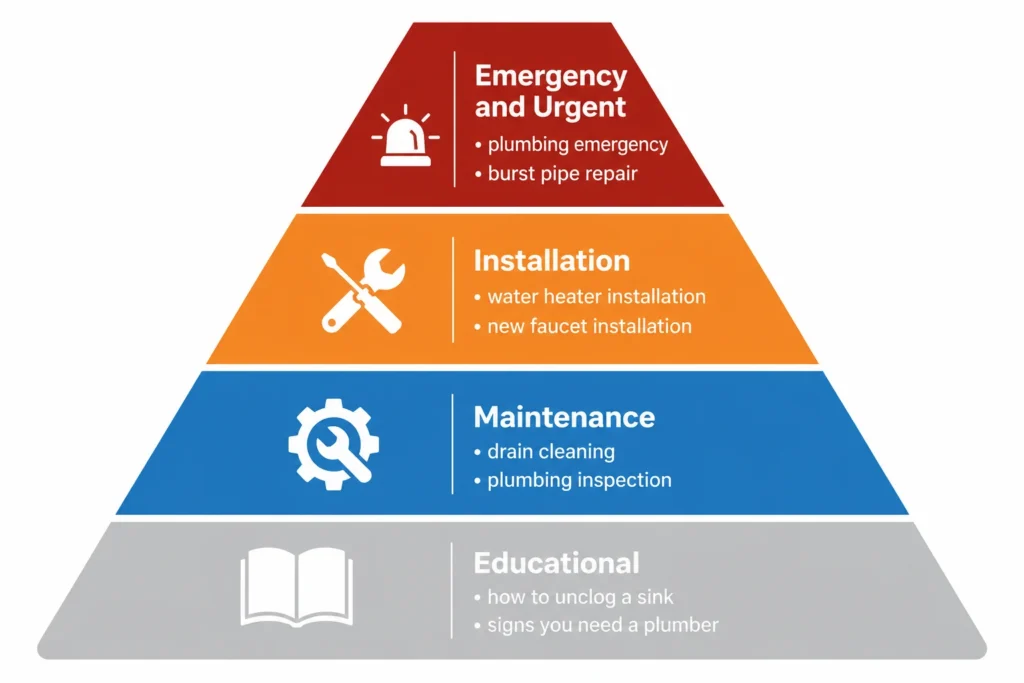
The difference between keywords that generate calls and keywords that generate traffic is intent.
| Priority | Keyword Type | Example | Why It Converts |
| 1 | Emergency | “AC not cooling [city]” | Caller is booking within hours |
| 2 | Installation | “New AC installation [city]” | High ticket, high intent |
| 3 | Maintenance Contract | “HVAC maintenance plan [city]” | Recurring revenue, low competition |
| 4 | Repair | “Furnace repair near me” | Consistent volume year-round |
| 5 | Educational | “When to replace HVAC” | Authority building, long-term |
Free tools that work for this research: Google Search autocomplete, the People Also Ask box in search results, and AlsoAsked.com. Type your service plus your city and read what appears. Those autocomplete suggestions are real searches.
Most HVAC owners target “best HVAC company [city]” as a primary keyword. Skip it. Someone searching “furnace not turning on at 11pm” is calling in the next hour. That is the search you want to own.
Step 2: Google Business Profile, Your Fastest Win
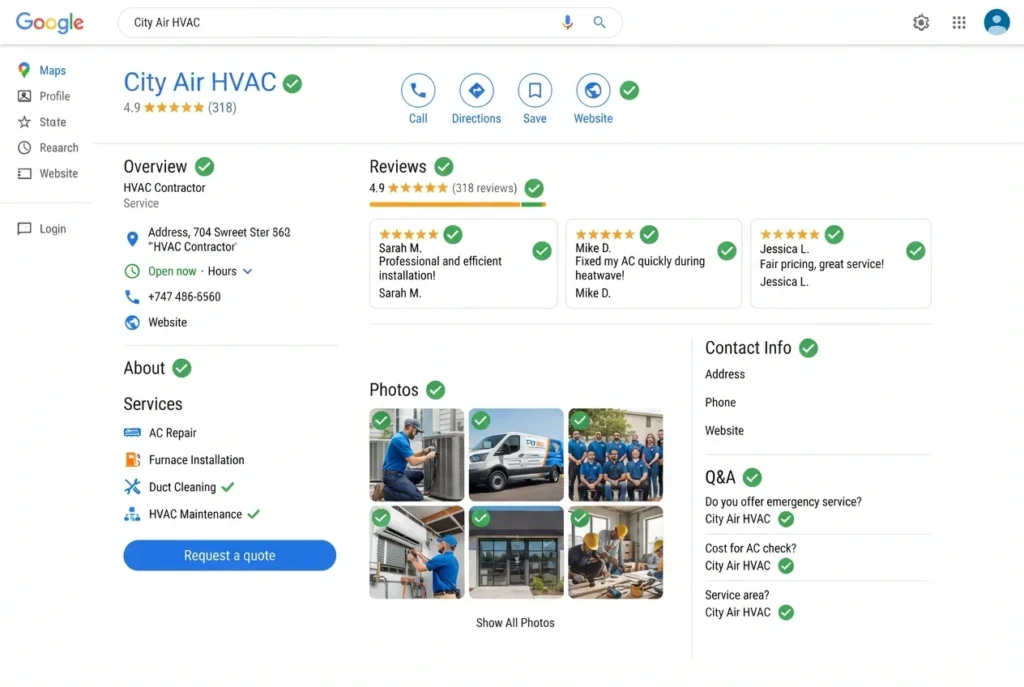
Your Google Business Profile is free, controllable, and directly tied to how often your phone rings from local searches. This is step one for a reason.
GBP setup checklist:
- Primary category set to HVAC Contractor, not Air Conditioning Repair Service
- Secondary categories added: Heating Contractor, Furnace Repair Service, Air Conditioning Contractor
- Every service listed with a short written description
- Service area covers every city and zip code you actually work in
- Minimum of 25 real job photos, no stock images
- Q and A section filled with common customer questions, including emergency availability
- Google Posts published at least twice per month
- Review request sent within 90 minutes of every completed job
The part most guides skip: the words your customers use in reviews act as keyword signals in your local ranking. A review that says “they replaced our AC unit same day” helps your profile rank for AC replacement searches. Coach customers naturally. “If you mention the service you needed in your review, it really helps other homeowners find us.” That one sentence to each customer compresses months of ranking work.
Stop Reading. Start Ranking. Your competitors are filling their Google Business Profile right now. If yours is incomplete, every day costs you calls. Get a Free GBP Audit from Our Team
Step 3: Service Pages That Rank for What You Actually Do
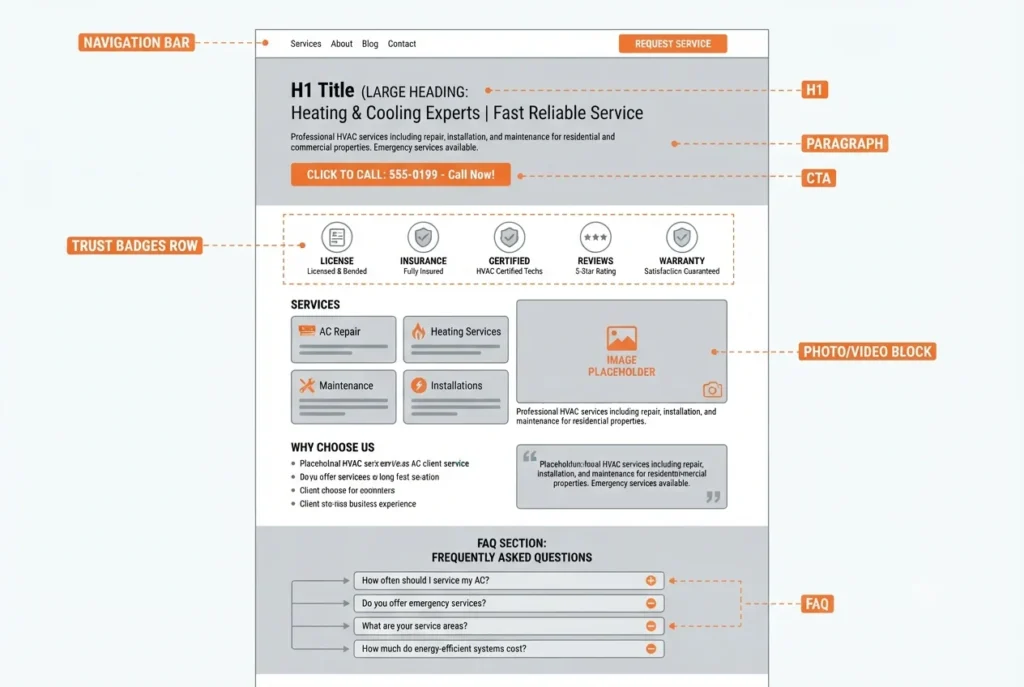
A single Services page listing AC repair, furnace installation, duct cleaning, and eight other services on one URL cannot rank for any of them. Google ranks pages, not websites. Each service needs its own page.
On-page checklist for every service page:
- H1 includes the keyword and city name
- Primary keyword appears within the first 100 words
- Meta title is 55 to 60 characters
- Meta description includes a specific benefit and a call to action
- URL is clean: /ac-repair-cityname/ not /services/id=7
- Click-to-call button visible without scrolling on mobile
- License number, insurance status, and certifications visible on the page
- FAQ section at the bottom with 3 to 5 real questions
- LocalBusiness and FAQPage schema markup added
For the technical side of making these pages rank-ready, the guide on SEO-friendly website development covers the structural decisions that affect how Google reads and indexes your pages.
Step 4: Technical SEO Basics Your Site Needs Right Now
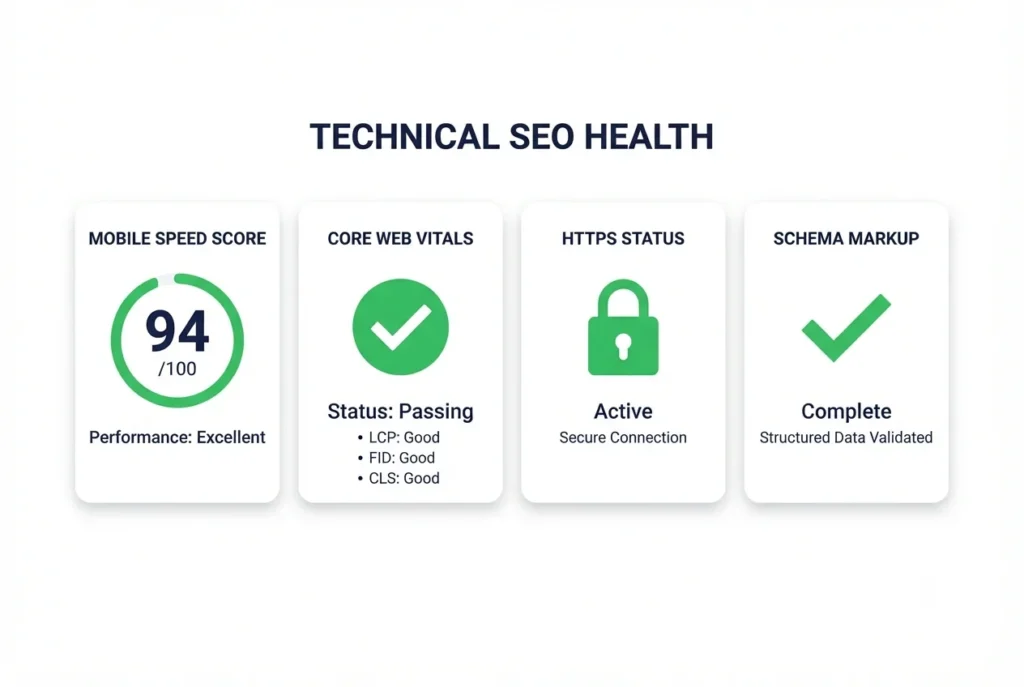
HVAC traffic is 60 to 80% mobile. A site that loads in six seconds on a phone is not competing regardless of how well everything else is done.
Technical checklist:
- Mobile page speed under 3 seconds, test with Google PageSpeed Insights
- HTTPS active across the entire site
- XML sitemap submitted to Google Search Console
- No broken links or 404 errors, check with Search Console’s Coverage report
- Schema markup live on service pages and homepage
- Click-to-call link functional on all mobile pages
- Google Analytics 4 and Search Console connected and collecting data
PageSpeed Insights is free and takes 90 seconds to run. If your mobile score is below 70, fixing that alone can move local pack rankings within weeks.
Step 5: Content That Builds Authority Before the Season Hits
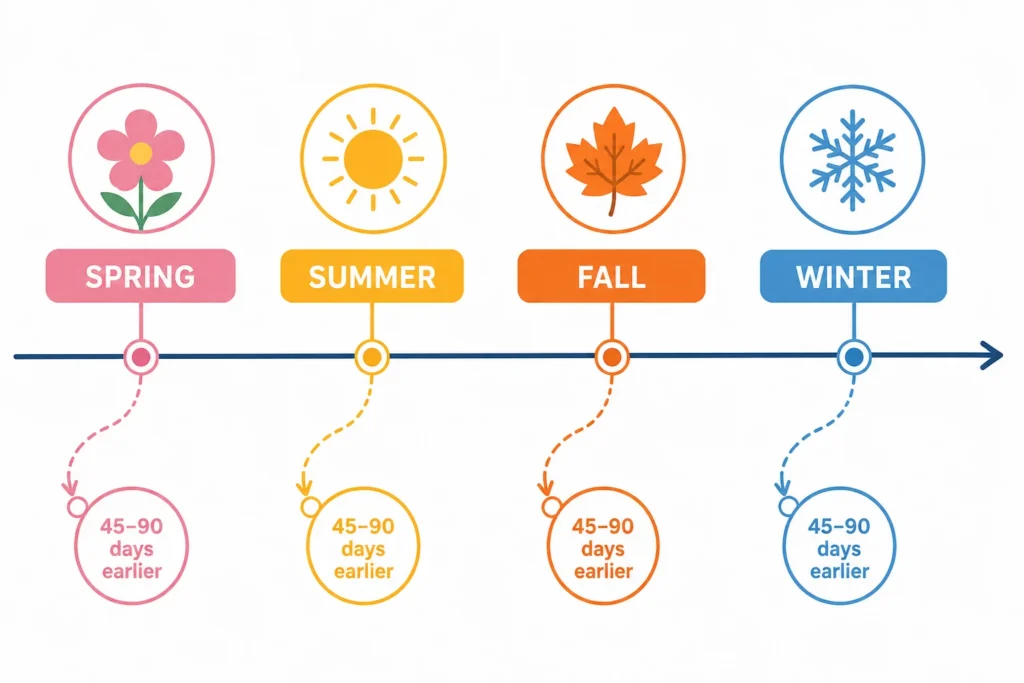
Google needs 45 to 90 days to index and rank a new page. Content published in July for July demand ranks in October.
Content types that generate actual leads for HVAC companies, ranked by return:
- Seasonal maintenance guides published 60 to 90 days early
- Cost guides for high-ticket services, “How much does AC installation cost in [city]”
- Maintenance plan landing page targeting “HVAC service agreement near me” and similar searches
- Problem and symptom pages, “Why is my furnace blowing cold air” captures emergency researchers
- Comparison guides, “Heat pump versus gas furnace for [city] homes” targets buyers close to deciding
One piece of content this guide covers that almost no competitor mentions: a dedicated maintenance contract page. The keyword “HVAC maintenance plan [city]” has real search volume and almost no competition in most markets. That page alone has generated consistent monthly bookings for service businesses we have worked with.
Step 6: Citations, Backlinks, and Local Trust Signals
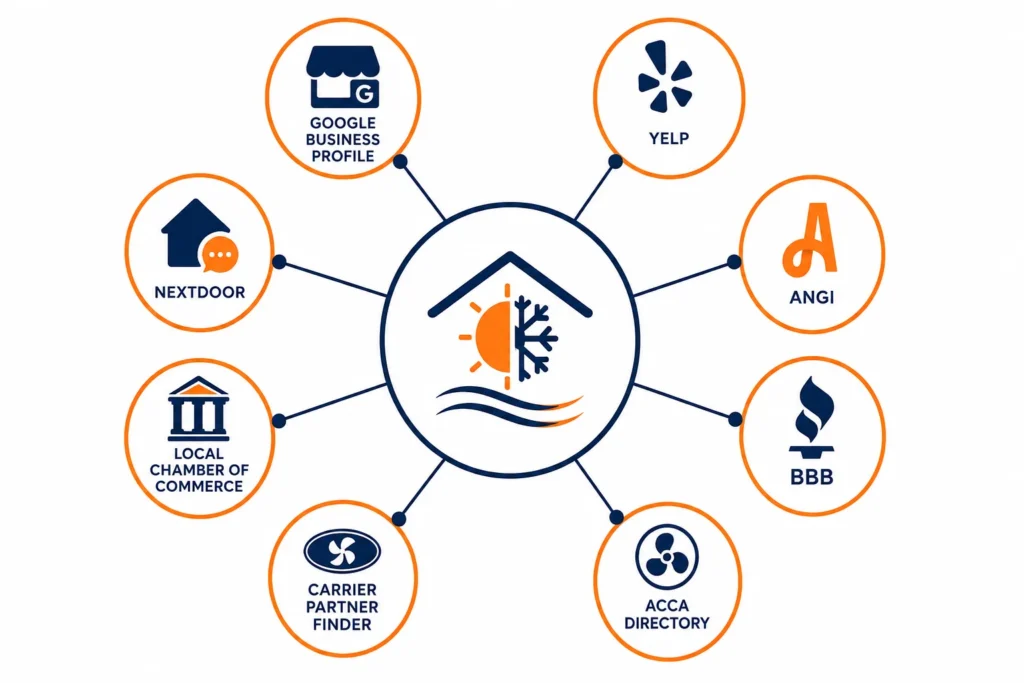
Citations are listings of your business name, address, and phone number across the web. Inconsistency between listings, “Street” in one place and “St.” in another, creates confusion for Google and can suppress local rankings.
Priority citation sources for HVAC companies:
- Google Business Profile
- Yelp
- Angi
- HomeAdvisor
- Better Business Bureau
- Houzz
- Nextdoor Business
- ACCA member directory
- Manufacturer partner locator (Carrier, Lennox, Trane, Rheem)
- Local Chamber of Commerce
Backlinks without an agency:
- Sponsor a local youth sports team, most have a website with a sponsor listing
- Get listed on your manufacturer’s contractor locator if you are a certified installer
- Write a seasonal tip article for a local HOA newsletter or community blog
- Join your regional ACCA chapter and claim the directory listing
Ten relevant local links outperform 200 generic directory submissions every time.
Step 7: Showing Up in AI Search Results
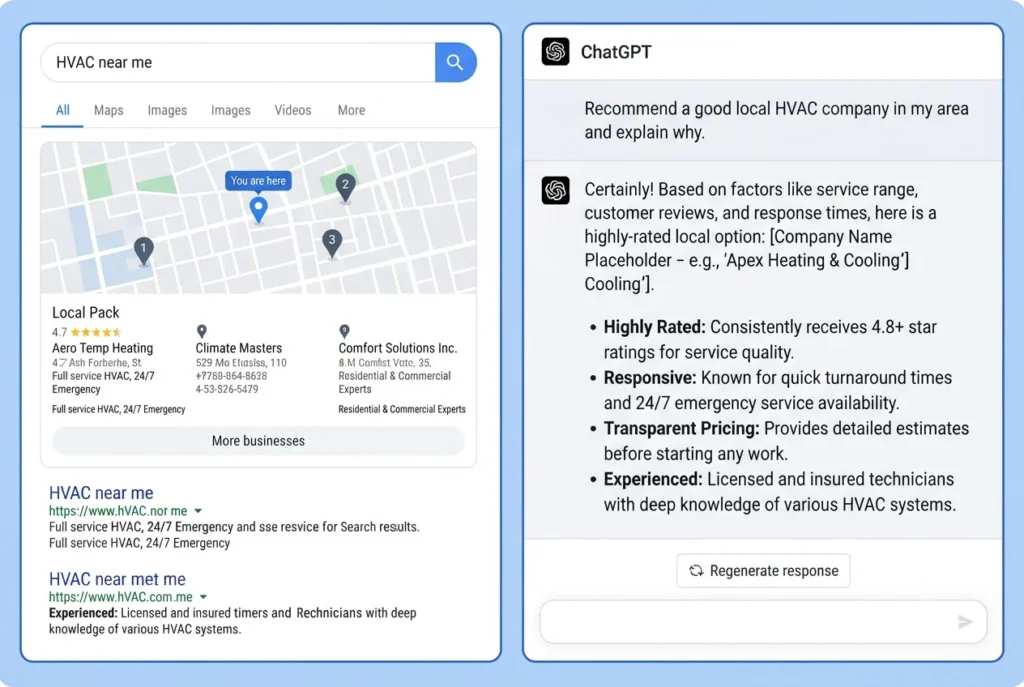
This is the largest gap in every competing guide on this topic.
Homeowners are now asking ChatGPT and Google AI Mode things like “who is the best HVAC contractor near me.” When AI recommends a business, the homeowner has largely decided before they pick up the phone. That lead converts faster and with less friction than a standard organic click.
How to structure your content for AI citations:
- Open every service page with a direct 40 to 60 word answer to the most likely question about that service
- Add FAQPage schema markup to every service page and your homepage
- Cover your topic completely, not just “AC repair” but “how long does AC repair take,” “AC repair versus replacement,” and “emergency AC repair cost”
- Ensure your business is mentioned on credible external sites, manufacturer directories, industry associations, and local media
Our breakdown of HVAC SEO services covers the full Answer Engine Optimisation system we build for service businesses looking to capture both Google and AI-driven leads.
The Complete SEO for HVAC Companies Checklist
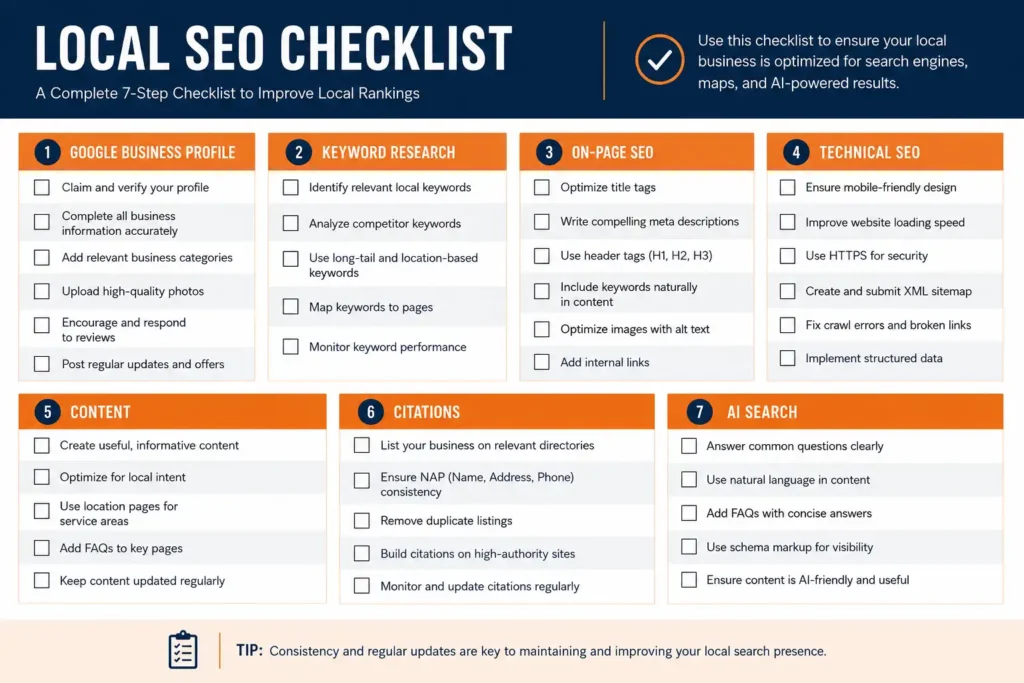
Foundation
- Google Analytics 4 and Search Console installed and linked
- Google Business Profile fully claimed and completed
- Top 10 target keywords identified per service and city
Google Business Profile
- Primary category: HVAC Contractor
- All services listed with descriptions
- Minimum 25 real job photos uploaded
- Review request system active after every job
- Google Posts published twice monthly
On-Page SEO
- Dedicated page per service
- H1 includes keyword and city
- Meta title 55 to 60 characters
- Click-to-call above the fold on mobile
- License and insurance visible on each page
- FAQ section on every service page
Technical
- Mobile speed under 3 seconds
- HTTPS active sitewide
- Sitemap submitted to Search Console
- Schema markup on all service pages
- No broken links
Content
- Seasonal content published 60 to 90 days early
- Maintenance plan page live with targeted keywords
- Problem and symptom pages for each major service
- Cost guide for at least one high-ticket service
Citations
- NAP consistent across all directories
- Listed on all 10 priority citation sources
- Manufacturer directory listing active if applicable
AI Search
- Direct answer in first 60 words of every service page
- FAQPage schema on all service pages
- Full topical coverage for each service category
Case Study: From Zero Organic Leads to 19 Calls Per Week
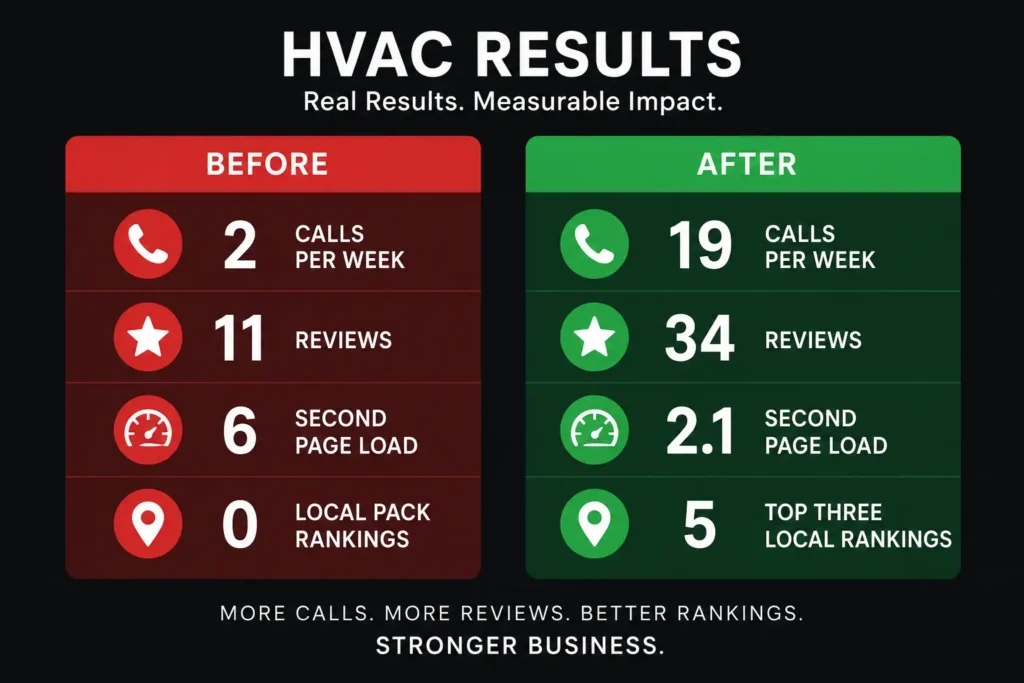
An independent HVAC contractor in a mid-sized suburban market was spending $1,800 per month on Google Ads to generate two calls per day. Their website had been live for four years. Their Google Business Profile had 11 reviews, the last from 14 months earlier. They were ranking for zero commercial keywords.
What the first audit found:
- GBP primary category set incorrectly
- One Services page for 11 different offerings
- No location pages, no schema markup, no FAQ sections
- NAP inconsistent across seven directories
- Mobile page load time: 6.2 seconds
What was done in 60 days using the exact checklist above:
- GBP rebuilt with correct categories, 34 job photos, service descriptions, and weekly posts
- Review request added to the job completion workflow, 23 new reviews in 60 days
- Eight individual service pages created with proper H1, schema, and trust badges
- NAP standardised across all directories
- Mobile page speed reduced to 2.1 seconds through plugin-level optimisation
- Emergency HVAC repair page created for 24/7 search intent
Results at 90 days:
- Organic calls: 2 per week to 19 per week
- Google Maps appearances up 280%
- Top 3 local pack ranking for five service and city keyword combinations
- Google Ads budget reduced from $1,800 to $400 per month
- Revenue from organic search: $14,000 per month in new booked jobs
Expert Tip from Jahid, Founder of Paradigm Media Networks: “The emergency HVAC repair page is the single most underbuilt page in the industry. Searches like ’emergency furnace repair near me’ spike after midnight on weekends. Most HVAC sites have no dedicated page for that search. The contractor that does, wins every one of those calls.”
When to Stop Doing It Yourself
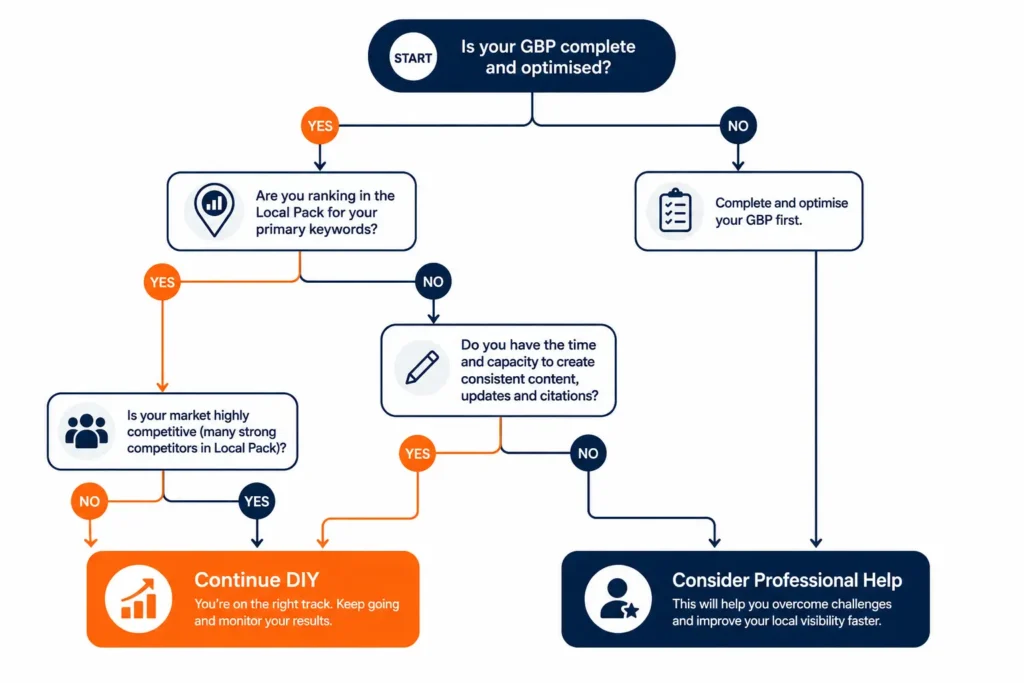
DIY works well for the foundation. It handles most of what an HVAC company needs to reach the top three in a small to mid-sized market.
There are situations where you hit a ceiling, though:
- Highly competitive metros where the top three GBP results have 500-plus recent reviews and city-specific landing pages for every area they serve
- Multiple locations where managing SEO manually becomes a distraction from running the business
- Plateau after initial gains, which usually signals the need for link building or content depth beyond the basics
- No realistic time to execute the checklist consistently, SEO done sporadically compounds nothing
If any of those are true right now, our breakdown of how much HVAC SEO costs in 2026 gives you realistic numbers before you make that call. And if you want to know exactly where your current presence is breaking down, the 47-point HVAC SEO audit checklist walks through the full diagnostic.
FAQ
Can I do HVAC SEO myself without hiring an agency?
Yes, and for most small to mid-sized HVAC companies, the foundation work is genuinely DIY-friendly. Your Google Business Profile, individual service pages, local citations, and a review request system can all be set up without technical expertise or a marketing budget. Where most owners get stuck is consistency. SEO is not a one-time task. The businesses that see compounding results are the ones running the checklist every month, not just once. If you have 4 to 6 hours per week to dedicate to it, you can manage the basics yourself. If you do not, that is when an agency makes financial sense.
Does having more Google reviews actually help HVAC companies rank higher?
Yes, but the detail most guides skip is that review velocity matters more than total count. A profile collecting 15 to 20 reviews per month consistently will outrank a competitor sitting on 300 reviews earned over five years. Google weights recency. Beyond quantity, the words customers use in their reviews function as keyword signals. A review mentioning “furnace installation” helps your profile appear for furnace installation searches. Ask every customer to describe the service they received in their review. That one coaching prompt does more for your local rankings than most technical fixes.
Do HVAC companies need a separate website page for every city they serve?
For most service areas, yes. If you serve 8 to 12 cities, a single homepage listing all of them cannot rank for any specific location. Dedicated location pages targeting “HVAC service [city name]” give Google a clear, indexable signal for each area. The mistake most contractors make is copy-pasting the same content across location pages with only the city name swapped. Google identifies thin location pages quickly. Each page needs genuinely localised content: local weather references, real job photos from that area, and customer reviews from that location if possible.
How do HVAC companies show up in Google AI Overviews and ChatGPT recommendations?
Structured content is the main lever. AI search tools pull citations from pages that open with a direct, factual answer to the likely question, follow that with supporting detail, and use FAQPage schema markup so the structure is machine-readable. Beyond your own website, AI engines learn who to recommend from external trust signals: manufacturer directory listings, industry association memberships, mentions in local media, and high-authority review platforms like Yelp and Angi. The HVAC companies appearing in AI recommendations in 2026 are the ones with comprehensive topical coverage on their site combined with credible third-party mentions across the web.
What is the difference between local SEO and regular SEO for HVAC companies?
Regular SEO focuses on ranking your website pages in standard Google search results. Local SEO specifically targets the map pack, the three business listings that appear at the top of Google results when someone searches with local intent, like “AC repair near me” or “furnace repair [city].” For HVAC companies, local SEO is more valuable because it drives direct phone calls rather than website visits. The primary levers for local SEO are your Google Business Profile, review velocity, NAP consistency across directories, and proximity to the searcher. Regular on-page SEO handles the organic blue-link rankings below the map. Both matter, but local SEO moves faster and connects more directly to booked jobs.
Your Next Step Is Simple: Let Us Run It While You Run the Business
Running service calls, managing your crew, handling customer callbacks. That is a full job. Adding “do SEO this week” to that list means it either does not happen or gets done in half measures that do not move rankings.
Paradigm Media Networks builds HVAC SEO systems that take everything in this checklist and run it as one compounding growth engine. We have done this for service businesses across the US, UK, and UAE. We handle the GBP, the service pages, the content calendar, the citations, the technical fixes, and the AI search optimisation. Every action tracked against one metric: revenue from organic search.
Book Your Free HVAC Growth Strategy Call Today
No packages to choose from. No generic slide decks. We look at your specific market and your current visibility and show you exactly what it takes to get more booked jobs from Google. No obligation.
About the Author
Jahid is the founder and lead strategist at Paradigm Media Networks, an AI-powered full-stack growth agency serving businesses across India, the US, UK, and UAE. He specialises in building SEO and Answer Engine Optimisation systems for service businesses, combining technical SEO, content strategy, and local search into compounding revenue engines. Paradigm Media Networks has been featured in IANS, Eastern Herald, and Sangri Times.