



Knowing how to choose HVAC marketing agency comes down to one skill most owners skip: reading the contract before the pitch has you excited. The clause that covers who owns your Google Business Profile, your website, and your ad accounts is the single most important line in any agency agreement. If those assets sit in the agency’s name when the relationship ends, you walk away with nothing built. This guide walks clause by clause through an HVAC marketing agency contract, shows you the wording to reject, the wording to insist on, and the specific questions to put to any agency before you sign.
Key Takeaways:
- Asset ownership is the most critical clause in any HVAC marketing agency contract: your GBP, domain, ad accounts, and GA4 must be registered in your business name from day one.
- Auto-renewal and lock-in clauses are among the most damaging HVAC marketing agency red flags: insist on 30-day notice periods, not 90.
- Performance marketing fees should be tied to outcomes, not ad spend percentages.
- Vague deliverables are not a paperwork problem. They are a revenue problem.
- A full-stack agency that runs SEO, paid media, and web as one integrated system has nothing to hide in its contract.
The Part of the Agency Process Nobody Warns You About
Most HVAC business owners do not lose money because they picked the wrong strategy. They lost it because they signed the wrong contract and did not know it until they tried to leave.
The agency pitch looks credible. The case studies are specific enough to feel real. The account manager mentions your slow season unprompted. By the end of the call, you have gone from sceptical to genuinely interested. That is the moment the contract gets emailed over, and that is the moment most owners stop paying close attention.
Six months later, the phone is not ringing the way it was supposed to. You have been getting reports full of impressions and click data, but nobody on the agency side has connected those numbers to actual booked jobs. You decide to move on. And then you find out that your Google Business Profile is registered to the agency’s Google account. The website files belong to them until the contract is paid in full. The ad account sits inside their manager account and the conversion history goes with it.
Jahid Hussain, Founder of Paradigm Media Networks, has seen this exact situation across multiple markets. Clients arriving from previous agencies with almost nothing portable: no GBP owner access, no ad history, no website source files. Months of budget spent on infrastructure that belongs to someone else. The problem was never the strategy. It was clause four on page three of the original contract.
Read what follows like you are already planning to leave this agency one day, because every business relationship eventually ends.
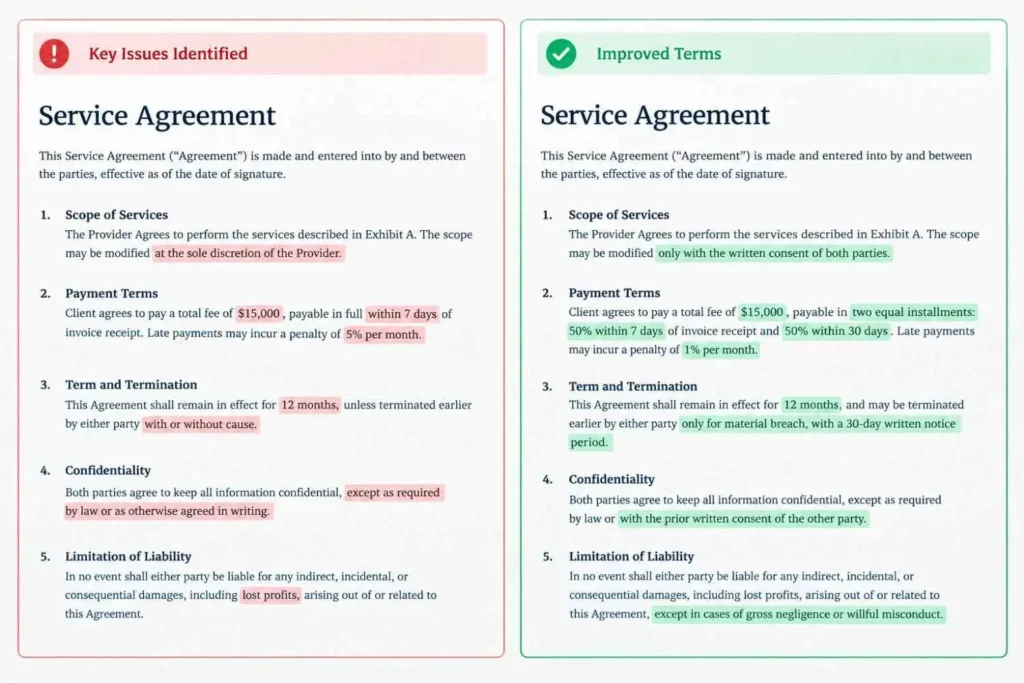
The 11 Contract Clauses: Red-Flag vs Safe Wording
Clause 1: Google Business Profile Ownership
| Wording | |
| Red Flag | “Agency will manage and maintain the client’s GBP listing on the client’s behalf.” |
| Safe | “Client holds owner-level access to the GBP at all times. Agency operates as a manager only.” |
The word “manage” does not mean “you own it.” An agency can manage a listing while sitting in the owner seat. If the relationship ends and you are only a manager on your own profile, you cannot remove the agency without their cooperation. Every review you have collected, every photo, every local ranking signal: all of it is tied to that listing. Get the ownership clause in writing before a single edit is made.

Clause 2: Website and Domain Ownership
| Wording | |
| Red Flag | “Website assets developed under this agreement remain the intellectual property of the agency until final payment is received.” |
| Safe | “Client owns the domain, all website files, and all developed assets upon delivery. Agency retains no rights to the website upon contract termination.” |
Some agencies register the domain in their own name. It happens more often than it should. If you switch and they control the domain, the SEO authority you spent 18 months building is sitting on an asset that is not yours to take with you. Check who the domain registrant is today, not after you decide to leave.
Clause 3: Ad Account Ownership
| Wording | |
| Red Flag | “Campaigns will be run through the agency’s Google Ads manager account.” |
| Safe | “Client holds admin access to all ad accounts. Agency operates as a linked manager. All accounts are transferable upon contract termination.” |
This is the clause that costs businesses the most when it goes wrong. An ad account contains conversion history, audience lists, and campaign learning accumulated over months. Without admin access, you cannot export that data, verify what is actually being spent, or hand anything meaningful to a new agency. You are also relying entirely on the agency’s reporting to know what your money is doing.

Clause 4: Call Tracking and Lead Data
| Wording | |
| Red Flag | “Tracking phone numbers are provided as part of agency service and will be retired upon contract cancellation.” |
| Safe | “All call tracking numbers are purchased under the client’s account and remain active upon termination.” |
If your tracking number has been published on your website, GBP, and local directories for the past year, retiring it is not a minor inconvenience. It is a broken lead path. Check who the number is registered under before the first campaign runs.
Clause 5: Deliverable Specificity
| Wording | |
| Red Flag | “Agency will provide ongoing SEO and content marketing services as agreed.” |
| Safe | “Agency will deliver: 4 optimised blog posts per month (minimum 1,000 words each), one technical SEO audit per quarter, and a monthly ranking report tied to agreed target keywords.” |
“Ongoing SEO services” is not a deliverable. You cannot measure it, dispute it, or hold anyone accountable to it. If you cannot point to a line in the contract and confirm whether it was delivered or not, it is not in the contract at all. Push for quantity, format, and frequency on every output.
Clause 6: Reporting Cadence and Metric Definitions
| Wording | |
| Red Flag | “Agency will provide monthly performance reports.” |
| Safe | “Monthly reports will include: impressions, clicks, cost per lead, leads by channel, and booked jobs where tracking allows. Reports are delivered by the 7th of each month with a 30-minute review call.” |
An agency that cannot tie its reporting to booked revenue will default to impressions. The contract should force revenue-tied reporting from the start. If you only discover six months in that the numbers they have been sending do not connect to actual jobs, that is six months of budget you cannot recover.
Clause 7: Lock-In Period and Exit Terms
| Wording | |
| Red Flag | “This agreement shall renew automatically for successive 12-month terms unless cancelled with 90 days’ written notice.” |
| Safe | “After an initial 3-month onboarding period, this agreement continues month-to-month and may be terminated with 30 days’ written notice by either party.” |
A 90-day cancellation window on an auto-renewing contract is the combination most likely to trap you. By the time you decide the relationship is not working, you could owe three more months of retainer regardless of performance. Thirty days is the reasonable standard. Anything longer needs a clear reason attached.
Clause 8: Early Termination Penalties
| Wording | |
| Red Flag | “Client will owe the full remaining contract value as an early termination fee.” |
| Safe | “Early termination by the client within the initial onboarding period requires 30 days’ notice and a one-time fee not to exceed one month’s retainer.” |
Penalties equal to the full remaining contract value are not about protecting the agency’s setup investment. They are about making it financially rational to stay even when the relationship is not working. A fee proportional to documented setup costs is fair. The rest is leverage.
Clause 9: Intellectual Property for Creative Assets
| Wording | |
| Red Flag | “All creative assets, including ad copy, images, and design files, remain the property of the agency and are licensed to the client during the term of this agreement.” |
| Safe | “All creative assets produced under this agreement are owned by the client upon full payment, including source files, ad copy, and design files.” |
If the agency owns the creative and you leave, the ads go with them. So do the landing pages and the visual identity work. That means rebuilding from scratch at a new agency, which means losing campaign learning at the same time. Source files matter. The published versions alone are not enough.
Clause 10: Ad Budget Handling and Fee Structure
| Wording | |
| Red Flag | “Management fee is calculated as 20% of monthly ad spend.” |
| Safe | “Management fee is a fixed monthly retainer of [amount], independent of ad spend. Ad spend is billed separately and passes through to the client at cost with full invoicing.” |
Percentage-of-spend models create a financial incentive to spend more of your budget, not to spend it better. An agency earning 20% of whatever goes into Google Ads benefits from scaling spend whether or not the return justifies it. A fixed retainer aligns the agency’s income with the stability of the relationship rather than the size of the invoice. If an agency insists on percentage-of-spend, press them on how they handle situations where cutting spend would improve efficiency.
Clause 11: Data Access and Portability
| Wording | |
| Red Flag | “Agency retains proprietary rights to campaign data and analytics configurations built during the engagement.” |
| Safe | “Client has unrestricted access to all campaign data, GA4 configurations, audience lists, and keyword tracking at all times. All data is fully exportable upon request.” |
GA4 configurations and audience lists take time to build and calibrate. If the agency controls the analytics property, you cannot independently verify the numbers they send you. You are reading a summary of your own business written by the person who benefits from making it look good.
If you are about to sign an agency contract and want a second read on the ownership clauses, book a free growth audit with Paradigm Media Networks. We will tell you which clauses need changing before the first invoice lands.
What to Push on During the Sales Call
The contract tells you what an agency is willing to commit to in writing. The sales call tells you how they respond when that commitment is tested early.
Ask who holds owner-level access to your GBP. The answer should be immediate and unambiguous. If there is any hesitation, or if the response involves “we manage it on your behalf,” push back.
Ask what happens to your ad account, call tracking numbers, and website files if you leave after six months. A confident agency answers this without referring to a lawyer. Evasion here is information.
Ask to see a sample monthly report from a current client in home services. If the report is a traffic dashboard with no cost-per-lead data and no revenue tie-in, that is what you will receive every month.
Ask whether their SEO, paid media, web, and content teams operate as an integrated system or as separate functions that occasionally share a Slack channel. The answer to this one question often tells you more about likely results than the case studies do.
Jahid Hussain, whose background spans local SEO and performance marketing built as an integrated system across four markets, makes this point consistently: most agencies are siloed not because they chose to be, but because that is how the business was built. The SEO team does not know what the paid team is testing. The web team builds pages without input from whoever is producing content. When a keyword starts ranking organically, nobody repositions the paid budget to capitalise on the signal. The result is a business paying for four separate services that were never designed to share information.
That question, asked plainly on the sales call, is one of the cleaner ways to separate full-stack agencies from siloed ones before money changes hands.

What a Full-Stack Agency Contract Should Look Like
A full-stack agency, where SEO, GEO, paid media, and web operate as one connected revenue system, should produce a contract that reflects that integration. Service scope sections should reference how channels feed each other. Reporting should consolidate data across all channels into a single view of cost per lead and attributed revenue. Deliverables should note dependencies between functions.
If an agency contract describes each service in a separate disconnected section with no reference to how they interact, read that as a structural signal. You are not buying a growth system. You are buying a set of siloed services that share a billing address.
For HVAC businesses combining local SEO services with paid media, the contract should also address how local and paid data is shared between teams. GBP review signals affect Quality Score. Landing page conversion rates affect both organic rankings and paid CPC over time. A contract that treats these as separate and unrelated scopes is building attribution confusion before the first campaign runs.
This integration principle is at the core of how Paradigm Media Networks operates: SEO, GEO & Ads, Engineered for the AI Era. GEO services sit inside that integrated system because AI platforms like ChatGPT, Perplexity, and Google AI Overviews are now a meaningful share of how homeowners find contractors. For HVAC specifically, where urgency and local intent dominate the search, showing up in an AI-generated recommendation is no longer an advanced tactic. It is part of the baseline. Your agency contract should address it, or at minimum the agency should be able to explain their approach to it.
Technical SEO contracts should also specify who is responsible for site speed, Core Web Vitals, and schema markup, since all three affect both organic rankings and the likelihood of being cited in an AI answer. An agency that omits schema from its SEO scope in 2026 is working from a two-year-old checklist.
The businesses that have the cleanest agency exits are almost always the ones who spent 30 minutes reading the contract before signing. Specificity in a contract protects both sides. Vagueness, without exception, protects the agency.

FAQ’s on How To Choose HVAC Marketing Agency
What should be in an HVAC marketing agency contract?
An HVAC marketing agency contract should specify ownership of the GBP, ad accounts, website, domain, and all creative assets. It should list deliverables with quantities and frequencies, define reporting metrics, and include clear exit terms with a cancellation notice period. Anything left vague in the contract will be resolved in the agency’s favour when a disagreement arises.
What are the biggest HVAC marketing agency red flags in a contract?
The biggest HVAC marketing agency red flags in a contract are: agency ownership of the GBP, domain, or ad accounts; percentage-of-spend fee structures; auto-renewal clauses requiring 90-day cancellation notice; early termination penalties equal to the full remaining contract value; and deliverables described in generic terms with no measurable output. Each transfers financial and operational risk from the agency to you.
How long should an HVAC marketing agency contract be?
Most reputable agencies use a 3-month onboarding period followed by month-to-month terms. A 12-month upfront commitment with no performance-based exit clause usually signals that the agency expects underperformance and needs lock-in to protect its revenue. Thirty-day notice periods after the onboarding window are the reasonable industry standard in 2026.
Can I negotiate an HVAC marketing agency contract?
Every clause in an agency contract is negotiable before signing. Ownership clauses, cancellation notice periods, early termination penalties, and deliverable specifics are all standard negotiation points. Agencies that refuse to negotiate on asset ownership in particular are signalling something important about how they expect the relationship to end.
What happens to my website and GBP if I leave an HVAC marketing agency?
That depends entirely on what the contract says. If the contract specifies client ownership of all assets, you retain full access to your website files, domain, GBP, and ad accounts. If the contract is silent on ownership, or attributes assets to the agency, you may leave with nothing and need to rebuild from scratch. This is why ownership clauses need to be confirmed in writing before any work begins, not after.

The Contract Is Where the Relationship Actually Starts
Contracts feel like paperwork at the end of a sales process. They are not. They are the first real test of what an agency thinks a fair working relationship looks like, because a contract written entirely to protect the agency is telling you something about how they expect things to go.
The 11 clauses above cover the situations that most commonly damage HVAC businesses in agency relationships: lost GBP access, ad accounts left stranded, creative assets that cannot be taken anywhere, and reporting that never connects to actual booked revenue. None of these are edge cases. Every one of them happens to businesses that read the pitch deck carefully and skip the contract.
Read it. Send it back with changes. If an agency refuses to negotiate clean asset ownership terms, that refusal is worth more information than anything in the proposal.
The Growth Audit That Starts Before Anything Is Signed
Paradigm Media Networks works as a full-stack growth agency. SEO, GEO, paid media, web development, and creative strategy run as one system from one team. Every client owns their assets from day one. Every report is tied to revenue, not ranked by impressions. If you are evaluating agencies and want a clear read on what your current marketing is actually producing, or what a clean agency contract should look like before you commit: book a free growth audit or schedule a 30-minute call directly.
About the Author
Jahid Hussain | Founder, Paradigm Media Networks
Jahid Hussain founded Paradigm Media Networks to solve a problem he kept seeing: businesses spending across SEO, ads, and content that never talked to each other. He specialises in local SEO, organic growth systems, and integrated marketing strategies that connect search, paid media, and creative into one lead generation engine. Paradigm has taken clients from zero search visibility to six-figure monthly revenue pipelines, and has been featured in IANS, Eastern Herald, Sangri Times, and Dailyhunt. Jahid operates across the US, UK, UAE, and India, and writes from the standpoint of someone who has built and broken growth systems for real businesses, not from a slide deck.