
From invisible to cited by AI in six months: 2,460 citations and 327K impressions for Moving Hub
Moving Hub is a USDOT-licensed long-distance mover that owns its own trucks. It began 2026 with no organic traffic, sat on page three of Google for the searches that actually book moves, and was never mentioned when people asked an AI assistant to recommend a mover. Six months later it holds a place in the local map pack and is named inside Google AI Mode, AI Overviews, Perplexity, Gemini and ChatGPT answers.
Free 30-minute call · No pitch decks · You leave with a prioritised plan
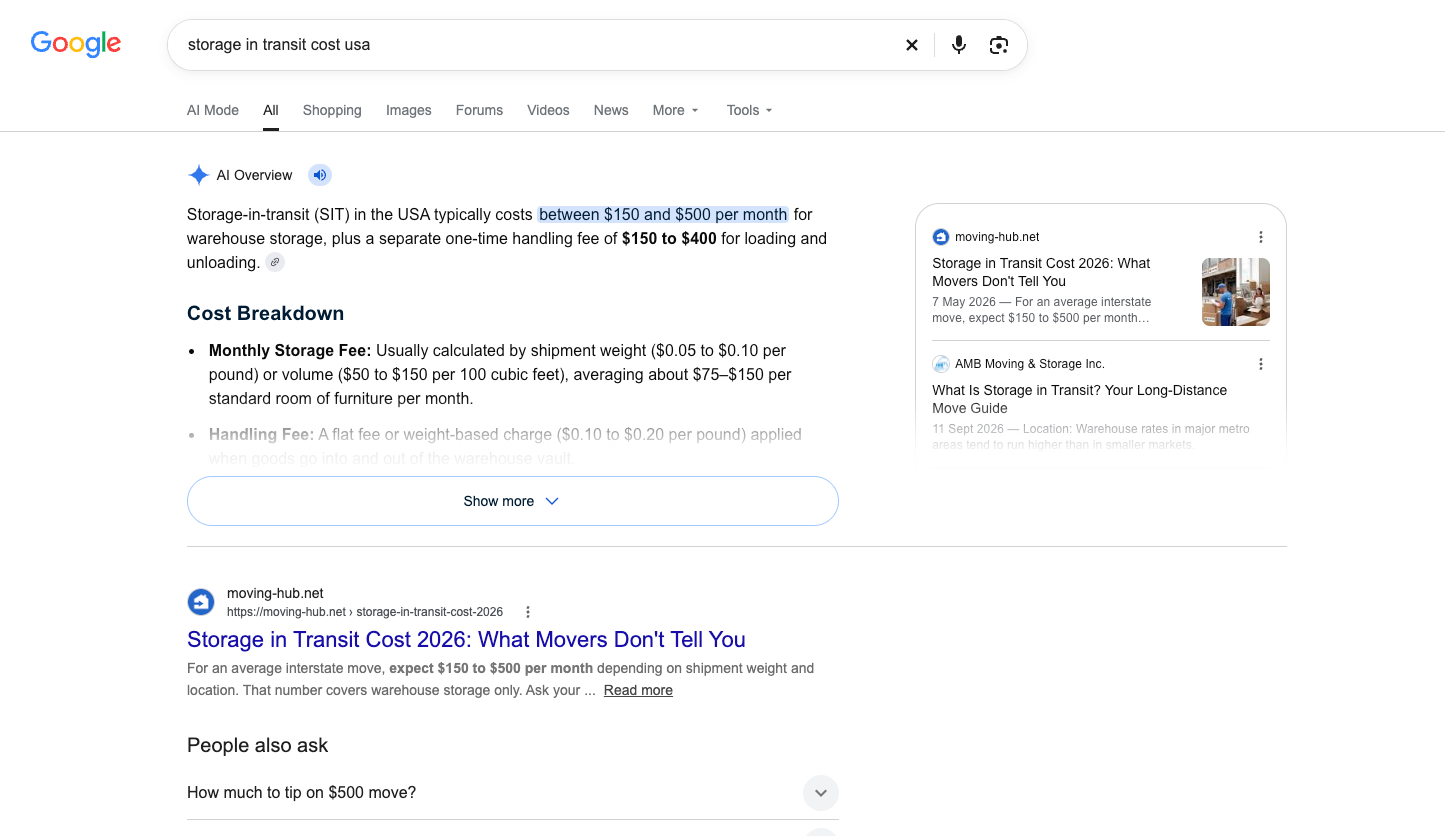
Google AI Overview
The answer Google writes for a high-intent moving cost query, with its source panel on the right.
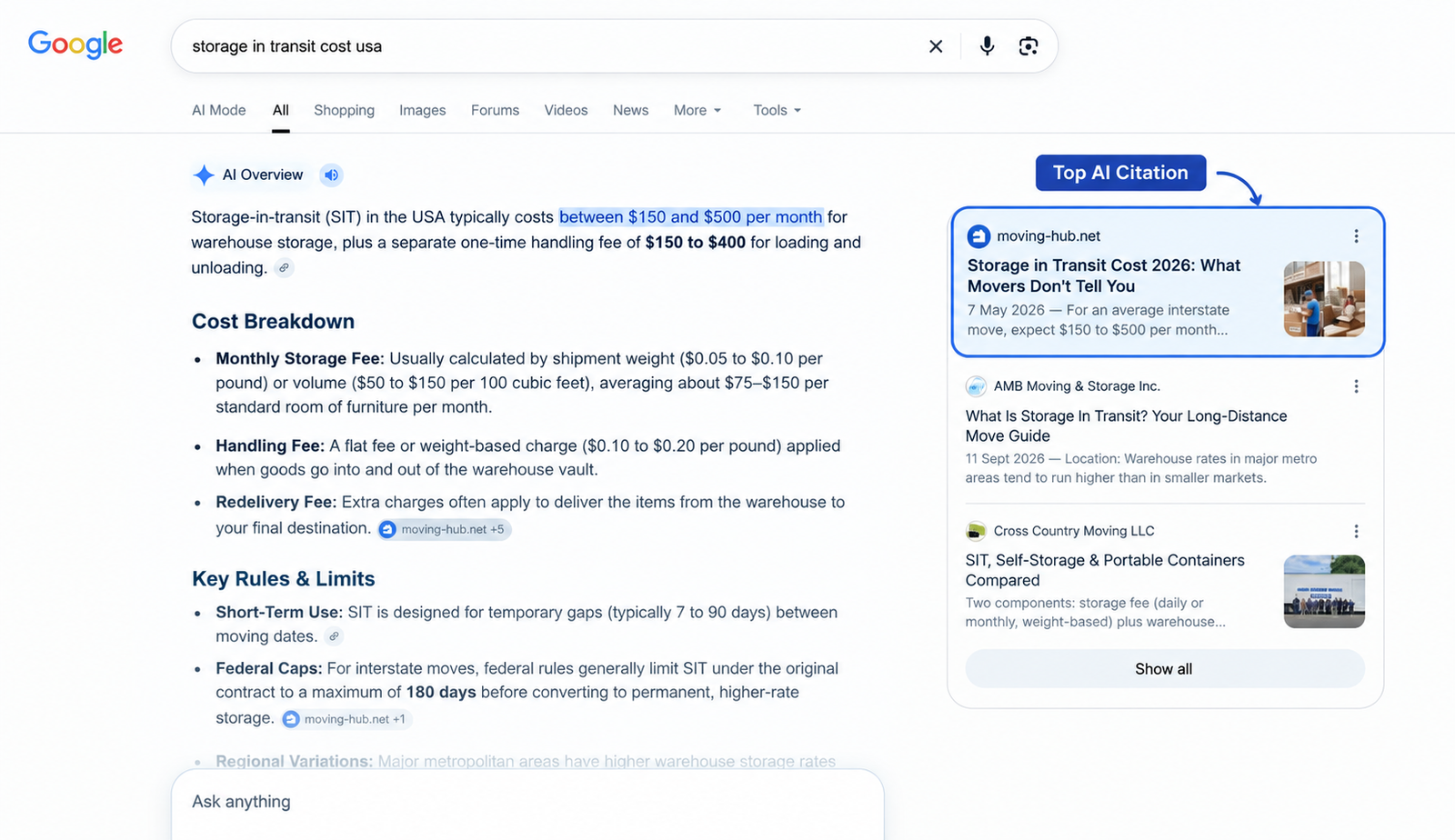
Moving Hub cited first
moving-hub.net leads the source list Google shows beside the AI Overview, ahead of national aggregators.
The engagement at a glance
One team running technical SEO, content, digital PR and AI visibility on the same roadmap, reporting into one set of numbers.
| Client | Moving Hub (moving-hub.net) |
|---|---|
| Industry | Moving and logistics, long-distance residential moves |
| Market | United States |
| Scope | Technical SEO, answer-first content, programmatic route and cost pages, digital PR, generative engine optimisation |
| Timeframe | Six months, 2026 |
| Starting position | No organic traffic, page three visibility, 68 referring domains, zero presence in AI answers |
| Strategy led by | Jahid Hussain, Founder, Paradigm Media Networks |
Where it started
Moving Hub had the hard part already solved. It was licensed, it owned its fleet, and its crews were rated well by the customers it did get. The problem was that almost nobody searching for a long-distance mover ever saw it.
Buried below the fold that matters
The site ranked on page three for its money terms. On mobile, where most moving research happens, that is the same as not existing.
A crawl and schema layer that leaked
Duplicate service URLs, missing canonical rules, no organisation or service markup, and slow templates that made every new page cost more than it earned.
Content written for nobody in particular
Generic service copy that answered none of the questions people actually type: what a move costs, how long a route takes, what changes the quote.
No authority signal
68 referring domains, most of them directories. Assistants had nothing credible to pull from, so they cited aggregators and lead brokers instead.
What we built
Four workstreams, one roadmap. Nothing shipped unless it moved a named metric.
We consolidated duplicate service URLs, fixed canonical and pagination rules, rewrote the internal linking so route and city pages fed each other, and added organisation, service, LocalBusiness and FAQ markup. Templates were trimmed so a new page ships fast and indexes quickly. More on this approach on our technical SEO services page.
Every guide opens with the answer, then shows the working: what a three-bedroom interstate move costs, what changes the number, how long a given route takes, what is and is not included. Short, quotable, source-backed paragraphs are what assistants lift into an answer.
A controlled template covering origin-to-destination routes and service areas, each with genuine local detail, real pricing bands and its own schema. Volume without thin pages, because every page had to earn its index slot.
Data-led moving cost studies and relocation trend pieces placed with journalists and regional publishers. Referring domains went from 68 to 450, and the profile shifted from directories to publications that assistants already trust.
A fixed portfolio of buyer prompts, run monthly against ChatGPT, Google AI Mode, AI Overviews, Perplexity and Gemini. We logged every citation, saw which pages earned them, and fed that back into the content plan. That loop is the core of our generative engine optimisation work.
How the six months played out
Months 1–2
Technical rebuild, schema layer, URL consolidation and the first cost guides. Indexing and impressions started moving before rankings did.
Months 3–4
Route and city pages rolled out, digital PR placements landed, and the first AI citations appeared on cost questions.
Months 5–6
Map pack visibility on high-intent local searches, referring domains past 450, and citations compounding across all five assistants.
The results
Every figure below is tied to a named platform and a stated window. Figures are rounded down, never up.
| Metric | Before | After six months | Source |
|---|---|---|---|
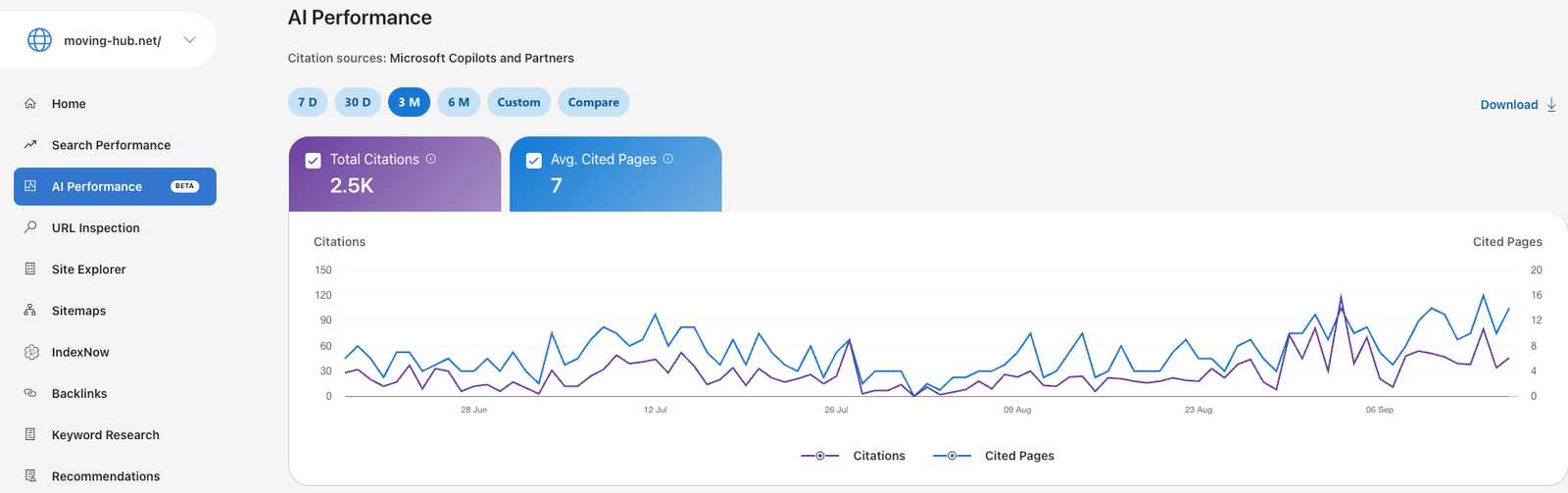
| Citations in AI answers | 0 | 2,460 in a 90-day window | Fixed prompt set, checked monthly |
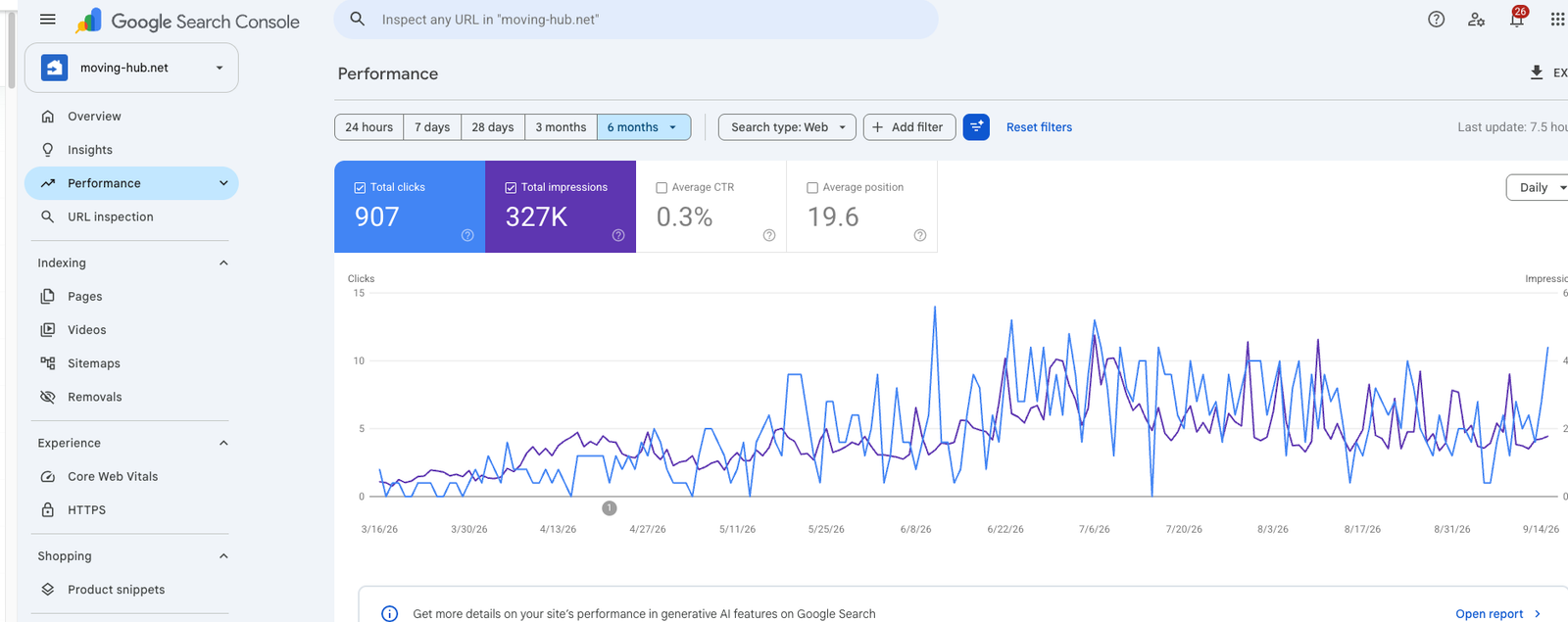
| Google impressions | Negligible | 327,000 | Google Search Console |
| Referring domains | 68 | 450 | Ahrefs |
| AI assistants citing the brand | 0 | 5 | ChatGPT, Google AI Mode, AI Overviews, Perplexity, Gemini |
| Position on high-intent moving searches | Page three | Local map pack | Google Search Console and manual checks |
Results vary by market, budget, site age and competition. Nothing on this page is a guarantee of future performance.
Straight from the dashboards
Unedited screenshots from the reporting these numbers came out of. Platform, property and date range are visible in each one.
How we measured it
Where the numbers come from
- Impressions, clicks and query data: Google Search Console
- Sessions and on-site behaviour: GA4
- Referring domains and backlinks: Ahrefs
- AI citations: a fixed prompt set checked monthly across five assistants
What we leave out
- No blended percentages that hide a small starting base
- No impression growth presented as revenue growth
- Revenue is omitted rather than estimated where a client keeps it private
- Nothing published without the client’s written permission
Questions buyers ask about this engagement
Was any of this paid media?
No. The figures on this page come from organic search, digital PR and AI visibility work. No paid budget was counted towards impressions or citations.
How long before anything showed up?
Indexing and impression changes registered inside the first six weeks. Rankings on commercial moving terms and the first AI citations took roughly three to four months.
How do you count a citation inside an AI answer?
We run the same portfolio of buyer prompts every month against ChatGPT, Google AI Mode, AI Overviews, Perplexity and Gemini, and log each answer that names or links the brand. Same prompts, same schedule, so the trend is comparable month to month.
Would this work for a mover in a different state?
The method transfers, the numbers do not. Starting authority, fleet size, route mix and local competition all change the timeline. We take one client per service area, so we will tell you early if your market is already spoken for.
Can I speak to the client?
We ask them first and introduce you directly rather than sending a curated quote. Ask us on the call.
Want your business to be the next case study?
Thirty minutes with a strategist, no deck. We look at your site, your search demand and your current visibility in AI answers, then tell you what we would fix first.
Generative Engine Optimisation
If you want to be named in AI answers.
Technical SEO
If crawling and indexing are the bottleneck.
Local SEO
If you sell by city or service area.
AI Visibility Checker
See where you stand today, free.
Back to all case studies or browse our work.