



Generative engine optimization cost in 2026 runs from $1,500 to $15,000+ per month for agency-managed programs, depending on scope, content volume, and how competitive your category is inside AI answers. Most growth-stage businesses land between $3,000 and $8,000 per month for a professionally executed retainer. The number on the proposal tells you nothing — the scope behind it tells you everything.
Key Takeaways
- Generative engine optimization cost for agency-managed programs ranges from $1,500 to $15,000+ per month in 2026.
- The $1,500 tier typically covers an initial audit, basic schema fixes, and templated FAQ content — not full execution.
- The $5,000 tier is where active citation-building, content production, and monthly AI visibility monitoring begin.
- The $15,000 tier covers senior-led entity engineering, multi-platform citation tracking, and PR-led authority campaigns.
- One-time GEO audits run $2,500 to $7,500 separately — or are bundled into the first month of a retainer.
- Combining GEO with SEO under one agency removes duplicated work across content, technical, and authority-building.
- The most common buyer mistake is comparing two proposals by monthly fee instead of by deliverables.
Why GEO Pricing Is Confusing Right Now
You requested quotes. You got three numbers with almost nothing behind them. One agency wants $2,000 a month. Another wants $7,500. The third sent you a deck with “AI search optimization” repeated twelve times but no line items anywhere.
This is where the AI SEO cost market sits in 2026. Gartner predicted that traditional search volume would drop 25% as AI answer engines absorb commercial queries — and that prediction has been accelerating faster than most agencies anticipated. The result is a pricing market that has not yet standardized.
Some agencies are bolting “GEO” onto existing SEO retainers as a label change with no new execution. Others are building genuinely different infrastructure: entity optimization, structured data engineering, citation campaigns, and weekly AI visibility tracking across ChatGPT, Perplexity, Gemini, and Google AI Overviews. Both call it the same thing and price it anywhere from $1,500 to $50,000 a month.
Jahid Hussain, founder of Paradigm Media Networks, sees this gap play out across client conversations regularly. In his view, the buyers who get burned are the ones comparing quotes by total price rather than asking what the agency is actually doing every month to move their citation share in AI responses.
The rest of this guide gives you the line-by-line scope for each major pricing tier so you know exactly what question to ask.
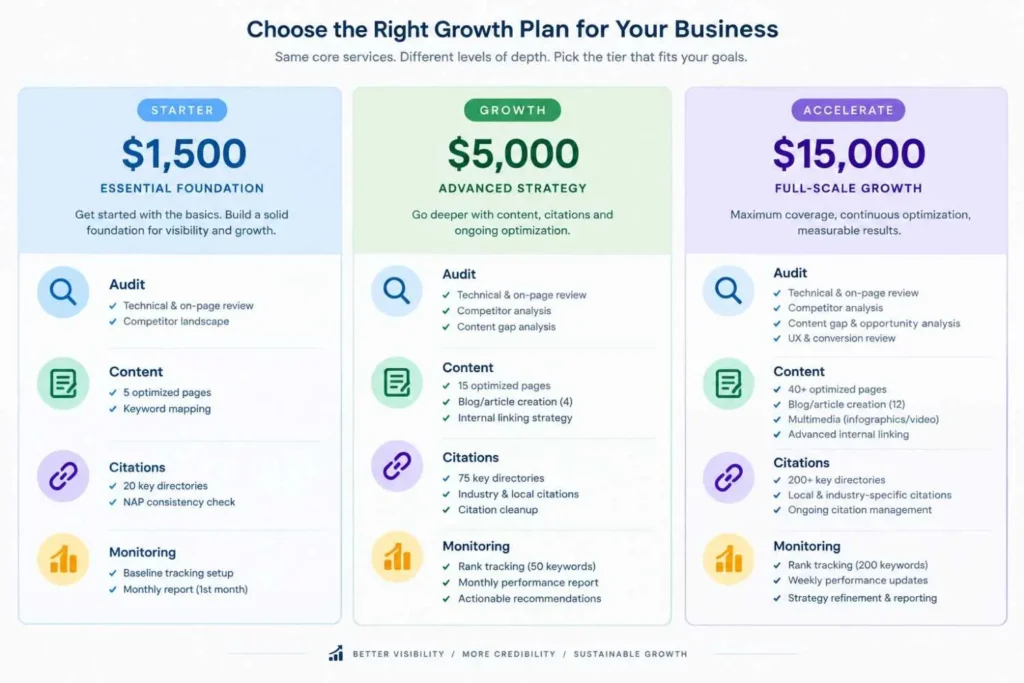
GEO Cost by Tier: What $1,500, $5,000 and $15,000 a Month Includes
Tier 1: $1,500 to $3,000 per Month
This is the entry band. What it covers at a credible agency:
- AI visibility audit across 3 to 4 platforms (ChatGPT, Perplexity, Gemini, Google AI Overviews)
- Schema markup and structured data implementation on priority pages
- FAQ and snippet optimization for 10 to 15 pages
- Templated content production: typically 2 to 4 pieces per month
- Monthly AI visibility reporting (citation rate and share of answer)
What it does not cover: active citation-building campaigns, entity optimization, digital PR, or senior-led strategy. The content produced is mostly on-page optimization and FAQ restructuring — not new authority signals pointing at your brand from third-party sources.
This tier works when you have a solid SEO foundation already in place and need a focused first pass at AI visibility. It does not work as a standalone long-term program in a competitive category.
Tier 2: $3,000 to $8,000 per Month
This is where the market majority of serious GEO agency pricing sits. A professional, senior-led retainer at this tier covers:
- Full AI visibility audit as an onboarding deliverable (or separate, see below)
- Entity optimization and knowledge graph alignment
- Schema implementation and ongoing structured data maintenance
- Content production at volume: 6 to 12 pieces per month, structured for AI citation
- Active citation-building: getting your brand mentioned in external sources AI engines pull from
- Weekly AI visibility tracking across 5 to 6 platforms
- Competitive citation analysis: which competitors are being cited for your target queries and why
- Monthly strategy review tied to citation rate, not just traffic
The difference between the $3,000 and $8,000 end of this range is mostly content volume and the depth of citation campaigns. A $3,000 retainer at a credible firm might include 6 content pieces and passive citation tracking. An $8,000 retainer includes active PR-led citation placements, 10 to 15 pieces of content, and dedicated senior strategist time.
If you are in a moderately competitive category with an existing website and some SEO foundation, Tier 2 is the right starting point. Climbing into AI answers for a query like “best CRM for small businesses” or “top logistics companies in Texas” requires consistent citation-building, not just on-page fixes.
Ready to understand where your brand stands in AI answers before choosing a tier? Run a free GEO visibility audit with us and we will show you your current citation rate across ChatGPT, Perplexity, Gemini, and Google AI Overviews — with a clear scope recommendation attached to the results.
Tier 3: $10,000 to $15,000+ per Month
Enterprise-level GEO pricing covers a fundamentally different scope:
- Dedicated senior GEO strategist (not shared across 20 accounts)
- Full entity engineering: Wikipedia alignment, knowledge panel optimization, data repository submissions
- Multi-platform citation campaigns with PR-led outreach producing 10 to 20 citation placements per month
- Content production at scale: 15 to 25+ pieces per month across your content stack
- Custom AI monitoring dashboards with executive reporting
- Multi-market or multi-brand scope
- Integration with paid media, web, and content for unified brand signals across all surfaces
This tier is not overkill for every business. If you are a B2B company with a $30,000+ average deal size and AI search puts you in front of 15 more research-stage buyers per month, the ROI math closes quickly. It is overkill if you are a $2M regional services business with light AI search competition in your category.
| GEO Tier | Monthly Range | Core Deliverables | Best For |
| Entry | $1,500 to $3,000 | Audit, schema, FAQ optimization, 2 to 4 content pieces | Established SEO base, low competition |
| Professional | $3,000 to $8,000 | Entity work, citation building, 6 to 12 content pieces, weekly tracking | Growth-stage with moderate competition |
| Enterprise | $10,000 to $15,000+ | Senior strategist, PR-led citations, 15+ pieces, multi-platform monitoring | High deal value, competitive category, multi-market |
One-Time vs. Recurring Costs: The Breakdown
Before the monthly retainer, most GEO programs carry one-time costs buyers do not anticipate. A standalone GEO audit — mapping your current citation share across platforms, benchmarking competitors, identifying content and schema gaps — runs $2,500 to $7,500 depending on depth and the number of AI platforms covered.
Many agencies fold the audit into month one of a retainer. If yours does not, ask whether it will be. Paying for a standalone audit and then a separate retainer that redoes the same discovery work is a budgeting mistake.
Recurring costs that sit on top of the agency retainer:
- AI visibility tracking tools ($50 to $500+ per month): Some agencies include these in the retainer. If yours does not, you are buying them separately. Tools like Profound, OmniSEO, or Surfer SEO’s AI tracking layer run $79 to $399 per month at standard tiers.
- Content production overages: If your retainer includes 8 pieces per month and a product launch needs 15, the overage hits. Get the content volume in the agreement, not just “ongoing content.”
- Schema and technical implementation: Some agencies quote strategy but outsource or exclude technical work. If schema markup, llms.txt, and structured data updates are not explicitly in scope, they may arrive as additional line items.
The practical takeaway: the number on the proposal is not the number you pay. Ask for a fully loaded monthly cost at your expected usage level before signing.

GEO + SEO Bundle: What Integration Saves You
Generative engine optimization and search engine optimization share the same underlying inputs: content quality, topical authority, structured data, link equity, and technical site health. Running them through separate agencies duplicates work and fragments the signals that AI engines rely on.
When GEO and traditional SEO run under one agency, the integration produces concrete savings:
- Content produced for AI citation also serves organic rankings. No duplicate strategy, no siloed editorial calendars.
- Technical audits cover both crawlability for Google and AI interpretability simultaneously.
- Authority-building (links and citations) serves both channels rather than funding separate PR budgets for each.
- Reporting is unified: you see GEO citation rate, organic traffic, and lead attribution in one view instead of two decks that contradict each other.
Paradigm Media Networks runs AI SEO cost as one integrated line item rather than separate GEO and SEO budgets. Clients working with us on both channels typically see 15 to 25% cost efficiency compared to maintaining separate vendors, because the same content, technical, and authority work powers both surfaces. To understand the full scope of what a dedicated generative engine optimization agency delivers versus a standard SEO retainer with GEO bolted on, the difference comes down to whether GEO has its own deliverables, its own measurement framework, and its own senior execution — or whether it is a label on existing work.
Moving Hub (USA) is a real example of what this looks like in practice. Starting from zero search visibility, they reached 600+ ranked keywords and built 300 programmatic SEO pages within 4 months — with GEO-ready content structure built into the approach from day one rather than retroactively. That is the difference between integrated execution and bolting GEO pricing onto an existing SEO retainer as an afterthought.
Our generative engine optimization services are built to run alongside or within your existing SEO program — not as a separate silo that someone has to coordinate with.
Red Flags in a GEO Proposal
Not every agency quoting GEO is doing GEO. Here is what to watch for:
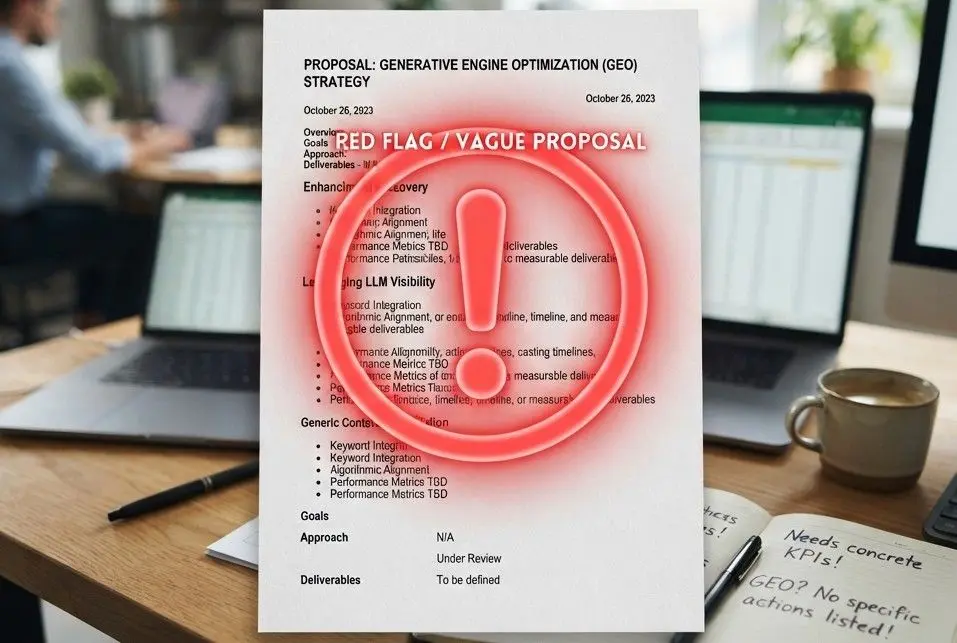
No scope document, just a retainer price. A credible GEO proposal names deliverables, platforms tracked, content volume, reporting cadence, and who owns technical work. If you received a monthly fee with three bullet points, you have a sales document, not a scope.
KPIs tied to traffic and rankings only. GEO success is measured in citation rate, share of answer, and brand mentions across AI platforms. An agency that only promises “improved rankings” has not updated their measurement framework for AI search.
GEO as a cheap add-on to an existing SEO retainer. “$500 per month to add AI optimization” is a label on existing work, not a new execution. Real GEO agency pricing reflects new deliverables: entity work, citation campaigns, structured data engineering. If it costs less than your monthly lunch budget, it is delivering less than you think.
No discussion of one-time setup work. Schema implementation, entity alignment, and initial content restructuring are front-loaded investments. An agency that skips these in month one to jump straight to “ongoing content” is skipping the foundation.
Guaranteed rankings in AI answers. No one controls what ChatGPT or Perplexity cites. Credible agencies commit to measurable inputs (citation campaigns, content, structured data) and track outputs (citation rate, share of answer) — they do not guarantee specific AI placements.
How to Evaluate Two Quotes That Don’t Compare
You have a $3,000 quote from Agency A and a $7,000 quote from Agency B. Here is the framework:
1. Count the deliverables, not the price. List every named output in each proposal. Content pieces, schema updates, citation placements, platforms tracked, reporting documents. A $3,000 proposal with 12 monthly deliverables is not cheaper than a $7,000 proposal with 8.
2. Identify who owns technical work. Schema implementation and structured data are technical outputs that require development-adjacent skills. If neither proposal names who implements technical changes, it probably is not happening.
3. Ask how they measure citation rate. The only way to know whether GEO is working is to track your brand’s citation share across AI platforms over time. If the agency cannot show you the tool they use and how they report citation rate, they cannot show you whether the work is moving.
4. Check the content volume against your category. In a competitive category, citation share is partly a volume game. If you are trying to outrank established brands in AI answers for high-intent queries, you need more content and more citation placements than a minimal-scope retainer delivers. Scope to your category’s competition, not to the lowest entry price.
Paradigm Media Networks approaches this as part of every scoping conversation. Our AI SEO services include an AI visibility baseline report before we propose a retainer — so the scope is built from your actual citation gaps rather than a generic package.
Schedule a 30-minute call to walk through your current AI search footprint: Book directly here.

Why Full-Stack Execution Changes the Equation
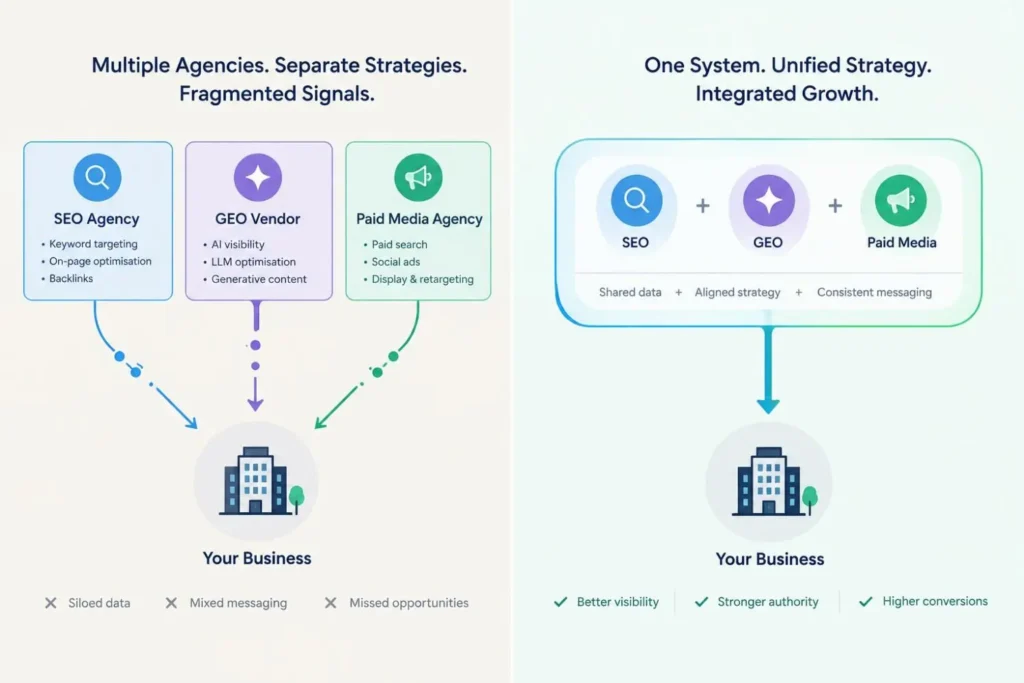
Here is something most GEO pricing guides miss entirely: the agencies that deliver the best cost-per-result on GEO are rarely pure-play GEO shops. They are full-stack growth agencies where SEO, GEO, paid media, content, and web work as one system.
The reason is simple. GEO success depends on domain authority (SEO), content quality and volume (content), brand presence across external sources (PR and media), and a website that AI engines can parse and trust (web and technical). If any of these are run by a different vendor with a different strategy and a different reporting cycle, the signals become fragmented. AI engines reward consistent, authoritative brand signals across the web — not departmentalized marketing budgets.
Paradigm Media Networks is a full-stack growth agency built specifically around this integration. SEO, GEO, performance marketing, and web all operate from one strategy, one content calendar, one technical audit, and one reporting framework. When a client’s paid media is working in the same direction as their GEO content strategy, brand authority compounds faster and the cost per AI citation drops. That is the integration advantage that siloed vendors selling channel-by-channel cannot replicate.
SEO, GEO & Ads, Engineered for the AI Era.
Frequently Asked Questions
Is generative engine optimization more expensive than SEO?
Not necessarily — but the scope is different. A comparable SEO retainer and a GEO retainer in the $3,000 to $8,000 range are doing fundamentally different work. SEO targets keyword rankings in traditional search results. GEO targets citation share in AI-generated answers. Many businesses run both under one budget, and when GEO and SEO share the same content and authority-building work, the combined cost is lower than maintaining separate programs.
How long before GEO shows results?
Initial AI visibility improvements typically appear within 4 to 8 weeks of schema, structured data, and FAQ optimization. Significant citation share gains — where your brand is regularly cited in AI answers for commercial queries — take 3 to 6 months of consistent content production and authority-building. Agencies that promise faster timelines are either operating in low-competition categories or overpromising.
What is a GEO audit and do I need one before starting a retainer?
A GEO audit maps your current citation share across AI platforms, benchmarks your visibility against competitors for target queries, identifies content and structured data gaps, and produces a prioritized action plan. It costs $2,500 to $7,500 as a standalone project. Many agencies fold it into month one of a retainer. If yours does not, the first two to four weeks of the retainer are spent doing discovery that could have been completed upfront — ask whether it is included.
Can I do GEO without an existing SEO foundation?
You can start, but GEO compounds much faster when your site already has domain authority, crawlable content, and structured data in place. AI engines pull from sources that Google already trusts. A site with no SEO foundation will need parallel investment in both channels to move citation share in any reasonable timeframe.
What should I ask an agency before signing a GEO retainer?
Ask for a scope document that names every monthly deliverable, the platforms your citation rate will be tracked across, who implements technical changes, what the reporting cadence is, and how they define success beyond traffic. Then ask what happens in month three if the citation rate has not moved — a credible agency will have a clear answer about what they adjust and why.

The Real Question Is Not What GEO Costs — It Is What Invisibility Costs
The market has already moved. Buyers in your category are running research queries on ChatGPT, Perplexity, and Google AI Overviews right now. If your brand is not in those answers, a competitor is. The cost of that gap compounds every month.
The right generative engine optimization cost for your business is the one that closes that gap at a pace your category requires — not the lowest monthly number that makes the budget conversation easier.
Paradigm Media Networks scopes every GEO engagement from your actual AI visibility baseline: where you are cited today, where your competitors are pulling ahead, and what it takes to close that gap in 3, 6, and 12 months. You walk away from the first call with data and a proposal, not a slideshow.
Request your free GEO visibility audit and get a scoped proposal built on your real numbers — or book a 30-minute strategy call if you want to talk through the tiers first.
About the Author
Jahid Hussain | Founder, Paradigm Media Networks
Jahid Hussain founded Paradigm Media Networks to solve a problem he kept seeing: businesses spending across SEO, ads, and content that never talked to each other. He specialises in local SEO, organic growth systems, and integrated marketing strategies that connect search, paid media, and creative into one lead generation engine. Paradigm has taken clients from zero search visibility to six-figure monthly revenue pipelines, and has been featured in IANS, Eastern Herald, Sangri Times, and Dailyhunt. Jahid operates across the US, UK, UAE, and India, and writes from the standpoint of someone who has built and broken growth systems for real businesses, not from a slide deck.