

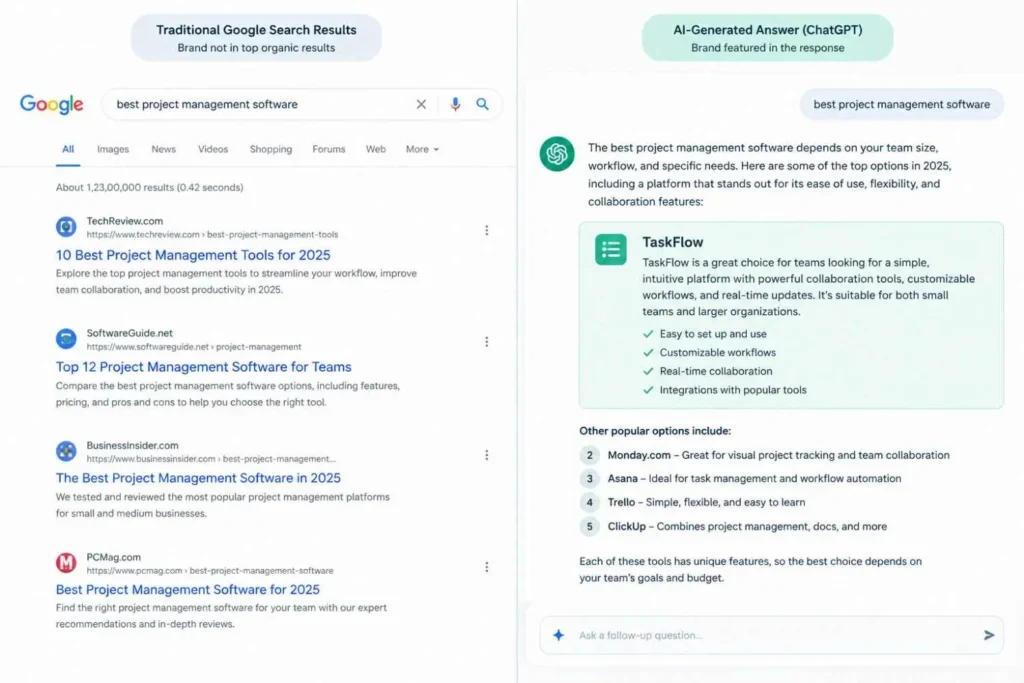
What Is AI Search Optimization?
AI search optimization is the practice of structuring your website, content, and digital presence so that AI-powered platforms, specifically ChatGPT, Google AI Overviews, Perplexity, and Gemini, can read, trust, and cite your brand when generating answers. It works through three disciplines: Generative Engine Optimization (GEO), Answer Engine Optimization (AEO), and LLMO (Large Language Model Optimization). If your brand does not appear in AI-generated answers today, you are absent from the fastest-growing, highest-converting discovery channel in search. The fix is not publishing more content. It is publishing content structured the right way, backed by the right authority signals, and technically accessible at the retrieval layer.
Key Takeaways:
- AI search optimization builds on top of traditional SEO. It does not replace it.
- The Princeton and Georgia Tech KDD 2024 study found that adding inline citations and statistics boosts AI citation visibility by up to 40 percent. The statistics tactic alone produced a 41 percent gain on their primary metric.
- According to AirOps’ analysis of over a billion citations, 85 percent of brand mentions in AI search come from third-party pages, not brand-owned content.
- Microsoft Clarity’s study of 1,277 domains found AI-referred visitors convert to sign-ups at 1.66 percent, versus 0.15 percent from traditional search. That is an 11x gap.
- Only 30 percent of brands stay visible from one AI answer to the next, per AirOps’ 2026 State of AI Search report.
- Pages not updated within the past three months are three times more likely to lose AI citations than recently refreshed content, per AirOps research.
- The overlap between Google AI Overviews citations and Google AI Mode citations is only 16 percent at the domain level. A single-platform optimization strategy misses most of the opportunity.
Most brands that come to Paradigm Media Networks with a traffic problem do not actually have a rankings problem. Their Google positions are holding. The searches they used to capture are still happening. The clicks have gone elsewhere, specifically to ChatGPT, Google AI Overviews, and Perplexity, where a competitor, or sometimes nobody recognisable, got cited in the answer instead.
That is the structural shift this guide is built around. Not rankings. Visibility at the synthesis layer.
What follows is not a definition piece. It covers what the research actually shows about how AI engines decide what to cite, how each major platform behaves differently from the others, which tactics the evidence supports, and importantly what GEO cannot fix. Marketers and SEOs who want to act on this, not just understand it, will find something to take away from every section. Our GEO services turn this into a repeatable process.
GEO vs AEO vs LLMO: Differences That Actually Matter
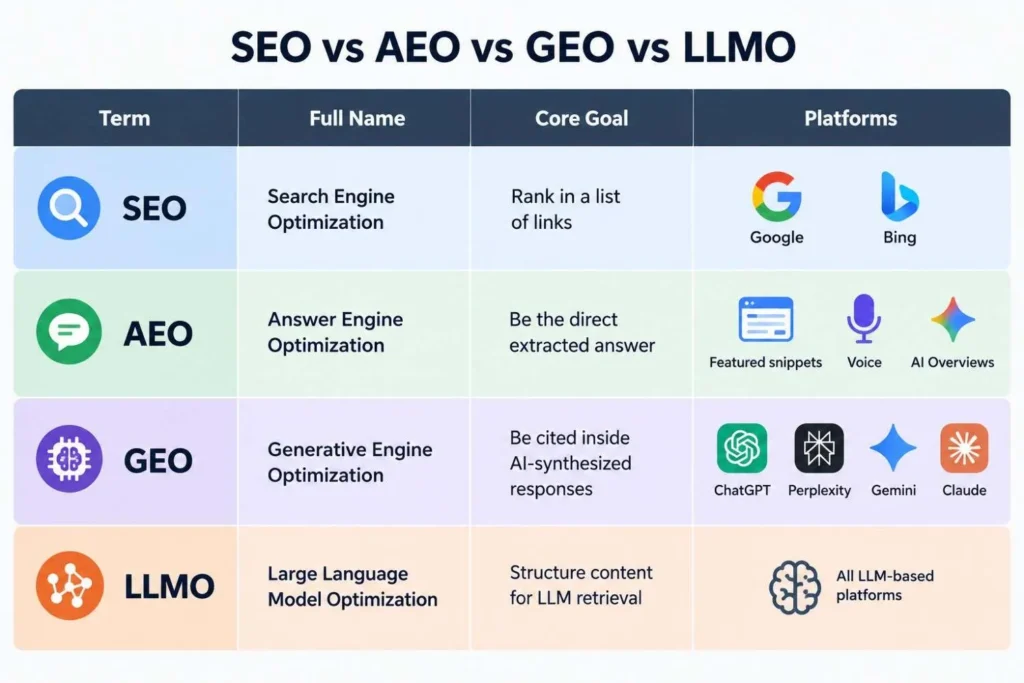
The terminology is unsettled enough that agencies are using these terms to mean different things, sometimes within the same proposal. Here is a working definition table that reflects how they are used in practice:
| Term | Full Name | Primary Goal | Platforms |
| SEO | Search Engine Optimization | Rank in a list of links | Google, Bing |
| AEO | Answer Engine Optimization | Be the direct extracted answer | Featured snippets, voice, AI Overviews |
| GEO | Generative Engine Optimization | Be cited inside synthesized AI responses | ChatGPT, Perplexity, Gemini, Claude |
| LLMO | Large Language Model Optimization | Structure content for LLM retrieval | All LLM-based platforms |
In practice, AEO and GEO describe almost identical work. The tactics overlap significantly, and Google itself does not separate them into distinct disciplines. Maintaining a strict conceptual split rarely adds value to an actual campaign plan.
What the distinction does clarify is the underlying principle: AI systems need to find your content, understand it, trust it, and be able to lift a passage from it when constructing a synthesized answer. A page that ranks well through SEO has a stronger base for AEO. A brand with solid AEO foundations has a better starting position for GEO. They are layers, not alternatives.
Jahid Hussain’s view: the brands that get stuck are the ones treating these disciplines as a sequence, finishing SEO before starting GEO work. That approach means entering the AI visibility race 18 months behind where you could already be. Both need to run simultaneously because the authority signals that GEO requires, domain credibility, topical depth, third-party citations, take months to accumulate whether or not you have started your SEO work.
What the Princeton GEO Research Actually Found
The term GEO did not come from a marketing agency. It was coined in a peer-reviewed paper presented at ACM KDD 2024 by researchers from Princeton University, IIT Delhi, Georgia Tech, and the Allen Institute for AI.
The team built GEO-bench, a benchmark of 10,000 queries across 9 datasets and 7 domains, then tested 9 content modification strategies against a generative engine to measure which changes actually improved citation visibility inside AI-generated answers.
The headline result: targeted content optimizations can boost visibility by up to 40 percent in generative engine responses.
The tactic breakdown matters more than the headline figure, and most agencies have not read past it:
- Statistics: the statistics tactic produced a 41 percent gain on Position-Adjusted Word Count and a 37 percent gain on Subjective Impression.
- Attribution: the attribution tactic produced a 115.1 percent visibility increase for pages at position 5, the so-called Equalizer Effect, meaning lower-ranked pages that adopted GEO tactics saw the largest gains, not pages already in position 1.
- Keyword stuffing: per the Elementera analysis of the paper, keyword stuffing scored 8 percent below the unmodified baseline on Position-Adjusted Word Count. The standard SEO tactic actively harmed AI citation rates.
- Fluency: fluency optimization produced roughly 28 percent gains on Position-Adjusted Word Count. Clear, well-constructed prose is easier for a language model to parse, summarise, and attribute accurately.
The Equalizer Effect is the finding most practitioners have glossed over. If your site is not a category-defining authority, GEO gives you a lever that traditional SEO’s link-equity model does not. The AI citation layer follows its own logic, and that logic rewards content structure and source credibility over raw domain authority.
One honest caveat: subsequent work, including a critical survey of GEO research from 2023 to 2026, has narrowed the scope of the original conclusion. General heuristics transfer poorly across domains, context order and relevance often dominate, and competitive adoption can erode gains in multi-actor settings. The tactics work, but they do not work equally across all domains, all AI engines, or when every competitor starts applying them simultaneously. Specificity and distinctiveness matter as much as structure.
How Each AI Platform Retrieves Sources Differently
Only 10.7 percent of URLs and 16 percent of domains overlap between Google AI Overviews and Google AI Mode citations. That figure alone makes the case for platform-specific thinking. A single approach will not cover the full opportunity.
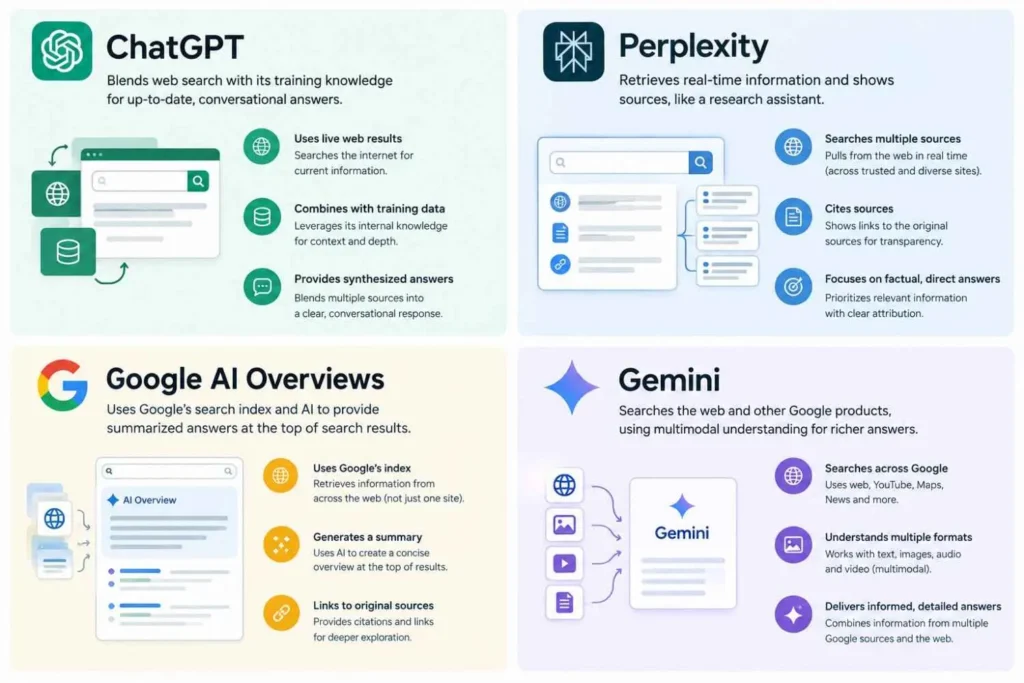
Google AI Overviews and AI Mode use real-time retrieval against Google’s index. A page blocked from Googlebot will not appear, regardless of content quality. Google AI Mode surpassed 1 billion monthly active users globally as of May 2026, making it the largest AI search surface available. Because AI Mode’s citation pool diverges significantly from AI Overviews’, treating them as the same surface leaves most of the available coverage unclaimed.
Perplexity is citation-native. Sources appear inline in the response, so a Perplexity citation is visible, attributable, and often drives direct clicks to verify. Pages not updated quarterly are three times more likely to lose citations, which means Perplexity actively penalises stale content at the retrieval stage. A competitor who published a year after you but refreshes every 90 days will consistently beat you in Perplexity citations for the same topic.
ChatGPT operates on a combination of training data and real-time retrieval. ChatGPT processes an estimated 1.2 to 1.5 billion search queries per month by mid-2026. Both what your pages say now and what the web has historically said about your brand affect ChatGPT visibility. Third-party mentions, earned media, and industry publications are not decorative for ChatGPT. They are what the model was trained on and what it retrieves when a user asks a relevant category question.
Gemini draws from Google’s index and from structured entity data. Brand consistency across your website, Google Business Profile, and third-party listings affects how confidently Gemini can include your brand in a response. Inconsistency creates ambiguity at the entity resolution stage, and ambiguous sources are replaced by competitors with cleaner data.
A technical note that applies across all four platforms: AI crawlers do not render JavaScript, per a Lantern analysis from June 2026 of GPTBot behaviour. If turning off JavaScript makes your page go blank, AI crawlers see blank too. Additionally, 73 percent of businesses are effectively invisible in AI search, in part because AI crawlers are silently blocked by default bot-protection settings, including Cloudflare’s changed default configuration.
GEO Tactics Backed by Research and Real Campaigns
The following tactics are supported by the Princeton research, the AirOps citation studies, or both. Where the evidence has a limitation worth knowing, that limitation is stated.
Put a direct answer in the first 150 words. AI retrieval systems that work in real-time evaluate opening content heavily. The first 200 words of any article should directly and completely answer the primary query, not build up to the answer. A page that takes three paragraphs to reach the point will be passed over for a page that states the answer in the first paragraph.
Add sourced statistics to every major claim. Per the Princeton paper, the statistics tactic produced the strongest individual gains of any tested modification. Put the data point, the source name, the year, and the context together in one sentence. Not a footnote. A standalone unit that a language model can lift and quote accurately without misrepresenting what it says.
Refresh content every 90 days. Pages updated within 3 months are 3 times more likely to be cited, per AirOps research. This applies to existing pillar content, not just new articles. Brands that publish new pieces while leaving core pages stale are gaining citations on one platform while losing them on another.
Build entity consistency across your full digital footprint. Your business name, description, categories, and services should match precisely across your website, Google Business Profile, industry directories, and any publication that references you. AI systems use entity data to confirm brand identity before recommending a source. Inconsistency is treated as ambiguity, and ambiguous sources get replaced.
Invest in third-party presence, not just owned content. AirOps analysed over a billion citations and found that 85 percent of brand mentions in AI search originate from third-party pages, not brand-owned sites. McKinsey’s AI Discovery Survey found that a brand’s own website accounts for only 5 to 10 percent of the sources that AI search references. Earning coverage in relevant publications, comparison sites, and community platforms is not a PR exercise sitting outside your GEO strategy. It is the dominant citation mechanism.
Check your AI crawler accessibility first. 73 percent of businesses are effectively invisible in AI search, in part because AI crawlers are silently blocked by default bot-protection settings. This technical check takes under an hour and potentially unlocks more AI citations than months of content work. Do it before anything else.
When GEO Won’t Help You
Most GEO content skips this section. It deserves its own heading.
GEO cannot substitute for weak topical authority. If your site has thin content, low domain credibility, or no genuine expertise signals, adding statistics and answer blocks to existing pages will produce minimal lift. The Princeton Equalizer Effect applied to pages that already had retrievable content. Pages that AI engines do not retrieve at all cannot be improved by formatting changes.
GEO will not fix a brand with no off-site presence. Only 30 percent of brands stay visible from one AI answer to the next, and just 20 percent remain present across five consecutive runs. Brands earning both citations and third-party mentions show a 40 percent higher likelihood of reappearing consistently. If your brand has no third-party coverage, no mentions in publications, and no presence in community platforms, GEO tactics applied to your own site will improve your citation rate marginally at best.
GEO also does not produce fast results in training-data-heavy platforms like ChatGPT. Changes you make to your site today affect what ChatGPT retrieves in real-time, but what the model was trained on reflects the state of the web months or years ago. Building brand presence in the training data requires consistent earned media over time, and there is no shortcut to that.
Jahid Hussain’s view: the question to ask before starting GEO work is not “what should we optimise?” It is “does enough credible content about us exist on the open web for an AI engine to have a confident reason to cite us?” If the answer is no, the first investment is off-site authority, not on-page formatting.
Why Siloed Agencies Cannot Deliver Full AI Visibility
The pattern shows up consistently in brands doing some GEO work but not seeing results. The tactics are being applied in isolation.
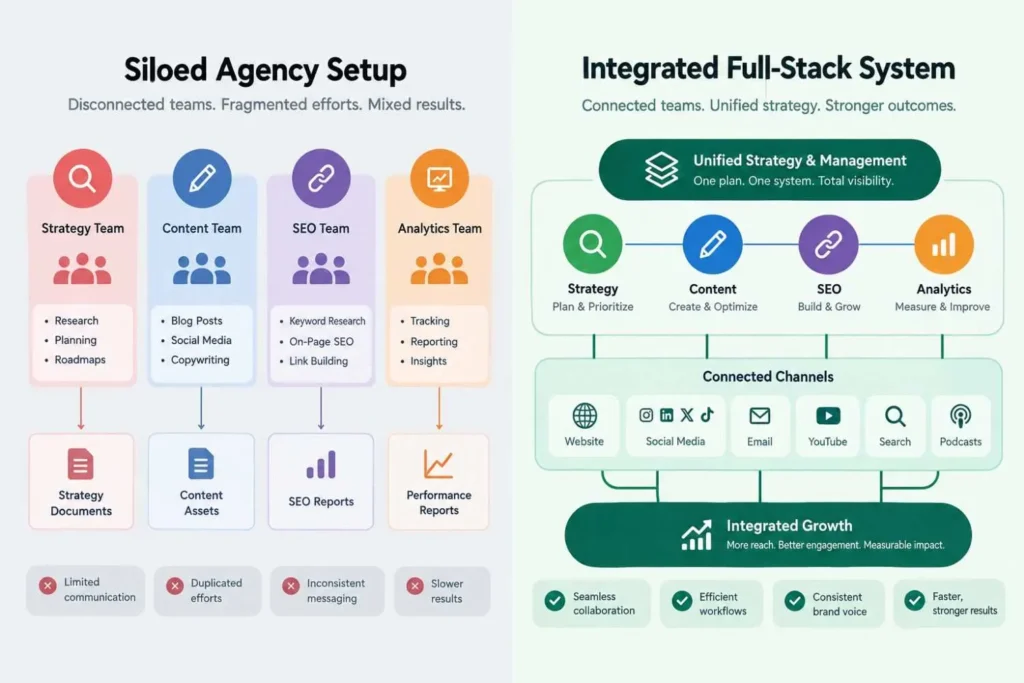
An SEO team optimises on-page content for answer blocks. A separate paid media team runs campaigns without feeding audience data back into content priorities. A web team builds pages without awareness of what the content team needs structurally for AI retrieval. Nobody coordinates third-party citation building because it sits between PR, content, and SEO and none of those teams formally owns it.
So the work happens in pieces. And pieces do not get cited.
AI engines strongly favour earned media, specifically authoritative third-party sources, over brand-owned content. Coordinating that earning process requires SEO, content, web performance, and brand authority to operate as one connected system. The data signals from paid campaigns inform what topics AI audiences engage with. Web architecture decisions affect whether AI crawlers access pages at all. Creative work affects whether third-party publications find the brand worth covering, which feeds the citation layer that ChatGPT and Gemini weight most heavily.
Paradigm Media Networks is a full-stack growth agency, not a siloed vendor. SEO, GEO, paid media, web, and creative run as one integrated revenue system. That structure is the structural requirement of a channel where 85 percent of citations come from sources that no single-channel vendor controls.
The Moving Hub campaign illustrates how this works in practice. Moving Hub came to Paradigm Media Networks with no search visibility and no established brand presence in the US moving and logistics market. Within four months, the integrated programme, combining SEO with 300 programmatic pages, performance marketing, and content at scale, took the brand from zero to over $100,000 per month in revenue with 600 plus keywords ranked. The compounding came from integration. Paid campaign data informed which content topics to scale. Organic authority supported paid efficiency. That loop is what AI search optimization for brands requires in 2026.
What Paradigm Media Networks Has Seen in Practice
The clearest signal Paradigm Media Networks has seen across campaigns is this: brands that invest in content volume and technical structure simultaneously, rather than sequencing one after the other, accumulate AI citation signals faster than brands that treat them as separate phases.
Moving Hub is the most documented example. Moving Hub came to Paradigm Media Networks with zero search visibility and no established brand presence in the US moving and logistics market. The programme combined technical SEO foundations, 300 programmatic pages built around long-tail moving queries, and performance marketing running in parallel from month one. Within four months, Moving Hub was generating over $100,000 per month in revenue with 600 plus keywords ranked.
What mattered for AI citation specifically was the programmatic content layer. Three hundred pages covering specific city-pair moving queries, each structured with a direct answer in the opening paragraph and sourced cost data, gave AI engines a large pool of individually citable, self-contained answer units. No single page had to carry the full topical authority. The coverage itself was the signal.
The performance marketing running alongside it was not separate. Paid campaign data showed which query types were converting, and that informed which programmatic topics to prioritise in the content build. The result was a content library shaped by actual buyer intent, not keyword volume estimates. That kind of integration is what makes content worth citing. AI engines do not distinguish between pages built for SEO and pages built for GEO. They distinguish between pages that answer a specific question well and pages that do not.
What the published data confirms, and what is consistent with what Paradigm Media Networks has observed across campaigns:
Pages with a direct answer block in the opening paragraph were cited in Google AI Overviews more frequently than topically equivalent pages without that structure, even when the non-answer-block page held a higher traditional ranking. Citation selection does not simply copy the organic rankings list.
On Perplexity, freshness acted as a decisive tiebreaker between topically similar pages. A well-sourced article updated within the previous 90 days consistently outperformed a higher-authority competitor page last refreshed 12 months earlier. This is consistent with the AirOps finding that pages updated within three months are three times more likely to be cited.
On ChatGPT, brand search volume correlated with category citation frequency more reliably than individual on-page signals. Brands that had built organic demand for their own name appeared in ChatGPT responses to category queries more often than competitors with stronger individual page metrics, consistent with the Semrush finding that brand search volume has one of the strongest correlations with AI citation frequency. Building brand recognition offline and through earned media is not a separate workstream from GEO. It feeds directly into it.

Frequently Asked Questions
What is the difference between AI search optimization and GEO?
AI search optimization is the umbrella term for making your brand visible inside AI-generated responses rather than traditional results pages. Generative Engine Optimization (GEO) is the most widely used discipline label within that umbrella, named in the Princeton KDD 2024 paper. AEO and LLMO are adjacent terms covering overlapping tactics. In practice, most agencies and practitioners use GEO and AI search optimization interchangeably when discussing citation-focused work.
Does ranking on Google still matter for GEO optimization?
Yes, but the relationship is no longer direct. Research from GEO firm Brandlight suggests that the overlap between top Google links and AI-cited sources has dropped from 70 percent to below 20 percent. A strong Google ranking gives you a better base because it signals crawlability and domain authority. But ranking first does not guarantee citation in AI answers, and the Princeton paper confirmed that lower-ranked pages can outperform top-ranked ones in AI citation visibility when GEO-specific tactics are applied.
How do I know if my brand is visible in AI search?
Start manually: run category queries and comparison prompts across ChatGPT, Perplexity, Gemini, and Google AI Overviews, and note whether your brand appears. Build a prompt library of queries your buyers would realistically ask and track citation rates across platforms over time. Tools including Profound, Otterly.AI, and Ahrefs Brand Radar offer AI visibility tracking dashboards. Paradigm Media Networks includes an AI visibility baseline assessment as part of its GEO audit engagements, starting with the Free Growth Audit.
How long does it take to see results from AI search optimization?
It depends on the platform and the starting point. Technical changes that improve AI crawler access can produce measurable improvement in Google AI Overview citations within a few weeks. Third-party citation building, which most directly feeds ChatGPT and Gemini visibility, typically takes three to six months before consistent brand mentions appear in LLM-generated answers. The brands seeing the fastest results in 2026 started technical and off-site work simultaneously in early 2025, not in sequence.
Is AI search traffic valuable enough to prioritise?
Volume is still modest. Microsoft Clarity’s research found AI-referred traffic had grown 155 percent over eight months while still accounting for under 1 percent of total visitors in the dataset. But conversion quality compensates for volume. LLM-referred visitors converted at 1.66 percent versus 0.15 percent from traditional search across 1,277 domains, an 11x difference in sign-up conversion rate. Brands cited in AI answers are reaching buyers who have already been pre-qualified by a synthesized response. The intent level is higher than organic search, and the gap is large enough that low absolute volume does not neutralise the commercial case for prioritising this channel now.
What to Do With This
AI search optimization in 2026 is an infrastructure decision, not a content update. The brands that will dominate AI citations in 2027 are building answer-block architecture, sourcing their claims, expanding third-party presence, and making their sites technically accessible to AI crawlers right now.
No single tactic covers the full opportunity. The citation signals that move results most, third-party credibility, entity consistency, content freshness, and web architecture, cut across SEO, content, web, and earned media. That is a full-stack problem, and it needs a full-stack solution.
If you are not sure where your brand currently stands in AI search, that is the question to answer first.
Book a Free Growth Audit and get a baseline of your current AI search visibility across ChatGPT, Perplexity, Google AI Overviews, and Gemini.
Prefer to talk through your specific situation first? Book a 30-minute call with Jahid directly.
About the Author
Jahid Hussain, Founder, Paradigm Media Networks
Jahid Hussain founded Paradigm Media Networks to solve a problem he kept running into: businesses spending across SEO, ads, and content that operated as separate silos and produced results that never compounded. He specialises in local SEO, organic growth systems, and integrated marketing that connects search, paid media, and creative into one lead generation engine. Paradigm Media Networks has been featured in IANS, Eastern Herald, Sangri Times, and Dailyhunt. Jahid works across the US and UK.
Last updated: 21 September 2026
