
The B2B SaaS SEO agency built for Google rankings and ChatGPT shortlists
Software buyers use AI assistants more than almost any other audience, and many build a vendor shortlist there before they open Google. We run SEO, GEO and paid search for B2B SaaS as one pipeline system, built on our SEO services, and report it against demo requests rather than sessions.
- Category, comparison and alternatives pages built for the prompts buyers type before they book a demo
- Your brand tracked across ChatGPT, Perplexity, Gemini and Google AI Overviews, with every prompt run repeatedly because the answers change
- Paid search optimized to qualified pipeline in your CRM
Free, 3 minutes, no login. Or bring your Search Console and CRM numbers to a call and we’ll show you where the pipeline leaks.
- SEO + GEO + paid search, one team
- Founder-led
- Reported to pipeline
- 300-page HR tech SaaS build

Short answer
Paradigm is a B2B SaaS SEO agency for US and UK software companies. We plan technical SEO, generative engine optimization (GEO) and paid search together and measure them against demo requests. For an HR tech SaaS client, 300 commercial pages in five months produced 180K+ impressions, 7,350 Bing AI citations and 15+ ICP-matched leads.
Why SaaS SEO is different now
Three numbers from our AI search statistics 2026 (60+ sourced numbers) index. Each one names who measured it, and none comes from a vendor selling AI tools.
of visits to IT sites came from AI assistants, more than double the 1.08% average across all industries.
Conductor 2026 AEO/GEO Benchmarks, May to September 2025 data, 3.3B sessions · source in our indexof the pages ChatGPT, Gemini and Copilot cite also rank in Google’s top 10 for the same prompt.
Ahrefs, 15,000 prompts, 2025 · source in our indexof the pages ChatGPT cited for software, product and agency recommendations were “best X” lists, more than any other page type.
Ahrefs, 26,283 source URLs · source in our indexFor a SaaS company, the bigger risk isn’t lost traffic. It’s being left off a five-vendor shortlist that a buyer forwards to their team before anyone visits your site.
One pipeline, three engines, one report
Most SaaS teams run SEO through one agency, paid search through another and “AI visibility” through a dashboard nobody acts on. Then the CFO asks which one produced last quarter’s pipeline and no one can answer. We run the three as one plan and report them against one number: cost per qualified opportunity.

Technical foundation and content mapped to buying stages
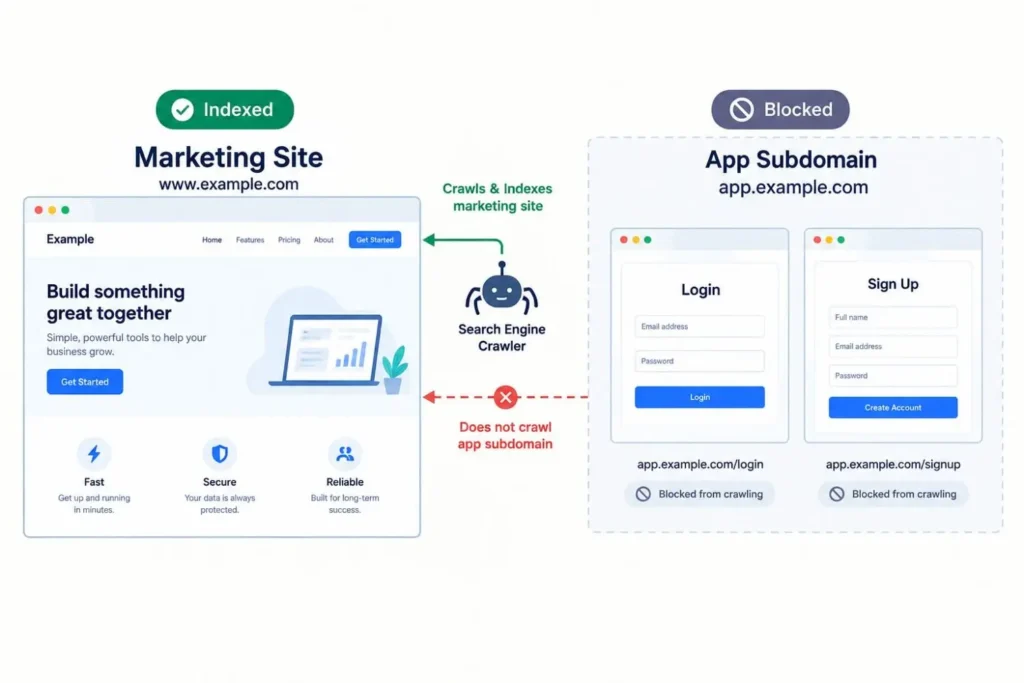
SaaS marketing sites break in predictable ways: JavaScript-rendered pages Google sees half-empty, app. and staging subdomains leaking into the index, docs on a separate subdomain with no links back, and a CDN rule quietly blocking AI crawlers. We fix that first with our technical SEO services, then build category, use-case, integration and comparison pages in the order buyers need them.

Getting onto the shortlist the assistant writes
We track a fixed set of buyer prompts (“best [category] for [team size]”, “[competitor] alternatives”, “is [brand] SOC 2 compliant”) across the major assistants. Then we close the gaps: answer-first pages, one consistent description of your company across your site, G2, LinkedIn and Crunchbase, and earned inclusion on the roundups assistants already cite. Our GEO services team runs this work.

Paid search measured to pipeline, not to form fills
Search campaigns cover high-intent terms while organic is still catching up, and pull back as it does. Conversions are imported from your CRM, so the platform optimizes toward SQLs instead of ebook downloads. We add negatives for the queries that drain SaaS budgets: “free”, “open source”, “login”, “template”, “jobs”, and your own customers searching for support. Our paid search team, measured to pipeline, manages the accounts.
Image: example reporting layout, illustrative figures.
One field we add to every demo form: “How did you first hear about us?”, with ChatGPT or another AI assistant as an option. AI-referred buyers often arrive as direct or branded traffic, so analytics alone undercounts them. Self-reported attribution is the cheapest way to see the channel your dashboards miss.
What we did for an HR tech SaaS company in five months
SaaS buyers check claims, so every figure here carries its date range and data source. The client’s name is withheld.
HR tech and workforce management SaaS
Engagement: December 2025 to April 2026
Work: programmatic SEO, technical SEO, topic clusters and AI-search visibility
Starting point
About 234 organic search clicks a month, an average position of 24, a 1.8% CTR and no programmatic pages. The product matched high-intent searches for attendance management, payroll, workforce management and canteen systems, but the site barely showed up for them.
What we did
We mapped search intent to each product module and built a programmatic framework with indexing and URL-structure standards. Then we published 300 commercial pages at 60 a month. In March we refreshed 180 existing pages and reorganized the site into pillar and cluster sections with parent-child internal links.
| Result | Figure | Source |
|---|---|---|
| Programmatic page impressions | 180K+ across the engagement | Google Search Console |
| Organic users | 3,567 | GA4 |
| Search clicks | +88% month on month in February | Google Search Console |
| Bing AI citations (Copilot and Bing AI answers) | 373 in January, 2,990 in April, 7,350 in total | Bing Webmaster Tools AI Performance |
| ICP-matched leads from SEO pages | 15+, including 3 demo bookings in March, with no paid spend | CRM and form log |
| Best single page (contract canteen management) | 53,187 impressions, best average position 3.89 | Google Search Console |

What it means for you: the leads came from commercial module pages, not blog traffic. That’s the order we work in on every SaaS site: bottom of the funnel first.
Two more things you can check today, without a call

Score your SaaS brand’s AI visibility
Our AI Visibility Checker grades your brand on 15 signals that decide whether an assistant names you, including comparison content, pricing visibility, schema, AI crawler access and review footprint. You get a 0–100 score and a fix list ranked by points recoverable. Three minutes, no login.
Run it on my SaaS domainEvery number sourced, every structure documented
Our AI search statistics 2026 index lists every number we quote with its source and date, and flags recycled figures, including ones we used to quote ourselves.
Our guide on how to structure content so AI engines cite it sets out the page structure we use on client sites, in full.
Where SaaS pipeline is won before the demo
A software purchase isn’t one search. It’s a buying committee: someone researches the problem, someone builds a shortlist, someone checks security and price, and someone signs. Each of them asks a different question, and more of them now ask an assistant first.
“Contact sales” pricing costs you in AI answers
When an assistant can’t describe what you cost, it has nothing to quote, and a competitor with published tiers may get named instead. You don’t need list prices. Starting-from figures or clear tier ranges are enough.
Repeated runs, not screenshots
Ask an assistant for the best tools in your category twice and you’ll often get two different lists. SparkToro’s 2026 research found the chance of the same brand list across repeated runs was under 1 in 100. That’s why we run each prompt repeatedly and report the share of answers you appear in.
Glossary traffic rarely signs contracts
The fastest way to grow a SaaS traffic graph is top-of-funnel glossary posts, and they seldom produce a demo. We start at the bottom of the funnel (comparison, alternatives, pricing, integration and use-case pages) and work upward once those pages convert.
Run the free checker, or send us your category and three competitors and we’ll show you the prompts where they appear and you don’t.
Six kinds of page every SaaS site needs to get shortlisted
Each page has one job and links to the pages next to it.
| Page type | Example query | Its job |
|---|---|---|
| Category | “customer onboarding software” | Says plainly what you are, so an assistant can file you in the right category |
| Use case or role | “onboarding software for HR teams” | Matches the problem a specific buyer describes |
| Comparison | “[you] vs [competitor]” | Gives a fair verdict, including where you’re not the right fit. A one-sided page gives buyers little reason to trust it |
| Alternatives | “[competitor] alternatives” | Reaches buyers who are already unhappy with someone else |
| Integration | “[tool] + Salesforce integration” | One controlled template, each page with real setup detail. Often the most scalable page set |
| Pricing and security | “[you] pricing”, “is [you] SOC 2” | The pages a committee checks last, and the questions an assistant can’t answer if the page doesn’t exist |
Programmatic pages often end up as 200 copies of the same paragraph with one word swapped. On the HR tech engagement, each of the 300 pages was mapped to a specific product module and search intent before it went live. A page that can’t say something specific doesn’t get published.
Running a larger SaaS site with more stakeholders?
When the site runs to thousands of URLs, multiple products and markets, and a release cycle marketing doesn’t control, the work changes shape: governance across templates, migration cover when you replatform, hreflang across the US and UK, and attribution that survives a board review. That program lives on our enterprise SEO & GEO for B2B SaaS page.
What’s in a SaaS retainer (no surprise line items)
Technical SEO
A month-one audit covering rendering, indexation, subdomains and AI crawler access, then a monthly crawl-and-fix sprint.
Bottom-funnel pages
Comparison, alternatives, pricing and use-case pages written for buyers who are evaluating vendors.
Integration and use-case templates
One controlled template with real detail on every page and its own schema.
AI visibility (GEO)
Your prompt set run repeatedly across the major assistants, with share of answers reported against named competitors.
Entity and review footprint
Consistent descriptions across your site, G2, Capterra, LinkedIn and Crunchbase, plus a review request routine.
Authority
Data-led digital PR and editor outreach for roundup inclusion. We earn placements with data and review profiles. We don’t pay to be presented as an independent recommendation, and any paid placement is labeled and nofollowed.
Paid search
Account build, CRM conversion import, negative keyword discipline and weekly optimization.
Reporting
Demo requests, SQLs and pipeline by channel, with AI-referred and self-reported traffic broken out.
Retainers start at $1,500 a month. Most SaaS companies with one product and one core market start on the $3,000 plan, multi-product teams on the $5,000 plan, and enterprise programs from $8,000. Ad spend is paid directly to the platforms. Full deliverables are on our pricing plans page.
Compare plansWhy SaaS teams hire us over a SaaS-only SEO shop
We publish our method
A written definition of an AI citation, a fixed prompt set and sourced numbers. Our AI search statistics index even flags figures we used to quote ourselves.
SEO and paid search, one plan
Paid search covers the terms organic hasn’t won yet, then steps back as rankings arrive.
We report to pipeline
Demo requests and SQLs by channel, with sessions as a supporting number.
We show where every number comes from
Our HR tech case study gives the date range and data source for each figure, even with the client’s name withheld.
Founder-led
You work with the person who built the method, not a junior account manager reading a template.
Run it yourself first if you’d rather
Free, no email gate.
Check before you write
The LLM SEO audit checklist, covering what to check before you write a single new page.
Find the real prompts
LLM keyword research for Google and AI search, on finding the prompts your buyers actually type.
Let the engines in
LLM technical SEO, covering crawler access, rendering and structured data for AI retrieval.
Questions SaaS founders and marketing leads ask on the first call
What do SaaS SEO services include?
SaaS SEO services cover technical fixes (rendering, indexation, subdomains, AI crawler access), bottom-funnel pages (comparison, alternatives, pricing, integration and use-case), authority building, and reporting tied to demo requests. Ours also include generative engine optimization (GEO) and paid search management, so one team owns the whole search channel. See our SEO services.
How do I choose an SEO agency for a SaaS company?
Ask where a past client’s numbers came from, with sources and date ranges. Ask whether they report to demo requests and pipeline or to traffic. Then ask how they measure AI visibility. If the answer is a single ChatGPT screenshot, keep looking: assistant answers vary between runs, so only repeated, logged prompts mean anything.
Should a SaaS company run PPC alongside SEO?
Usually, yes, at the start. Paid search wins evaluation-stage terms like “[competitor] alternatives” while organic pages are still building authority, then budget steps back as rankings arrive. The catch in SaaS PPC is waste: “free”, “open source”, “login” and job searches can eat a large share of spend. Import CRM conversions so the platform optimizes toward qualified pipeline. More on our paid search measured to pipeline.
What does a B2B GEO agency do?
A B2B GEO agency works to get your brand named and linked inside AI answers from ChatGPT, Perplexity, Gemini and Google AI Overviews when buyers ask for vendor recommendations. That means answer-first pages, one consistent brand description across every profile, earned inclusion on the third-party roundups assistants cite, and tracking a fixed prompt set over time. No one can guarantee a citation, but you can measure your share of answers and move it.
What’s in a SaaS SEO audit?
Our SaaS SEO audit checks how Google renders your JavaScript pages, which subdomains are indexed that shouldn’t be, whether AI crawlers can reach the site, schema and entity consistency, and which comparison and pricing queries you’re missing. It also checks which AI answers name your competitors instead of you. You get fixes ranked by pipeline impact. Start with the free LLM SEO audit checklist or the AI Visibility Checker.
How long does SaaS SEO take to produce pipeline?
It depends on your domain’s existing authority, how much technical cleanup comes first, and your sales cycle. For our HR tech client, publishing started in December 2025. February impressions rose 77% month on month, the first qualified leads came that month, and three demos were booked in March. Expect demo requests first and closed revenue one to three quarters later, depending on deal size.
Get your SaaS search and AI visibility audit
Tell us your category and your three closest competitors. We’ll come back with:
- Where you rank on the evaluation-stage queries that produce demos
- Which AI answers name your competitors, and which name you
- Technical issues blocking Google or AI crawlers from reading your site
- A prioritized 90-day plan tied to demo requests
No contract, no obligation, no pitch deck.
Founder of Paradigm Media Networks. Built the SEO, GEO and paid search method on this page and led the HR tech engagement in the case study above.
Last reviewed 7 October 2026