

By Jahid Hussain, Founder, Paradigm Media Networks · Data: March to May 2025 and 2026
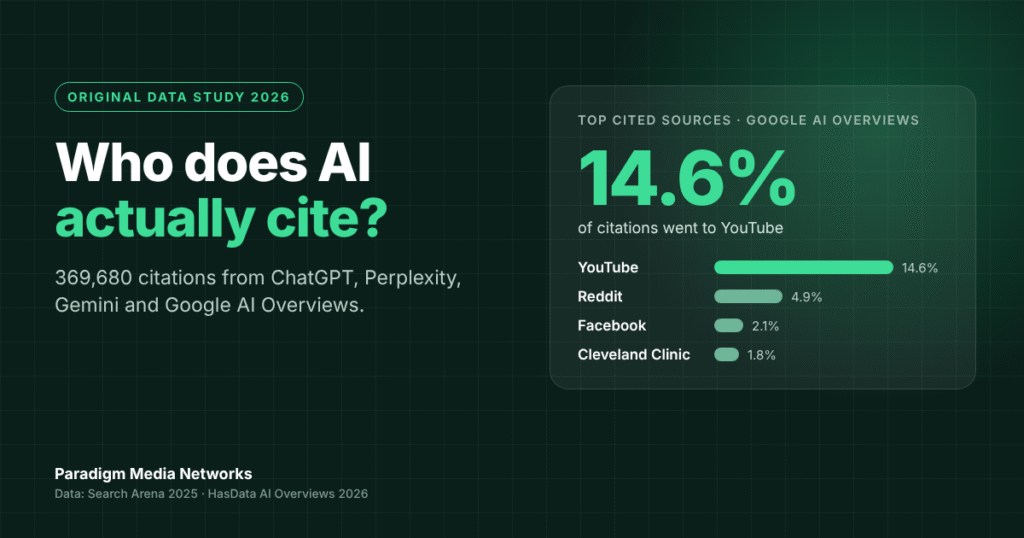
AI search engines mostly cite and recommend brands that trusted third parties talk about. That means video, community threads, reference sites, news and other people’s “best of” lists, more than the brand’s own website. In nearly 370,000 citations from ChatGPT, Perplexity, Gemini and Google AI Overviews, YouTube was the single most-cited site in 2026 AI Overviews. More than half of those YouTube citations came from videos outside Google’s top 10.
Key Takeaways:
- In the 2026 panel of 1,100 Google searches, YouTube accounted for 14.6% of all AI Overview citations, and 72.2% of AI Overviews cited at least one video.
- Ranking still sets the odds: a page in positions 1 to 3 was cited 55.5% of the time, against 22.6% for page two. But 12.8% of AI Overview citations came from pages outside the top 50.
- In 2025, ChatGPT search, Perplexity and Gemini drew on very different sources. ChatGPT leaned on Wikipedia and wire news. Perplexity and Gemini leaned on YouTube and Reddit.
- When users asked for recommendations, 48.1% of AI answers cited a “best” or “top” list, and only 2.2% cited a review directory such as G2, Clutch or Yelp.
- A popular reading of the 2025 data, that users prefer AI answers citing Reddit, mostly disappears once you compare answers from the same engine.
Key stats you can quote
Free to cite with a link back to this study. Each figure lists its base and dataset.
- 14.6% of Google AI Overview citations went to YouTube, the single most-cited site (3,597 citations in 723 AI Overviews; HasData dataset, 2026).
- 72.2% of AI Overviews cited at least one YouTube video (723 AI Overviews; HasData, 2026).
- 57.3% of YouTube AI Overview citations came from videos outside the organic top 10 (536 citations; HasData organic panel, 2026).
- 55.5% vs 22.6%: the chance a page ranking 1-3 is cited in its query’s AI Overview, against a page ranking 11-20 (805 AI Overviews; HasData organic panel, 2026).
- 48.1% of AI recommendation answers cited a “best” or “top” listicle URL, and only 2.2% cited a review directory such as G2, Clutch or Yelp (2,918 English answers; Search Arena, Mar-May 2025).
- 9.5% of ChatGPT search citations went to Wikipedia and 0.0% to YouTube or Reddit (25,925 citations; Search Arena API version, Mar-May 2025).
Cite this study
Hussain, J. (2026). AI Search Citation Study 2026: What Nearly 370,000 Citations Show About Who Gets Recommended. Paradigm Media Networks. https://paradigmmedianetworks.com/ai-search-citation-study-2026/
Download all 18 figures (CSV)How We Ran This Study
This study combines two open datasets that anyone can download and recheck.
| Dataset | What it contains | When |
|---|---|---|
| Search Arena (UC Berkeley and LMArena, accepted at ICLR 2026) | 24,069 real user conversations with AI search engines from OpenAI, Perplexity and Google: 366,083 cited URLs and 8,315 decisive user votes | Collected March to May 2025, using API versions of each engine |
| HasData Google AI Overview dataset (CC BY 4.0) | 1,100 US desktop searches across 11 intent types: 723 AI Overviews with 3,597 cited sources, plus organic rankings 1 to 50 for 805 AI Overviews | 2026 |
We counted every cited URL or domain, grouped domains into types (community platforms, reference sites, government and education, review directories), flagged listicle URLs by “best” or “top” in the path, and compared head-to-head votes between answers from the same provider. The analysis ran as Python scripts written with AI assistance; every figure in this article was recomputed from the raw files. The scripts and result files are available on request.
The study has limits, listed in full near the end. The biggest one: the 2025 and 2026 data come from different Google products and different query sets, so they are two snapshots, not one trend line.
Which Sources Does Google’s AI Cite Most in 2026?
YouTube. In the 2026 panel, youtube.com earned 525 of 3,597 AI Overview citations (14.6%), nearly three times Reddit’s 178 (4.9%). Facebook (77) and Cleveland Clinic (64) came next. Community platforms as a group made up 24.6% of citations, and 79.5% of AI Overviews cited at least one of them.
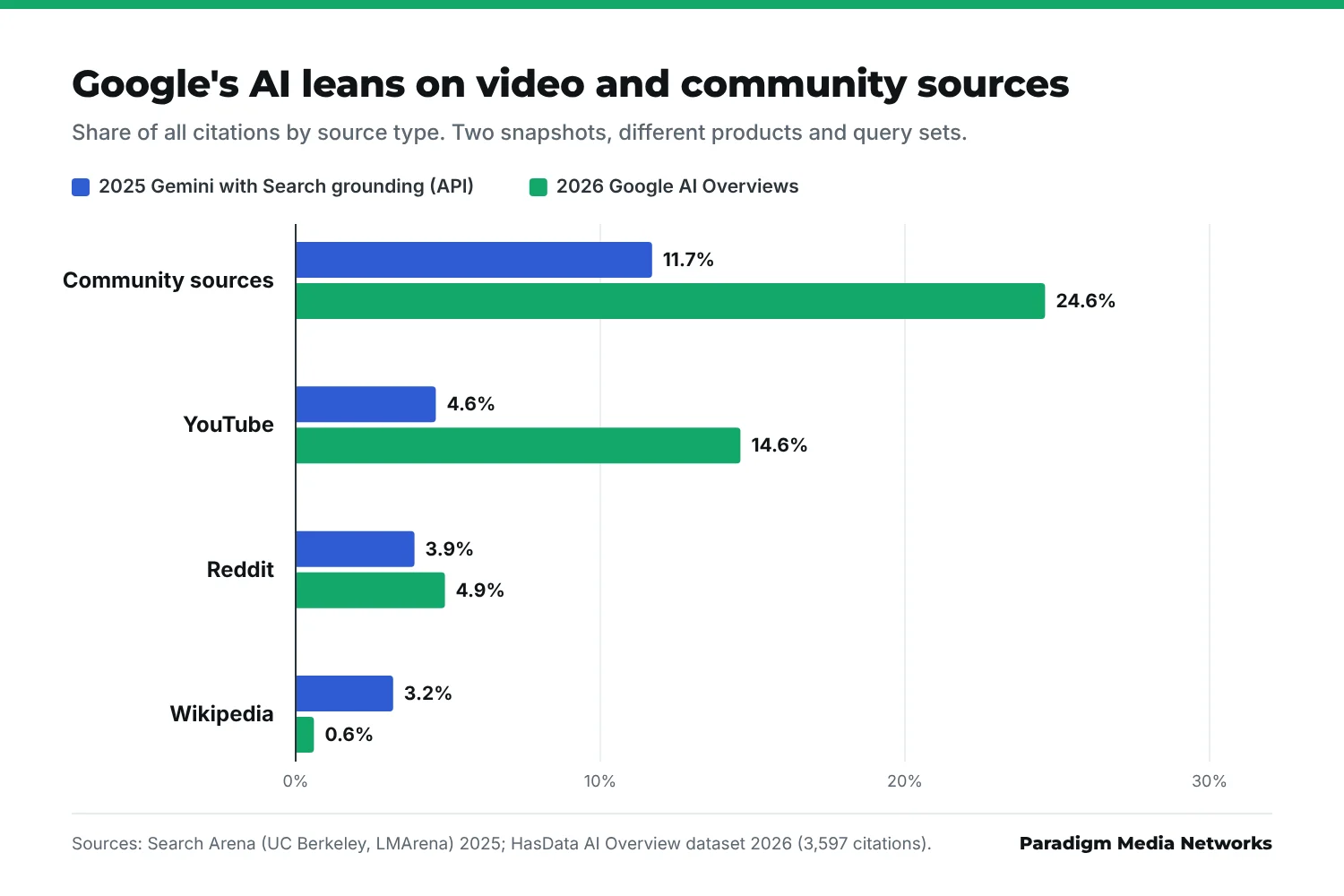
Our 2025 snapshot of Google’s AI, Gemini answering through the API with Google Search grounding, looked different. Community sources were 11.7% of its citations and YouTube was 4.6%. We would not call that a tripling, because the products and the questions differ. The honest reading is narrower: in both snapshots Google’s AI leans on video and community content, and in the consumer AI Overviews that buyers actually see in 2026, that reliance is heavy.
Wikipedia, by contrast, was 3.2% of Gemini’s 2025 citations and 0.6% of 2026 AI Overview citations.
Do You Need to Rank on Page One to Be Cited in an AI Overview?
No, but ranking is still the biggest single advantage. When we matched AI Overview citations against each page’s organic position:
| Organic position | Chance the page was cited in that query’s AI Overview |
|---|---|
| 1 to 3 | 55.5% |
| 4 to 9 | 38.5% |
| 11 to 20 | 22.6% |
| 21 to 50 | 19.0% |
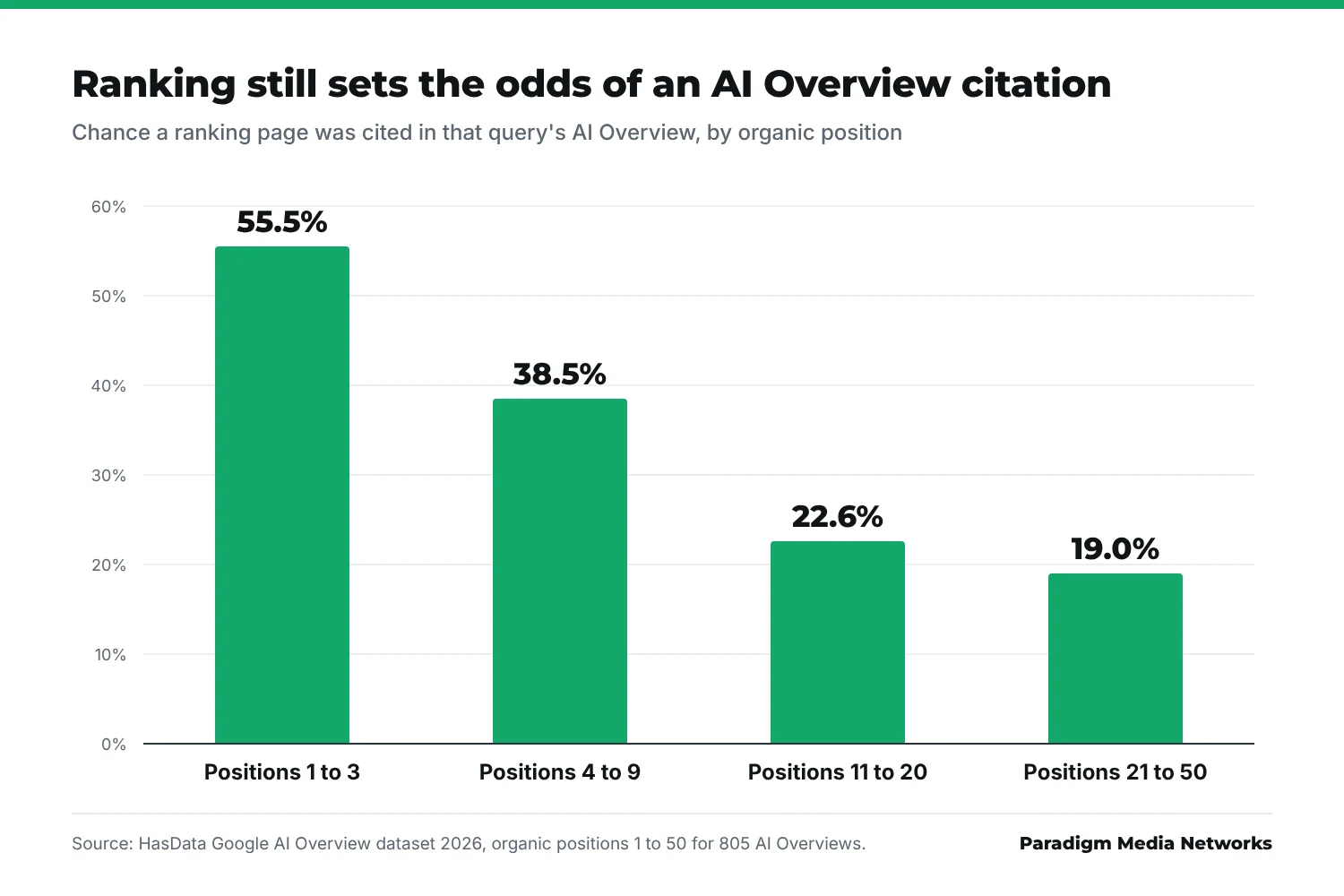
90.7% of AI Overviews cited at least one top-10 page, yet only 57.8% of individual citations came from the top 10, and 12.8% came from pages outside the top 50 entirely. Google’s AI is drawing from a wider pool than page one. Page one is simply the deepest part of that pool.
Why YouTube Reaches AI Overviews Without Ranking
Sites differ sharply in how their citations arrive. Reddit is cited almost entirely through ranking: 89.4% of Reddit’s AI Overview citations came from threads already in the top 10. YouTube is the opposite. 57.3% of YouTube citations came from videos that were not in the organic top 10.
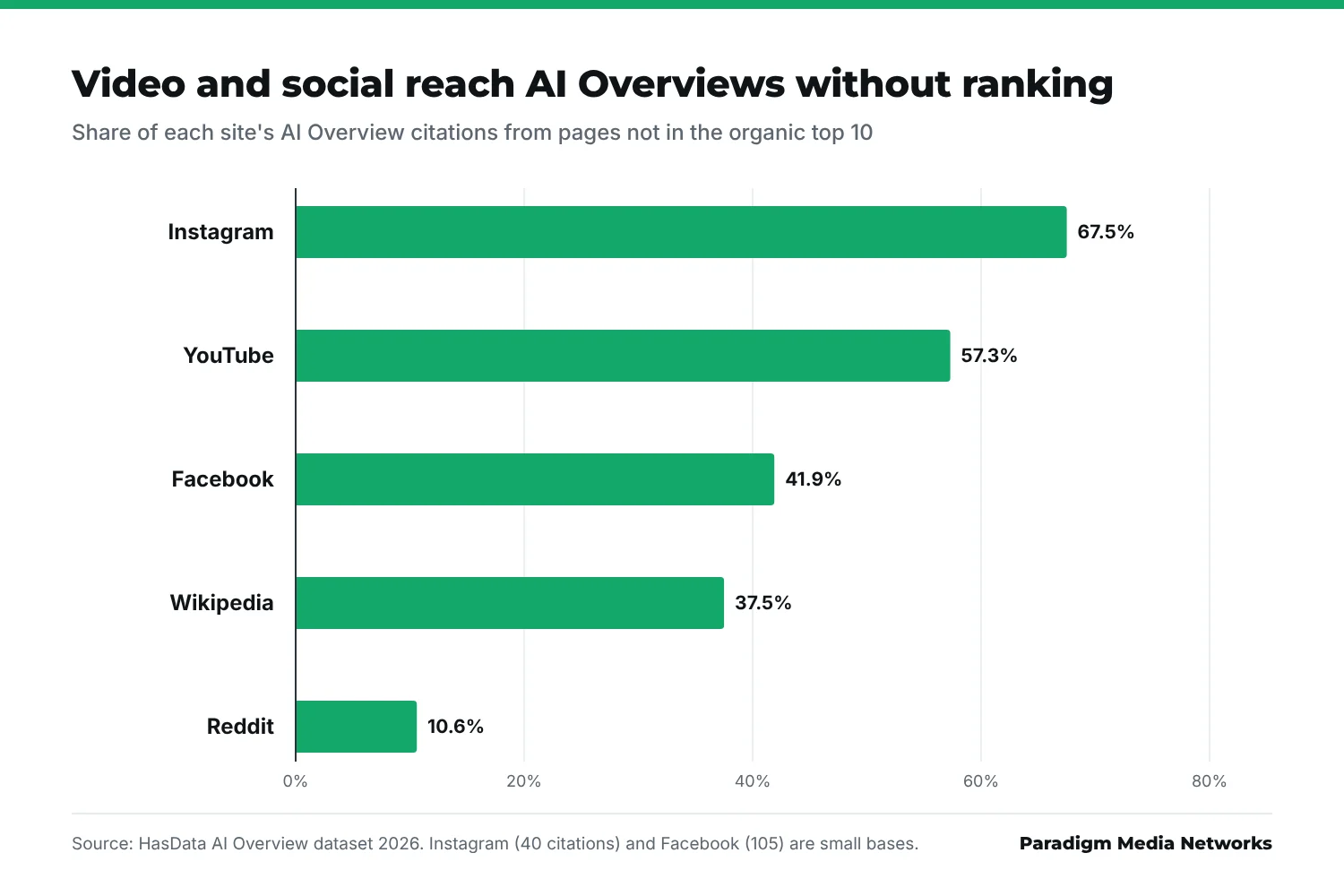
Instagram (67.5%) and Facebook (41.9%) show the same pattern, though from smaller bases of 40 and 105 citations. On comparison searches (“X vs Y”), YouTube was the most-cited domain with 86 citations, followed by Reddit with 61.
The practical reading: if a clear, well-titled video genuinely answers the question someone typed, Google’s AI may use it even when the video does not rank in the blue links. That is a reason to make useful videos for the questions your buyers ask. It is not a loophole, and padding YouTube with thin videos made only to be cited is the kind of activity Google’s spam policies now cover in AI answers.
Do ChatGPT, Perplexity and Gemini Cite the Same Sources?
They did not in 2025, and the gap was large. Here is the share of each engine’s citations going to four source types (English answers, API versions):
| Source | ChatGPT search | Perplexity | Gemini with Search |
|---|---|---|---|
| Wikipedia | 9.5% | 3.2% | 3.2% |
| Reuters and AP | 9.2% | 0.3% | 0.2% |
| YouTube | 0.0% | 7.8% | 4.6% |
| 0.0% | 4.5% | 3.9% | |
| Average sources per answer | 2.8 | 12.1 | 7.1 |
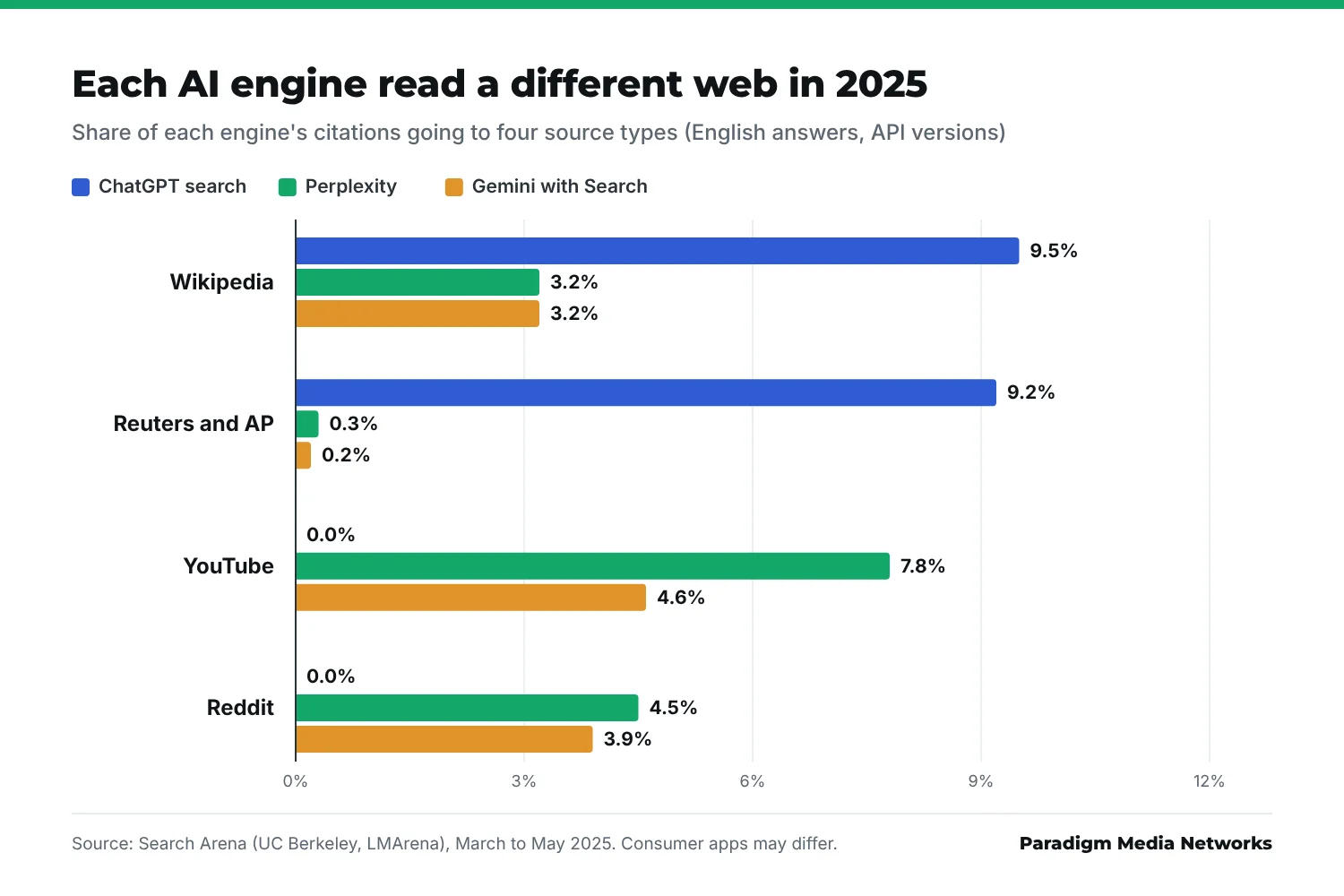
ChatGPT’s 2025 search model cited few sources and leaned on reference and wire news, with no YouTube or Reddit at all. Perplexity cited the most sources per answer and pulled heavily from video and community sites. Consumer ChatGPT has changed since then, so treat the ChatGPT column as a 2025 baseline rather than today’s behaviour.
The planning point holds either way: visibility in one AI engine says little about visibility in another.
Where Do “Best X” Recommendations Come From?
Mostly from other people’s lists and from community threads. Across 2,918 English recommendation answers (27,572 citations):
- 48.1% cited at least one URL with “best” or “top” in the path.
- 43.0% cited Reddit or YouTube.
- 2.2% cited any review directory (G2, Capterra, Clutch, Trustpilot, Yelp, BBB, Angi and similar).
- Brand homepages were 3.2% of citations.
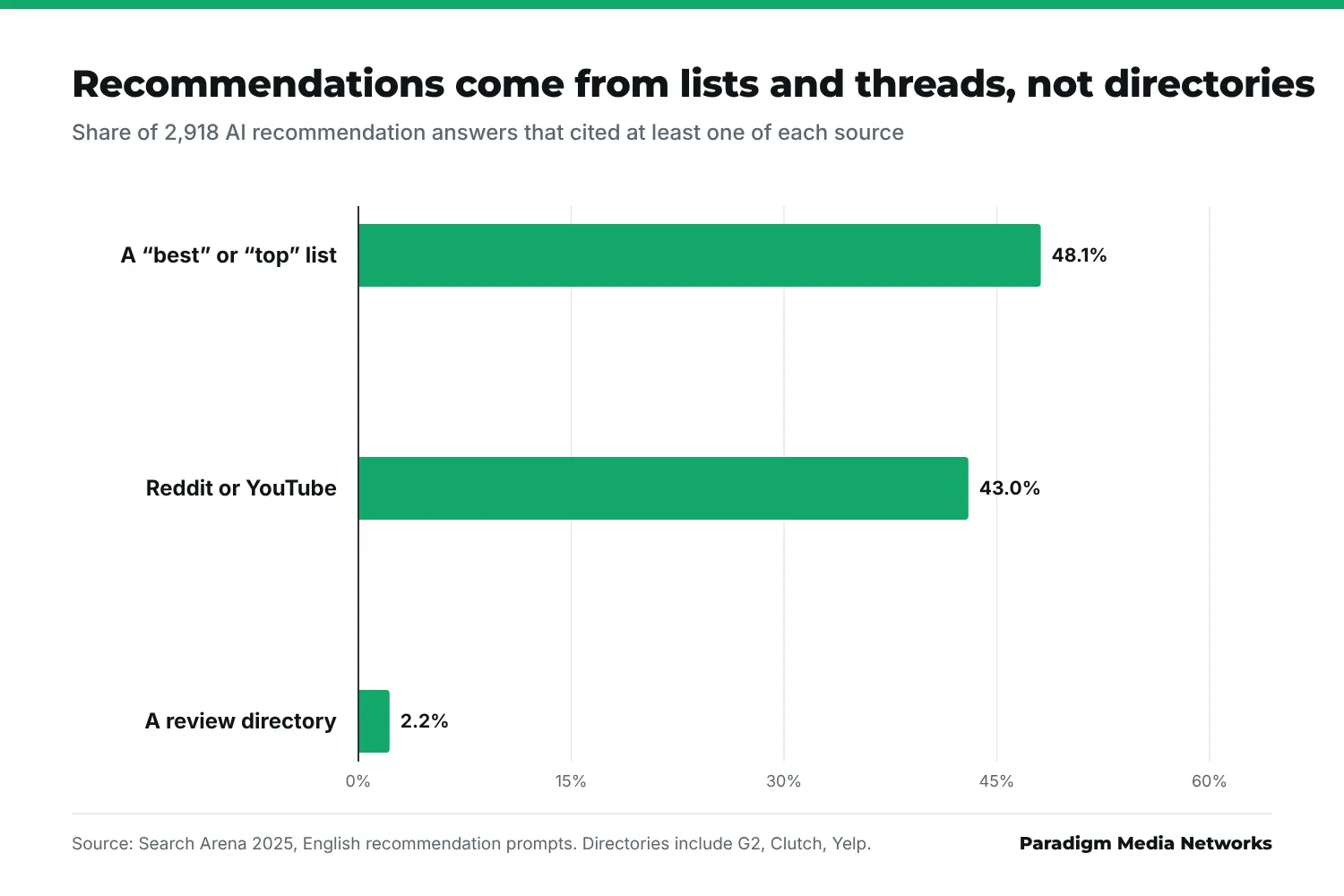
Listicle URLs made up 14.1% of citations on recommendation prompts against 1.6% on factual ones. The publishers cited most often for lists were Reddit threads, PCMag, TechRadar, Zapier, ZDNet, CNET, Tom’s Hardware, Tom’s Guide, Forbes and TechTarget.
The 2.2% directory figure is from 2025. Some 2026 vendor studies report directories cited far more often in ChatGPT, so this number may have moved, and we would test it again before relying on it.
Do Users Prefer AI Answers That Cite More Sources?
Yes. In 1,476 head-to-head votes between two answers from the same provider, the answer citing more sources won 58.6% of the time (59.9% for OpenAI against OpenAI, 56.8% for Perplexity, 61.3% for Google). The Search Arena authors also report that users favoured heavily cited answers even when the cited pages did not support the claim, a gap between how credible an answer looks and how credible it is.
Myth Check: Do Users Prefer Answers That Cite Reddit?
Not on this evidence. Across all decisive votes, the answer with a larger share of community sources won 66.5% of the time, which is where the “users prefer Reddit” reading comes from. But Perplexity and Gemini cite far more community content than ChatGPT, so that comparison is mostly one engine against another. When we compared answers from the same provider, the community advantage fell to 53.9% across 356 votes, which is not statistically significant (p ≈ 0.14).
AI engines clearly favour community content. Whether people do is still an open question.
What We See in Client Work
Jahid Hussain’s view, from running these projects: optimising for AI search is still SEO, but not equally for every model, and Google itself is still experimenting with how its AI picks sources. Beyond content, he sees two things separate the brands that get cited: technical hygiene, and writing that is genuinely human rather than AI filler. The most common mistake he sees is mass-producing AI-written pages and hoping volume earns citations.
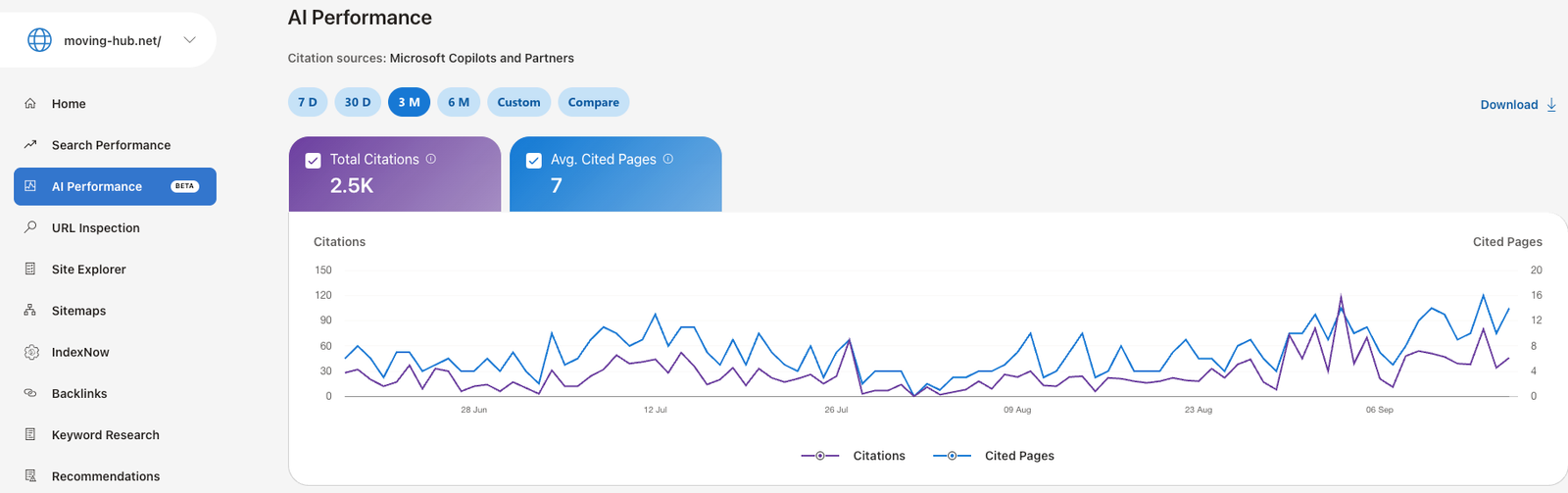
Moving Hub, a US long-distance mover, is the clearest example from our own projects. It started 2026 with no organic traffic, sat on page three for the searches that book moves, and was not mentioned when people asked AI assistants for a mover. After six months of technical clean-up, answer-first content, route and city pages built on real pricing and local detail, digital PR and monthly tracking of buyer prompts, it logged 2,460 AI citations in a 90-day window. moving-hub.net was the first source cited in Google’s AI Overview for “storage in transit cost usa”. Referring domains grew from 68 to more than 450. The full breakdown is in the Moving Hub case study.
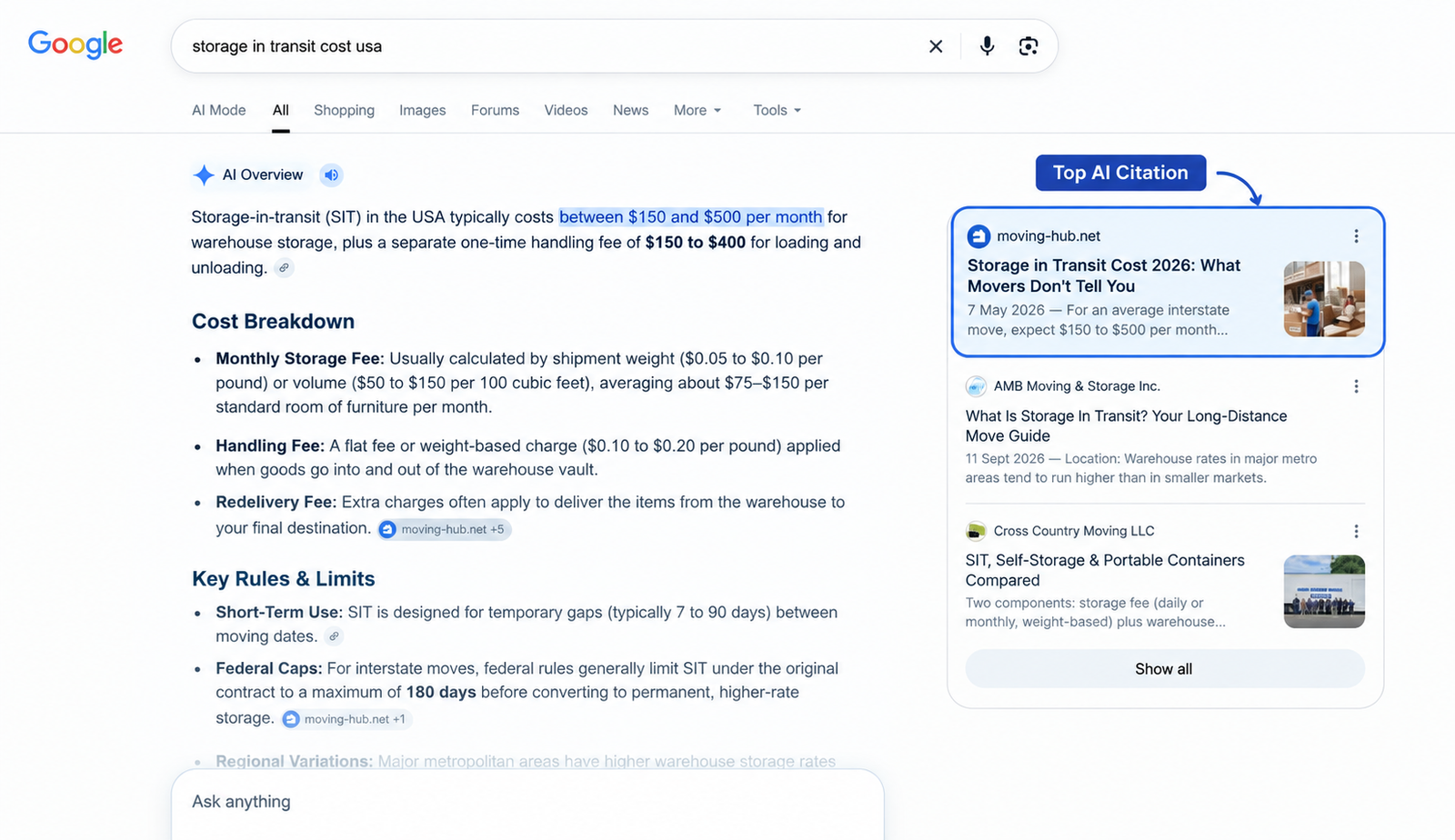
The route and city pages are worth a comment, because they look like the mass production Jahid warns against. The difference is that every page carried its own pricing bands and local detail and had to justify being indexed. Templated pages with real, unique data are fine under Google’s guidelines; swapped place names with no substance are not.
Five Patterns in the Data
These are our interpretation of the findings, not rules any engine has published. We call the first one Borrowed Authority.
- Borrowed Authority. AI engines recommend brands that trusted third parties discuss: lists, threads, videos and press. A brand’s own homepage was a small share of citations in every cut of the data.
- Video reaches AI answers without ranking first. Most of YouTube’s AI Overview citations (57.3%) pointed to videos outside the top 10.
- Each engine reads a different web. The 2025 source mix of ChatGPT search barely overlapped with Perplexity’s.
- Page one is the biggest bucket, not the only one. Beyond the top 10 sat 42.2% of all AI Overview citations.
- Visible sourcing wins votes. Answers with more citations beat answers with fewer, within the same engine.
What to Do With These Findings
For B2B SaaS companies. Find the “best [your category] software” lists that AI answers already cite for your category, and earn a place on them through product quality, reviews, PR and genuine relationships with the publishers. Never pay for an undisclosed placement. Build honest comparison pages against your main competitors, and record a clear walkthrough video for your most common “X vs Y” question. More detail is in our guide to how SaaS brands earn AI search citations.
For local service businesses such as HVAC. Our 2026 panel saw AI Overviews on only 8 of 100 local “near me” searches, but those queries were about restaurants and car washes, and other 2026 local studies report much higher rates. Do not plan around the 8%. What the data does support is that AI Overviews appear on 91% of comparison searches, so the questions buyers ask before they call (heat pump vs furnace, R-32 vs R-410A refrigerant, what a new AC costs) are where AI answers show up. In our small 2025 HVAC sample, AI engines cited manufacturer specification pages, trade press such as ACHR News, and the EPA. Our guide to AI search for home service businesses covers this in more depth.
For marketing teams and agencies. Plan per engine, not “for AI”. Measure over repeated prompts rather than single screenshots, because AI answers vary between runs. And avoid mass-producing pages for every query variation: Google’s spam policies now explicitly cover attempts to manipulate its AI answers. If you want to see where a brand currently stands, our free AI Visibility Checker scores it across ChatGPT, Perplexity, Gemini and AI Overviews.
Limitations
- The 2025 and 2026 data come from different products (Gemini API with Search grounding vs consumer AI Overviews) and different query sets. Compare them as snapshots, not as a trend.
- Search Arena uses API versions of each engine (GPT-4o search preview, Perplexity Sonar, Gemini 2.0 and 2.5 with grounding), not the consumer apps, and its users skew technical.
- The HasData panel is US desktop only, with 100 queries per intent type. HasData is a commercial search-data company; its dataset is openly licensed.
- Listicle detection uses URL paths and misses lists without “best” or “top” in the URL.
- Neither dataset covers Claude, Grok or Microsoft Copilot.
- The HVAC observations come from a small sample (74 answers) and are directional only.
Frequently Asked Questions
What is the most-cited website in Google AI Overviews in 2026?
In the 2026 HasData panel, YouTube, with 14.6% of all AI Overview citations. Reddit was second with 4.9%. Results will differ by industry and query type.
Is optimising for AI search different from SEO?
Mostly no. Google’s own guidance says optimising for its AI features is still SEO, and our rank data agrees that ranking sets the odds. The differences are at the edges: video and community content carry more weight in AI answers, and engines outside Google draw on different sources.
Does llms.txt help you get cited?
Google says its AI features ignore llms.txt, so it neither helps nor harms in Google. Nothing in our data suggests it is a lever.
How was this data collected?
From two open datasets: the Search Arena dataset (UC Berkeley and LMArena, 2025) and the HasData Google AI Overview dataset (2026). We did not run new queries for this article; every figure can be recomputed from the public files.
Cite This Study
Paradigm Media Networks (2026). AI Search Citation Study 2026: What Nearly 370,000 Citations Show About Who Gets Recommended. https://paradigmmedianetworks.com/ai-search-citation-study-2026/
The charts can be reused with credit and a link to this page.
See Where Your Brand Shows Up in AI Answers
Run the free AI Visibility Checker to see how ChatGPT, Perplexity, Gemini and AI Overviews describe your brand today. If you want the lists, threads and videos those engines cite worked into a plan, see our generative engine optimization services, then book a free growth audit or schedule a 30-minute call.
About the Author
Jahid Hussain | Founder, Paradigm Media Networks
Jahid Hussain founded Paradigm Media Networks to fix a problem he kept seeing: businesses spending on SEO, ads and content that never talked to each other. He specialises in local SEO, organic growth systems and integrated marketing that connects search, paid media and creative into one lead generation engine, working with clients across the US and UK. Paradigm Media Networks is a full-stack growth agency, and has been featured in IANS, Eastern Herald, Sangri Times and Dailyhunt.
Related reading: AI search statistics 2026 · How to get mentioned by ChatGPT · Is GEO just SEO?
