



How to choose a GEO agency comes down to one test: can it prove its work changed what AI engines say about you, and connect that change to qualified leads? Ask for the raw prompts, run dates and full responses behind any result it claims. Check that month one fixes your site, content and reputation, not just a dashboard. Read the contract for data ownership and exit terms. And treat any “best GEO agencies” list as marketing until you know who wrote it and whether anyone paid to be on it.
Key Takeaways:
- Ask for raw evidence: prompts, dates, engines and full AI responses, not a visibility score.
- Mentions aren’t the goal. Qualified leads and revenue are.
- AI engines lean on “best X” lists, so a paid list spot can reach AI answers without an ad label.
- You should own your content, accounts, tracking data and prompt logs.
- Weak website or basic SEO? Fix that before paying for GEO.
You have three GEO proposals open. Each has a new acronym, a dashboard of “AI mentions,” and a link to a “best GEO agencies” list where that same agency sits near the top.
Two of those lists were written by the agencies on them. You may never find out whether the third was paid for.
Below: the questions to ask, the answers that should end the call, the contract terms that protect you, and a printable checklist.
How to Choose a GEO Agency: Start With What the Work Is
A GEO agency gets your brand mentioned, cited and described accurately when buyers ask ChatGPT, Perplexity, Gemini or AI Overviews for help. Most of that rests on SEO. The genuinely new work is narrower: tracking real buyer prompts across engines, making sure AI crawlers aren’t blocked, and earning third-party mentions. Good GEO services build on an SEO foundation rather than replacing it.
The question prospects ask Jahid Hussain most isn’t about citations. It’s how GEO produces leads and measurable outcomes. It’s also why they leave agencies: the last one reported rankings, traffic or activity without connecting any of it to qualified leads.

12 Questions That Separate Real GEO Work From Relabelled SEO
These are the questions to ask AI SEO agency teams before you sign. Good answers are specific and checkable; bad ones are vague or promise things nobody controls.
| # | Question | A good answer | Walk away if you hear |
| 1 | Which buyer prompts will you track, and how did you choose them? | Named prompts mapped to your services and buying stages | “We track thousands of AI keywords” |
| 2 | Can I see raw prompts, dates and full responses behind a past result? | Yes, plus what changed between runs | Only a visibility score or screenshot |
| 3 | Which engines do you cover, and how often do you re-run prompts? | Named engines, repeated runs, because answers vary | One run, one engine |
| 4 | How will you separate GEO gains from normal SEO gains? | A baseline, dated changes and honest limits | “It all works together” |
| 5 | What will you change on my site in month one? | Specific pages, entity details, crawler rules | An llms.txt file and “AI schema” |
| 6 | Can AI crawlers reach my site right now? | Checked robots.txt and CDN bot settings already | Hasn’t looked |
| 7 | How do you earn third-party mentions? | PR, genuine reviews, accurate directory data | Seeded forum posts or bought list spots |
| 8 | How does this connect to leads and revenue? | AI referrals, assisted conversions, lead quality | Mentions are the outcome |
| 9 | Who does the work, and who fixes what you find? | Named people who can change pages, site and ads | “We’ll send recommendations to your developer” |
| 10 | Do you pay for placement in rankings or lists? | No, and any advertising is labelled as advertising | Evasion, or “everyone does it” |
| 11 | What happens to my content, accounts and data if we part ways? | You own them, with a documented handover | Agency-owned accounts or tracking |
| 12 | When would you tell me not to start GEO yet? | Names the foundations to fix first | “Never, everyone needs this now” |
Question 1 does the most work. Prompt selection is where weak agencies hide: a tracker full of prompts nobody asks will always look healthy. Our guide to LLM keyword research and entity-based prompt mapping shows what a grounded prompt set looks like.
The list also works as questions to ask digital marketing agency teams that have bolted GEO onto an existing package. Are most GEO agencies just rebranded SEO shops, as forum threads keep asking? Plenty are, and that isn’t automatically bad. An SEO team that added prompt tracking, crawler audits and mention work is doing GEO. The problem is the one that changed only its service page and price. Questions 2, 4 and 5 expose it in ten minutes.
6 GEO Agency Red Flags Worth Walking Away Over
Some GEO agency red flags appear in the proposal. Others surface three months in, when the reports start.
- Guaranteed AI rankings or citations. Can anyone guarantee ChatGPT will recommend you? No. Nobody controls model output, and answers shift between runs.
- A citation dashboard with nothing underneath. No prompts, dates or full responses means nothing you can audit.
- Reports instead of visibility. Jahid sees this most in audits of previous agencies’ work: months tracking AI mentions while the content, entity signals, authority and technical foundation never improved.
- File tricks as headline deliverables. An llms.txt file, “AI chunking” or special AI schema sold as the core of a retainer.
- Manufactured mentions. Seeded Reddit threads, fake reviews or bought list spots. A mention that gets called out does more harm than none.
- Lock-in. The agency owns your ad accounts, analytics or prompt history.
Got a proposal in your inbox already? Our free AI visibility audit shows how AI engines describe your brand today and which proposed line items are real GEO work versus padding. Request your free audit or book a 30-minute call.

Why Pay-to-Play Rankings Should Worry You
Rankings matter more now because AI engines read them. An Ahrefs study of 26,283 source URLs found “best X” lists made up 43.8% of the pages ChatGPT cited for recommendation prompts, including agency queries.
Wix’s AI Search Lab found that in professional services, third-party lists earned about 81% of listicle citations, against 19% for self-promotional ones. So a spot on a list that looks independent is worth real money, and people sell those spots. Once that placement feeds an AI answer, any “sponsored” label on the original page is gone.
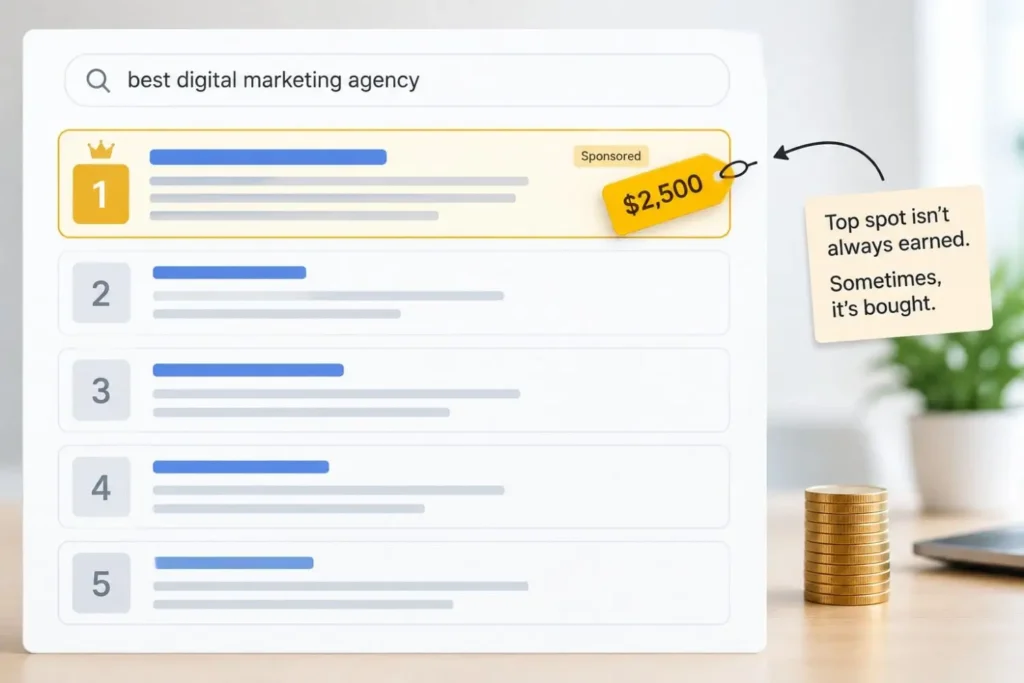
On the source page, at least, the rules are clear. The FTC’s endorsement guidance treats payment as a material connection that must be disclosed clearly, close to the recommendation itself.
Now our own house. PMN publishes rankings too, including our roundup of SEO companies for moving companies, where Paradigm is listed first. Read it as marketing and editorial opinion, not independent endorsement. That’s the point: an agency should keep its opinions, its case-study evidence, genuinely independent rankings and paid placements clearly apart.
Our rule: we don’t pay to be presented as an independent recommendation, and we don’t buy inclusion to manipulate search or AI results. Test any list an agency shows you:
- Who wrote it? Check whether the publisher appears on its own list.
- Did anyone pay? Look for sponsorship, affiliate or “featured partner” language.
- Is the method published? Criteria you can check beat “our experts reviewed.”
- Does the evidence match the rank? Named results and pricing, or just adjectives?
Contract Clauses to Check Before You Sign
The contract tells you more about an agency than its case studies do.
| Clause | What good looks like | Watch for |
| Scope | Named deliverables, prompts tracked, engines covered | “Ongoing GEO optimisation” |
| Minimum term and notice | Stated plainly, with a reason for the length | Auto-renewal buried in terms |
| Content and creative ownership | You own everything produced | Licence that ends when you leave |
| Account access | Your ad, analytics and Search Console accounts, with agency access | Accounts created under the agency |
| Data ownership | Prompt logs, baselines and reports are yours | Tracking locked inside their tool |
| Exit | A practical handover of assets and history | Nothing written down |

Paradigm’s agreements cover each of those rows, and on exit the client keeps its business assets and gets a practical handover. Price should follow scope: how many prompts, pages, markets and how much PR work sits behind it. Published GEO retainers run from a few hundred dollars a month for one local market to five figures for enterprise programmes. Our pricing page lays out what drives cost.
When Not to Hire a GEO Agency Yet
Jahid’s advice is to hold off if the business has major foundational problems: a weak website, fuzzy positioning, thin content, a broken conversion path or neglected basic SEO. GEO works best when there’s already a credible business with useful expertise and a site worth recommending.
AI assistants summarise what the web already says about you. If that picture is thin, a GEO retainer mostly pays someone to report it back. Start with a technical SEO audit that checks AI crawler access, fix what it finds, then decide.
Why a Siloed GEO Vendor Struggles to Move Revenue
AI visibility depends on inputs a standalone GEO vendor doesn’t control: your site’s speed and structure, the expertise in your pages, your reviews and press, and demand created by ads, since people ask assistants about brands they’ve already seen. A siloed vendor can report on citations. It usually can’t change what produces them.
That’s the gap a full-stack agency closes. Paradigm runs SEO and GEO, performance marketing, website design and development, and creative strategy as one system (SEO, GEO & Ads, Engineered for the AI Era). The team reading your AI visibility report can fix the page, site or ad creative behind it, then measure against leads, not mentions.

The Proof We Offer, and Its Limits
For Moving Hub, a US moving company, we built 300 programmatic SEO pages. The site ranked for 600+ keywords within four months and grew from $0 to $100K+ a month.
That’s an SEO result, not proof of AI citations, and we label it that way. Hold every agency, including us, to the same standard.
Frequently Asked Questions
What should I look for in a GEO agency?
Look for raw evidence behind past results, a prompt set tied to your real buyers, and a plan that improves your site, content and reputation. The agency should connect AI visibility to qualified leads and leave you owning your data.
How much does a GEO agency cost?
It depends on scope: prompts tracked, pages, markets and PR work. Published retainers range from a few hundred dollars a month for a single local market to five figures for enterprise programmes, so compare what each price actually includes.
What questions should I ask a digital marketing agency before hiring?
Ask how its work connects to leads and revenue, who does the work, and what you keep if you leave. For GEO specifically, ask to see the prompts, dates and full AI responses behind any result it claims.
How can you tell if a GEO agency is just a rebranded SEO agency?
Ask what it will change on your site in month one and how it separates GEO gains from SEO gains. A rebranded shop has the same deliverables as before, while a real GEO team adds prompt tracking, AI crawler checks and third-party mention work.
Can a GEO agency guarantee ChatGPT recommendations?
No. Nobody controls what an AI model outputs, and answers vary between runs, so a guarantee is a sales tactic rather than a method.
Conclusion
Choosing well mostly means refusing anything you can’t check. Ask for the prompts and responses. Ask what changes on your site first and how it reaches your pipeline. Read the exit clause before the case studies. When shown a ranking, find out who wrote it and who paid. That’s how to choose a GEO agency you won’t need to replace in a year.
Take the GEO Agency Checklist Into Your Next Sales Call
The printable checklist puts the 12 questions, 6 red flags, contract clauses, measurement criteria and pay-to-play test on two pages. Bring it to every agency call, including ours.
- Download the GEO Agency Checklist (PDF)
- Book a Free Growth Audit
- Schedule a 30-minute call
About the Author
Jahid Hussain | Founder, Paradigm Media Networks
Jahid Hussain founded Paradigm Media Networks to solve a problem he kept seeing: businesses spending across SEO, ads, and content that never talked to each other. He specialises in local SEO, organic growth systems, and integrated marketing strategies that connect search, paid media, and creative into one lead generation engine. Paradigm has taken clients from zero search visibility to six-figure monthly revenue pipelines, and has been featured in IANS, Eastern Herald, Sangri Times, and Dailyhunt. Jahid operates across the US and UK, and writes from the standpoint of someone who has built and broken growth systems for real businesses, not from a slide deck.
