



HVAC social media marketing books jobs when organic posts build trust and paid Facebook ads do the selling. Posting alone rarely fills a schedule: Facebook business pages average about 0.15% organic engagement per post, per Socialinsider’s 2026 benchmarks. The long-running HVAC Facebook ads in Meta’s Ad Library share three traits: a specific price, a seasonal reason to act now, and a one-tap way to book. Use a tune-up offer to win the first visit, then remarket the maintenance plan.
Key Takeaways:
- A boosted post is distribution. Well-run HVAC Facebook ads are a lead system.
- 11 of the 12 documented HVAC Facebook ad examples below lead with an offer or a specific failure. None sells a plan outright.
- Sell the plan on the second touch, to people who already booked or engaged.
- Test with $1,500 to $3,000 a month for 6 to 8 weeks.
- Slow lead follow-up makes every ad more expensive. Fix it first.
You boosted a few posts. The likes came in, and so did a comment from your cousin. The phone stayed quiet.
See it in practice: our HVAC SEO case study shows how one single-location contractor went from 10 to 80+ inbound calls a month in four months with no ad spend.
Facebook works for trades. Boosting and hoping doesn’t. Below are 15 HVAC Facebook ad examples (12 documented in Meta’s public Ad Library, 3 labelled templates), a testing framework built around maintenance-plan sign-ups, and a straight answer on paid versus organic. For how social fits with search and AI visibility, see our HVAC marketing strategy guide covering SEO, ads and AI.
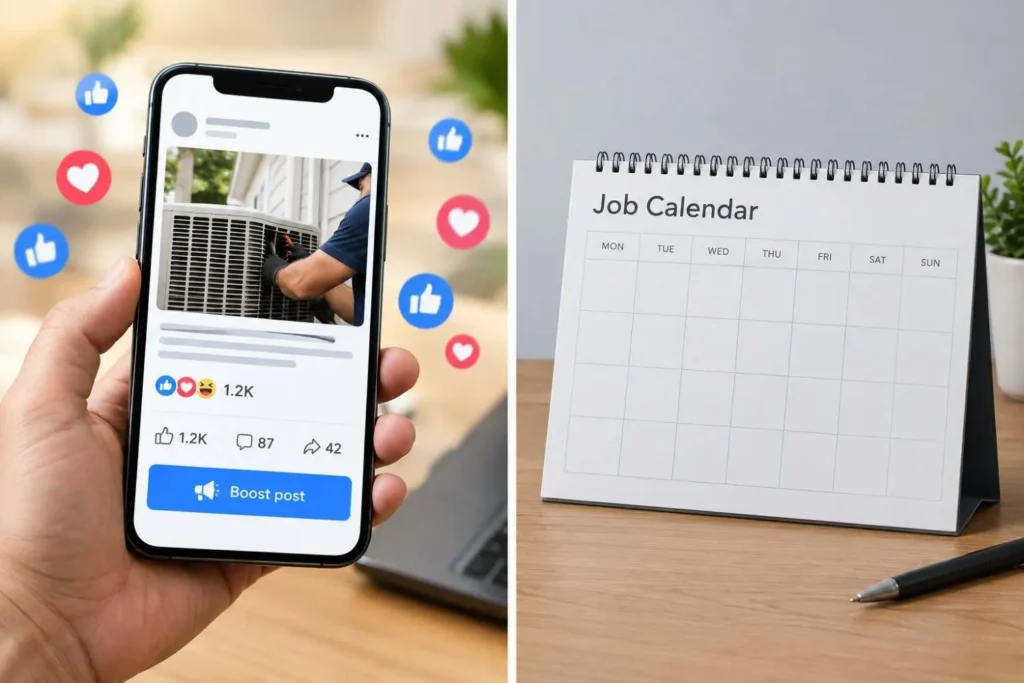
Why Boosted Posts Don’t Book HVAC Jobs
The Boost button pushes a post to more people, and that’s all. Jahid Hussain points out that owners treat it as a lead system when it lacks nearly every part: a conversion goal, a deliberate audience, an offer, a landing experience, and tracking that ties jobs to ads.
If you would rather have specialists run this for you, see our Meta Ads management service.
WordStream’s 2026 Facebook ads benchmarks put the median cost per lead for Home & Home Improvement lead campaigns at $42.95, against $27.39 across all industries. At that price, a vague boost buys reach and teaches you nothing. Well-built HVAC Facebook ads start from the offer and the tracking, not the post.
The mistake Jahid sees in nearly every contractor’s account: the ad gets treated as the strategy. Generic “we fix ACs” creative runs with no split between audiences, offers or landing pages, and the owner blames the photo.
15 HVAC Facebook Ad Examples, Broken Down
The HVAC advertising examples numbered 1 to 12 have been documented in Meta’s public Ad Library. The library hides performance data but shows run time, and contractors rarely keep paying for ads that don’t book work. Ads rotate, so search each advertiser for the current version.
| # | Advertiser | Angle | Hook | Visual or format | Offer |
| 1 | Global International Heating and Cooling | Price anchor | “$59 A/C Tuneup. Keep your A/C running all season long.” | Price-led, Book Now | $59 tune-up (running since 2022) |
| 2 | Lee’s Air, Las Vegas | Undercut | “$39 AC System Tune-Up.” | Price-led | $39 tune-up |
| 3 | Integrity Services | Rebate stack | “$79 Tune-Up Special! Only $29 after $50 TVA rebate.” | Rebate math | Utility rebate on the price |
| 4 | Bonsky Heating | Seasonal regret | “Last summer’s heat wave caught a lot of people off guard.” | Book Now | $69 spring tune-up, 0% financing |
| 5 | Horne Heating | Value stack | “Schedule an A/C tune-up today and receive a FREE plumbing inspection.” | Book Now | Tune-up plus free plumbing check |
| 6 | Rescue One Air | Cause marketing | “$19.95 + 2 cans of food” | Book Now | Furnace and AC tune-up |
| 7 | Ferran Services | Two paths | “Whether you need a tune-up or an estimate for a new system…” | Contact Us | Tune-up or estimate |
| 8 | Baumann & DeGroot | Second opinion | “Are you really getting a fair deal on your AC quote?” | Comparison framing | Free second opinion |
| 9 | HM Tech A/C & Heating | Free estimate | “Get Your Free Estimate” | Video, service list overlay, lead form | Free estimate |
| 10 | Greens Energy Services | Emergency | A direct emergency question | AC units, click-to-call | Urgent repair |
| 11 | Filterbuy (filter brand) | Fear of failure | “Your AC is going to fail this summer” | Reel, technician holding a dirty filter | Preventive service |
| 12 | Shannon’s Heating and Air | Education | “3 Signs Your AC Is About to Fail” | Educational static | Tips first, booking second |
Templates, not live ads. These three sell the plan itself, the gap the documented ads leave.
| # | Template | Hook | Visual | Offer | Audience |
| 13 | Tune-up follow-up | “Your tech checked your system last spring. The plan covers the next two visits.” | Photo of the customer’s unit type | First-year plan, tune-up fee credited | Tune-up bookers, last 90 days |
| 14 | Benefits carousel | “What members get that everyone else waits for” | One card per real plan benefit | Plan sign-up | Page and video engagers |
| 15 | Peak-season line-jump | “In July, members get booked first.” | A full dispatch board | Join before summer | Past customers not on a plan |
Only list benefits your plan actually includes. Promising priority service, then making members wait, gets plans cancelled.
What the Long-Running Ads Have in Common
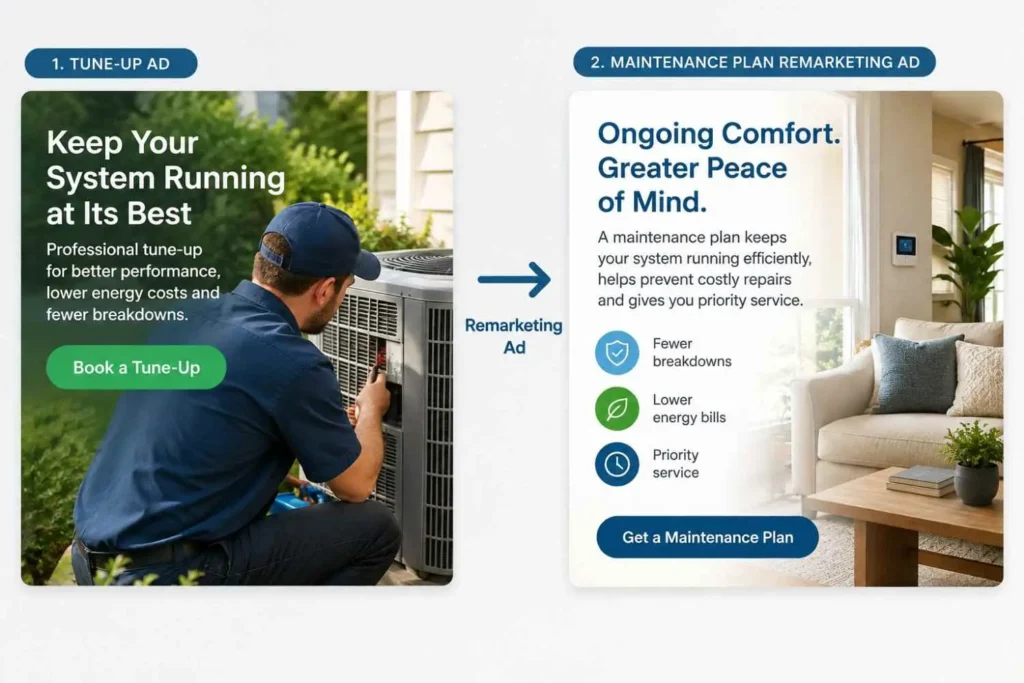
These HVAC advertising examples follow one pattern. A number beats a promise. A season gives a reason to act this week. The next step is one tap: Book Now, a lead form or a call. Notice what’s missing, too. Not one of the 12 documented HVAC Facebook ads asks a cold stranger to buy a yearly plan.
So run plan campaigns in two steps. Tune-up ads (examples 1 to 6) win the first visit from cold homeowners. Plan ads (templates 13 to 15) go only to people who booked or engaged. Skip step two and you get a swipe file full of tune-up HVAC Facebook ad examples and plan numbers that never move. Education ads like example 12 build the warm audience you remarket to.
A Testing Framework for Maintenance-Plan Ads
In PMN’s home-service campaigns, the strongest results have usually come from service-specific offers, local creative, strong proof and simple lead forms. For plan-focused HVAC Facebook ads, test seasonal offers, plan benefits and remarketing to people who already know the brand.
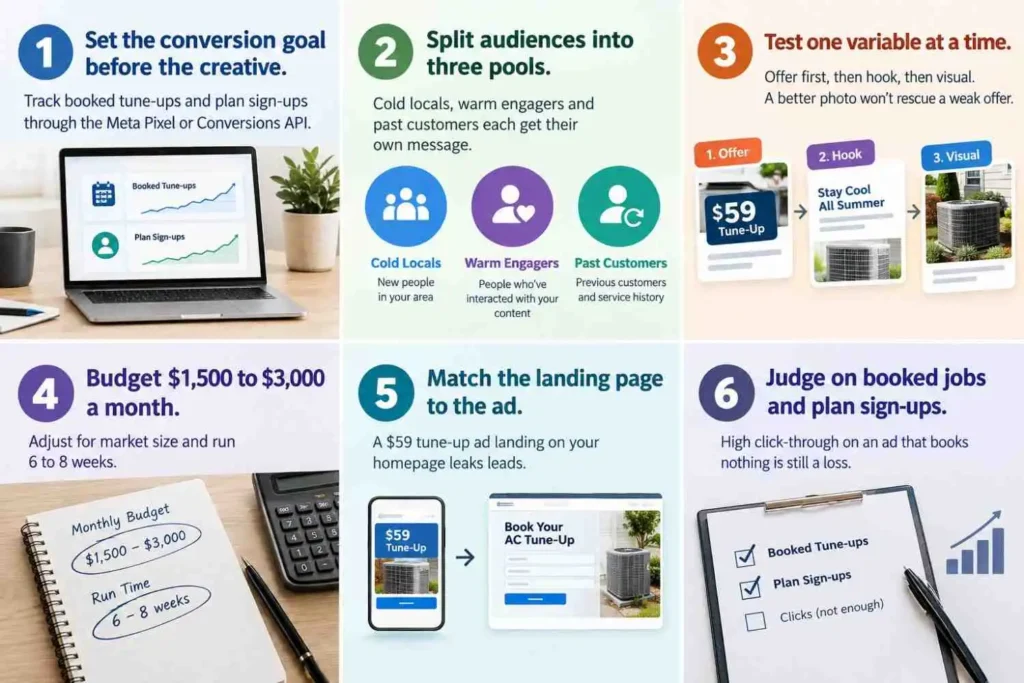
- Set the conversion goal before the creative. Track booked tune-ups and plan sign-ups through the Meta Pixel or Conversions API.
- Split audiences into three pools. Cold locals, warm engagers and past customers each get their own message.
- Test one variable at a time. Offer first, then hook, then visual. A better photo won’t rescue a weak offer.
- Budget $1,500 to $3,000 a month. Adjust for market size and run 6 to 8 weeks.
- Match the landing page to the ad. A $59 tune-up ad landing on your homepage leaks leads.
- Judge on booked jobs and plan sign-ups. High click-through on an ad that books nothing is still a loss.
Most accounts stall at step 3 because nobody owns creative. A creative strategy built around hooks, proof and offers lowers cost per lead over time, because each round shows which angle to scale.
Not sure which of these your account is missing? A free creative audit reviews your hook, offer, CTA and visuals, plus the gaps between ad, landing page and tracking. Request your free creative audit or book a 30-minute call.
HVAC Social Media Marketing: When Paid Beats Organic
Paid wins once you have a clear offer, a working conversion path and fast lead response. Jahid’s view: paid ads amplify whatever bottleneck already exists.
| Your situation | Lean toward | Why |
| Few reviews, thin website | Organic and SEO first | Paid traffic won’t convert |
| Leads wait hours for a callback | Fix response first | Every paid lead goes cold |
| Clear offer, tracking in place | Paid | You can measure cost per booked job |
| Slow shoulder season | Paid | Organic can’t fill it in time |
| Strong reviews, past-customer list | Both | Proof makes remarketing cheaper |
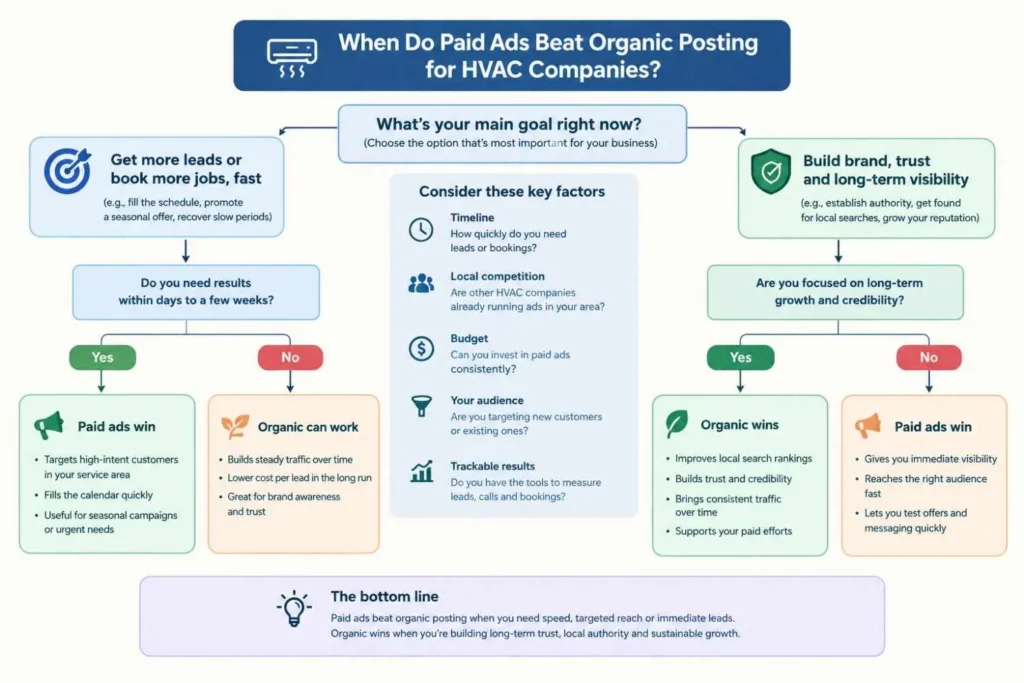
Is Facebook advertising worth it for an HVAC company? Yes, when the offer is specific and leads get a call back within minutes. No, if you hope an ad will fix the business behind it. Most “Facebook doesn’t work” forum threads come from owners boosting posts with no offer or tracking.
How much should you spend? Start at $1,500 to $3,000 a month for 6 to 8 weeks, then scale only ad sets whose cost per booked job your ticket and plan value can carry. Running search too? Read our HVAC Google Ads campaign setup that stops wasted budget.
This is where a full-stack agency and a siloed vendor part ways. A Facebook-only vendor optimises the ad and stops, yet the ad sends people to a website that has to convert. The same offer and reviews should also appear on your Google Business Profile and in search, which ChatGPT and Google AI Overviews draw on when recommending local contractors. Paradigm runs SEO and GEO, performance marketing, web design and creative as one system (SEO, GEO & Ads, Engineered for the AI Era), so an HVAC marketing agency that runs every channel can see where each lead dropped off.
What a Different Industry Taught Us About Creative Testing
Our closest paid-media result comes from outside HVAC. For Pleotropy, a D2C wellness brand in India, structured creative testing and funnel work delivered 4x+ ROAS within 90 days. Spend scaled profitably from ₹2L to ₹12L a month while cost per lead fell 61%. Wellness isn’t HVAC, so don’t expect those numbers, but the method transfers: test offers systematically, separate audiences, and scale only what tracking proves.
Frequently Asked Questions
What is the best social media platform for HVAC companies?
For most residential HVAC businesses, Facebook is the best start: local targeting, lead forms and a homeowning audience. Instagram runs from the same Meta ad account and suits short videos.
What should HVAC companies post on social media organically?
Post job-site photos, quick tips, reviews and technician introductions. Reach is low, so treat these as trust-builders for people who later see your ads. Our 25 HVAC marketing ideas that book jobs has more formats to try.
What type of Facebook ad works best for HVAC?
Across documented HVAC advertising examples, price-specific seasonal tune-up offers with a one-tap booking button run longest. Second-opinion and financing angles suit replacement buyers. Maintenance-plan ads work best shown to people who already booked or engaged.
Is Facebook advertising worth it for HVAC companies?
Yes, when you have a clear offer, conversion tracking and fast lead follow-up. Without those, ads just pay to hit the same problems faster.
How much should an HVAC company spend on Facebook ads?
A practical starting point is $1,500 to $3,000 a month in ad spend, depending on market size and service margins. Run it 6 to 8 weeks, then scale HVAC Facebook ads on cost per booked job, not cost per click.
Conclusion
Boosted posts fail because nothing sits behind them. The HVAC Facebook ads that last are specific: a price, a season, one action. Win the first visit with a tune-up, remarket the plan, and judge every ad on booked jobs. Organic posting still earns its place in HVAC social media marketing as the trust layer. It just won’t fill a July schedule alone. Our HVAC SEO agency service covers the organic side of this.
Get a Free Creative Audit of Your HVAC Ad Account
Clicks without bookings from your HVAC Facebook ads means a gap between ad, page and tracking. PMN’s free creative audit checks your hooks, offers, messaging, CTAs and visual hierarchy, then shows where leads leak out.
About the Author
Jahid Hussain | Founder, Paradigm Media Networks
Jahid Hussain founded Paradigm Media Networks to solve a problem he kept seeing: businesses spending across SEO, ads, and content that never talked to each other. He specialises in local SEO, organic growth systems, and integrated marketing strategies that connect search, paid media, and creative into one lead generation engine. Paradigm has taken clients from zero search visibility to six-figure monthly revenue pipelines, and has been featured in IANS, Eastern Herald, Sangri Times, and Dailyhunt. Jahid operates across the US and UK, and writes from the standpoint of someone who has built and broken growth systems for real businesses, not from a slide deck.
