



On page seo for hvac means optimizing the individual parts of every page on your website, the title tags, headers, service content, internal links, images, so Google actually understands what you do, where you work, and why someone should pick up the phone and call you instead of the next guy on the results page. It isn’t a switch you flip once and forget. It’s page-by-page work, and honestly, nobody really tells new HVAC owners this part: most sites only ever get this treatment on the homepage. Everything else just sits there, quietly ignored, doing nothing.
I’ve opened enough HVAC websites over the years to notice the same pattern show up again and again. Something like 80% of the pages that could actually generate a phone call, service pages, location pages, blog posts, never get touched once the site’s live. Meanwhile the homepage gets fussed over endlessly, tweaked, redesigned, tweaked again. But Google doesn’t rank homepages for “furnace repair in Austin.” It ranks the page built for that exact search. So that’s really the point of this guide, what to fix, page by page, in the order that actually moves the needle for you.
What Are the Key Takeaways From This Guide?
- Your homepage, service pages, location pages, and blog posts each need their own approach, not one blanket fix
- Build one page per core service, not a single combined “Services” page
- Never reuse the same content across location pages with just the city name swapped out
- Page speed under 3 seconds and mobile friendliness are ranking factors, not nice-to-haves
- Reviews and trust content now shape how AI tools recommend HVAC businesses too, not just how Google ranks them
Why Does Page by Page Optimization Beat Site Wide Tweaks?
Most advice you’ll find on on site seo for hvac treats the whole website like one single object. Add keywords. Improve speed. Get reviews. None of that’s wrong exactly, it’s just too broad to actually sit down and do something on a Monday morning. Every page type on an HVAC site has a different job, and that nuance gets lost the moment advice gets generic.
See it in practice: our HVAC SEO case study shows how one single-location contractor went from 10 to 80+ inbound calls a month in four months with no ad spend.
Your homepage introduces the brand. Service pages convert someone who already knows they need “AC installation cost.” Location pages fight for the map pack when someone types “near me” into their phone at 9pm because the AC just died. Blog posts catch people who are still figuring things out, not ready to call yet, just poking around. Each of those needs different keywords, different structure, different calls to action. Treat them all the same and you end up ranking fine for your own business name and pretty much nowhere else, which, if I’m being honest, is the single most common thing I run into when I open a new HVAC site for the first time.
If you want the wider picture of how this connects to local rankings specifically, our local SEO playbook for HVAC contractors goes deeper into that side of things.
What Does Homepage On-Page SEO Actually Require?
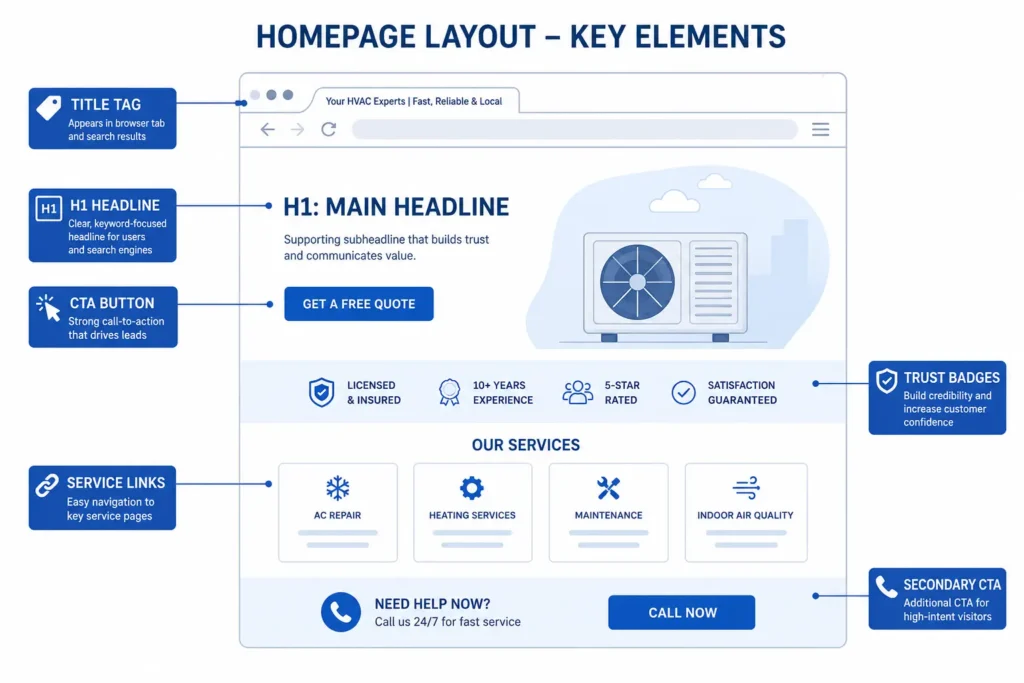
Getting homepage on page seo for hvac right starts with your title tag, before anything else. Your homepage really has one job: answer “does this company do what I need, where I live?” fast enough that the visitor doesn’t just bounce back to Google.
Here’s what usually needs fixing, more often than you’d think:
- A title tag that leads with your primary service and city, kept under 60 characters
- One clear H1 stating your service area and core offering, not a slogan someone liked in a brand meeting three years ago and never revisited
- Your phone number and a booking button visible without scrolling
- Internal links to your top service pages using their actual names, not “click here”
- Certifications and years in business written as real, crawlable text, not stuffed into an image where Google can’t read a word of it
How Do You Optimize HVAC Service Pages?
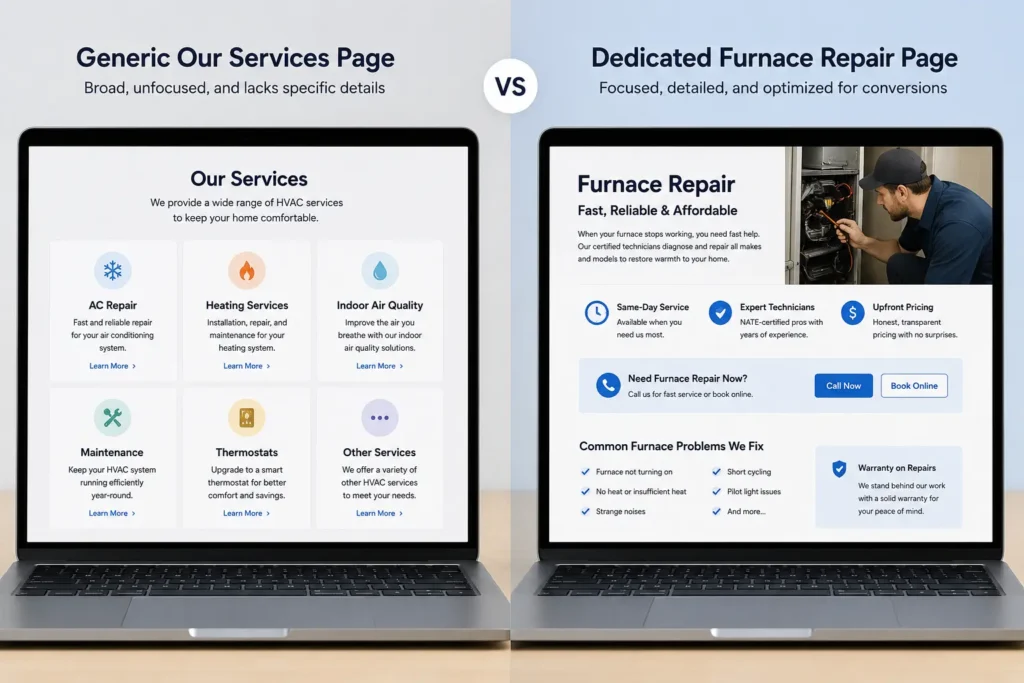
This is the single biggest lever in on page seo for hvac, more than any other page type on the site. HVAC companies that build one generic “Our Services” page instead of a dedicated page per service are usually leaving 60 to 70% of their long-tail traffic sitting on the table, unclaimed, just gone.
Build a separate page for each core service: AC repair, AC installation, furnace repair, heat pump installation, duct cleaning, maintenance plans, whatever applies to your business specifically.
On each one, include a unique title tag, an H1 that matches exactly what someone typed into Google, a pricing range if you’re able to offer one, a few FAQs specific to that service, and a CTA both above the fold and again down at the bottom.
Not sure whether your service pages are already built this way? Our team runs a free on-page review through our SEO service and tells you plainly which pages are underperforming and why, no jargon, no runaround, just what’s actually wrong.
How Do You Optimize HVAC Location Pages?
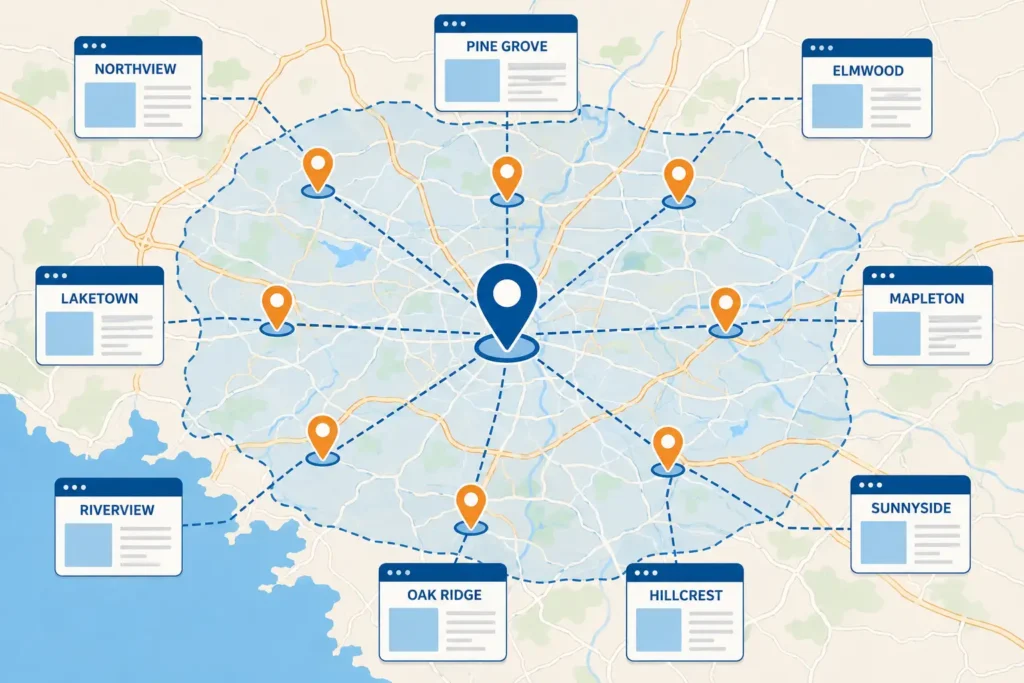
This is one of the most overlooked parts of on site seo for hvac, and it costs multi-location businesses more than they realize. If you serve more than one town, each one deserves its own page. Not a paragraph tucked at the bottom of the homepage between the footer links and the copyright line nobody reads.
A location page that actually works includes the city name in the title tag and the opening paragraph, genuine content about neighborhoods and local climate, LocalBusiness schema, an embedded map, and testimonials from customers in that specific area, if you’ve got any to use.
The mistake I run into constantly, more than I’d like, honestly, is copying the same 400 words across five city pages and just swapping the city name each time. Google reads that as thin, duplicate content, and it drags down every page involved, not just the copies. Write each one fresh, even when it’s tempting to take the shortcut.
How Do You Optimize HVAC Blog Posts?
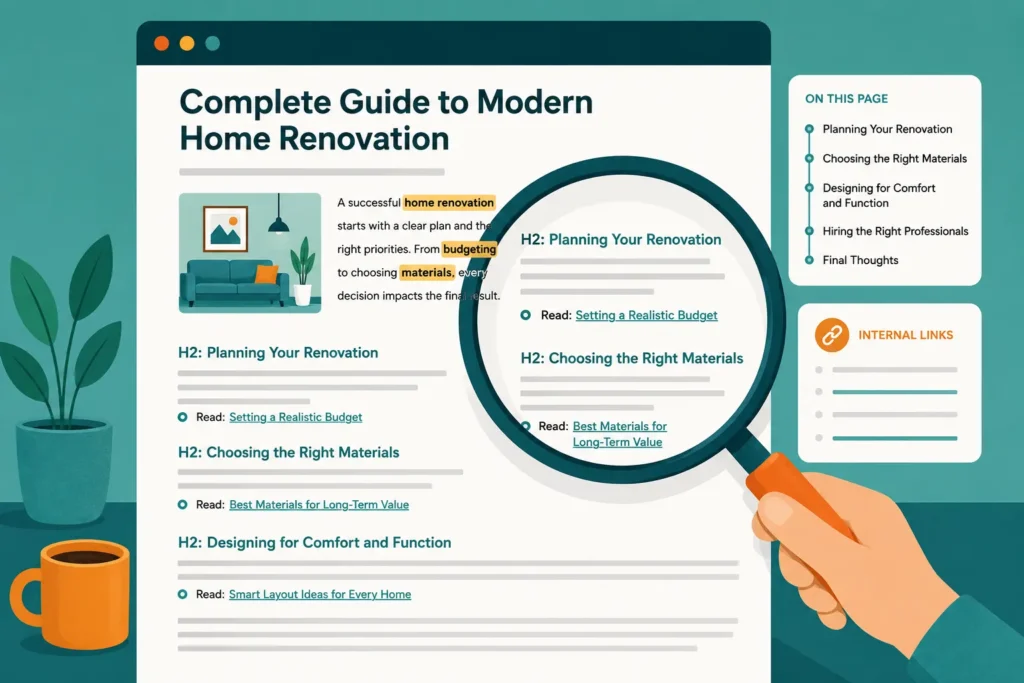
Blog content is how you win the searches people make before they’re ready to pick up the phone, things like “how often should I service my AC.” Each post should target one main keyword, answer the actual question in the first hundred words or so, and link back to the relevant service or location page. That last part matters more than people give it credit for. It’s really the difference between a blog post that just reads nicely and one that actually turns into a booked job somewhere down the line.
For a full page-by-page scoring breakdown of what a properly optimized HVAC site looks like from top to bottom, take a look at our 47-point HVAC SEO audit checklist.
What Technical Elements Does Every Page Need?
These technical basics are what separate real on page seo for hvac work from surface-level tweaks. A handful of things apply across the whole site, and they’re the ones people forget about most, again and again.
| Element | Why It Matters |
| Page speed under 3 seconds | Slow pages lose mobile visitors before your CTA even loads |
| Descriptive image alt text | Helps image search and makes the site accessible |
| Schema per page type | Service schema on service pages, FAQPage schema on FAQ sections |
| Internal linking depth | No page should sit more than 3 clicks from the homepage |
| Mobile responsiveness | Google indexes the mobile version of your site first, always |
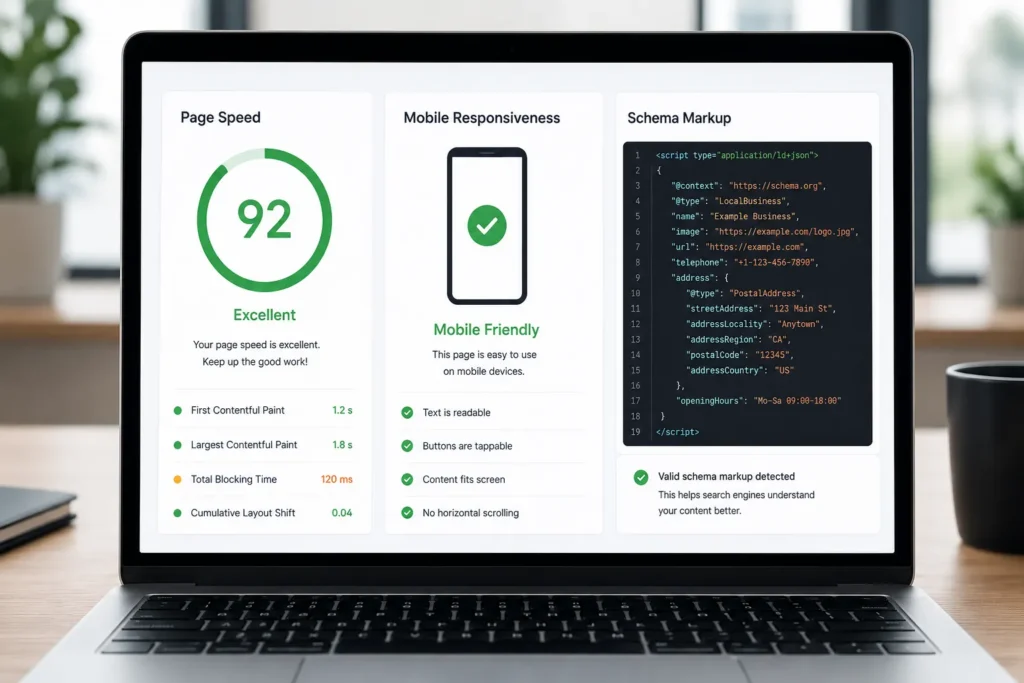
If your site’s speed or mobile layout hasn’t been touched since it launched, fix that before spending more time on content. Our website design and development team can rebuild the foundation first. No amount of keyword work saves a site that takes eight seconds to load, none at all.
Trust signals matter more than most HVAC owners realize, too. According to BrightLocal’s Local Consumer Review Survey, 97% of consumers read reviews before choosing a local business, and 45% now use AI tools like ChatGPT for local recommendations, up from just 6% a year earlier. That’s not a small shift, not even close. It means the review content sitting on your service and location pages isn’t decoration anymore, it’s part of what AI search actually leans on when deciding who to recommend. You can read the full breakdown in BrightLocal’s Local Consumer Review Survey.
What Does a Real HVAC Case Study Look Like?
A regional HVAC client came to us ranking on page one for exactly one thing, their own brand name. Their site had over 40 pages, but 30 of them were thin location pages with nearly identical content, and every service they offered was squeezed onto one long, cluttered page nobody wanted to scroll through, let alone read.
We split that page into six dedicated service pages, rewrote all twelve location pages with genuinely distinct local content, added Service and LocalBusiness schema across the site, and got mobile load time down from 6.2 seconds to 2.4 seconds.
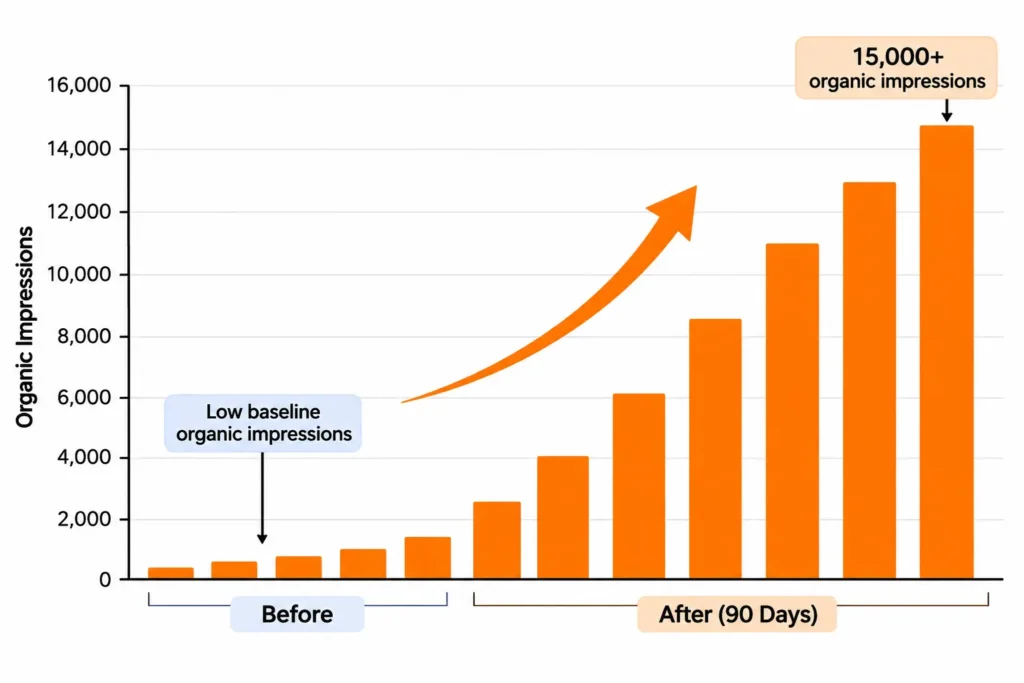
Ninety days later, organic impressions for non-branded HVAC keywords were up 218%, and booked calls attributed to organic traffic had more than doubled. None of that came from writing more content, worth saying twice. It came from restructuring what was already there, page by page, nothing fancier than that.
Expert tip: before you write a single new blog post, audit your title tags in bulk using the Pages report inside Google Search Console. Duplicate or missing titles usually cost you more visibility than thin content ever does.
What Is the Page by Page Checklist?
Run through this before calling your on page seo for hvac work done for the quarter.
- Unique title tag and meta description on every page
- One clear H1 per page matching search intent
- Separate page for each core service
- Separate, non-duplicated page for each location
- Schema markup matched to page type
- Page speed under 3 seconds on mobile
- Descriptive alt text on every image
- Internal links connecting blog content to service and location pages
FAQs
Do I need to redo my entire website to fix on page SEO, or can I do it in stages?
You can absolutely do it in stages. Start with your highest-traffic service pages, then move to location pages, then blog content. A full redesign isn’t required for most of these fixes.
What’s the biggest on page SEO mistake HVAC companies make?
Combining all their services into a single page instead of building one page per service. It’s the single change that tends to unlock the most new traffic, more than anything else on this list.
Does adding more blog posts help my HVAC site rank faster than fixing existing pages?
Not usually. Fixing structural issues on your service and location pages tends to move rankings faster than adding new blog content on top of a weak foundation.
How often should I revisit my HVAC website’s on page SEO once it’s fixed?
Review it every 6 months, or whenever you add a new service or expand into a new city. Search behavior and competition both shift over time, even when you’re not paying attention.
Can on page SEO alone get my HVAC business into the map pack?
Not on its own. On page SEO supports local rankings, but the map pack also depends on your Google Business Profile, reviews, and citations working together with your website.
Stop Guessing. Start Ranking. Get Your Free On-Page SEO Review Today.
Right now, somewhere in your city, a homeowner is typing “AC repair near me” into Google, and your competitor’s page is the one showing up, not yours. That isn’t bad luck. It’s a fixable, page-by-page problem, and every day it stays unfixed is another booked job that goes to someone else.
You’ve read the whole playbook. You know what a properly optimized homepage looks like, what separates a real service page from a generic one, why your location pages might be quietly hurting you, and why page speed alone can make or break a ranking. The question now isn’t whether this works. It’s whether your site is actually built this way today.
Here’s the honest part: most HVAC owners don’t have the time to audit forty-plus pages themselves, and they shouldn’t have to. That’s exactly why we offer this for free.
Get Your Free On-Page SEO Review Now
No sales pitch. No 90-slide deck. Just a straight, page-by-page breakdown of what’s costing you rankings and calls, and exactly what to fix first. Fill out the form, tell us your website, and we’ll show you precisely where the money is being left on the table, before your competitor finds it first.
About the Author
Jahid, Founder of Paradigm Media Networks, has spent years building and auditing on-page SEO systems for HVAC and home service businesses across the US and UK. His approach combines technical SEO, content strategy, and conversion design into one connected system rather than isolated fixes.
