


Local SEO for HVAC contractors determines which businesses Google shows in the Map Pack when a homeowner searches for help right now. Three factors decide who ranks: relevance (does your profile match the search), proximity (how close you are), and prominence (how established and trusted Google believes you are). This playbook covers all three, in the order that moves the needle fastest.
Quick Wins This Week: 17 Local SEO Tips Ranked by Impact
The steps above are the strategic foundation. These 17 tips are what you action this week while the longer work compounds. They are ranked by how much each one moves call volume, not just rankings.
1. Treat Your GBP Like a Marketing Channel, Not a Directory Listing
Most contractors fill it out once and walk away. Post updates twice a month. Upload real job photos every week. Respond to every message within the hour. Businesses with fully optimized profiles are 2.7x more likely to be seen as reputable.
2. Build Service Area Pages Only Where You Have Real Demand
“AC Repair in Plano TX” can rank where “Services, Dallas” does not, but that is not a reason to build a page for every town on your list. Build a service area page only for towns with real search demand and real jobs, reviews or crews, and give each one something specific: local housing stock, response times and jobs completed there, plus testimonials from that area. Pages that only swap the city name risk being treated as doorway pages under Google’s spam policies. Our HVAC service area page template shows what each page needs. See the full internal link structure in our HVAC SEO complete guide.
3. Put a Review System in Place, Not a Hope
According to BrightLocal’s 2026 Local Consumer Review Survey, 97% of consumers read reviews before choosing a local business. Text the customer within 30 minutes of finishing the job. One message. One direct link. No follow-up needed. Four or more new reviews per month is realistic with this alone. For word-for-word scripts, see our HVAC review generation scripts.
4. Fix Every Inconsistent Business Listing
Your Name, Address, and Phone Number must be identical everywhere — not similar, identical. Check Yelp, Angi, HomeAdvisor, BBB, Facebook, Nextdoor, Apple Maps, and Bing Places. Fix every mismatch. Do this audit every quarter. Our 40 HVAC local citations and directories list tells you exactly where to look.
5. Publish Seasonal Content Before the Season
AC repair content needs to be live by late February to rank by April. Furnace content needs to be live by August to rank by October. Publish 6–8 weeks before the demand peak. If you publish in June for summer, you missed it. The contractors winning peak season started months earlier.
6. Add Schema Markup to Every Service Page
Most HVAC sites have zero schema. That means Google AI Overviews and ChatGPT have no structured way to understand your business. Add LocalBusiness, FAQPage, and AggregateRating schema. This is how your business gets cited when someone asks an AI tool for the best HVAC contractor near them.
7. Get Local Backlinks, Not Just Directory Listings
Sponsor a local youth sports team. Write something useful for a local home improvement publication. Claim your slot on your HVAC supplier’s dealer page (Carrier, Trane, Lennox, and Rheem all have these). One link from a trusted local source outperforms 50 directory submissions.
8. Fix Your Mobile Page Speed Today
Run Google PageSpeed Insights right now. Aim for 85 or above on mobile. Compress your images — most HVAC sites fail because technicians upload photos straight from their phones. Convert everything to WebP. A site that takes more than four seconds to load on mobile loses a meaningful share of callers before they read a word.
9. Build Location Pages That Establish Physical Presence
Location pages are different from service area pages. They include your address, an embedded Google Map, a local phone number, and content that references actual neighborhoods. Google uses these to confirm your business operates in or near a specific area. Our local SEO services pair these with technical on-page work for full effect.
10. Write Content the Way Homeowners Actually Ask Questions
“Who fixes AC near me” is a voice search. “Best HVAC contractor in [city]” is an AI search. Neither sounds like a typed keyword. Use question-based H2s and H3s on your service pages. Answer each question directly in the paragraph beneath it. Add FAQ schema. This is the exact format AI tools pull from when they build answers. See our full 150+ HVAC SEO keywords sorted by intent for the search terms that matter most.
11. Turn Your Blog Into a Lead Door
Every question a homeowner asks you on the phone is a keyword they are searching on Google. “Why is my AC running but not cooling?” “How often does my HVAC need servicing?” “What size unit do I need for a 2,000 square foot home?” Each post is one more indexed page pulling in someone who has never heard of you.
12. Find Your Competitors’ Weak Spots and Target Them
Pull up Semrush, Ahrefs, or free Ubersuggest. Look at the top three contractors in your market. Find every keyword they rank for between positions 4 and 20. Those are pages they started but did not finish. Write more specific, more useful content around those exact searches.
13. Link Your Pages to Each Other on Purpose
Your homepage should link to your service pages. Your service pages should link to your city pages. Your blog posts should link to the service pages they relate to. Authority flows through internal links. Pages that are not connected to anything do not benefit from the authority the rest of your site is building.
14. Use Free Data to Stop Guessing
Google Search Console shows you exactly what searches bring people to your site. Google Analytics 4 shows what they do when they arrive. GBP Insights shows how many calls and direction requests your profile generates each month. Look at these monthly. Our 47-point HVAC SEO audit checklist shows you what to track and why.
15. Respond to Every Review, Including the Bad Ones
Responding to reviews is a confirmed local ranking signal. A calm, professional reply to a one-star review also matters to the next homeowner reading your profile. Keep it short, offer to resolve it offline, never argue in public.
16. Claim and Maintain Your HVAC Directory Listings
Get listed on Angi, HomeAdvisor, Houzz, and ACCA member directories. Google uses these as local prominence signals. Every listing must match your GBP exactly. Old phone numbers and wrong addresses on these platforms quietly undermine every other piece of local SEO work you do.
17. Optimize for AI Search Now, While the Window Is Open
Google AI Overviews, ChatGPT, and Perplexity are already naming specific HVAC contractors in their answers. To get cited, write content that answers one specific question per page. Put the answer in the first two sentences. Include your business name, city, and core services in your schema and in the opening paragraph of every page. Our guide on how HVAC companies get cited by AI search covers the full mechanics.
What the Top-Ranking Guides Miss Completely
After analyzing the top five currently ranking articles for local SEO for HVAC, a pattern appears. They all cover Google Business Profile, reviews, and local citations. All solid advice. Here is what almost none of them address.
See it in practice: our HVAC SEO case study shows how one single-location contractor went from 10 to 80+ inbound calls a month in four months with no ad spend.
Multi-location HVAC SEO strategy. Most guides are written for a single-location contractor. The page architecture, keyword targeting, and internal linking for a company serving 12 cities is fundamentally different. No guide covers this at a practical level.
Speed-to-response as a ranking signal. According to Lead Connect research cited by PipelineOn, 78% of customers hire the HVAC company that responds first. Response time affects your GBP response rate signals, which influence local pack rankings. Nobody connects these two facts.
Review content coaching as keyword injection. Most guides say get more reviews. Nobody explains that the specific words your customers write in reviews act as keyword signals that expand your GBP’s relevance for those exact terms.
Seasonal content timing. Every guide says publish seasonal content. None give you the specific timing windows that actually drive peak-season traffic before demand spikes arrive.
These are the gaps this guide fills.
Why Local SEO for HVAC Companies Is Non-Negotiable in 2026
The importance of local SEO for HVAC companies is backed by numbers that should frustrate any contractor still sitting on the fence.
According to the 2025 American Home Comfort Study, a survey of 2,501 homeowners, contractor reputation now tops the list of reasons homeowners choose an HVAC company. That reputation is researched online. And that online reputation is built through local SEO.
The data is direct:
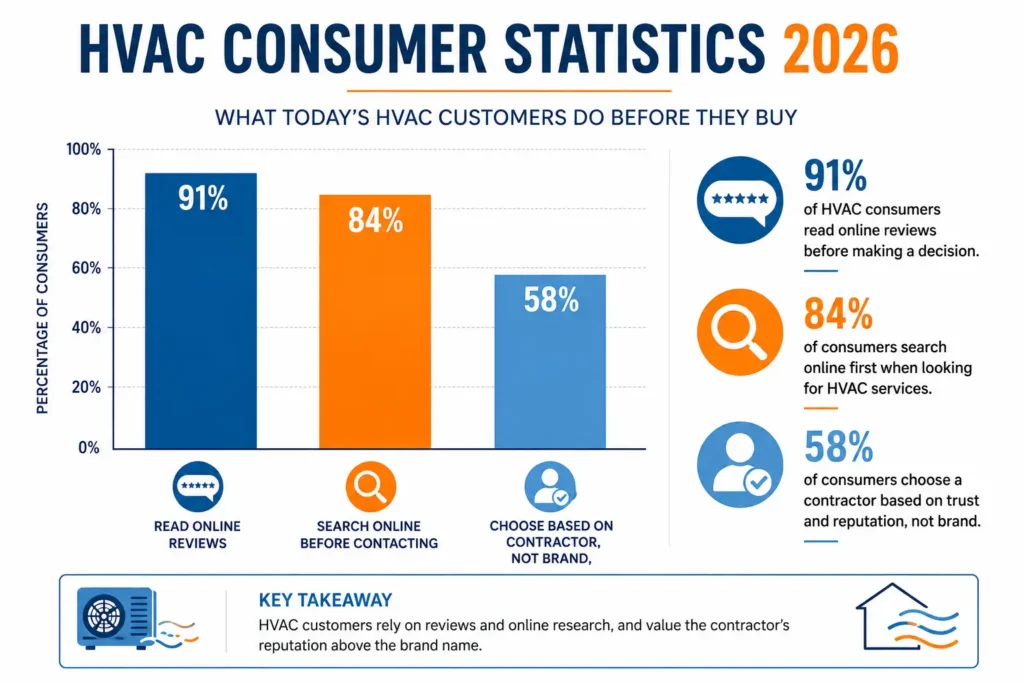
- 91% of HVAC consumers read online reviews before booking
- 84% of consumers contact an HVAC company after first searching online
- 58% of homeowners chose a contractor before even choosing a brand
- Companies maintaining 5 to 12 new reviews per month with ratings above 4.5 stars experience 12 to 25% higher close rates
- Service agreements obtained with new equipment jumped from 56% in 2022 to 61% in 2025, meaning homeowners are actively looking for ongoing maintenance relationships with contractors they find and trust online
Every month you are not ranking, a competitor is collecting reviews and widening the gap. The contractors who will dominate their markets in 2027 are building local authority right now.
Step 1: Build a Google Business Profile That Actually Ranks
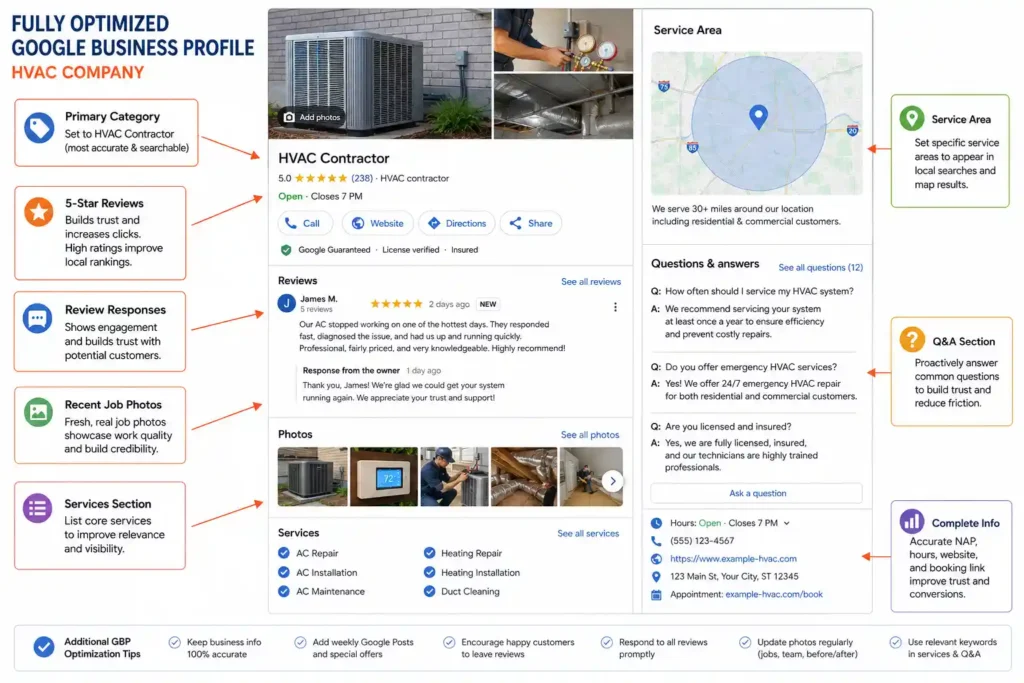
Your Google Business Profile is the single most powerful lever in local SEO for HVAC contractors. GBP signals drive approximately 32% of all local ranking decisions.
Most HVAC contractors set theirs up once and never touch it again. The contractors dominating your local Map Pack right now are managing their GBP actively every week. Here is what that actually looks like, whether you run it in-house or hand it to our HVAC GBP management team.
Set the primary category to HVAC Contractor. Not “Air Conditioning Repair Service.” Then add secondary categories for every service you provide: Heating Contractor, Furnace Repair Service, Air Conditioning Repair Service, Heat Pump Supplier. These secondary categories factor directly into rankings for those specific service searches.
Define your service area, not just a pin. If you operate in eight cities but only have your office address pinned, Google is only confident showing you to searchers near that pin. Define every city you actually serve in the service area settings.
Upload photos on a schedule. HVAC businesses with fresh photo activity consistently outperform those with static libraries. Upload completed job photos weekly. Doing all of this by hand works for one location. Once posts, photos and replies start slipping, a tool can take over the routine parts. See our comparison of the best tools to optimize Google Business Profile for HVAC for what’s worth paying for and what Google already does for free. Freshness signals matter to Google’s local algorithm.
Pre-populate the Q&A section. Left unmanaged, random visitors can add their own answers to your GBP questions, sometimes wrong ones. Get there first with questions your homeowners actually ask.
Review velocity beats total review count. The business with 80 reviews earned steadily over six months will usually outrank one with 200 reviews collected in a six-week push two years ago. Our complete HVAC SEO guide covers the mechanics of review velocity in detail.
Expert Tip from Paradigm Media Networks: The contractors who finally crack the Map Pack are treating their GBP the same way they would treat a social media account. Active, visual, and responsive. The ones who set it up and walk away are turning off a ranking signal every month they ignore it. To see where the profile ranks across your whole service area, not just from your office, track your Map Pack position with a grid scan.
Your Google Business Profile Is Losing You Jobs Right Now
An incomplete or inactive GBP is one of the most common reasons HVAC contractors stay invisible on Google Maps. Find out exactly what yours is missing before your competitor does.
Get Your Free Local Visibility Scan
Step 2: Create a Location-First Website Architecture
This is where most HVAC company websites fall apart completely and where the biggest opportunity sits.
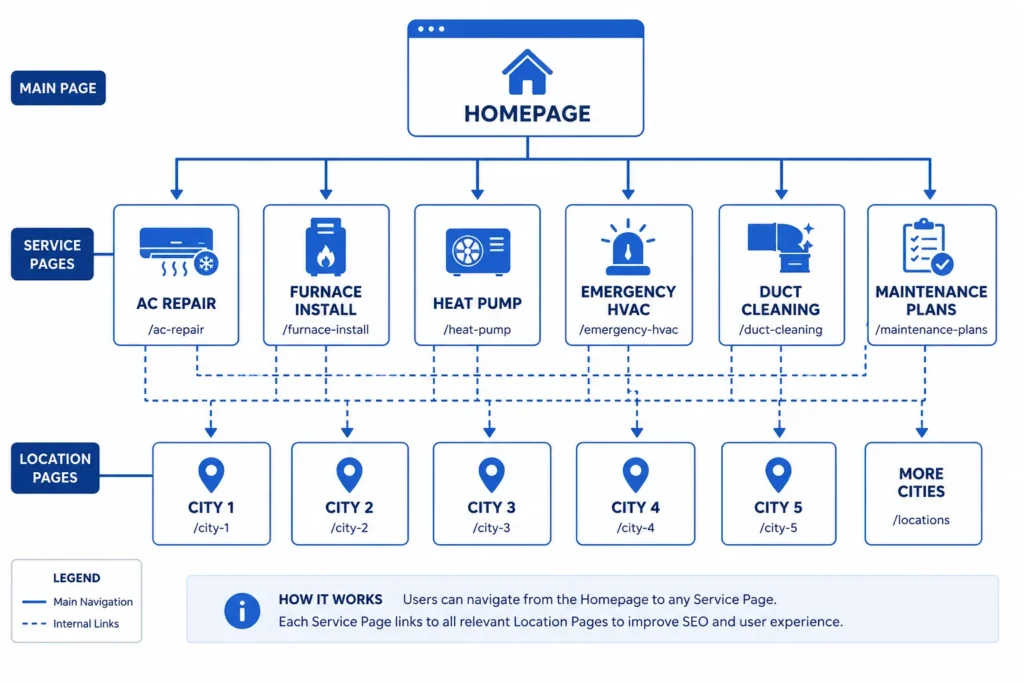
The typical HVAC website has a homepage, an About page, a Services page listing everything, and a Contact page. That single Services page tries to rank for AC repair, furnace installation, heat pump service, duct cleaning, and emergency HVAC all at once. Google cannot rank that page for anything specific.
The right structure is one dedicated page for every service you offer, one dedicated location page for each city where you have real jobs and search demand, and internal links connecting service pages to the relevant location pages.
Service page essentials:
- An H1 matching the exact search query such as “AC Repair in Austin”
- A description that answers the homeowner’s real question, not just describes your company
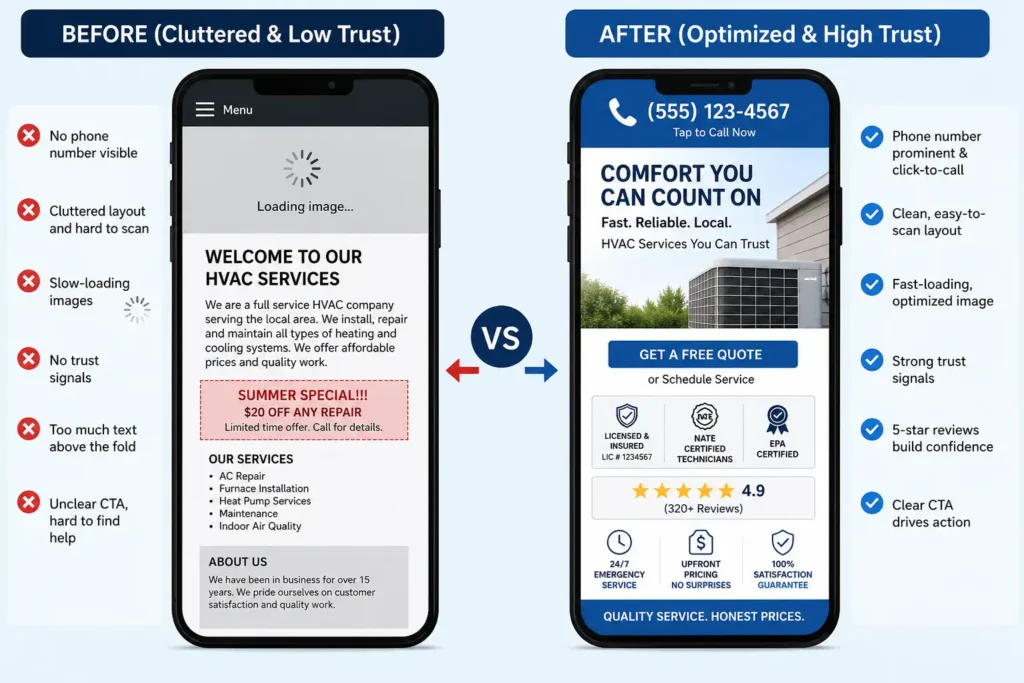
- License numbers and certifications visible above the fold
- A photo from an actual local job, not stock photography
- Phone number visible without scrolling on mobile
- An FAQ section with five to eight questions written exactly as homeowners type them
Location page rules for multi-city operators: Every city page needs genuinely local content. Reference the local climate, specific neighborhoods, common issues in older housing stock in that area. Google’s algorithm is highly effective at identifying templates where only the city name changes. Those pages do not rank.
Step 3: Target the Right Local Keywords at the Right Time
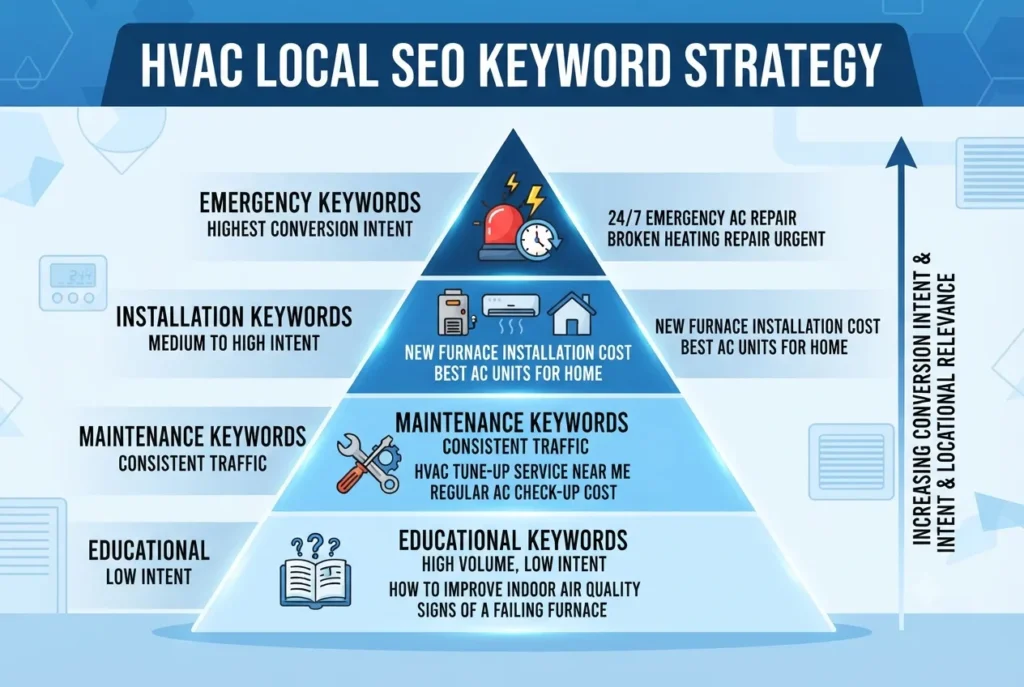
Not all keywords convert equally. “HVAC tips” gets traffic. “Emergency furnace repair near me” gets booked jobs.
| Keyword Tier | Examples | Priority |
| Emergency and Urgent | “AC not cooling city”, “furnace stopped working city” | Always first |
| Installation and Replacement | “AC installation city”, “HVAC replacement cost city” | Year-round service pages |
| Maintenance and Agreements | “HVAC maintenance plan city”, “annual furnace tune-up near me” | Off-peak focus |
| Educational and Seasonal | “when to replace AC unit”, “why is my heat pump making noise” | Blog and shoulder-season content |
The most overlooked category is maintenance agreements. Every HVAC owner knows a signed maintenance contract is the most predictable revenue in the business. Yet almost no HVAC website has a page targeting “HVAC maintenance plan near me.” That gap is sitting open in most markets right now.
For AI search engines like ChatGPT and Google AI Mode, structure your content around question-based keywords. These engines pull answers from content that directly addresses how homeowners phrase questions conversationally: “how much does furnace replacement cost in Ohio,” “is it worth repairing a 15-year-old AC unit.” Pages that answer these directly with the answer near the top are the ones that get cited. Our HVAC SEO services team builds keyword maps like this for every HVAC client market before writing a single page.
Step 4: Seasonal SEO, The Strategy Almost Nobody Executes Right
HVAC demand is among the most seasonal of any home services trade. The search volume for “AC repair near me” can multiply several times during a heat wave. Furnace searches spike sharply on the first cold night of fall. The contractors that dominate those peaks started ranking for those keywords weeks before the weather changed.
The timing framework:
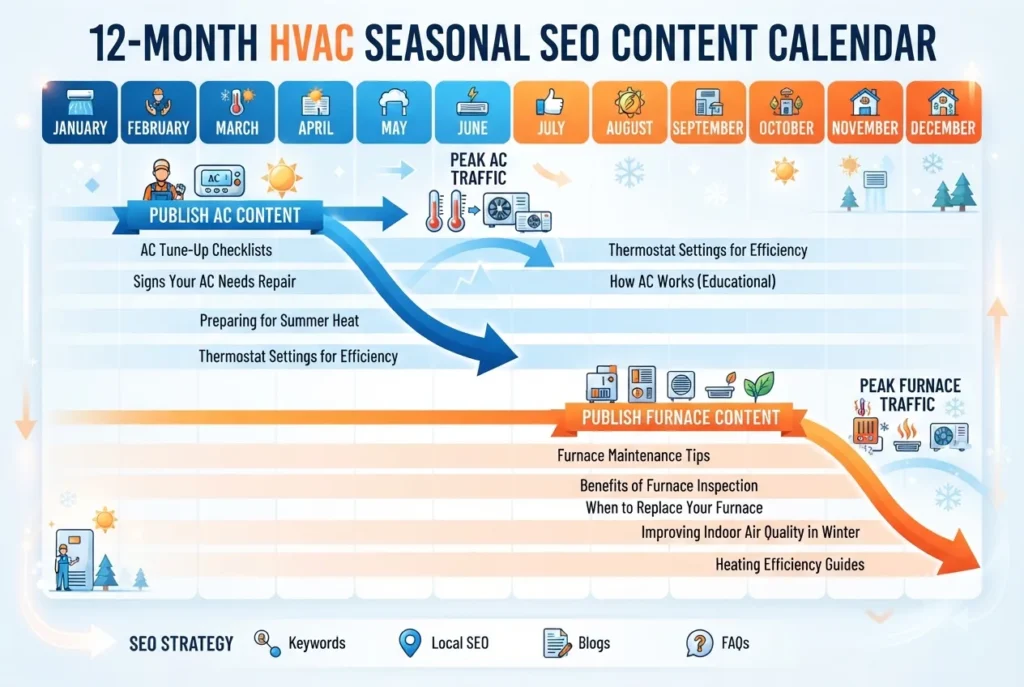
- AC and cooling content: Publish in late February or early March, target ranking by April
- Furnace and heating content: Publish in August or early September, rank by mid-October
- Emergency pages: Live permanently and optimized year-round
Most HVAC companies publish their “prepare your AC for summer” post in June. By then the peak is already past. The contractors making seasonal SEO work are 10 to 12 weeks ahead of the weather curve, every single season.
How to do this on a tight budget: Start with your top two seasonal service pages, build them properly, and focus your review acquisition during your busiest months. One genuinely strong seasonal page will outperform twelve thin ones every time.
Step 5: Build Local Authority Through Citations and Real Backlinks
Local citations are consistent listings of your business name, address, and phone number across the web. The specifics matter more than most guides admit.
“Main Street” and “Main St.” look the same to a human but can create two different entities in Google’s local knowledge graph. Audit every directory listing and standardize your NAP to an exact format, then never deviate from it.
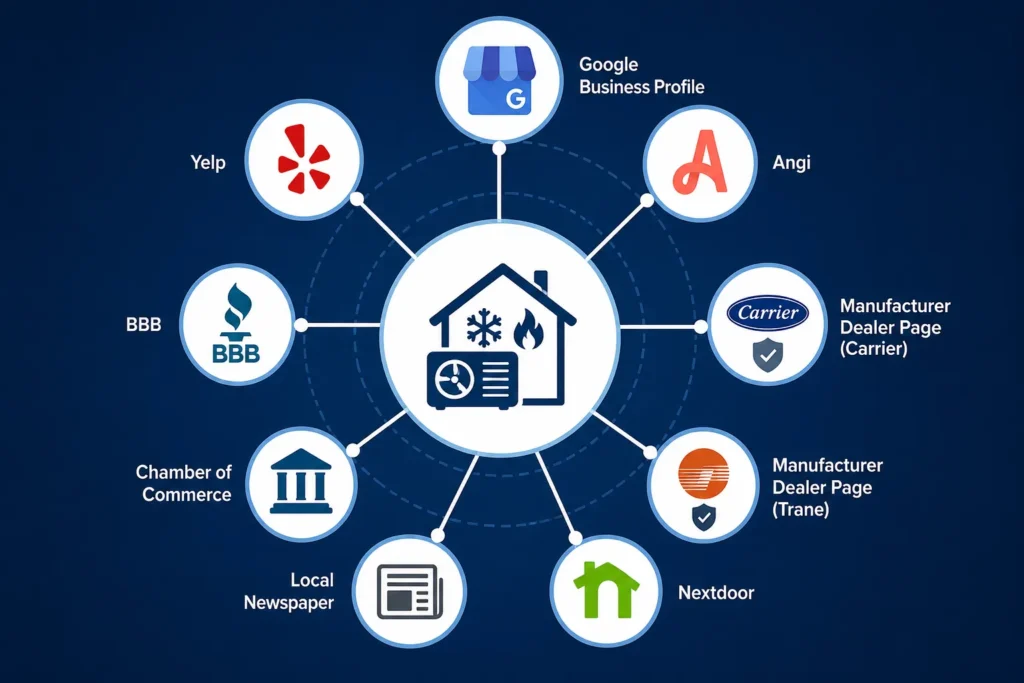
The HVAC-specific citations that matter most:
Google Business Profile, Yelp, Angi, HomeAdvisor, Better Business Bureau, Houzz, Nextdoor Business, your local Chamber of Commerce, ACCA chapter directories, and manufacturer dealer locator pages. Carrier, Trane, Lennox, and Rheem all maintain dealer directories with high domain authority and strong relevance. Most HVAC contractors have never claimed these listings.
For real backlinks beyond citations: sponsoring a local youth sports team with your name and link on their website is one of the most reliable local backlink strategies for service businesses. Community newspapers and local home improvement publications are worth pitching seasonal content to.
If you want a structured audit of your off-page authority gaps, our 47-point SEO audit for HVAC contractors covers backlink toxicity checks, citation gaps, and competitor link gap analysis in detail.
Step 6: Turn Reviews Into a Ranking Engine
Here is the insight almost no local SEO for HVAC guide gives you: the specific words your customers write in their Google reviews function as keyword signals that directly expand your GBP’s relevance for searches containing those words.
When a customer writes “called them for emergency furnace repair at 10pm and they arrived within an hour,” those words “emergency furnace repair” strengthen your GBP’s relevance for that exact search. Most guides say get more reviews. That is incomplete. The specificity of what is written matters too.
The practical system:
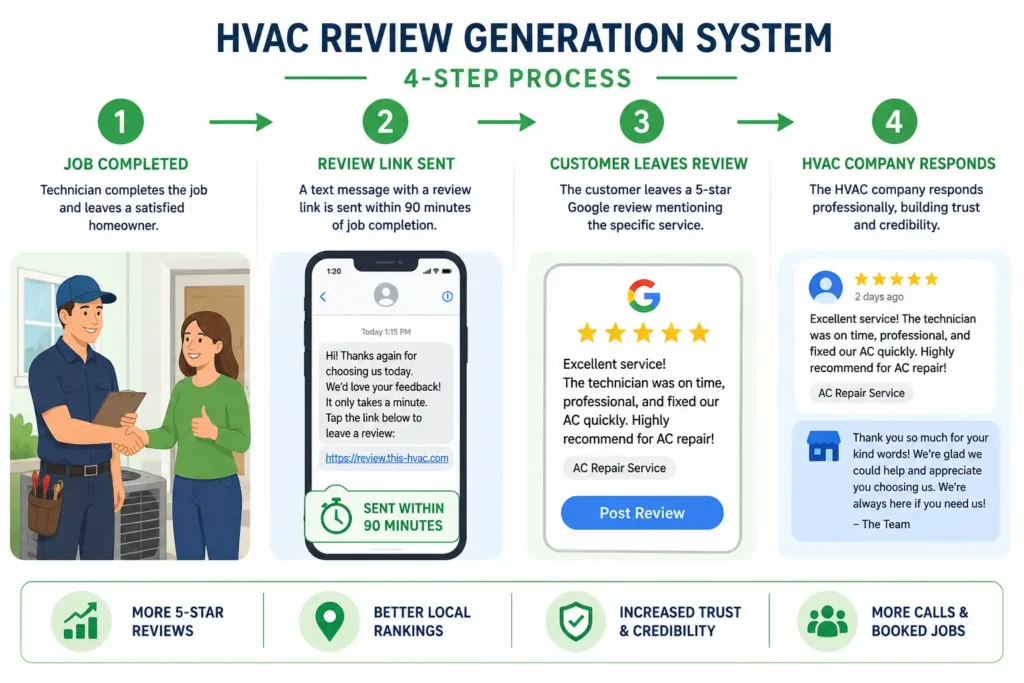
- Send a text message to every completed job within 90 minutes. Text links get opened, email links get ignored. Include your direct Google review link.
- Train your technicians to mention the specific service conversationally: “If you’re happy with the furnace repair today, a quick Google review mentioning what we did really helps us out.”
- Add a QR code to every invoice that links directly to your review page.
- Respond to every review within 24 hours. Google tracks response rate and recency as local ranking signals.
The Jobber 2026 Home Service Trends Report found that customers choose HVAC providers based on quality (65%), price (56%), and reviews (49%). Reviews are the third-most important factor in contractor selection, and it is the only one you can actively compound through a system.
Not Sure Which of These Steps Is Costing You the Most Jobs?
We scan your HVAC business across Google, Maps, and local search and tell you exactly where visibility is leaking and what to fix first. It takes 48 hours. It costs nothing.
Claim Your Free Local Visibility Scan
Step 7: Optimize for Conversion, Not Just Traffic
Rankings without bookings are just expensive visibility. The gap between ranking and converting is where most HVAC websites quietly lose money every month.
Phone number above the fold on mobile, always. More than 65% of HVAC searches happen on phones. If a homeowner whose AC stopped working on a Saturday afternoon has to scroll to find your number, you have already lost a meaningful percentage of them.
Page speed is a conversion factor, not just a ranking factor. A site that takes four or more seconds to load on mobile loses users before they read a word. Most HVAC sites fail this because of uncompressed installation photos uploaded straight from a technician’s phone. Convert all images to WebP before upload.
Answer the price question directly. “How much does HVAC repair cost?” is one of the most-searched related queries in this space. HVAC companies that address pricing transparently with ranges consistently see higher contact rates because they have removed the biggest source of pre-call anxiety.
Schema markup on every service page is how Google’s AI Overview and tools like ChatGPT pull structured answers about your business. LocalBusiness schema, FAQPage schema, and Service schema together are what put you in AI-generated contractor recommendations. Our local SEO services guide covers the technical implementation in detail.
Real Case Study: A Single-Location HVAC Contractor Goes From 10 to 80+ Calls a Month
A single-location HVAC contractor in the US, anonymised at their request, lived on referrals and was getting 10 to 12 inbound calls a month. Within four months of focused local SEO, inbound calls were consistently above 80 a month, Google Business Profile views were up 320%, and every lead was organic with $0 ad spend. The figures come from the engagement’s call tracking and Google Business Profile insights.
- Google Business Profile rebuilt and worked every week, not set up once and left
- A peak-season page set for emergency AC repair and installation searches
- An off-season page set for maintenance plans and heating inspections
- Each page set published ahead of its season, plus steady review velocity, which moved the profile into the Map Pack
The shift was not magic. It was fixing the same structural problems that cost most HVAC companies their local visibility in the first place. Read the full HVAC case study.
FAQ
How long does local SEO take to work for HVAC contractors?
Most HVAC contractors see meaningful local pack movement within 60 to 90 days when GBP optimization and review velocity are prioritized first. Organic website rankings for competitive service keywords typically require 4 to 6 months. In competitive metros like Phoenix, Dallas, or Atlanta, allow 9 to 12 months for dominant positioning. Anyone promising guaranteed rankings in 30 days is not being honest with you.
What is the most important local SEO factor for HVAC companies?
In 2026, your Google Business Profile is the single highest-impact lever for Map Pack visibility. GBP signals account for approximately 32% of local ranking decisions. Proximity is largely fixed. Relevance and prominence through reviews, citations, and content are where the real work pays off.
Should I build separate pages for each city I serve?
Yes, but only if you can write genuinely unique, locally relevant content for each one. A template with only the city name changed is a duplicate content problem, not a local page. Start with your top three to five service cities and build quality pages before expanding.
Stop Watching Your Competitors Take Calls That Should Be Yours
See Exactly Where Your HVAC Business Stands in Local Search
Every day your HVAC company is not in the top three on Google Maps, a competitor is taking calls that belong to you. Some of those are emergency jobs that would have paid immediately. Some are maintenance contracts that would have renewed every year. All of them are revenue that went somewhere else.
We run a free local visibility scan for HVAC contractors that shows you exactly where your business appears in search, which ranking signals you are missing, and what your three highest-impact fixes are. This is a real analysis built around your specific market and your specific competitors, not a generic checklist generated in ten seconds.
No sales pitch. No long-form proposal. Just a clear picture of what is holding your rankings back and what to fix first so your phones start ringing from organic search.
Get Your Free Local Visibility Scan Today
Conclusion
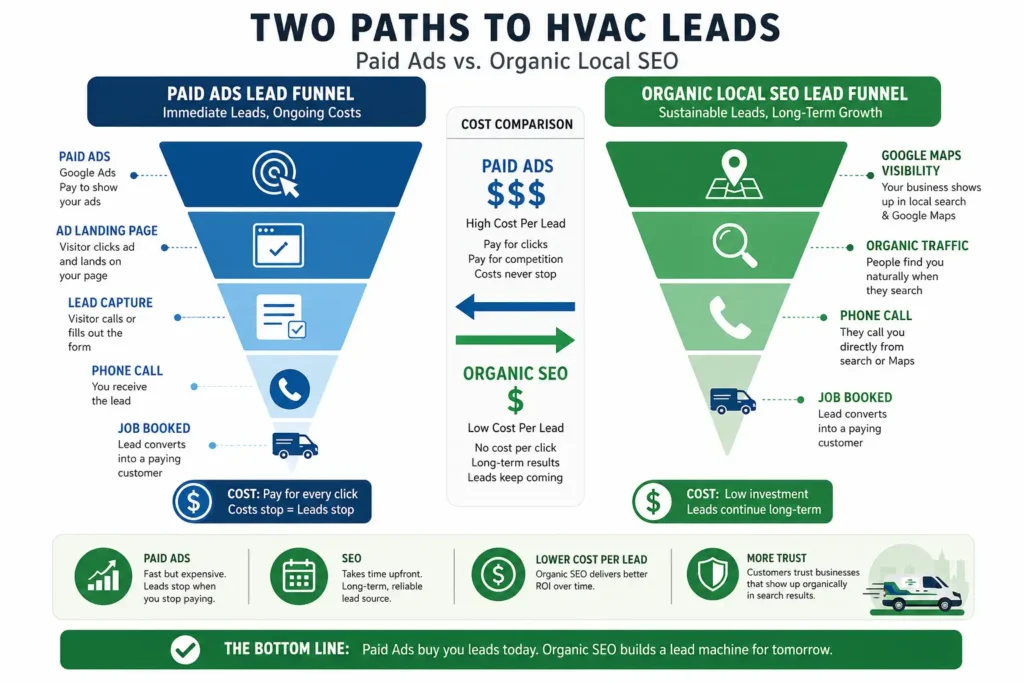
Local SEO for HVAC contractors is a compounding system. The operators treating it that way are the ones whose phones keep ringing without paying $45 per lead for every call. The playbook is seven interconnected steps: a Google Business Profile actively managed rather than set up and forgotten; a website where every service and every city has its own dedicated page; keywords chosen by conversion intent; seasonal content published ahead of demand peaks; citations built with NAP precision; reviews collected systematically and used as keyword signals; and a website fast enough and clear enough to convert the traffic you earn.
If you want to diagnose where your specific website and local presence fall short, the 47-point SEO audit for HVAC contractors is the same diagnostic framework our team uses before building any local SEO system for a new client.
Author Bio
Jahid, Founder and Lead Strategist, Paradigm Media Networks
Jahid is the founder of Paradigm Media Networks, an AI-powered full-stack digital growth agency serving businesses across the US and UK. He specializes in building organic lead systems for home service businesses by combining technical SEO, local SEO architecture, content strategy, and Answer Engine Optimization into one compounding revenue system. Paradigm Media Networks has been featured in IANS, Eastern Herald, and Sangri Times.
