



Answer engine optimization (AEO) means shaping your pages so ChatGPT, Perplexity, Gemini and Google’s AI Overviews can pull a clean answer out of them and credit you for it. SEO gets you ranked. AEO gets you quoted. You do it by answering each question up front, backing it with a source or number, keeping pages crawlable, and checking monthly whether AI tools name you.
Key Takeaways:
- AEO sits on top of SEO. Google says AI Overviews need nothing beyond normal SEO best practice.
- Most early wins are boring ones: move the answer to the top of the section.
- Hardly anyone clicks the links inside AI answers, so traffic on its own will undersell the results.
- Reviews, directories and Reddit threads shape AI answers about as much as your own copy.
- When content, dev and PR each work alone, AEO stalls.
Ask ChatGPT for a moving company in Dallas, or a CRM for a 20-person sales team. You’ll get three or four names and a line on each. For many buyers, that’s the shortlist.
If you’re not on it, ranking fifth on Google for the same search doesn’t count for much.
That gap is what AEO is for. Below: what the term means, what a fix looks like on a real page, and a plan you can run without hiring anyone. It’s one piece of our wider AI search optimization guide.
What Is AEO? A 40-Word Definition
The AEO definition we give clients fits in 40 words:
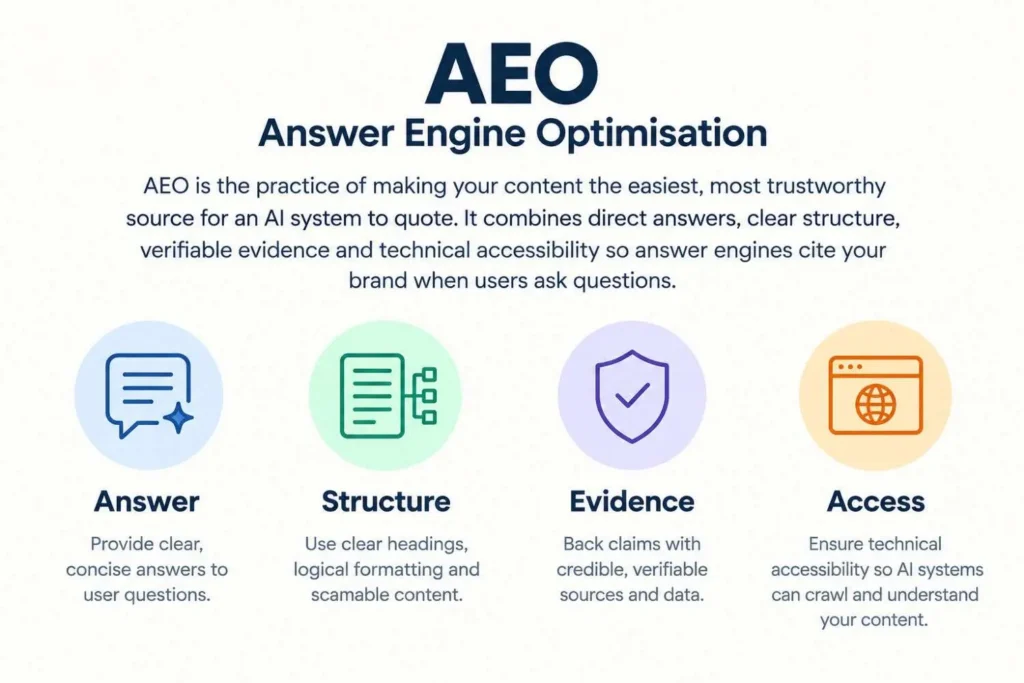
AEO is the practice of making your content the easiest, most trustworthy source for an AI system to quote. It combines direct answers, clear structure, verifiable evidence and technical accessibility so answer engines cite your brand when users ask questions.
“Answer engine” just means any tool that replies with an answer instead of ten blue links. AI Overviews, ChatGPT, Perplexity, Gemini, Copilot. Same idea, different logos.
The bit people miss: these tools lift passages, not pages. They grab a paragraph and drop the rest. A paragraph that opens with “There are many factors to consider” is dead weight. One that opens with a price range, a timeline or a named requirement gives the model something it can actually use.
How AEO Differs From SEO and GEO
SEO chases the ranking. AEO chases the answer. Generative Engine Optimization (GEO) goes after how AI tools describe and recommend your brand across the whole web. They overlap a lot, and our GEO vs AEO vs SEO comparison separates them.
| SEO | AEO | GEO | |
| Main goal | Rank a page | Get quoted as the answer | Get recommended by generative AI |
| What you optimise | The page | A passage or section | Your brand across the web |
| What you track | Rankings, clicks | Citations, answer share | Mentions, sentiment, share of voice |
| Best for | Capturing demand | Question-style searches | “Best X” and comparison prompts |

If your SEO is shaky, fix that first. Answer engines mostly quote pages that are already crawlable and already trusted.
What’s Actually New
Marketers ask all the time whether AEO is just SEO with a new label. Partly, yes. Google’s own guidance on AI features says there are no extra requirements for AI Overviews or AI Mode, and no special markup or AI text files either.
What has changed is the reader. A human scrolls; an answer engine takes one paragraph and bins the rest. So structure and hard evidence count for more than they used to.
Answer Engine Optimization Examples You Can Copy
These are illustrative AEO examples, the sort of fixes most sites need somewhere.
1. The Answer Buried Under a History Lesson
A dental clinic’s implant cost page spends two paragraphs on the history of implants before it mentions money. Open instead with the price range for a single implant and the two things that push it up: bone grafting and crown material. Same page. Now a model can quote it.
2. “More Flexible Than Alternatives”
Every SaaS site says this, and it means nothing to an AI. Swap it for a table comparing three named competitors on pricing model, integrations and setup time. Ask ChatGPT “X vs Y” and a table cell is exactly the clean fact it wants.

3. The FAQ Nobody Can Find
An online store has 30 FAQs tucked into an accordion on its contact page. Move the five most-asked onto the product and category pages they belong to, answer each in two or three sentences, and they’re where crawlers look.
4. “We” With No Name Attached
A Dubai interiors firm writes “we” and “our team” all the way down the page and names its city once, in the footer. Quoted alone, no paragraph says who “we” is. Put the brand, the service and the location back into the paragraphs that matter.
Want more AEO examples at the heading and chunk level? Our guide to structuring content for LLMs goes deeper.
Not sure ChatGPT even knows you exist? Check before you rewrite a word. Run the free AI visibility checker, or book a 30-minute call and we’ll show you what ChatGPT and Perplexity say about your brand right now.
How to Do AEO in 2026: A 6-Step Plan
Step 1: Collect the Questions Buyers Really Ask
Sales call notes, support tickets, People Also Ask boxes, Reddit threads. If your sales team hears a question every week, people are typing it into ChatGPT too.
Step 2: Give Each Question Its Own Section
One question, one H2. Answer it in the first sentence or two, then explain. The classic mistake is a “Key Considerations” heading hiding five different questions. A model can’t tell which one you’re answering.
Step 3: Back Every Claim With Something Checkable
A source, a date, a price, a range, your own data. Jahid Hussain’s take is that the pages that get quoted are rarely the longest ones. They’re the ones willing to commit to a number while everyone else writes “it depends”.
Step 4: Fix the Technical Basics
Check that robots.txt isn’t blocking AI crawlers, that the important text sits in the HTML rather than loading through JavaScript, and that your schema matches what’s actually on the page. Our LLM SEO audit explains why AI engines skip sites that look fine to humans.
Step 5: Get Talked About Somewhere Else
Answer engines read reviews, directory listings, press coverage and community threads. If only your own site says you’re good at something, don’t expect an AI to repeat it.
Step 6: Put Refreshes on the Calendar
Update stats, prices and examples at least once a quarter. A page last touched in 2023 looks stale. Usually because it is.
Want your team trained before you start? HubSpot’s free AEO Fundamentals course comes with an answer engine optimization certification and takes about two and a half hours. Decent grounding, but it won’t audit your site or show who’s getting quoted instead of you. Treat it as day one, not the plan.

How to Measure AEO Without Guessing
Track three things: citations, brand mentions, and what happens after.
Prompt Testing, by Hand
“How do I know if ChatGPT mentions us?” comes up constantly in marketing forums. There’s no perfect tool yet, so do it by hand. Write 20 to 30 prompts your buyers would genuinely type. Run them through ChatGPT, Perplexity, Gemini and Google AI Mode once a month. Note whether you showed up, whether you were linked, and who appeared instead.
Run every prompt twice. Answers shift between sessions, and a single run will fool you.

Why Traffic Undersells AEO
Pew Research Center found that Google users clicked a result in 8% of visits when an AI summary appeared, against 15% when one didn’t. Links inside the summary itself got clicked in 1% of visits. One percent. A citation can win the buyer without ever showing up as a session.
So watch the side doors: branded search volume, direct traffic, GA4 referrals from chatgpt.com and perplexity.ai, and a “how did you hear about us” field on your forms. Jahid Hussain’s view is that this last one catches AI influence your analytics miss completely, since someone who saw your name in ChatGPT often comes back later by typing your URL.
Why Siloed Teams Struggle With AEO
AEO cuts across content, technical SEO, reputation and conversion, which usually sit with four different vendors. You can guess how that goes. The writer adds neat answer blocks, and the developer’s JavaScript framework hides them from crawlers. PR lands a great mention, and nobody connects it to the pages AI tools cite. The ads team knows exactly which questions convert and never tells anyone.

That’s why Paradigm Media Networks works as a full-stack growth agency, not a siloed vendor. Our generative engine optimization agency work runs in the same system as SEO, performance marketing, website design and development, and creative strategy. That’s SEO, GEO & Ads, Engineered for the AI Era in practice: paid search shows which questions convert, web keeps answers crawlable, creative produces proof worth citing.
None of it works without an organic base. For Moving Hub in the US, we built 300 programmatic SEO pages and ranked 600+ keywords in four months, taking the business from $0 to $100K+ a month. AEO builds on that. It doesn’t replace it.
Frequently Asked Questions
What Is the Difference Between AEO and SEO?
Going by the AEO definition, the target is a citation, not a ranking: SEO tries to get a page clicked, while AEO tries to get a passage quoted inside an AI answer. Most AEO work sits on SEO foundations, so you need both.
How Long Does AEO Take to Work?
Structural fixes can show up in AI answers within weeks once pages get recrawled. Steady citations usually take a few months, depending on your authority, how competitive the questions are, and how often you refresh.
Is AEO Just SEO With a New Name?
Partly. Google says AI Overviews need nothing beyond SEO best practice, but writing for passage extraction, adding hard evidence and earning off-site mentions are habits most SEO programmes never prioritised.
How Do I Check if ChatGPT Mentions My Brand?
Run the same buyer-style prompts across ChatGPT, Perplexity, Gemini and Google AI Mode every month and log where you appear. Run each one more than once, since answers vary, and pair the results with GA4 referral data and a “how did you hear about us” field.
Is an Answer Engine Optimization Course Worth Taking?
If you’re new to this, HubSpot’s free AEO Fundamentals course is worth an afternoon. It gives you the vocabulary, but results only come from applying it to your own pages and prompts.
The Bottom Line
AEO comes down to one habit. Make each section of your site the clearest, best-backed answer to one real question, then go and check whether AI tools are using it. Baseline first, fix structure, earn off-site mentions, and judge it on mentions, not just sessions.
See What ChatGPT Says About Your Brand
If AI tools keep recommending your competitors, we’ll show you what’s holding you back and what to fix first.
About the Author
Jahid Hussain | Founder, Paradigm Media Networks
Jahid Hussain founded Paradigm Media Networks to solve a problem he kept seeing: businesses spending across SEO, ads, and content that never talked to each other. He specialises in local SEO, organic growth systems, and integrated marketing strategies that connect search, paid media, and creative into one lead generation engine. Paradigm has taken clients from zero search visibility to six-figure monthly revenue pipelines, and has been featured in IANS, Eastern Herald, Sangri Times, and Dailyhunt. Jahid operates across the US and UK, and writes from the standpoint of someone who has built and broken growth systems for real businesses, not from a slide deck.
