



LLM SEO Audit: Find Out Why AI Search Ignores Your Brand
Our LLM SEO audit shows why ChatGPT, Perplexity, Gemini and Google AI Overviews skip your brand: blocked AI crawlers, missing entity and schema signals, pages AI can’t quote and a thin third-party footprint. You get a 50-prompt baseline against your top five competitors and a 90-day fix plan in 10 working days.
Request the auditBook a 30-min call
✓ Fixed scope, fixed fee, quoted before you start · Delivered in 10 working days · Written up by a strategist, not a tool export
By Jahid Hussain, Founder, Paradigm Media Networks · Updated 23 October 2026

 50 promptstested on 4 AI engines10 working daysfrom intake to report
50buyer prompts in your baseline, handed over to rerun4AI engines tested: ChatGPT, Perplexity, Gemini, AI Overviews5signal groups, each scored and turned into fix tickets90-dayprioritised fix plan, split by who ships each fix
Key takeaways
- An LLM SEO audit is a one-off diagnosis of whether AI answer engines can reach, understand, trust and cite your website. It is not a monthly programme.
- Ours tests 50 buyer prompts on four engines (ChatGPT with search, Perplexity, Gemini and Google AI Overviews) and records who gets cited instead of you.
- The blockers we look for first are mechanical: a CDN or security plugin blocking OAI-SearchBot or PerplexityBot, missing Organization and Service schema, and inconsistent business details across profiles.
- Ranking on Google is no longer enough on its own. Ahrefs found that about 38% of AI Overview citations came from top-10 pages in March 2026, down from about 76% in July 2025.
- No one can guarantee AI citations. The audit tells you what is in your control and in what order to fix it.
What is an LLM SEO audit?
An LLM SEO audit is a structured review of how well AI search tools such as ChatGPT search, Perplexity, Gemini and Google AI Overviews can find, interpret and cite a website, followed by a live test of real buyer prompts.
It checks crawler access, entity clarity, structured data, the citability of key pages and the brand’s footprint on third-party sites, then tests the questions buyers actually ask to see where the brand appears and where competitors appear instead.
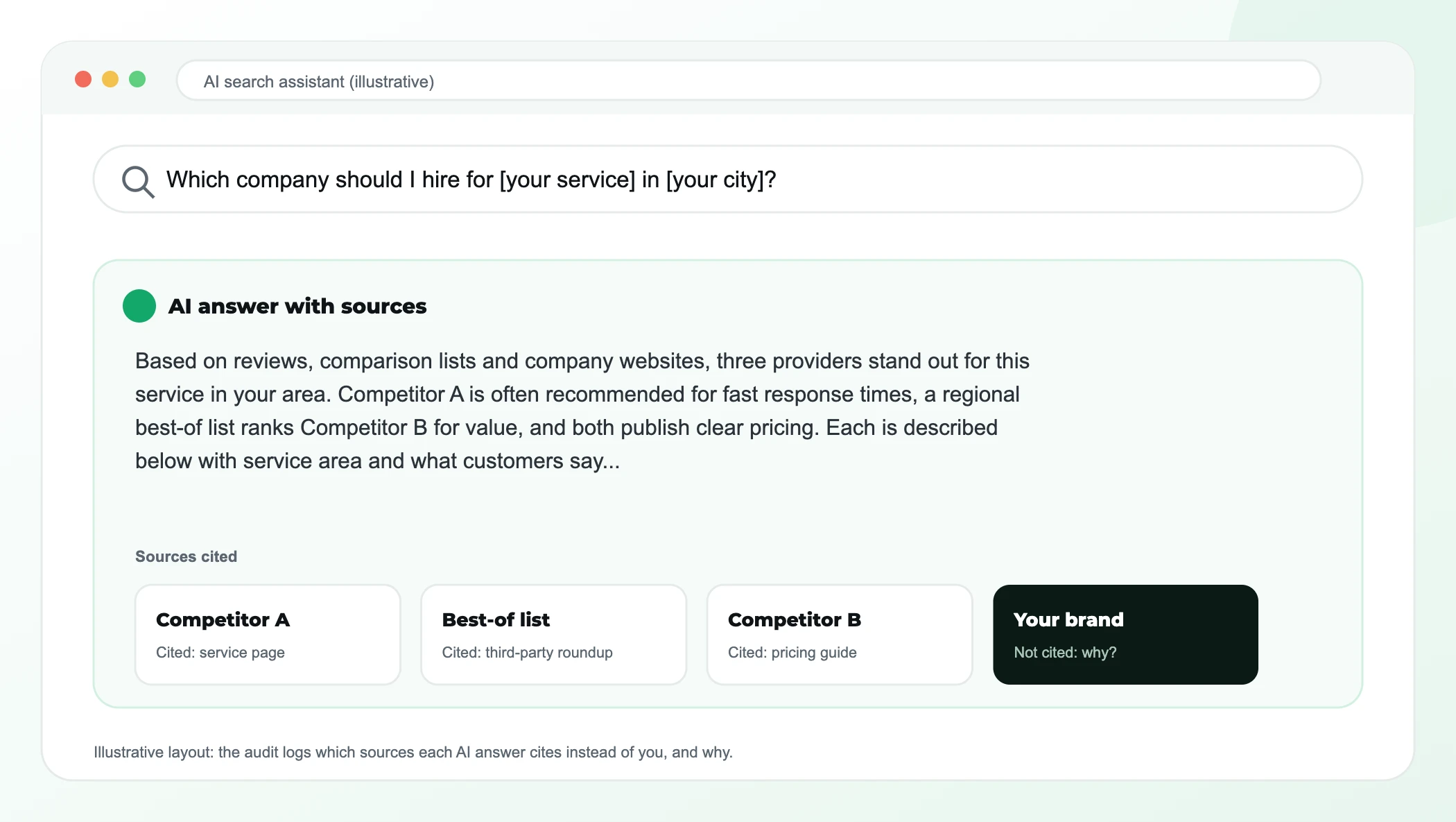
A traditional SEO audit asks whether Google can crawl, index and rank your pages. An LLM SEO audit asks a different question: when a buyer asks an AI assistant for a recommendation in your category, does your brand come up, is the description correct, and if not, why not?
A note on terms: “LLM audit” is also used in AI governance for auditing the language model itself (bias, safety, compliance). This page is about auditing your website and brand for AI search visibility, sometimes called an LLM SEO check or AI visibility audit.
What does the LLM SEO audit check?
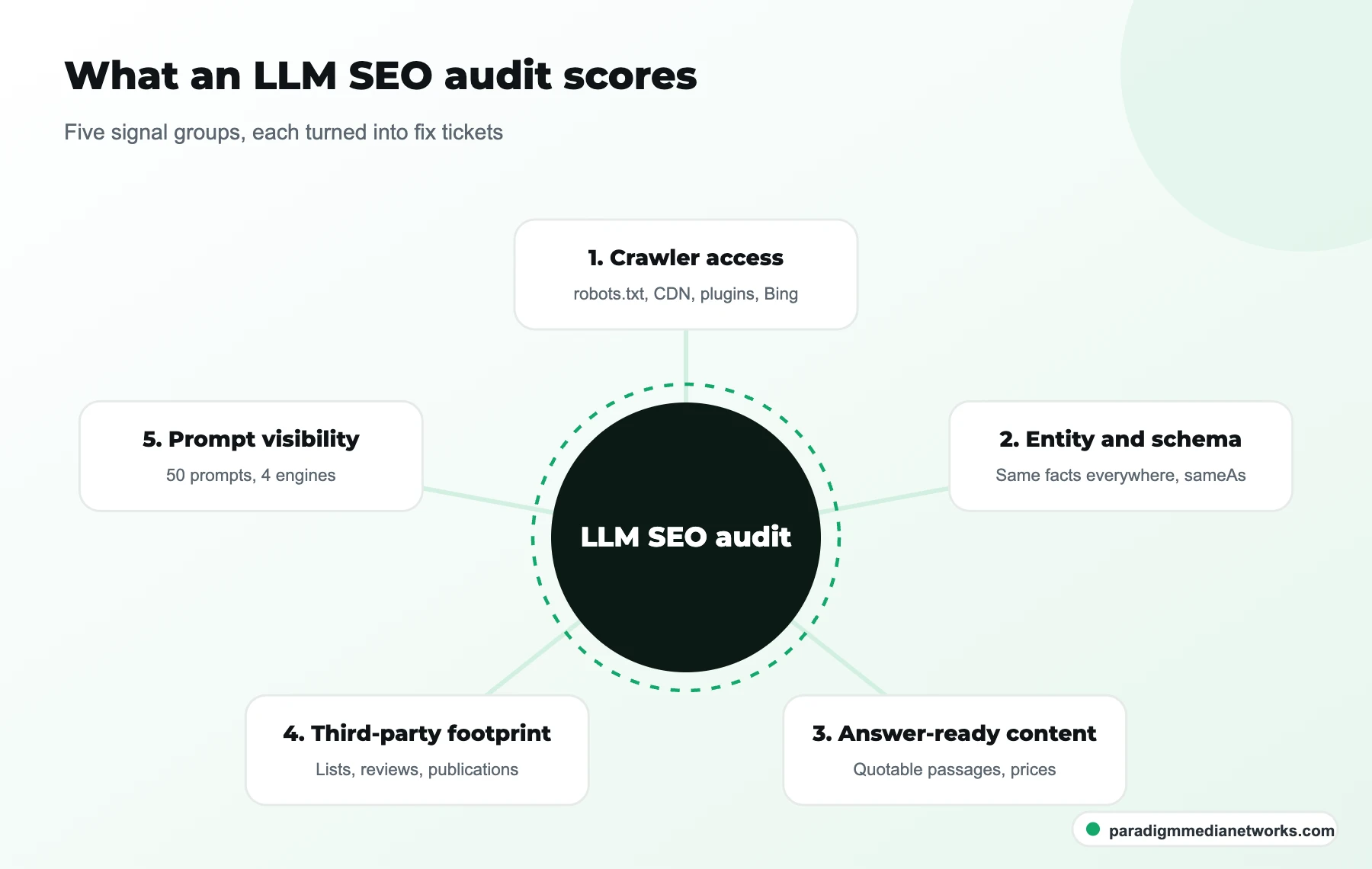
The PMN LLM SEO audit covers five groups of signals, each scored and turned into fix tickets: crawler access, entity and schema signals, answer-ready content, third-party footprint and prompt-level visibility.

1. AI crawler access and indexability
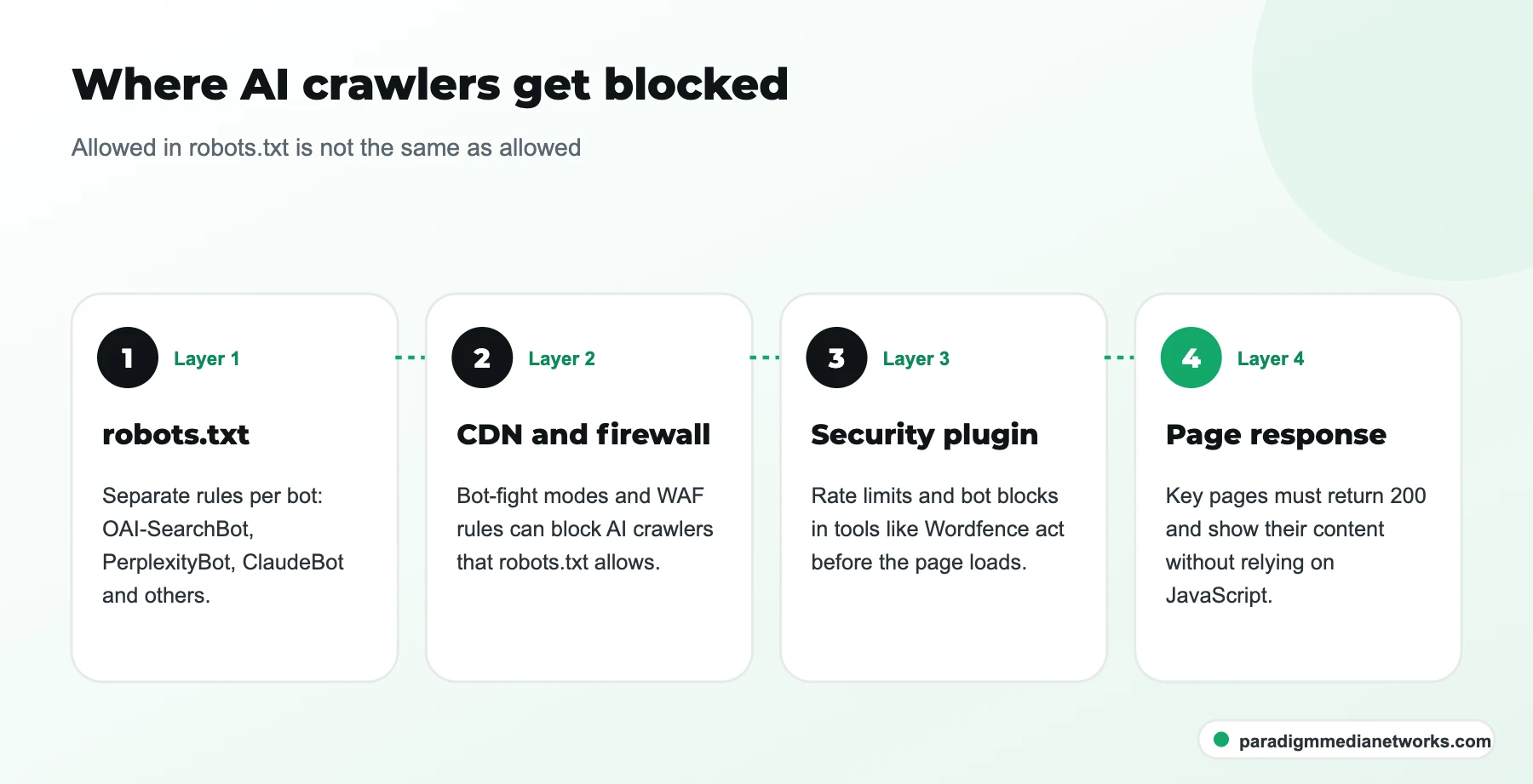
Can the engines you want citing you actually fetch your pages? We read your robots.txt, then check firewall, CDN and security-plugin rules (Cloudflare bot settings, Wordfence and similar), because a block at that layer never shows up in robots.txt. We check each crawler separately, because they do different jobs:
| Crawler | Owner | What it does | What blocking it costs you |
|---|---|---|---|
| OAI-SearchBot | OpenAI | Surfaces sites in ChatGPT search answers | OpenAI says sites that opt out will not be shown in ChatGPT search answers |
| GPTBot | OpenAI | Collects content that may train OpenAI models | Training only; blocking it is a business choice, not a visibility fix |
| ChatGPT-User | OpenAI | Fetches a page live when a user asks ChatGPT about it | User-initiated; OpenAI says robots.txt rules may not apply |
| PerplexityBot | Perplexity | Surfaces and links sites in Perplexity results | Perplexity recommends allowing it so you appear in results |
| Perplexity-User | Perplexity | Fetches a page when a user asks a question | User-initiated; generally ignores robots.txt |
| Google-Extended | Controls use of content for Gemini models | Google states it does not affect inclusion or ranking in Google Search | |
| ClaudeBot | Anthropic | Crawler for Anthropic’s models | Checked and reported; your call to allow or block |
Sources: OpenAI crawler documentation, Perplexity crawler documentation, Google crawler documentation.
We also confirm that Bing Webmaster Tools is verified and your sitemap is submitted there, because Bing powers Microsoft Copilot and OpenAI says ChatGPT search draws on third-party search providers.
2. Entity and schema signals
Can a machine tell exactly who you are? We check that your business name, category, services, locations and one-line description match across your site, Google Business Profile, LinkedIn, directories and review platforms. We validate your Organization, Service, Person (author) and BreadcrumbList markup, and the sameAs links that connect your site to your other profiles. Google says no special schema is needed for its AI features, so we treat schema as a clarity signal for every engine, not as an AI trick.
3. Answer-ready content
Can an AI engine lift a passage from your key pages and quote it accurately? For your top commercial pages, we check whether each one opens with a direct answer, states prices or ranges, uses tables for comparisons and numbered steps for processes, names its author, cites sources and shows a real “last updated” date. Vague, unsourced pages are the ones engines skip or summarise wrongly.
4. Third-party footprint
What do other sites say about you? AI engines lean on reviews, directories, “best of” comparison lists, industry publications and community threads when they recommend a company. We map which third-party sources the engines cite in your category and list the ones where you are missing or described inaccurately.
5. Prompt-level visibility and competitor citation gaps
Where do you show up today, and who wins the prompts you lose? This is the 50-prompt test described in the next section.
Want to see where you stand first?
The free AI Visibility Checker scores 15 signals in about three minutes. No login.
How does the 50-prompt AI visibility test work?
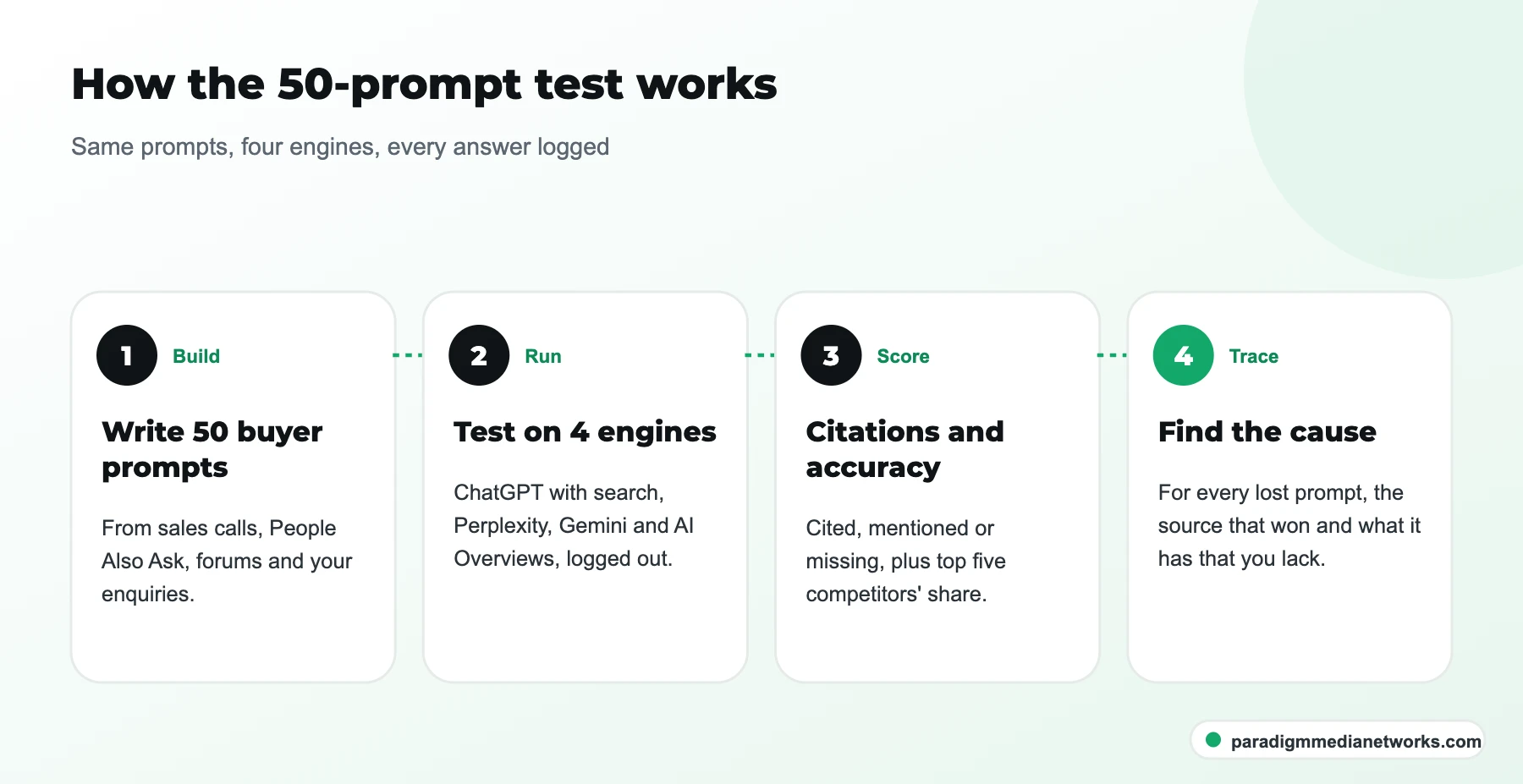
The 50-prompt test runs the questions your buyers actually ask on four AI engines and logs, for each answer, whether your brand is cited, mentioned or missing, and which competitor or source appears instead.
- Build the prompt set from buyer language. We write 50 prompts from your services, markets and competitors, using sales-call questions, People Also Ask results, forum threads and the enquiries you share with us. Example shapes: “best [service] company in [city]”, “[your brand] vs [competitor]”, “how much does [service] cost in [market]”.
- Run each prompt on each engine. ChatGPT (with search), Perplexity, Gemini and Google AI Overviews, logged out where possible, with the date, engine and full answer stored.
- Score the results. Citation share (the share of answers that cite your domain as a source), mentions without a link, answer accuracy (does the engine describe your services, locations and prices correctly) and the top five competitors’ share for comparison.
- Trace every lost prompt to a cause. For each prompt a competitor wins, we record the page or third-party source being cited and what it has that yours does not.
AI answers change from run to run, so the baseline is a snapshot, not a permanent score. That is why the prompt set is handed over to you: you, or an ongoing programme, can rerun the same 50 prompts later and compare like with like.
What do you get, and when?
You get a written audit, a 50-prompt baseline, a competitor citation map, a prioritised 90-day fix plan and one sample page rewrite, delivered in 10 working days from the day we receive access and your intake form.
| Deliverable | What it contains |
|---|---|
| Audit report (PDF) | Findings for all five groups, each with severity, evidence and the exact fix |
| 50-prompt baseline | Spreadsheet of every prompt, engine, answer, citation and competitor, ready to rerun |
| Competitor citation map | Your citation share against your top five competitors, plus the sources the engines cite in your category |
| Prioritised 90-day fix plan | Every fix ranked by expected impact and effort, split into “your developer”, “your content team” and “off-site” |
| Sample page rewrite | One key commercial page rewritten answer-first as a worked example |
| Walkthrough call | A live walkthrough with the strategist who ran your audit |
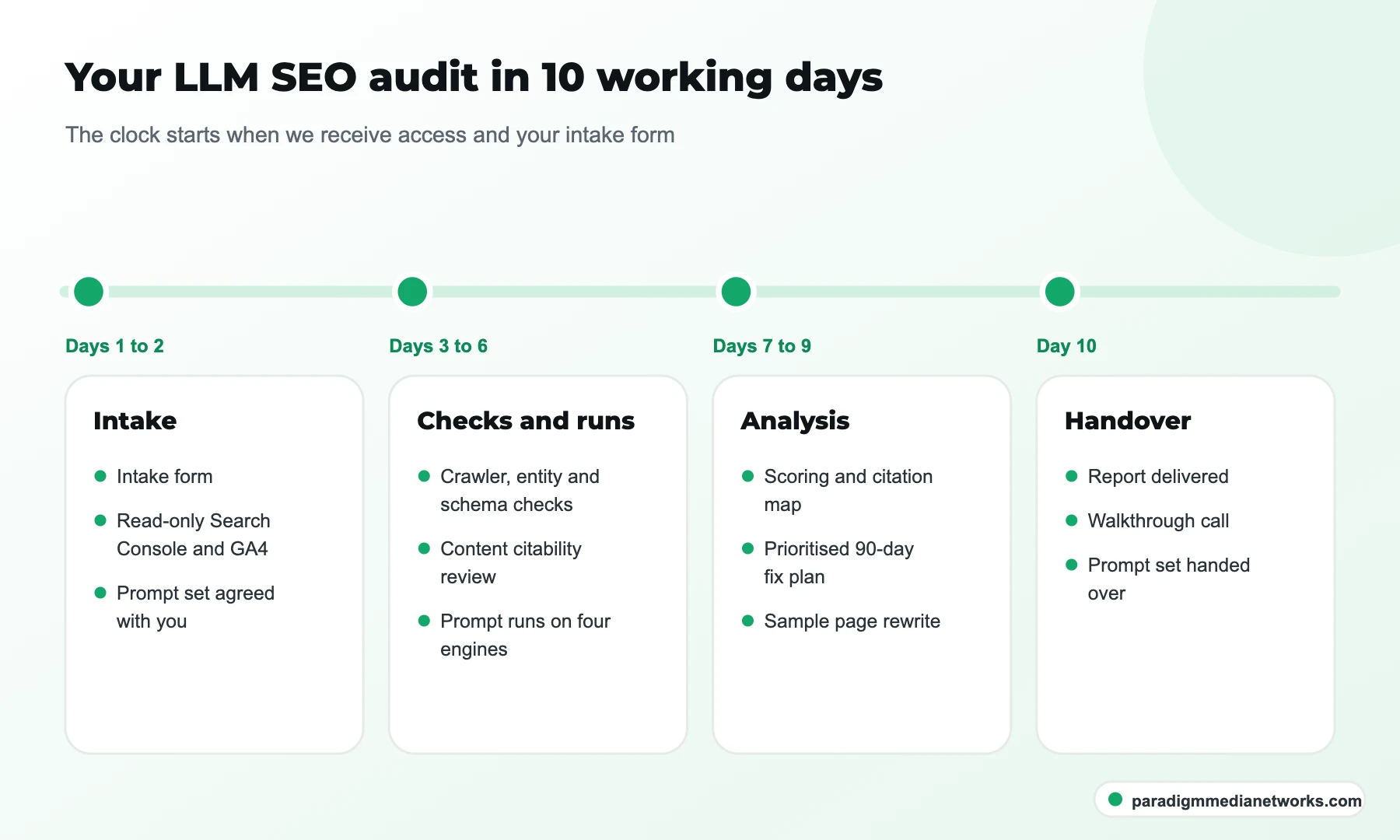
We do not need admin access to your site. Read-only access to Google Search Console and GA4 is enough for the audit.
How much does an LLM SEO audit cost?
The PMN LLM SEO audit is a fixed-scope, fixed-fee audit: we quote the fee in writing before any work starts, with no retainer required and no add-on fees for the prompt test or the fix plan.

The scope on this page is the full scope, so the quote you approve is the amount you pay. For context, published prices for comparable work vary widely. One AI-search agency lists an LLM SEO audit at $2,500 to $5,000 (p0stman, January 2026), and MarketerHire puts a one-time entity and schema audit at $4,000 to $12,000 (MarketerHire, August 2026). What drives the price is mostly the number of prompts tested, the number of engines, and whether a human writes up the findings or a tool exports a score.
| Option | Cost | What you get | Best for |
|---|---|---|---|
| Free AI Visibility Checker | $0 | A 15-signal self-assessment and a 0 to 100 score | A first look before spending anything |
| Free LLM SEO audit checklist | $0 + your time | The checks to run yourself, in order | In-house teams with SEO skills and time |
| PMN LLM SEO audit | Fixed fee, quoted before you start | Everything on this page, written up by a strategist, in 10 working days | Businesses that want a fix list they can act on now |
| Ongoing GEO programme | Roughly $2,000 to $10,000+ a month | Monthly fixes, content, earned mentions and citation tracking | Brands competing for AI answers every month |
Fixed scope. 10 working days.
A fix list your team can start on the day it lands. Tell us your site and market and we will send the quote.
What does a sample LLM SEO audit look like?
Every finding in the report has a status, the evidence behind it and the exact fix, so your team can act on it without a second meeting.
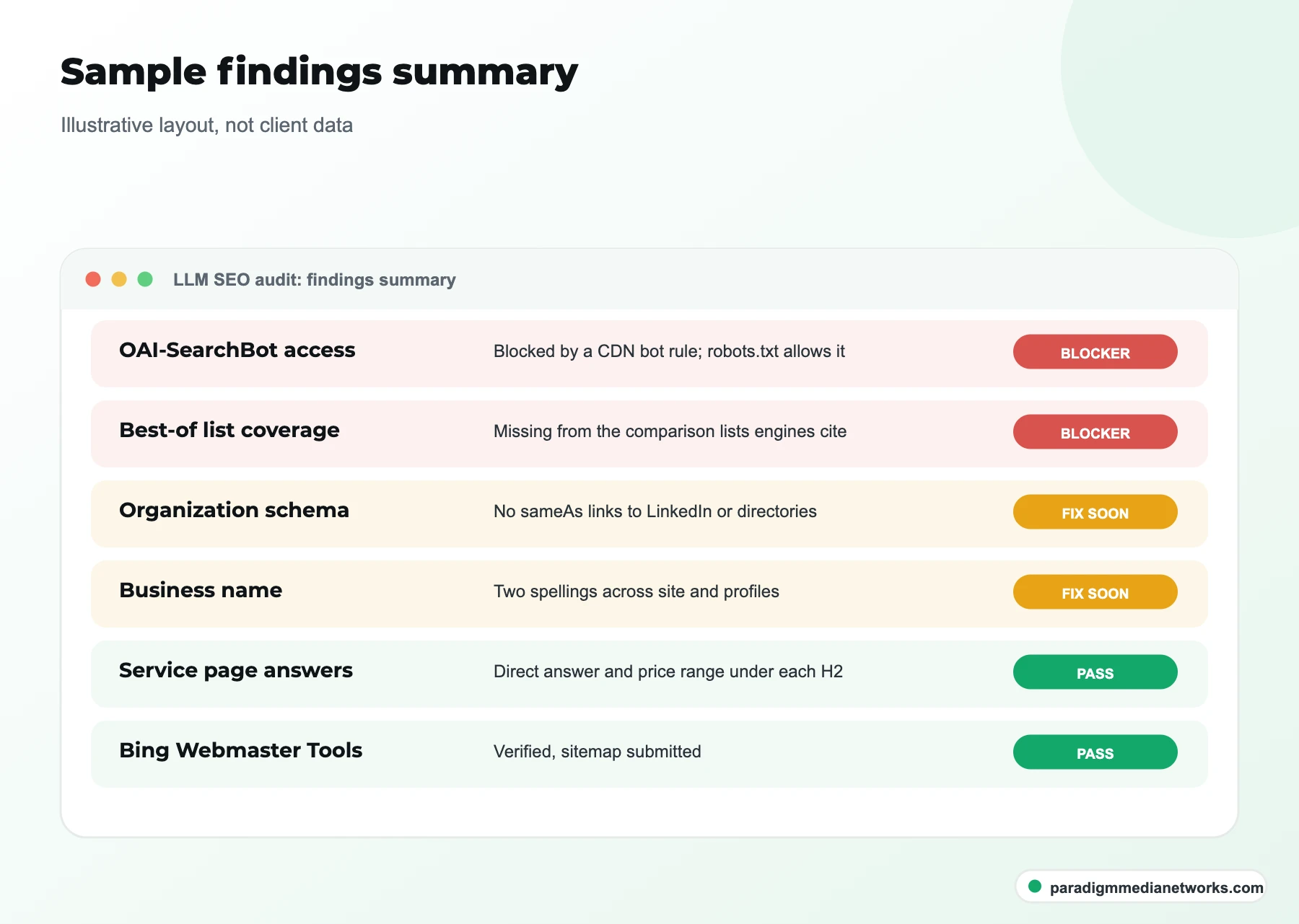
Blockers come first because nothing else matters if an engine cannot fetch the page. “Fix soon” items are clarity and content gaps. Passes are listed too, so you know what not to spend time on. If you would like to see a real, anonymised excerpt before you commit, ask us on the call for a walk-through.
Does this method work? What we saw with Moving Hub
The problems this audit looks for are the ones we found at the start of our work with Moving Hub, a USDOT-licensed US long-distance mover that started 2026 with no organic traffic, 68 referring domains and zero presence in AI answers.
The starting review found the problems that later became the roadmap: duplicate service URLs, missing canonical rules, no organisation or service markup, and generic copy that answered none of the cost and route questions buyers ask. The fixes were then delivered as a full programme (technical rebuild, answer-first cost and route guides, programmatic route and city pages, digital PR and monthly tracking of a fixed prompt set across five assistants), not by an audit alone.
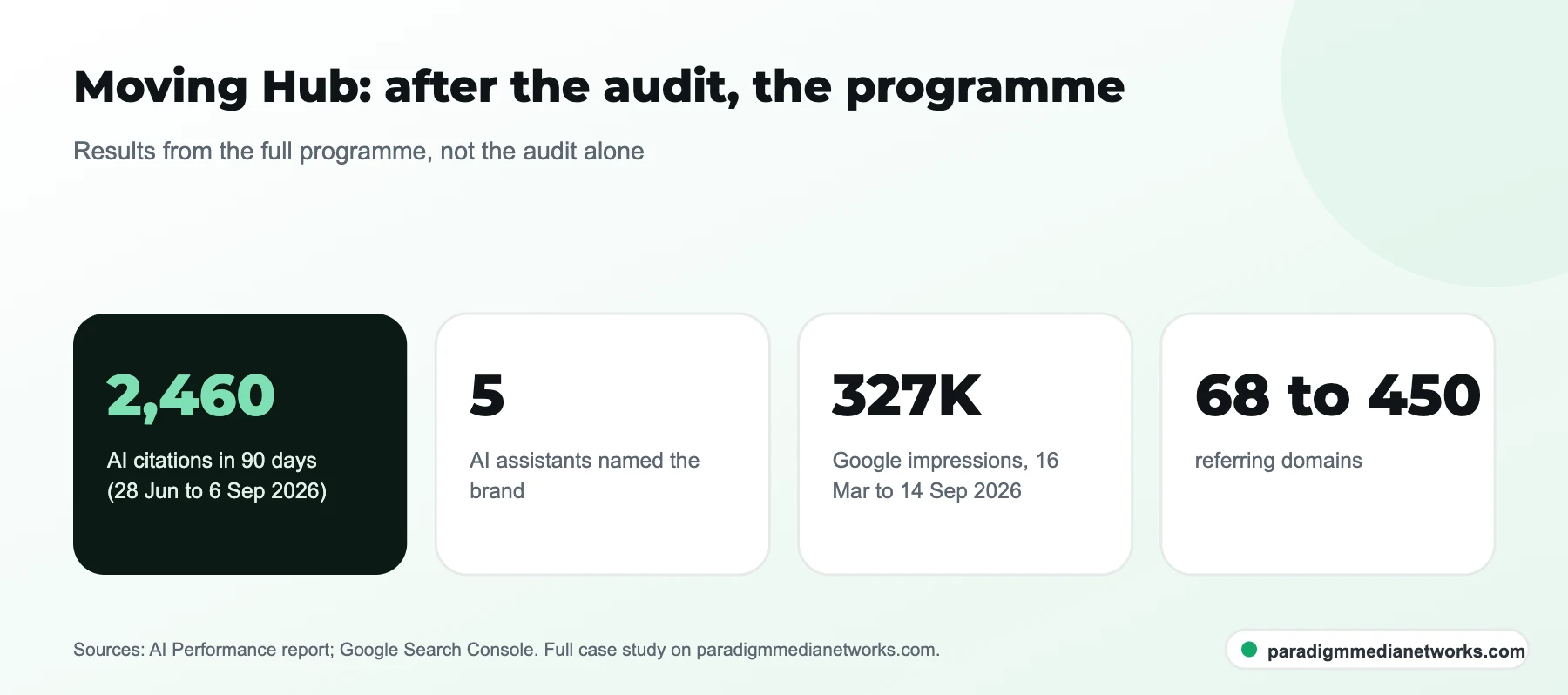
- About 2,460 AI citations in 90 days (AI Performance report, 28 June to 6 September 2026)
- Named by 5 AI assistants: ChatGPT, Google AI Mode, AI Overviews, Perplexity and Gemini
- Cited first in the Google AI Overview for “storage in transit cost usa”
- 327K Google impressions and 907 clicks (Google Search Console, 16 March to 14 September 2026)
- Referring domains from 68 to 450
- First AI citations after roughly three to four months
An audit on its own does not produce these numbers. It tells you which fixes to make first, so the work after it is aimed.
How is an LLM SEO audit different from a traditional SEO audit?
A traditional SEO audit diagnoses Google rankings; an LLM SEO audit diagnoses whether AI answer engines can reach, trust and cite you. The two overlap on crawlability and content quality, and differ on what they test and how success is measured.
| Traditional SEO audit | LLM SEO audit | |
|---|---|---|
| Main question | Can Google crawl, index and rank my pages? | Do AI engines cite and describe my brand correctly? |
| Crawlers checked | Googlebot, Bingbot | Googlebot and Bingbot plus OAI-SearchBot, GPTBot, PerplexityBot, Google-Extended, ClaudeBot, at robots.txt and CDN level |
| Unit of research | Keywords | Prompts (the full questions buyers type into an assistant) |
| Content test | Keyword targeting, duplication, thin pages | Can a passage be quoted on its own: direct answers, prices, tables, sources, authors |
| Off-site test | Backlink profile | Mentions on the reviews, lists and publications AI engines cite in your category |
| Output metric | Rankings, traffic, technical health score | Citation share, mention share vs competitors, answer accuracy |
If your technical SEO is weak, fix that first. Google’s own guidance says optimising for its AI features is still SEO, and an LLM SEO audit will flag the same crawl and indexing faults a normal audit would. Our technical SEO services cover that layer in depth.
Do you need an audit, or an ongoing GEO programme?
Buy the audit if you need to know what is wrong and you have people who can make the fixes. Choose an ongoing programme if you are competing for AI answers every month and need the fixes, content and earned mentions done for you.
The audit is the right first step if
- You have never checked how AI engines describe you, and want facts before committing to a retainer.
- You have an in-house developer or content team who can act on a fix list.
- You want an independent second opinion on work another agency is doing.
An ongoing programme makes more sense if
- The audit shows a large third-party gap, which takes months of earned coverage to close.
- You need monthly tracking to prove progress to a board or client.
- You have no one in-house to ship technical and content changes.
This audit is not for
- Brand-new sites with no indexed pages yet (start with SEO services first).
- Anyone who wants a guaranteed number of citations. AI answers vary between runs and models change; we will not promise a citation count.
When you are ready for ongoing work, our GEO services pick up the fix plan where the audit ends, and our AI SEO services cover the on-site content and entity work.
Are you an agency? Resell the audit under your brand
Yes. Through our white-label GEO services, we deliver the same audit, 50-prompt baseline and 90-day fix plan with your logo on every file, and we never contact your client unless you invite us.
Wholesale pricing, suggested resale prices and SLAs are published on that page. Agencies use the audit in three ways: as a paid discovery product before pitching a retainer, to find entity and schema gaps that hurt a client’s existing SEO, and to surface new topic and prompt opportunities for the client’s content plan. Our guide to LLM audits for agencies walks through each of those, with a sample finding and how to price the audit to your client.
Why choose Paradigm Media Networks for your LLM SEO audit?
Because the method is published, a person writes the findings, and the fix plan is sorted by what moves revenue.
- A strategist writes it. Every audit is run and written up by our team and reviewed by Jahid Hussain, not exported from a tool.
- The method is published. Prompts, engines, scoring and evidence are on this page and in your spreadsheet, so you can check every number.
- We plan for what comes after. PMN runs SEO, GEO and paid media as one system, so the fix plan sorts work by what moves revenue, not by what is easiest to bill.
- No AI tricks. We do not sell llms.txt as a lever (Google says Google Search does not use it) and we do not buy or fake mentions, because Google’s spam policies now cover attempts to manipulate generative AI responses.
Why not do it in-house? You can. The LLM SEO audit checklist is free and covers the same checks. Teams choose the paid audit when they lack the time to run 200 prompt-engine combinations by hand, or want a competitor citation map they do not have the tools to build.
LLM SEO audit: frequently asked questions
How long does an LLM SEO audit take?
The PMN LLM SEO audit takes 10 working days from the day we receive your intake form and read-only access to Search Console and GA4. Days 1 to 2 agree the prompt set, days 3 to 9 cover the checks, prompt runs, scoring and fix plan, and the report is delivered with a walkthrough call on day 10.
Will an LLM SEO audit get my brand cited by ChatGPT?
No audit can guarantee citations, and you should be wary of anyone who promises them. The audit finds what is stopping AI engines from citing you, such as blocked crawlers, unclear entities or pages that can’t be quoted, and ranks the fixes. Citations depend on making those fixes and on what competitors do in the same period.
Which AI engines does the audit test?
The 50-prompt test runs on ChatGPT with search, Perplexity, Gemini and Google AI Overviews. The crawler-access check covers OpenAI, Perplexity, Google and Anthropic crawlers, plus Bing Webmaster Tools, because Bing powers Microsoft Copilot and ChatGPT search draws on third-party search providers.
Can I run an LLM SEO check myself for free?
Yes. Start with the free AI Visibility Checker, which scores 15 signals in about three minutes, then work through the free LLM SEO audit checklist. The paid audit adds the 50-prompt competitor test, evidence for every finding and a written 90-day plan.
Does the audit include an llms.txt file?
The audit reports whether you have one and whether it causes server errors, but we do not treat llms.txt as a visibility lever. Google states that Google Search does not use these files. If you want one for other AI tools, we note it in the fix plan.
What happens after the audit?
You own the report, the fix plan and the prompt set. Your team can implement it, or we can quote for implementation or an ongoing GEO programme. You can rerun the same 50 prompts later to measure progress against the baseline.
Is an LLM SEO audit worth it for a small local business?
It is worth it when buyers in your area already ask AI assistants for recommendations, which is common for services like HVAC, moving and clinics. If your site is new or has basic Google problems, fix those first; the audit will show them, but a standard SEO engagement may be the better first spend.
 Who does the work
One team, one revenue number
Strategy is led by Jahid Hussain, founder of Paradigm Media Networks, with 7 years in growth marketing, SEO and performance marketing and an MBA in Marketing. SEO, AI search, paid media, content and web run as one system, so nobody hands you a report that contradicts another vendor’s.
- 500+ marketers trained and 30+ brands scaled
- Published results you can check: HVAC case study and Moving Hub case study
- Reporting on calls, leads and booked jobs, not just rankings
Find out what AI engines say about you, and why
You get a 50-prompt baseline, a competitor citation map and a ranked 90-day fix plan in 10 working days, for one fixed fee quoted before you start. Questions first? Email info@paradigmmedianetworks.com or WhatsApp +91 80995 64306.
Request the auditGrab a slot directly
✓ Free 30-minute call · No pitch decks · Walk away with a real plan
What you walk away with
- A report covering all five signal groups, with evidence for every finding
- A 50-prompt baseline across four AI engines, ready to rerun
- Your citation share against your top five competitors
- A 90-day fix plan split by developer, content and off-site work
- One key page rewritten answer-first as a worked example
