


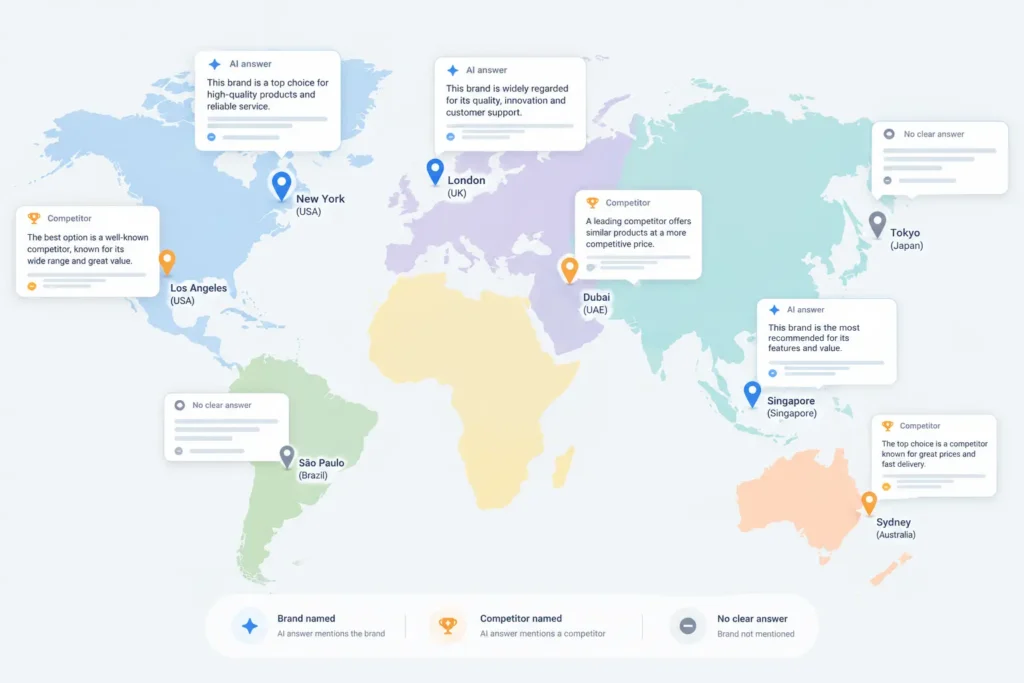
An enterprise GEO audit shows whether ChatGPT, Perplexity, Gemini and Google’s AI Overviews can get to your site, make sense of it and quote it in each market you sell in. It covers crawler access, entities, citable content, off-site mentions and measurement, with every market scored on its own, since plenty of brands are ChatGPT’s first pick in Dallas and don’t exist in Manchester.
Key Takeaways:
- Give every market its own score, then weight by revenue. Otherwise your worst market hides inside a decent average.
- robots.txt is set per host. Nine country domains means nine files.
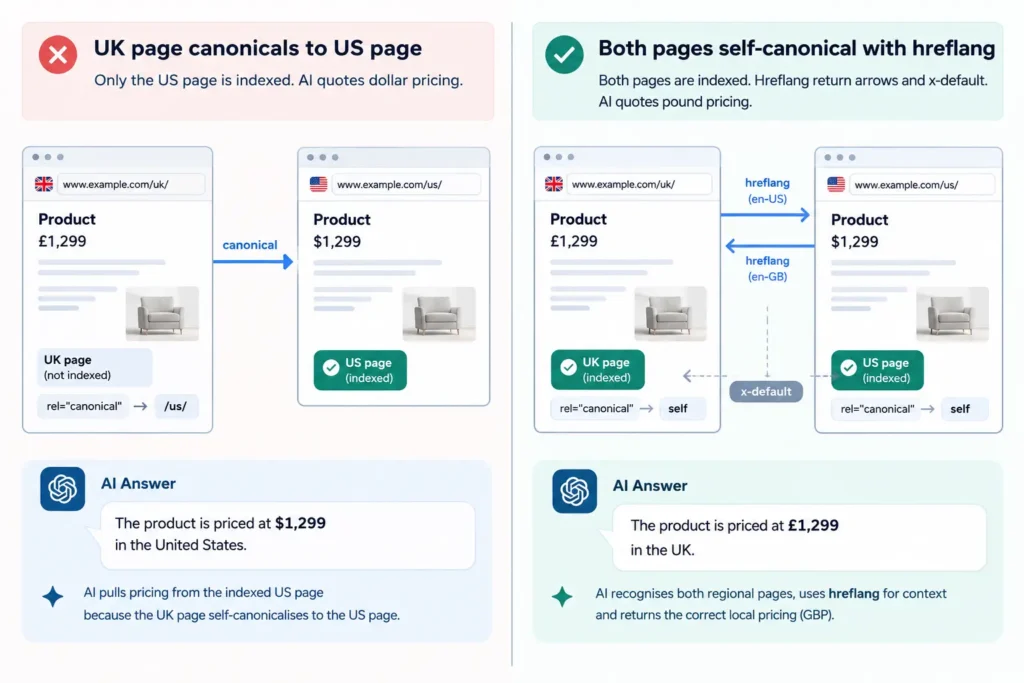
- A UK canonical pointing at the US page can leave AI quoting dollars to British buyers.
- If a location page reads the same with any city’s name in it, AI has nothing to cite.
You rarely learn about this from a report. Usually a UK sales rep forwards a screenshot of ChatGPT recommending a competitor, or a Phoenix manager asks why the AI Overview lists Dallas hours. Most GEO audit guides assume one site in one country, so this never comes up. New to GEO? Read our AI search optimization guide first.
Why Large Sites Need a Different GEO Audit
Because the answer someone gets depends on where they’re standing. For local and commercial questions, engines search the web first and results depend on location, so testing from New York tells you little about Sydney. The engines don’t agree with each other either. In our analysis of nearly 370,000 AI citations, each drew on a noticeably different mix of sources.
The 6-Step Enterprise GEO Audit
1. Build a market-by-market prompt list
Write 20 to 40 categories, comparison, problem and brand prompts per market, the way locals talk, not translated from your US list.
| Market | Language | Prompt type | Example prompt | Engines |
| Dallas, US | en-US | Category | best AC repair company in Dallas | ChatGPT, AI Overviews, Perplexity |
| UK | en-GB | Comparison | Daikin or Mitsubishi heat pump for a small office | ChatGPT, AI Overviews, Copilot |
| Phoenix, US | en-US | Problem | AC blowing warm air, who should I call | ChatGPT, AI Overviews, Gemini |
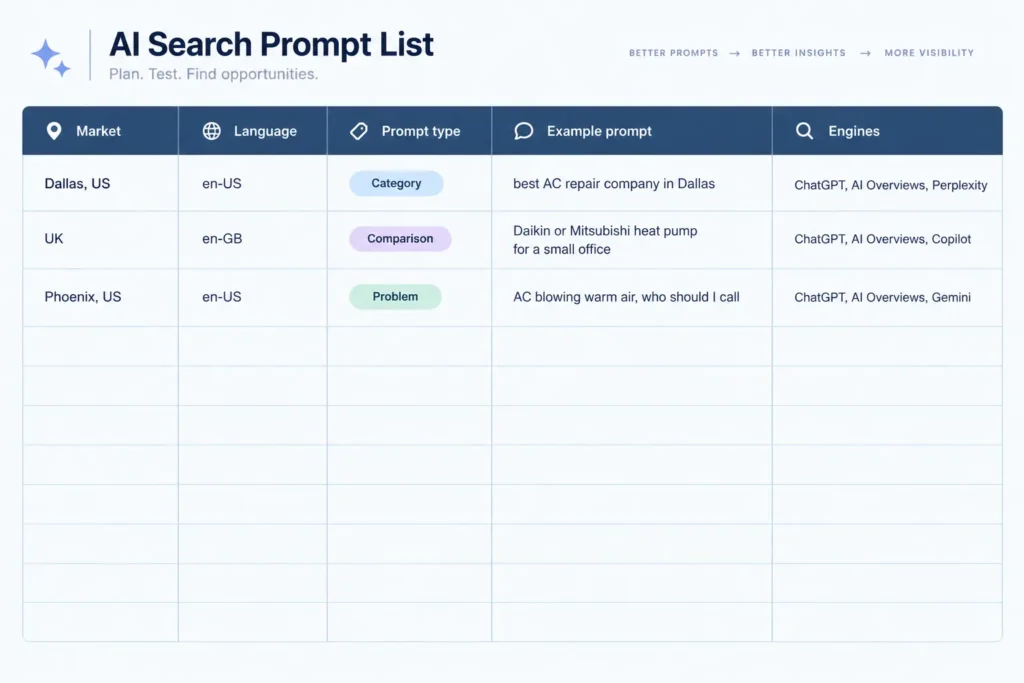
Run them logged out, with your location set to that market.
2. Check AI crawler access on every host
Every subdomain and country domain has its own robots.txt, and firewall bot rules often differ by region. Check that OAI-SearchBot, PerplexityBot and Googlebot are allowed everywhere. OpenAI says sites blocking OAI-SearchBot won’t appear in ChatGPT search answers, and robots.txt changes take about 24 hours to register. Then check server logs for 200s; in technical SEO, trust logs over the file.
3. Untangle hreflang and canonicals
On multi-country sites, the UK page’s canonical often points at the US page. Google indexes only the US version, and a British buyer asking about pricing gets an answer in dollars. Google says a page just needs to be indexed and eligible for a snippet to show in AI Overviews, so unindexed pages can’t appear. Give each regional page a canonical pointing to itself, with hreflang return links between all versions and an x-default.
4. Audit entities across domains and locations
Ask each engine, in each market, what your company does and who owns your regional brands, and note anything blended or out of date. Then check Organization schema links parent and sub-brands, and that sameAs profiles and location details match everywhere. Our guide to entity SEO for LLMs covers the fixes.
5. Score citable content by template, not by URL
Take 5 to 10 pages per template per market. Look for facts only that branch could state: licences, technicians, service radius, local prices, local reviews. Then swap in another city’s name. If nothing else needs changing, the template fails. See our LLM SEO audit for page checks.
6. Map off-site mentions and set the baseline
List the sites the engines cite in each market: directories, trade press, YouTube, Reddit and “best of” roundups. In our citation study, 48.1% of answers to recommendation questions cited a “best” or “top” list.
Answers change between runs, so:
- Keep two numbers apart: mention rate (answers that name you, out of all tested) and citation rate (answers that link to you). You can be mentioned often and linked almost never.
- Ask each prompt at least three times on different days and use the average. Leave the list alone for a quarter.
That’s 270 answers per market at 30 prompts, three engines and three runs, so AI visibility tools soon pay for themselves.
Running ten or more markets? Request an enterprise GEO audit and we’ll score each against local competitors.
The 0-100 Enterprise GEO Scorecard
Score each dimension 0 to 4 per market. Points = (score ÷ 4) × weight.
| Dimension | Weight | Scores 4 when | Scores 0 when |
| Crawl access | 20 | Bots allowed, logs confirm | Bots blocked |
| Entity clarity | 20 | Brand described correctly | Brands merged |
| Citable content | 25 | Templates carry local facts | City-swap templates |
| Off-site mentions | 20 | Named on cited sources | Missing from them |
| Measurement | 15 | Same prompts, run 3+ times | Nobody’s tracking it |
Over 70, it’s mostly upkeep. Between 40 and 69 there’s a short fix list. Below 40, leave content for now and sort out access and entities. These are our weights, not an industry standard.
An Example: Scoring a 14-City HVAC Brand
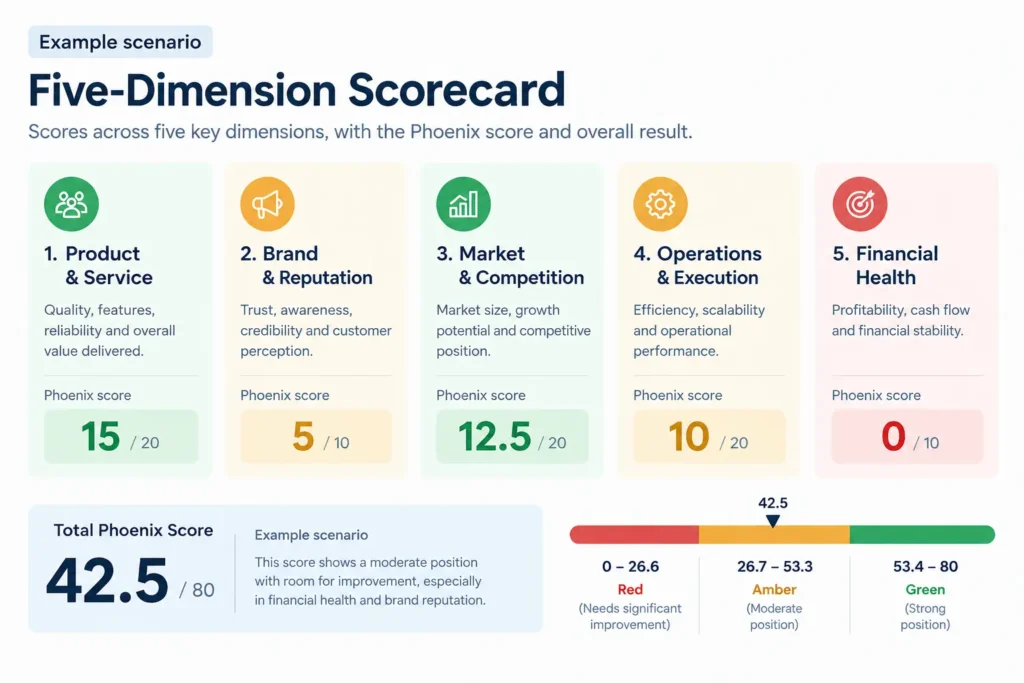
We made this one up to show the maths: a home HVAC company with 14 city pages on its main site and a commercial brand on another domain.
Phoenix gets a 3 for crawl access (15 points), a 1 for entity clarity (5), a 2 for citable content (12.5) and a 2 for off-site mentions (10). Nobody measures anything there: 0. Total: 42.5. Phoenix is 30% of the business and the other 13 cities average 58, which gives 42.5 × 0.3 + 58 × 0.7 = 12.75 + 40.6, roughly 53. A plain average would land near 57, and Phoenix’s problem would barely show.
We’d fix it in this order:
- Rebuild the location template with local facts, helping all 14 cities.
- Separate the two brands the engines had merged.
- Get Phoenix onto the local roundups the engines already cite.
Why Siloed Teams Fail This Audit
Most of these fixes cross team lines: hreflang with SEO, location pages with regional teams, mentions with PR. Fixed separately, the picture AI builds can still contradict itself. That’s why Paradigm Media Networks runs enterprise SEO and GEO as one team on one scorecard, which is how a US enterprise services client went from 0 to 34% AI citation share in six months. Our GEO services team does the work after the audit.
Frequently Asked Questions
What does an enterprise GEO audit include?
A prompt list per market, crawler checks on each host, hreflang review, entity checks, template scoring, a list of who mentions you and a baseline. Each market is scored out of 100.
How long does an enterprise GEO audit take?
Markets and templates matter more than URL count. With ten or more markets, we’d budget around three to six weeks.
How is an enterprise GEO audit different from an enterprise SEO audit?
One asks whether your pages can rank. The other asks whether AI tools mention and link to you when people in each market ask about your category.
Does ChatGPT give different answers in different countries?
Often, for anything local or commercial. It searches the web for those, and results shift with the person’s location. Test from inside each market.
How do you measure AI citations when answers change every time?
Stop changing the prompts, ask each one on three separate days and work from the average. Then compare quarter to quarter.
Where to Start
Audit your biggest-earning market first. Whatever’s broken there, usually a template or a muddled entity, tends to be broken everywhere. For a rough read, try our free AI Visibility Checker or go through Jahid’s SEO and AI search audit checklist.
SEO, GEO & Ads, Engineered for the AI Era.
About the Author
Jahid Hussain | Founder, Paradigm Media Networks
Jahid Hussain founded Paradigm Media Networks to solve a problem he kept seeing: businesses spending across SEO, ads, and content that never talked to each other. He specialises in local SEO, organic growth systems, and integrated marketing strategies that connect search, paid media, and creative into one lead generation engine. Paradigm has taken clients from zero search visibility to six-figure monthly revenue pipelines, and has been featured in IANS, Eastern Herald, Sangri Times, and Dailyhunt. Jahid operates across the US, UK, UAE, and India, and writes from the standpoint of someone who has built and broken growth systems for real businesses, not from a slide deck.
