


Quick Answer: Moving company local SEO marketing gets your business to the top of Google Maps when someone nearby searches for movers. Google weighs three signals: relevance, distance, and prominence. Get all three right and the Map Pack becomes your most consistent source of booked jobs without buying every lead.
Rather hand it over? Local SEO is the first engine of our SEO for moving companies service, run with AI visibility and paid search as one plan.
Key Takeaways
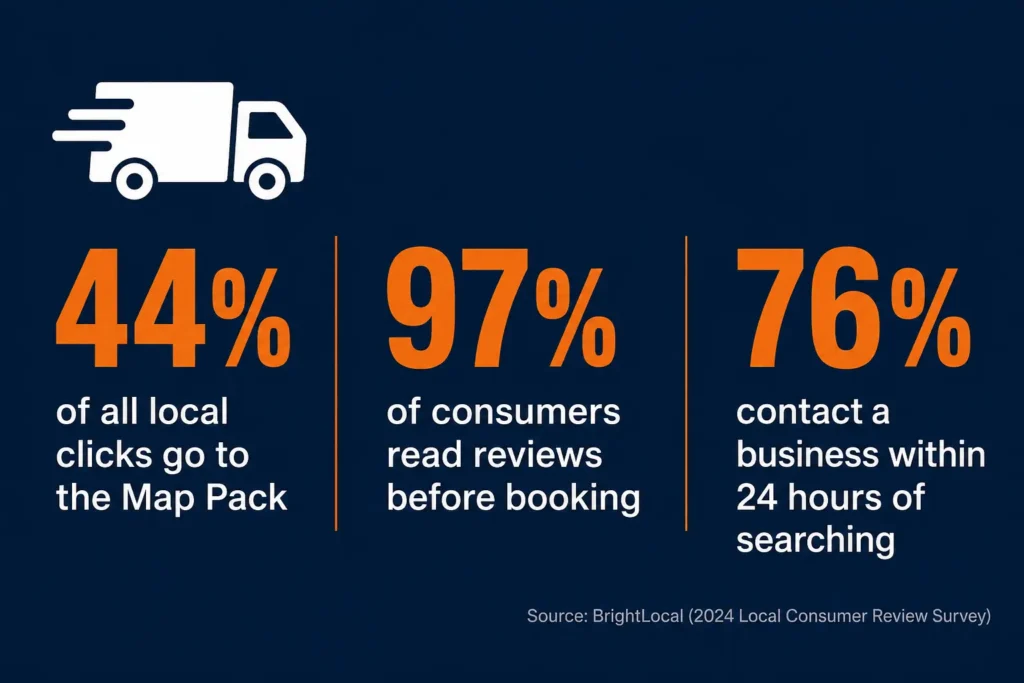
- The Google Map Pack captures 44% of all local clicks. If you are not in the top three, most ready-to-book customers never see you.
- According to BrightLocal’s 2026 Local Consumer Review Survey, 97% of consumers read reviews before choosing a local business.
- One NAP mismatch across your listings quietly erodes ranking trust you spent months building.
- Location pages with genuinely unique city content beat homepage-only strategies in every neighboring market.
- Review velocity matters more than total count. A steady weekly drip beats a burst of 50 reviews followed by months of silence.
- 45% of consumers now use ChatGPT to find local businesses. The same signals that win Maps feed AI recommendations.
Why Local SEO for Moving Companies Cannot Wait
Here is what actually happens when someone needs a mover.
See it in practice: read our Moving Hub case study to see how this approach works for a real moving company.
They just signed a lease. Or the job offer came through faster than expected. They open Google, look at the first two or three results, check who has reviews that feel current, and make the call. Not in an hour. Right then. The whole decision takes maybe 90 seconds.
If your business is not sitting in those top spots, that call goes somewhere else. Not because that company moves furniture better than you do. Because Google handed them the customer and you were nowhere to be found.
Most moving companies try to solve this with Thumbtack or HomeAdvisor or Google Ads. Those work for a while. But the cost per lead climbs every year without fail, and the day you stop funding them the phone goes quiet immediately. Moving company local SEO marketing solves a different problem. It builds something those platforms will never give you. An owned asset that generates leads while you are out on jobs, on weekends, while you sleep. One that gets more valuable over time instead of more expensive.
That is the difference. This guide covers how to build it, in the right order.
How Google Actually Decides Who Ranks
No secrets here. Just three factors Google has been fairly open about.
Relevance is how well your profile matches what someone typed. Set up your GBP for general residential moving and someone searching for office movers may not find you. Distance is physical proximity to the searcher. You cannot change where you are. Prominence is how credible and active your business looks online, built through reviews, citations, and how often you engage with your own profile.
The part most moving company owners do not account for: prominence can override distance. A competitor based across town with 300 fresh reviews and a profile that gets consistent weekly attention will regularly outrank a closer business whose owner set up the GBP two years ago and has not logged in since. Distance is fixed. Prominence is not. That is where the work goes.
Step 1: Your Google Business Profile
We work with local service businesses regularly and we see the same pattern constantly. The GBP gets set up properly in month one, collects a few early reviews, and then gets completely forgotten while the owner focuses on actually running the business. Six months later a competitor who has been posting updates every week is sitting in a top three spot that used to belong to nobody.
Your GBP is not a form you fill out and file away. It is an active signal Google monitors week after week.
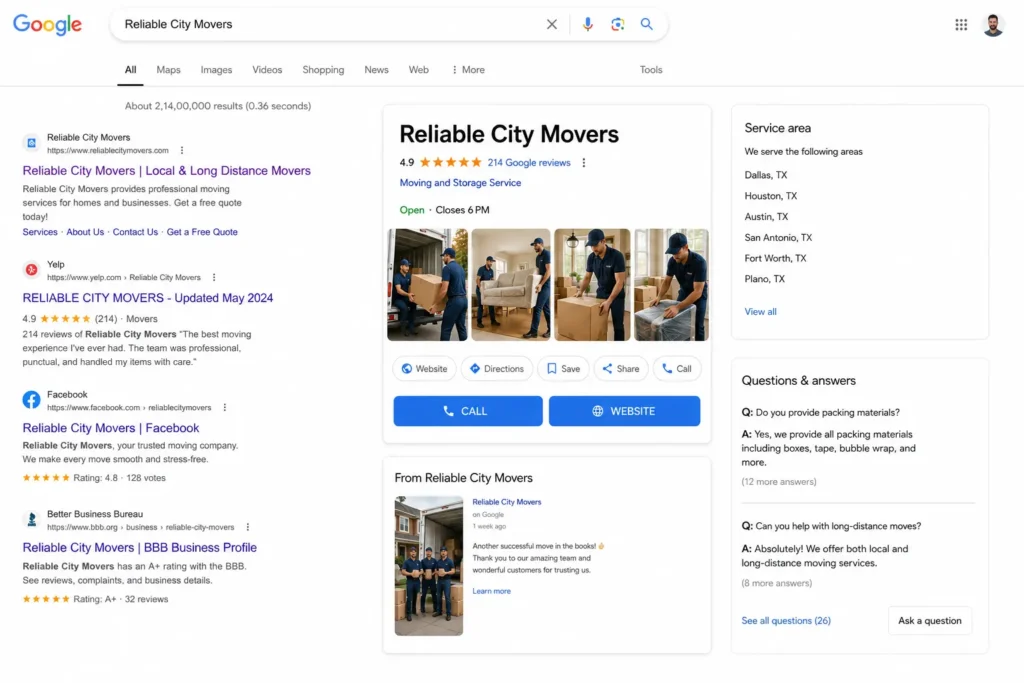
Select “Moving and Storage Service” as your primary category. Add secondary categories for anything you genuinely specialize in. List every city and zip code you actually serve, not just your headquarters location. Write individual descriptions for each service you offer rather than one vague paragraph trying to cover everything. Upload real photos of your crew at real jobs every single week. Post updates. Pre-answer the questions customers call to ask before they have any reason to call.
One small thing almost every guide skips: the attributes section. “Free estimates,” “Family-owned,” “Veteran-led.” These show up on your listing directly. When someone is comparing two profiles that look roughly similar, the one that feels like a real local business with a personality wins the call. Be that one.
Step 2: A Website That Closes the Deal
Your GBP earns the click. Your website has the next 30 seconds to turn that curious visitor into someone who actually picks up the phone.
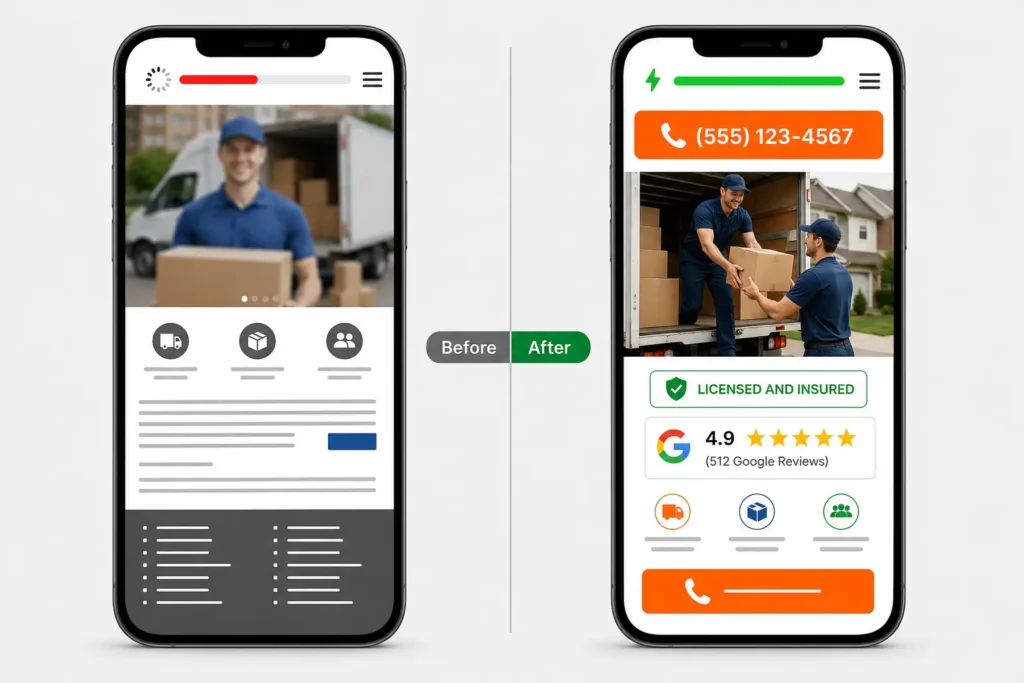
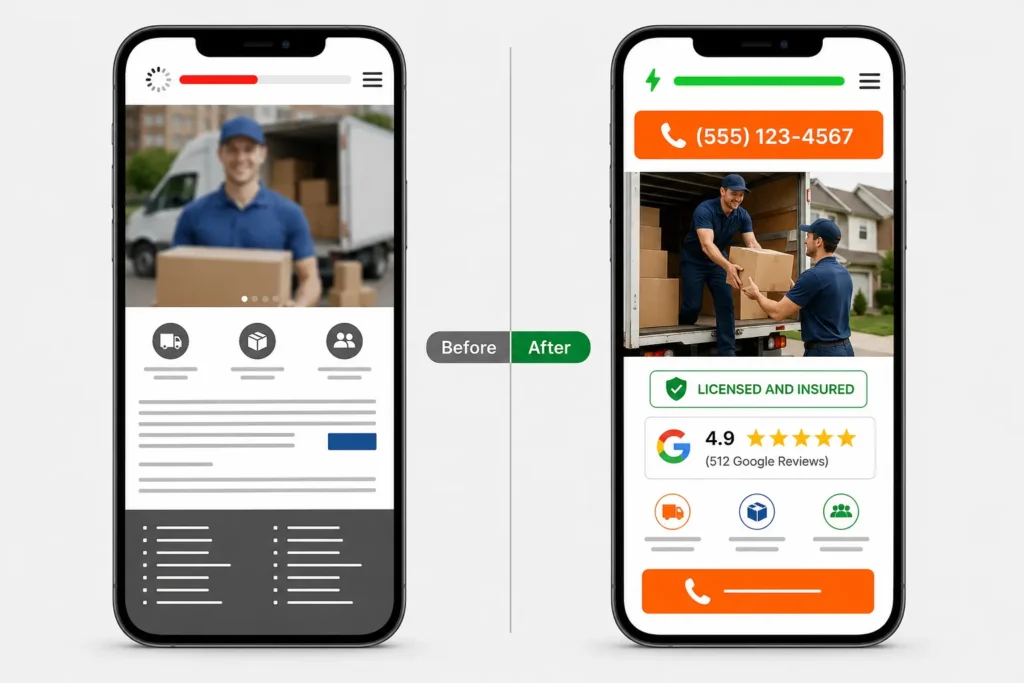
Primary keyword in the H1. Business name, address, and phone number displayed identically on every page. LocalBusiness schema installed so Google reads your details cleanly. Click-to-call button placed where a thumb finds it immediately on mobile, not buried below three paragraphs of company history. Real photos of your actual crew at actual jobs. Someone trusting strangers with everything they own on moving day wants to see real people. A stock image of a cheerful generic mover tells them nothing about who is actually showing up at their door.
Site speed matters more than most owners realize. Over three seconds to load on mobile and the majority of visitors are already gone. Run it through Google PageSpeed Insights today, not when you have time.
For a deeper look at how SEO and website structure work as one connected system rather than two separate projects, our guide on local SEO services for small businesses covers what tends to get missed when they are treated independently.
Step 3: Keywords That Actually Convert
Ranking nationally for “moving company” means competing against brands that have spent a decade building domain authority. That is not a realistic target for a local mover and frankly it is not even the right target. The customers ready to book a job tomorrow are searching for something far more specific.
| Keyword Type | Example | Intent |
| City plus service | “apartment movers in Austin TX” | Booking |
| Neighborhood | “movers in Hyde Park Chicago” | Booking |
| Move type | “long distance moving company Houston” | Booking |
| Problem-based | “how much does it cost to move a 2-bedroom” | Research |
| Near me | “moving company near me same day” | Emergency booking |
Each of these clusters needs its own dedicated page. Stack multiple keyword types onto a single page and you water down the relevance signal for all of them. Your homepage, your service pages, and your location pages should each go after something distinct and own it.
Before You Fix Anything, Find Out What Is Actually Broken
There is no point rebuilding what already works. Our free Local Visibility Scan looks at your GBP, citations, website SEO, and Map Pack positioning. You walk away knowing exactly where the gaps are before spending anything on fixes.
Claim Your Free Local Visibility Scan
Step 4: Reviews Are the Real Ranking Weapon
According to BrightLocal’s 2026 Local Consumer Review Survey, 31% of consumers will only consider a business rated 4.5 stars or higher. That number nearly doubled in one year. And 74% say reviews need to be less than three months old to actually influence their decision.
Sit with that second number for a second. A moving company with 150 glowing five-star reviews from 2023 is being quietly dismissed by nearly three quarters of potential customers today because those reviews feel old. Freshness is not just a nice-to-have. It is part of the trust signal itself.
The system that actually works in practice: send an automated text within two hours of every completed job. Not a link to your homepage. A direct link to your Google review page. Brief and human, not a corporate template. Train your crew to mention it naturally as they are wrapping up rather than reading from a script. Respond to every review within a day, including the difficult ones. A genuine, considered reply to a two-star review tells future customers more about how you actually run your business than a dozen perfect scores sitting there with no response from the owner.
Step 5: Citations and Backlinks
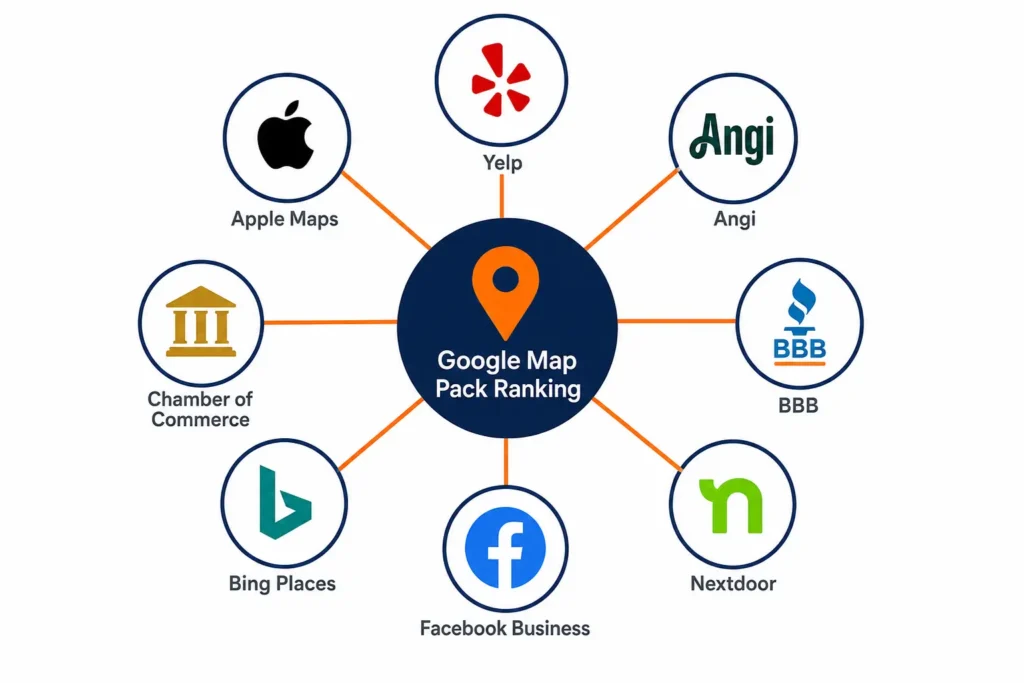
Citations are mentions of your business name, address, and phone number across directories and websites. They tell Google your business is real, consistent, and where it claims to be. The directories worth covering: Google Business Profile, Yelp, Angi, HomeAdvisor, BBB, Nextdoor, your local Chamber of Commerce, Bing Places, Apple Maps, and Facebook Business.
The thing that quietly undermines local SEO marketing for moving companies more than almost anything else is inconsistent NAP data. “Suite 200” on your website and “Ste. 200” on Yelp looks like two different businesses to Google. It sounds like nothing. The ranking impact is real. Run a citation audit through BrightLocal or Whitespark and fix every mismatch before touching anything else.
For backlinks, local and contextual beats are generic every time. Real estate agent blogs that serve your city, neighborhood association websites, local news coverage, event sponsorships that put your name on a relevant local site. These carry weight because they tie your business to your actual community rather than a directory that lists plumbers in Nebraska alongside interior designers in Singapore.
Our SEO agency builds exactly these kinds of systems, combining citations, targeted backlinks, and profile signals into one coordinated approach where every piece of the puzzle actually talks to the others.
Step 6: Location Pages for Every City You Serve
Your homepage ranking well in your primary city does absolutely nothing for you in the town fifteen minutes away. Each market you genuinely serve needs its own page built specifically for it.
A proper location page needs a unique H1 with that city in it, 400 to 600 words of content that says something specific and true about that place, an embedded Google Map, real neighborhood references that show you actually know the area, and customer testimonials from people who live there if you have them.
Copy your homepage content across twenty pages with only the city name changed and Google flags it as thin duplicate content quickly. Those pages rank for nothing and you have wasted significant time creating them.
The approach almost every competitor skips: micro-neighborhood sections. A “Movers in Chicago” page that covers Lincoln Park elevator reservation requirements, Wicker Park peak-hour parking rules, and River North HOA move-in procedures outranks generic competitor pages because nobody else sat down and wrote that specific detail. The effort is the advantage.
For how this kind of structured local content builds authority month by month, the 90-Day HVAC SEO Strategy guide uses identical content frameworks that apply directly to any local service business building organic presence from scratch.
The AI Search Layer Nobody Is Talking About
BrightLocal found the share of consumers using AI tools to find local businesses went from 6% to 45% in a single year. That is not a trend arriving in 2027. It is changing how people find movers right now, this month.
When someone asks ChatGPT for the best movers in their city, it is not running a live search. It draws on GBP data, review quality, and mentions across authoritative local sites it has already indexed. Getting your business named in “best moving companies in [city]” articles on local publications is one of the highest-leverage AI visibility moves available to a mover today.
Structure your FAQ content as direct question and answer pairs. Short, factual, specific. AI engines pull these almost word for word when recommending local service businesses.
For a practical breakdown of how AI search is reshaping local visibility for service businesses, the guide on what HVAC SEO is and how it generates leads in 2026 covers frameworks that translate directly to moving company local SEO services. Local is one layer of SEO for moving companies — here is the whole system.
Real Case Study
Sett Movers had no Google Maps presence at all when they started. No ranking, no visibility, nothing. Through consistent local SEO for moving companies, covering GBP optimization, citation cleanup, and a review process woven into their post-job workflow, they went from $400,000 to over $1,000,000 in annual revenue inside two years.
A separate case study from MapRanks tracked a home services business climbing from page two of Google Maps to the top three Map Pack positions in six months. Profile calls more than doubled. Website clicks rose by more than 70%. Revenue climbed 40%.
The pattern holds everywhere we look. Early results appear between months three and six. By month twelve, businesses that stayed consistent own positions generating leads without paid spend propping the whole thing up.
What Most Guides Get Wrong
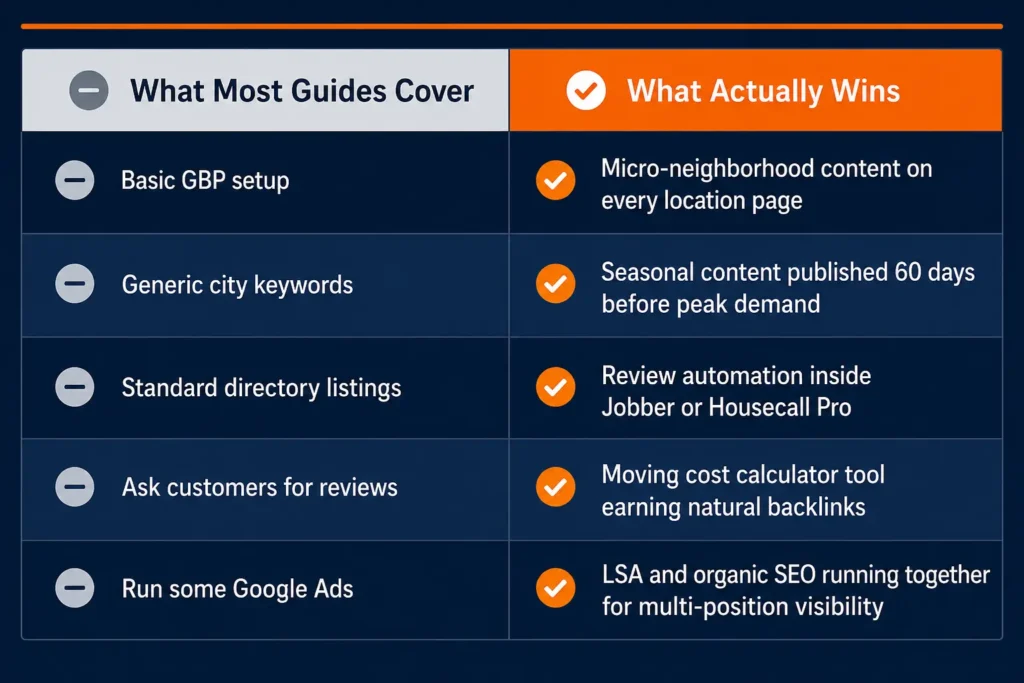
After going through the top five ranking articles for moving company local SEO marketing, the same gaps keep showing up.
Seasonal keyword timing. Peak moving season is May through September. Publishing “summer movers [city]” content in February gives those pages months to age and rank before demand peaks. Not one competitor guide treats publish timing as a deliberate strategic decision.
Review automation inside job management software. Housecall Pro, Jobber, and ServiceTitan can send an automated review request the moment a job is marked complete. The pipeline runs itself. Nobody explains how to actually set that up.
Moving cost calculators. An interactive estimator keeps visitors engaged longer and earns natural backlinks from real estate and relocation sites. Almost no moving company website has one despite how obvious the opportunity is.
Google Local Services Ads working alongside organic SEO. LSAs appear above the Map Pack. Run both and your business occupies multiple positions on the same results page simultaneously. How your organic signals feed LSA quality scores is something almost no practical guide addresses.
Expert Tip
Jahid Hussain, Founder of Paradigm Media Networks, on why strong moving companies keep losing Map Pack spots to competitors doing inferior work:
“The businesses we see stuck on page two are not there because they did anything wrong. Most of them actually did a solid job setting things up. What happened is they stopped. Life got busy. The jobs were coming in from other sources and the profile just sat there. Meanwhile a competitor who posts a photo on Monday, replies to reviews on Tuesday morning, and spends maybe 90 minutes a week on their GBP maintenance ends up sitting above them. Nobody beat them with a clever algorithm trick. They just kept showing up after everyone else stopped. That really is the whole game.”
FAQ
How do I get my moving company to show up on Google Maps?
Claim your Google Business Profile and select “Moving and Storage Service” as your primary category. List every city and zip code you serve. Upload real crew photos weekly and build a consistent flow of Google reviews. Your business name, address, and phone number must match exactly across your website and every directory. These are the core signals Google weighs when deciding who gets a Map Pack spot.
How long does local SEO take for a moving company?
Most moving companies see initial Map Pack movement within three to four months. Meaningful organic ranking gains arrive between months six and nine. Businesses that stay consistent usually hold stable top positions by month twelve, with cost-per-lead declining steadily from there.
How much does local SEO cost for a moving company?
Most moving companies invest between $1,000 and $3,500 per month. Where you land depends on how competitive your market is, how many cities you serve, and what the scope covers. Citation cleanup, content, and link building all push the number in one direction or the other.
What actually makes a moving company rank higher than local competitors?
Three things done without stopping: an actively maintained Google Business Profile, a consistent flow of fresh reviews at 4.5 stars or above, and unique location pages for every city you serve. Most competitors let at least two of these slide. Staying consistent on all three puts you ahead of the majority in almost any market.
Should a moving company run Google Ads alongside local SEO?
Yes and they work better as a pair than either does alone. Google Local Services Ads appear above the Map Pack so running both means your business shows up in multiple positions on the same results page at once. Your organic SEO signals also feed your LSA quality score directly, so the two channels reinforce each other rather than pulling budget in different directions.
Your Competitors Are Getting Called Right Now
Strong moving companies lose booked jobs to average ones every single day because the average company showed up first on Google. The quality of your work only matters once someone can actually find you.
We audit your moving company local SEO from the ground up. GBP health, citation accuracy, website technical issues, Map Pack positioning. Then we build you a specific, prioritized plan at no cost.
Not a templated report with suggestions that could apply to any business in any city. A real breakdown of what is holding your specific company back in your specific market, with a clear and honest path forward.
Get Your Free Local Visibility Scan Today
About the Author
Jahid Hussain is the Founder of Paradigm Media Networks, a full-stack growth agency serving businesses across the US and UK. He has 7 years of experience in growth marketing, SEO and performance marketing, has worked with multiple B2B firms, and holds an MBA in Marketing. He builds local search systems for service businesses that generate compounding organic leads rather than campaigns that reset every month. Paradigm has been featured in IANS, Eastern Herald, and Sangri Times.
