


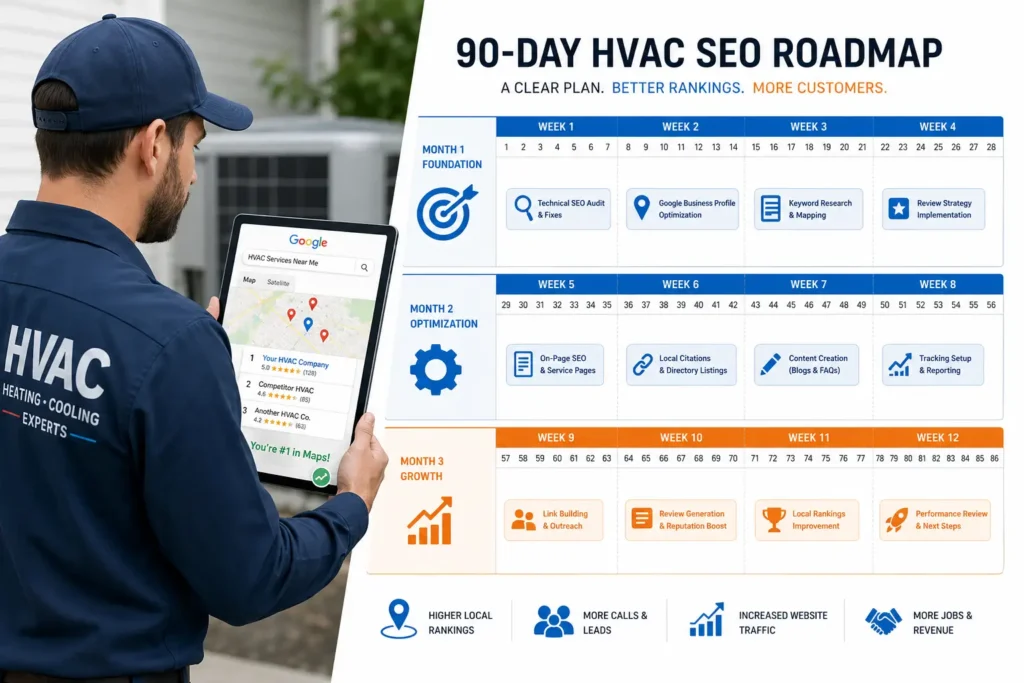
A solid HVAC SEO strategy works in three phases. Month 1 is your foundation: technical fixes, Google Business Profile, keyword mapping. Month 2 builds local authority through service pages, city pages, and a review system. Month 3 activates your compounding engine with link building and AI search visibility. Do this in order and qualified calls start coming in by day 60 to 90.
Here is something that should bother you. According to SearchLight Digital’s Q4 2025 HVAC SEO ROI study, HVAC companies running organic SEO saw a median return of 27.46x, with top performers exceeding 60x, across 1.42 million leads and $791 million in tracked closed revenue.
Google Ads for HVAC averaged $45 per lead that same year. You are paying per call for something you could own permanently.
See it in practice: our HVAC SEO case study shows how one single-location contractor went from 10 to 80+ inbound calls a month in four months with no ad spend.
The problem most HVAC contractors run into is not effort. It is sequence. Most SEO guides hand you a list of 40 tactics with no sense of what matters first, what depends on what, or what you should realistically expect by when. That is what this plan fixes. You get 90 days broken down by month, with specific actions and honest timelines based on how Google actually works in 2026.
Why 90 Days Is the Right Time Frame for HVAC SEO
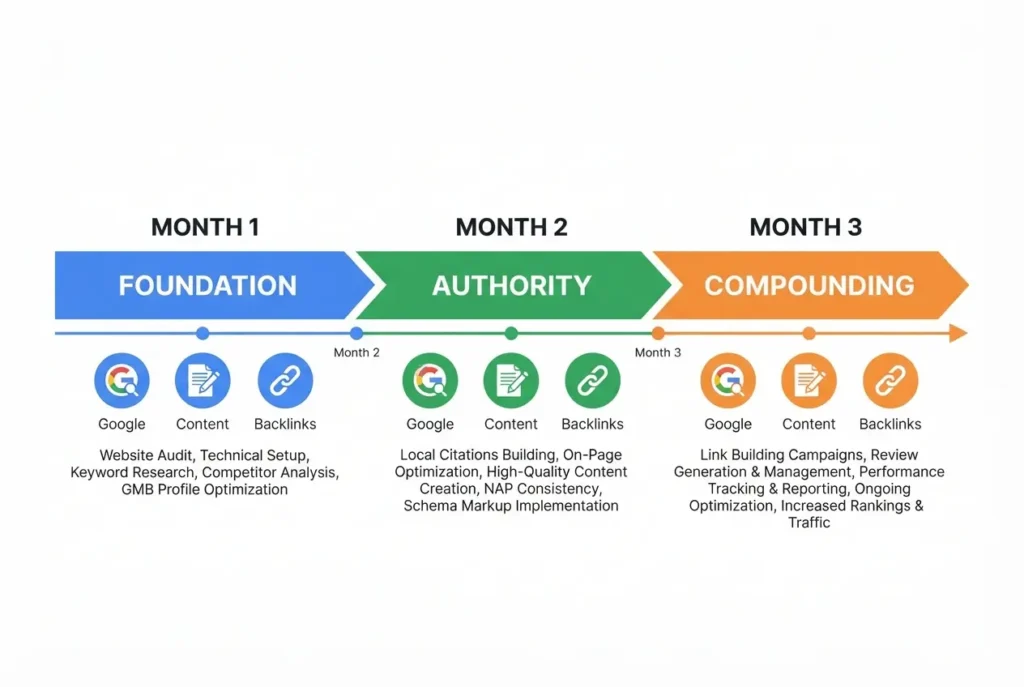
Think about how a furnace installation works. You do not turn it on and expect heat before the pipework is done. SEO is the same. Skip the foundation and nothing above it holds.
The 90-day frame maps directly to how Google processes changes to your site and local presence:
- Technical fixes register in crawl within days
- GBP improvements shift local pack visibility within 2 to 4 weeks
- Citations take 4 to 8 weeks to propagate across directories
- New content starts building ranking momentum at 60 to 90 days
According to Marketing LTB’s 2026 HVAC Marketing Statistics, HVAC companies with blogs generate 67% more monthly leads, and 62% of HVAC leads come from search engines. That is not a side channel. That is your main channel waiting to be built.
Three Things Most HVAC Businesses Get Wrong With SEO
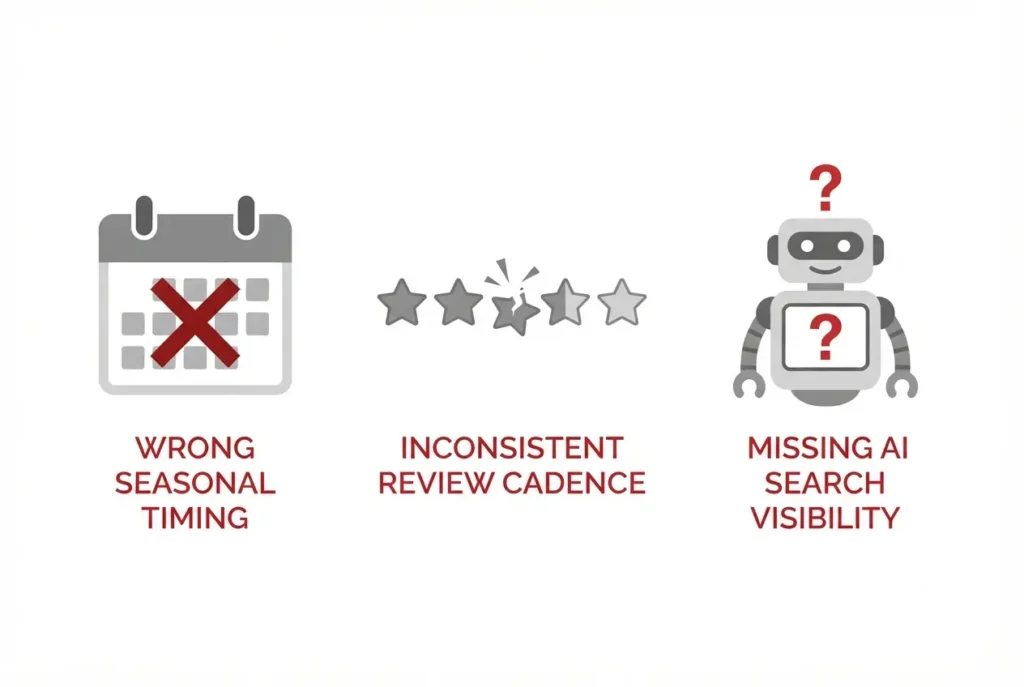
We work with service businesses week in and week out. The mistakes that slow HVAC companies down are almost always the same three.
Seasonal timing is off. Most HVAC businesses publish content when demand is already spiking. A “furnace tune-up” blog in November is already racing against pages that were indexed weeks ago. Your content needs to be live and indexed before the season, not during it.
Reviews are treated as a task, not a system. Getting reviews is not the strategy. Running a consistent review cadence is. Google reads review recency as an activity signal. A business that collected 50 reviews eight months ago and has had nothing since looks dormant to the algorithm, regardless of what is actually happening at the business.
AI search is completely ignored. Homeowners now ask ChatGPT and Google AI Overviews who to call for AC repair. Your website content and GBP signals directly affect whether your business appears in those answers. Most HVAC companies have no plan for this. Month 3 covers exactly what to do.
Month 1: The Foundation Sprint (Days 1 to 30)
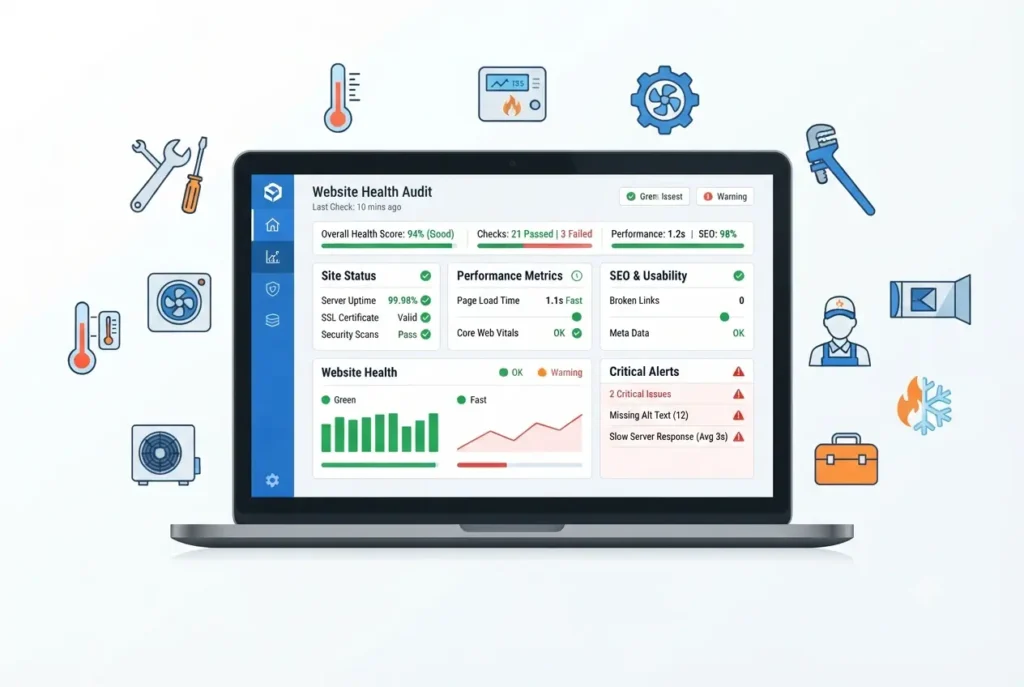
Month 1 is not about publishing content or chasing rankings. It is about making sure everything underneath is clean and crawlable before you build on top of it.
Fix What Is Broken First
Run your site through Google Search Console, Screaming Frog, and PageSpeed Insights. Look for:
- Crawl errors and broken internal links
- Pages loading slowly (fast-loading HVAC sites convert 50% better)
- Missing or duplicated title tags and meta descriptions
- Mobile usability errors (60% of HVAC emergency calls come from mobile search)
- Any pages without HTTPS
The single most common issue we find on HVAC websites is service pages with fewer than 300 words and no internal links pointing to or from them. Google cannot rank pages it cannot clearly understand.
Get Your Google Business Profile Right
Your GBP drives more local calls than most HVAC websites. Treat it accordingly:
- Make sure your Name, Address, and Phone number matches your website exactly
- Set HVAC Contractor as your primary category
- Upload at least 15 real photos of your team, vehicles, and finished jobs (listings with photos get 42% more requests)
- Write a business description that includes your city name and main services
- Pre-fill your Q&A section with the questions homeowners actually ask
Map Your Keywords Before Writing Anything
One page, one search intent. Before writing a word of content, map each keyword cluster to a specific page:
- Service intent: “AC repair [city],” “furnace installation [city]”
- Emergency intent: “AC not working [city],” “no heat emergency near me”
- Cost intent: “how much does AC installation cost”
- Maintenance intent: “HVAC tune-up checklist”
This stops your pages competing against each other and helps Google understand exactly what each page is for.
Need help structuring this? Our HVAC SEO agency builds and runs this full 90-day plan for contractors.
Your website might be actively costing you bookings right now and you would not necessarily know. We audit HVAC websites every week. Get a free audit and find out exactly where you are losing ground to competitors.
Month 2: The Authority Build (Days 31 to 60)
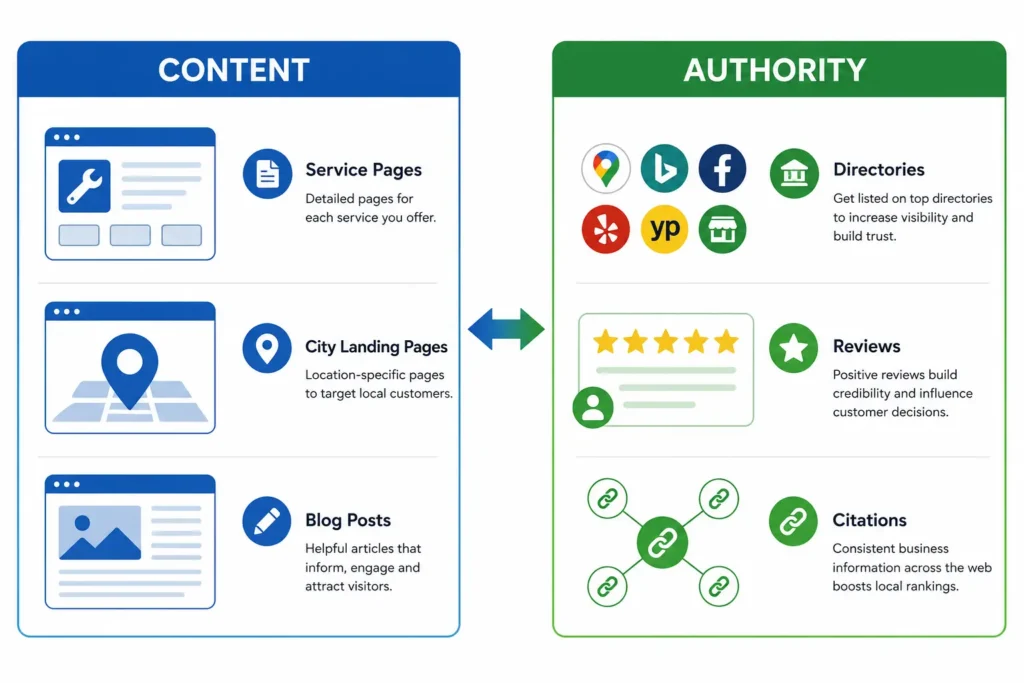
Month 2 is where the visible work starts. You are building the pages, citations, and review signals that local rankings actually depend on.
Build Service and City Pages That Mean Something
A page that says “We offer AC repair. Call us today.” is not going to rank. Here is what an effective service page actually includes:
- H1 with your service and city (“Furnace Installation in Denver, CO”)
- 800 to 1,200 words of genuinely useful content written for a homeowner, not a search engine
- References to local areas, neighbourhoods, and common local HVAC problems
- A FAQ section with real questions homeowners search for
- At least one or two authentic customer testimonials
- A clear, visible call to action with a phone number
If you serve multiple cities, build a dedicated page for each one. Do not try to cover five service areas on a single page.
Get Your Seasonal Timing Right
| Season | Peak Search Window | Publish Content By |
| Summer AC season | June to August | April |
| Fall furnace tune-up | September to October | July |
| Winter emergency heating | December to January | October |
| Spring HVAC maintenance | March to April | January |
Publishing during peak season means competing against pages that have been indexed for weeks. Publishing ahead of season means you are already ranking when homeowners start searching.
Build Citations and Clean Up Inconsistencies
Submit your business to core directories (Google, Yelp, Bing Places, Apple Maps), HVAC-specific platforms (Angi, HomeAdvisor, Thumbtack), and local directories (chamber of commerce, local news sites). Every listing needs identical NAP information. A single inconsistency in your address format across 30 directories adds up and weakens your local signals.
Run a Review System, Not a Review Request
Send a text with a direct GBP review link within two hours of every completed job. Respond to every review within 24 hours. Aim for 4 to 6 new reviews per month minimum. ServiceTitan data found automated review request systems produced a 70% increase in review volume within six months. You do not need special software to start. A saved SMS draft with your GBP link is enough.
For how this connects to a broader local SEO approach, read our Local SEO Playbook for HVAC Contractors.
Month 3: The Compounding Engine (Days 61 to 90)
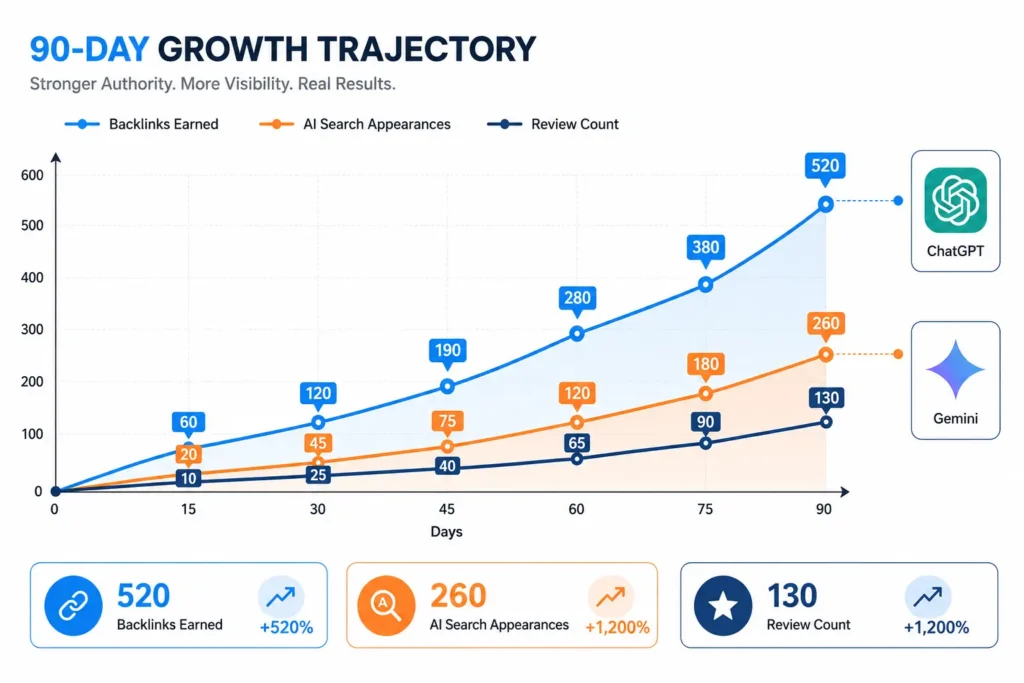
By Month 3, your foundation is solid and your authority is building. Now you make both of those things compound.
Earn Links Without Buying Them
- Check whether your equipment suppliers (Carrier, Trane, Lennox) list certified dealers on their website and ask to be added
- Write a practical seasonal piece for a local homeowner blog or neighbourhood publication
- Look at ACCA, RSES, and your state contractor association for member directory listings
- Reach out to local real estate agents whose clients might benefit from a referral to a trusted HVAC company
For how paid and organic can support each other at this stage, see our performance marketing services.
Get Your Business Into AI Search Answers
When a homeowner types “best HVAC company near me” into ChatGPT or Google AI Overview, the answer comes from structured data, citation consistency, FAQ content, and review strength. In Month 3:
- Add LocalBusiness and Service schema to every service page
- Write FAQ sections as direct question-and-answer pairs, not buried paragraphs
- Make sure your business appears consistently on Yelp, Angi, the BBB, and at least one local news source
Our HVAC SEO Checklist That Gets Your Phone Ringing walks through the AI optimisation steps in more detail.
Check Your Internal Links
Every page on your site should connect to at least two other relevant pages. Your homepage should link clearly to your main service pages. Each service page should link to the relevant city pages. If a page is sitting with no internal links pointing to it, Google is unlikely to prioritise it.
Real Case Study: From Zero to 194% More Organic Leads
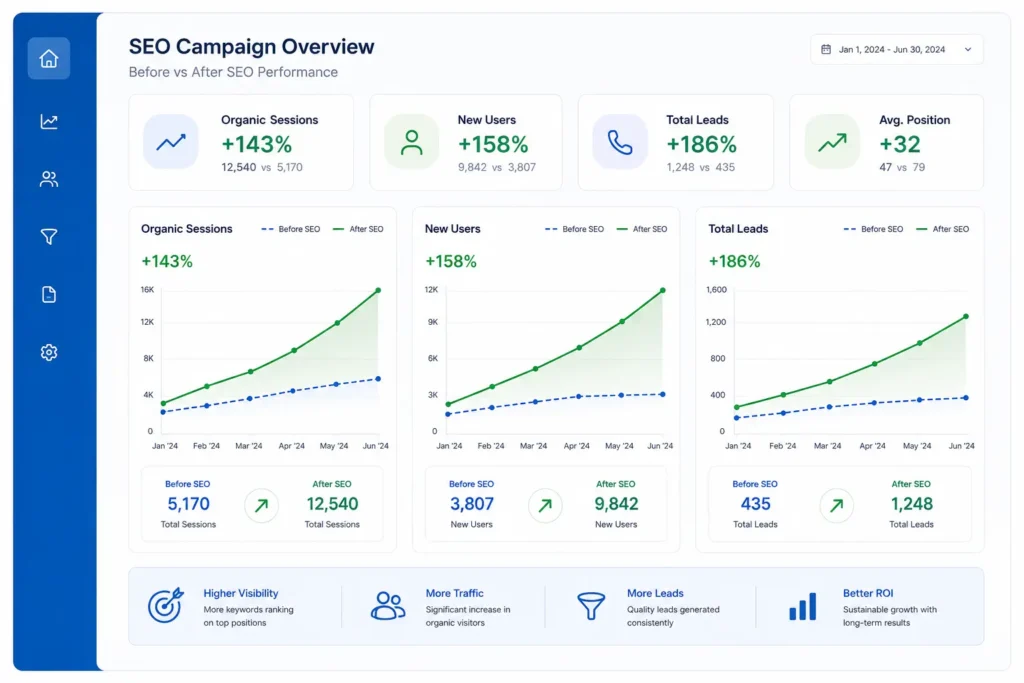
One HVAC company documented by Macro Digital Media started from near zero. No real GBP presence, thin service pages, and a site taking over four seconds to load. Their first 90 days followed this exact sequence.
By the end of the campaign:
- Organic sessions grew 69% year-over-year
- New organic users increased 84.5%
- Total organic leads rose 194%
- Click-to-call leads from GBP jumped 359%
Month 1 was the technical overhaul and GBP rebuild. Month 2 was service pages and citation cleanup. Month 3 brought in local content and a proper review system. No paid shortcuts. No black-hat tricks. Just the right HVAC SEO strategy done in the right order.
What Happens After Day 90
Amber DeLong, VP of DeLong and Sons HVAC: “The companies I see holding their rankings are not doing anything clever. They are just consistent. New GBP photos every month. A blog every couple of weeks. Answering every review within a day. That consistency is the whole strategy.”
From our team at Paradigm Media Networks: The most predictable way to lose rankings after a strong 90 days is to stop publishing. Companies build solid pages, start ranking, and then go quiet. Google treats that quiet as a signal. Commit to at least one new piece of substantive content per month, and more during your peak seasons. It is not about volume. It is about keeping the signal alive.
90-Day HVAC SEO Plan at a Glance
| Month | Focus | Key Actions | Expected Outcome |
| Month 1 | Foundation | Technical audit, GBP rebuild, keyword mapping | Crawl health, GBP visibility |
| Month 2 | Authority Build | Service and city pages, citations, review system | Early rankings, local pack movement |
| Month 3 | Compounding Engine | Link building, AI search, internal linking | Traffic growth, qualified call volume |
Frequently Asked Questions
What is the best HVAC SEO strategy for getting more local leads?
The most effective HVAC SEO strategy for local leads combines a fully optimised Google Business Profile, location-specific service and city pages, and a consistent citation build across HVAC and local directories. Done in sequence over 90 days, this builds into a reliable organic lead channel that costs far less per lead than paid alternatives.
How long does HVAC SEO take to show results?
Most HVAC SEO strategies start moving GBP and local pack visibility within 30 to 60 days when technical and GBP work is done correctly. Content-driven rankings for competitive city-level terms take 4 to 8 months to mature. Organic lead volume is typically measurable by day 90.
What HVAC keywords should I target first?
Start with high-intent local service terms like “AC repair [city]” and “furnace installation [city].” Then add emergency intent terms and cost comparison searches. Map each cluster to a single dedicated page so your pages are not competing against each other for the same searches.
How much does HVAC SEO cost per month?
HVAC SEO costs typically range from $1,500 to $5,000 per month depending on market size and scope. That cost per lead is substantially lower than Google Ads, which averages $45 to $149 per HVAC lead.
Does HVAC SEO work for AI search engines like ChatGPT?
Yes. HVAC SEO strategies built around schema markup, consistent citations, FAQ-formatted content, and strong review signals are exactly what AI engines like ChatGPT and Google AI Overviews reference when recommending local HVAC providers. Optimising for Google and AI search is now largely the same work.
Stop Paying for Leads You Could Be Earning
Your competitor down the street is booking jobs from free organic search while you are paying $45 to $149 per lead to platforms that own the customer relationship, not you. This 90-day plan is exactly how that gap closes.
The work is not complicated. But it does require the right sequencing, consistent execution, and attention to detail that is genuinely hard to maintain when you are also running a team and dispatching jobs.
That is what we do at Paradigm Media Networks. We build HVAC SEO systems that generate consistent inbound calls from homeowners who are already looking for exactly what you offer.
Book Your Free Strategy Call Now and walk away with a full audit of your current rankings, a clear competitor gap breakdown, and a real 90-day roadmap built for your market. No pitch decks. No vague promises.
Author Bio
Written by the Paradigm Media Networks Strategy Team Paradigm Media Networks is a full-service growth marketing agency working with HVAC contractors, independent technicians, and multi-location HVAC companies across the US and UK. We help heating and cooling businesses rank for high-intent local searches and convert that traffic into booked service calls. Featured in IANS, Eastern Herald, and Sangri Times.
