



Think of a website migration SEO checklist as insurance for launch week. Every page earning you traffic, links or leads has to survive the move. You benchmark the old site, map each old URL to a new one with a 301, test staging, double-check redirects and sitemaps on launch day, then keep an eye on Search Console for about three months. Most losses come down to boring stuff, like a forgotten URL or a staging noindex that sneaked onto the live site.
Key Takeaways:
- One 301 per old URL, aimed at its nearest match.
- Lock staging with a password. Noindex tags love following you to production.
- Changing domains is the scary one. Expect months of recovery, not weeks.
You’ve probably watched this happen. The new site is quicker and prettier, everyone signed it off, and three weeks in, organic leads start slipping. Ask which pages vanished and the room goes quiet. The site works fine. It just doesn’t rank like the old one.
Why Migrations Lose Traffic: It’s an SEO Project With a Development Deadline
Most migrations are run as development projects, with SEO squeezed in near the end. A developer is done when the new site loads. Search isn’t done until every old URL lands on the right new page.
Jahid’s view is that this is backwards. A migration is an SEO project that happens to have a development deadline, so one person owns the redirect map from week one and can delay launch if redirects aren’t tested.
And it’s not only Google traffic on the line. Your old URLs also live in Google Ads, old email footers and your Google Business Profile. An SEO agency working alone checks rankings and stops there. A team running search, ads and the website together is more likely to check everywhere people arrive from.
We ran the same checks moving our own /seo-agency-india/ page to /seo-services/. Nothing fancy, really. One 301 straight to the new page, internal links changed to skip the redirect, then watching Search Console as the new page picked up the old one’s queries.
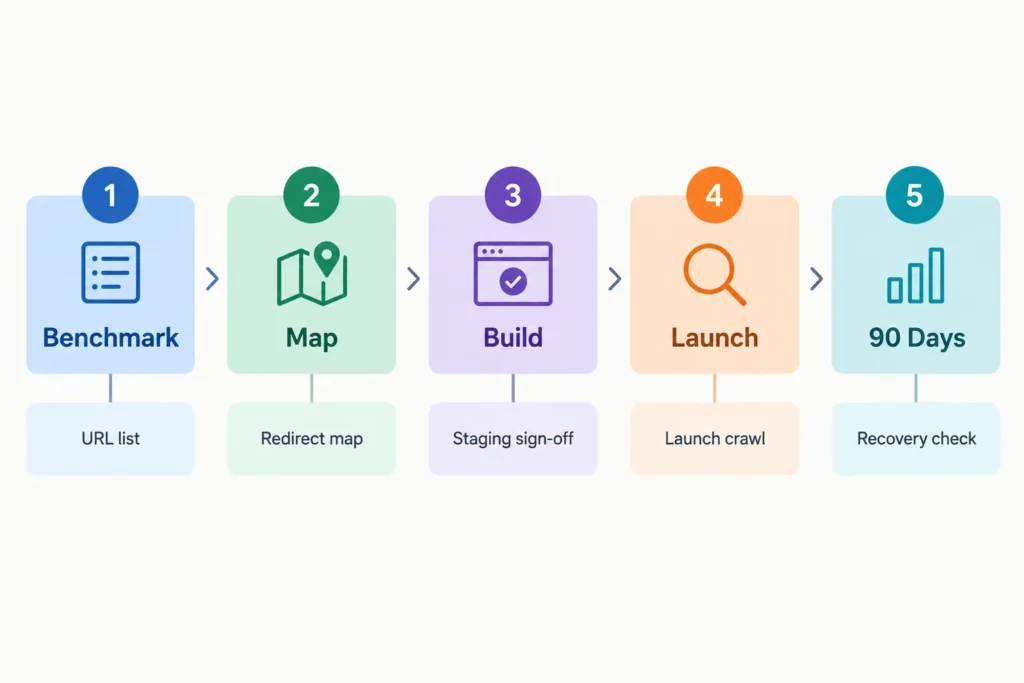
Phase 1 of the Website Migration SEO Checklist: Write Down What’s Working
- Export the full 16 months of Search Console data by page and query. That’s all Google keeps.
- Pull 12 months of GA4 conversions by landing page. A modest-traffic page is sometimes your best lead source.
- Crawl the live site with whatever you already pay for. Screaming Frog and Sitebulb both work.
- Pile the crawl, Search Console, GA4, sitemaps and a backlink export into one big URL list. Backlink data turns up pages nobody remembers.
- Write down rankings for the keywords that make you money, not the ones that just look nice in reports.
- Mark each URL keep, merge or remove.
Phase 2: Build Your 301 Redirect Map
If one document decides whether rankings survive, it’s this spreadsheet. Old URL, clicks, referring domains, action, new URL, redirect type, tested or not, and owner will cover you.
- Pair every old URL with its nearest match, one to one. Switching platforms shuffles paths too (Shopify files products under /products/ whether you like it or not).
- Resist dumping everything on the homepage. Google says piles of redirects to an unrelated page can be treated as soft 404s.
- Some pages honestly have no replacement. Let those return a 404 or 410.
- Stick with 301s or 308s. Google counts a permanent redirect as a canonical signal. A 302 basically says you might change your mind.
- Hunt down redirect chains. Your last migration probably left a few behind.
- Get SEO and dev in one room to sign the map off before the build freezes.
Phase 3: Poke Around Staging Before Launch
- Protect staging with a password. A staging noindex has a nasty habit of getting copied across at launch.
- Keep the titles, meta descriptions, H1s and copy on your best pages. Sometimes the paragraph a designer cut was the one doing the ranking.
- New URLs get canonical tags pointing at themselves.
- Internal links should go straight to final URLs, never through a redirect.
- Don’t forget structured data, hreflang and image URLs. People always do.
- Run the whole redirect map against staging and check Core Web Vitals.
Our SEO-friendly website development guide has a longer pre-launch list.
Not sure your redirect map is complete? Get a free migration risk check before the launch date is fixed.
Phase 4: On Launch Day
- Strip out whatever hid staging: the password, robots.txt disallow lines and every last noindex tag.
- Once redirects are live, crawl your old URL list. Each should hit one 301, then a working page.
- Check robots.txt still allows Googlebot, Bingbot and AI crawlers. Here’s how to keep AI crawlers’ access after launch.
- Submit your new XML sitemap in Search Console.
- Changed domain? Use the Change of Address tool for every verified version of the old one.
- Fill in a form yourself and make sure the conversion actually shows up in analytics.
Phase 5: The Next 90 Days
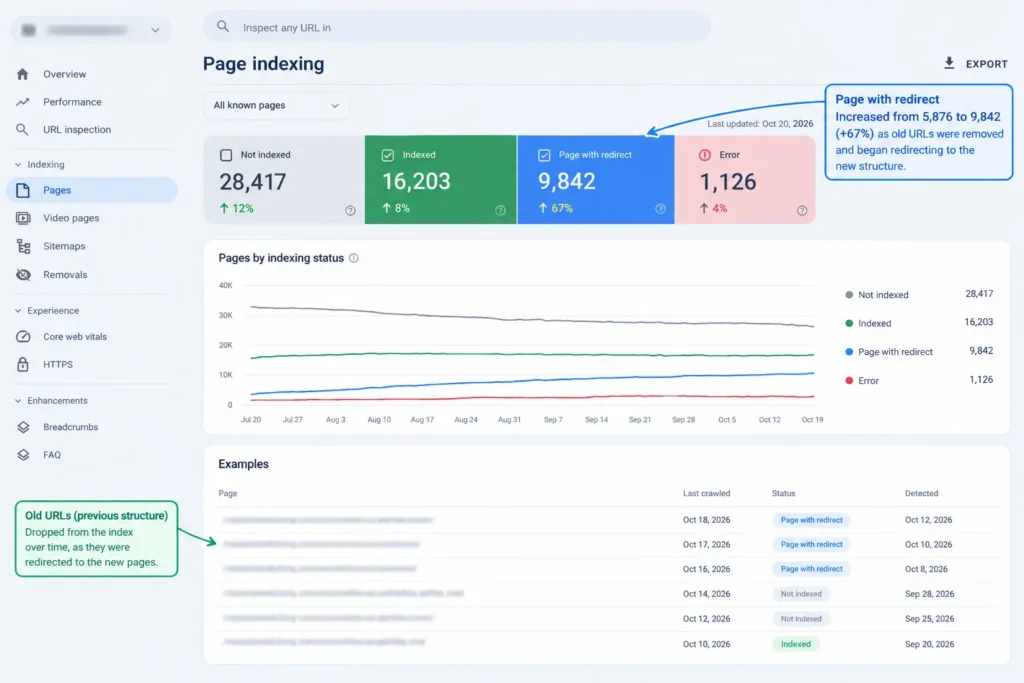
- For two weeks, check the Page indexing report every morning with your coffee.
- Once a week, line up clicks by page against your benchmark.
- Any 404 still getting traffic or links? Redirect it.
- Fix your own ad and profile links, and ask for valuable external links to be updated.
- Crawl again at 30, 60 and 90 days.
- Leave the redirects in place for generally at least a year, and keep the old domain.
For small and medium sites, Google reckons most pages move over within a few weeks. Domain changes drag on. A study of 892 domain migrations put the average at 523 days to win back estimated organic traffic, and 17% still hadn’t after 1,000 days.
So is your drop normal? Look at where the traffic went. A small dip spread across lots of pages, easing as new URLs get indexed, is the move settling. Losses on a handful of pages mean something’s broken, so check those redirects first.
Common Website Migration Mistakes
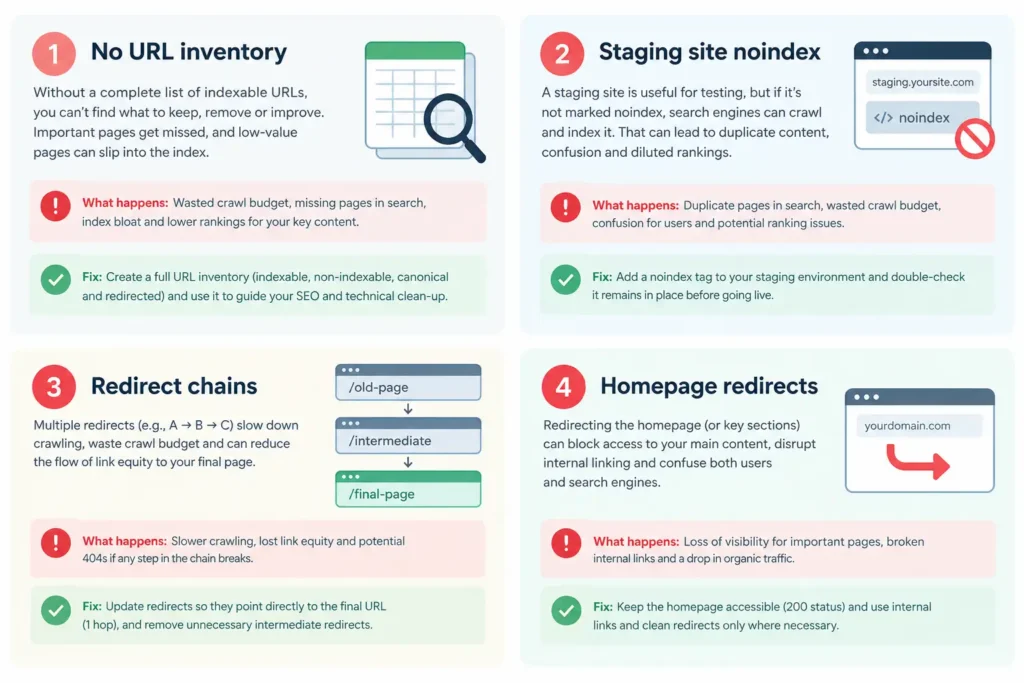
| Mistake | What happens | Fix |
| Skipping the URL inventory | Pages with links get no redirect | Pull from five sources |
| Staging noindex ships | Site falls out of Google | Use a password instead |
| Leaving redirect chains | Slower crawling | Go straight to the final URL |
| Sending everything home | Soft 404s | Map one to one |
Our HVAC website examples post has a cautionary note about merged city pages. Bigger moves fall under our technical SEO services and website design and development work.
Common Questions About Website Migrations
Do I lose SEO if I change my domain name?
Usually some, for a while. One-to-one redirects, a Change of Address and keeping the old domain usually shorten the dip.
How long does it take to recover rankings after a website migration?
Same domain? Things often calm down within weeks. A new domain is a different animal and can take months, so have that chat with your boss before launch, not after.
What should I check in Search Console after a site migration?
I’d open Page indexing first, then sitemaps, then Performance by page. You’re hoping to see old URLs slowly dropping out while new ones take their place.
How do I create a 301 redirect map in a spreadsheet?
Old URLs in column A, clicks and backlinks beside them, then the new URL, redirect type and a pass or fail. Sort by clicks so the pages that pay the bills get checked first.
Should I hire an SEO company to manage a website migration?
With hundreds of URLs, a domain or platform switch, or nobody in-house with time to own the redirect map, it’s usually worth it. Ask how they test redirects and how long they keep watching.
Got a Migration Coming Up in the Next Few Months?
Start the URL list this week, before design locks in your URL structure. Want a second opinion? We’ll go through your redirect map and tell you which pages worry us. Paradigm Media Networks: SEO, GEO & Ads, Engineered for the AI Era.
About the Author
Jahid Hussain | Founder, Paradigm Media Networks
Jahid Hussain founded Paradigm Media Networks to solve a problem he kept seeing: businesses spending across SEO, ads, and content that never talked to each other. He specialises in local SEO, organic growth systems, and integrated marketing strategies that connect search, paid media, and creative into one lead generation engine. Paradigm has taken clients from zero search visibility to six-figure monthly revenue pipelines, and has been featured in IANS, Eastern Herald, Sangri Times, and Dailyhunt. Jahid operates across the US, UK, UAE, and India, and writes from the standpoint of someone who has built and broken growth systems for real businesses, not from a slide deck.
