



By Jahid Hussain, Founder, Paradigm Media Networks · Published 7 October 2026
SaaS SEO is how a software company gets in front of buyers in two places now: Google’s results, and the shortlists ChatGPT, Perplexity and Google’s AI Mode give people who ask which tool to buy. The same work covers both. You need pages built around what buyers are trying to decide, a site that crawls cleanly, a brand described the same way everywhere, and other websites that genuinely vouch for you.
Key Takeaways:
- Ranking without getting mentioned by AI engines is half a win.
- Your keywords fall into four tiers: problem, category, comparison and vendor. Each needs its own page.
- Comparison pages earn money long before how-to posts do, so build them early.
- Sessions are the wrong scoreboard. Watch demos, trial conversions and how often AI engines mention you.
Where Most Guides Stop
Most guides on this topic read like the same checklist. Find keywords, plan some posts, get a few backlinks, done. For them, Google is where the story ends.
It isn’t anymore. A sales director picking a CRM today might well open ChatGPT, type “best CRM for a 20-person sales team,” and get four names back. That’s her shortlist. If you aren’t one of the four, ranking sixth for “sales CRM” won’t rescue you.
A quick word on where we stand. We sell this work, through our B2B SaaS SEO agency team and our wider SEO services, so we have a stake in the topic. What follows is what we’d tell a software founder before they spend money with anyone, us included. Every statistic links to its original source, and the one client result we use is our own.
What Is SaaS SEO?
It’s the work of making sure a software product shows up, in search engines and in AI answers, whenever someone researches the problem it solves, the category it sits in or the vendors they’re weighing up. Keyword research, technical fixes, content and links still do most of the lifting, for AI answers too.
Software is a different animal from, say, shoes. Nobody signs a three-year contract on a whim, and it usually takes a few approvals and a trial first. Three hundred visitors who run sales teams are worth far more than thirty thousand students looking up “what is a CRM.”
What Changed for Software Buyers
Search has always suited software, mostly because it gets cheaper the longer you stick with it. A comparison page that ranks can pull in demos for years after an ad would have stopped.
The research has moved. G2’s 2026 Buyer Behavior Report, a survey of more than 1,000 software buyers, found that over 80% had taken recommendations from an AI chatbot in the previous two years. Buyers who did were also more likely to purchase from their first shortlist. On Google, a March 2025 analysis by Pew Research Center found people clicked a regular result on 8% of visits when an AI summary appeared, against 15% when there wasn’t one.
So fewer people click through, but the ones who arrive have often already put you in the running. We keep these figures in our AI search statistics 2026 roundup.
How SEO for SaaS Differs From Regular SEO
Three things make SEO for SaaS a different job.
The Person Who Finds You Isn’t the One Who Pays
Your champion might be a sales ops manager, but finance wants pricing, IT wants security documentation, and the VP wants to know what changes for her team. Speak only to the champion and deals die in meetings you never hear about.
Buyers Take Steps, Not One Search
People rarely start with “Chili Piper pricing.” First there’s a problem (“why do so many demo bookings no-show?”). Then a category (“sales scheduling software”), then a head-to-head (“Calendly vs Chili Piper”), and only then the vendor. Each step deserves its own page.
Trial Companies and Demo Companies Need Different Pages
If people can sign up free, your pages should get them into the product and stay out of the way. If they have to book a demo, they need more convincing first: proof, honest answers and a rough idea of cost.
There’s a mistake Jahid Hussain runs into a lot. A demo-led company copies a freemium brand’s content plan, publishes a few hundred how-to posts, then can’t understand why traffic doubled while demos stayed flat. The articles were fine. They just never gave anyone a reason to talk to sales.
Mapping Keywords to How Buyers Actually Decide
We split the bottom of the usual funnel into two, because a buyer comparing two tools and a buyer ready to pick a vendor want very different pages. Here it is with our own keywords:
| Tier | What the searcher wants to know | Live example | Page type | What you want them to do |
| Problem | Why isn’t our organic traffic producing demos? | why saas traffic doesn’t convert | Blog guide | Join the email list |
| Category | What is this, and how does it work? | saas seo | Pillar guide | Try a free tool, keep reading |
| Comparison | Which approach suits our stage? | seo for saas vs paid ads | Comparison page | Put you on their shortlist |
| Vendor | Who can do this for us, and for how much? | saas seo agency | Service page | Book an audit or a call |
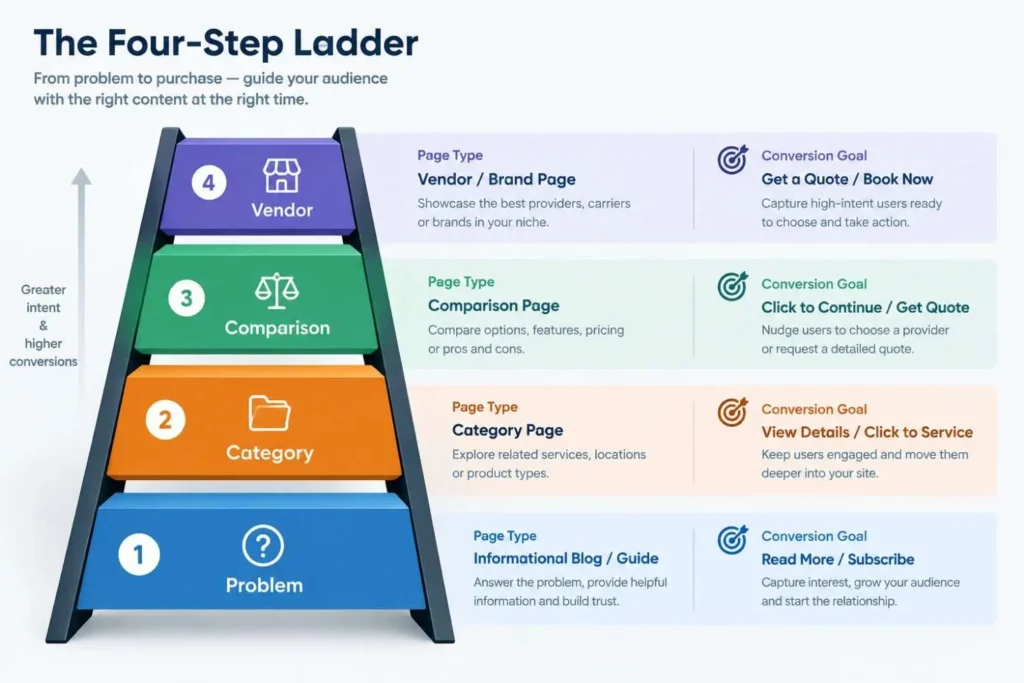
This guide is the category page and our agency page handles the vendor row, so they don’t compete in Google. Give each page on your site one main job, plus a link that invites the reader one step further.
Keyword tools miss most of what people ask ChatGPT. Our guide to LLM keyword research shows how to find those questions. Just don’t build a page for every variation. Google treats pages made mainly to catch rephrased queries as scaled content abuse.
Where Product Sites Trip Up Technically
On software sites, technical problems tend to start the same way, with bits of the product creeping into the marketing site.
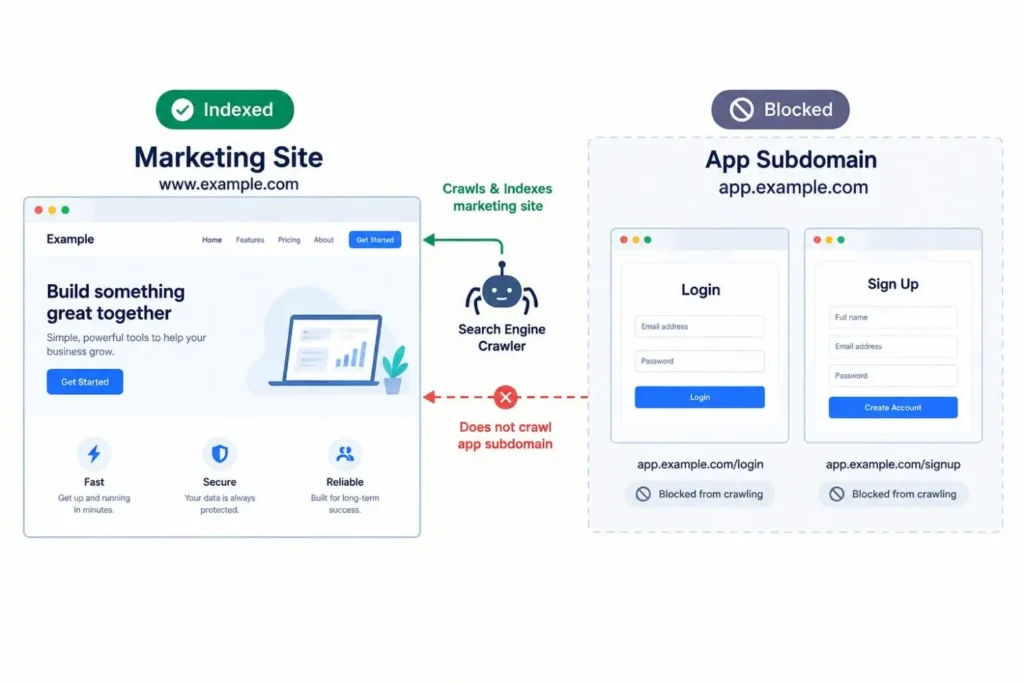
Keep the App Out of Google
Login pages, signup steps, account settings, the app subdomain: Google needs none of it. Block the app from crawling and noindex thin public pages.
Make Sure Pages Work Without JavaScript
Plenty of marketing sites are built as single-page apps, which can look like an empty page to a crawler. Many AI crawlers don’t run JavaScript at all. If a page matters, render it on the server.
Add Structured Data, Honestly
Product pages should carry SoftwareApplication markup that matches what’s visible on the page. Only show star ratings if the reviews are real and independent.
Don’t Overthink llms.txt
Google’s own guide to optimizing for generative AI features says you don’t need new AI text files or special markup to appear in Search, and calls optimizing for AI search “still SEO.” Your hour is better spent elsewhere.
When Jahid isn’t sure about a page, he asks whether a buyer would ever search for it. If the answer’s no, it stays out of the index. For heavier clean-ups, our technical SEO services cover audits and fixes, and our LLM technical SEO guide covers AI crawler access. For the full list, our SaaS technical SEO checklist turns these into 14 fixes engineers can ship.
The Pages Worth Building First
Good software content works like a relay, each page handing the reader to the next.
Pillar pages, like this one, own a broad category term. Comparison pages (“your product vs a competitor”) catch people weighing two options. Write them fairly. Readers can smell a hatchet job. Alternatives pages reach people already fed up with their current tool, often your warmest visitors. Integration pages answer “will this work with our stack?”
If the budget only stretches to one type, make comparisons, since the people reading them are close to deciding.
Write for whoever’s reading. Google says there’s no need to chop content into tiny pieces for AI. Answer early, call things by their name, and use a table when you’re comparing. Our guide on how to structure content so AI engines cite it goes deeper.
Not sure which of these pages your site is missing? Book a free growth audit or grab a 30-minute call. Or start with Jahid’s free SEO and AI search audit checklist.
How AI Engines Decide Which Vendors to Recommend
The AI companies don’t publish their formula. In the visibility checks we run, though, engines tend to favour vendors they can identify confidently, that independent sites describe consistently, and whose pages give a clear answer to repeat.
Make Yourself Easy to Recognise
Use the same company name, category description and product names on your site, review profiles and directories, connected with Organization schema and sameAs links. If your homepage calls you a “revenue platform” while G2 lists you under “sales engagement,” the model has to guess what you are. Our piece on LLM entity SEO goes deeper.
Let Real Customers Describe You
In the same G2 research, review sites (38%) narrowly beat AI chatbots (37%) as the biggest influence on which vendors made a shortlist. Chatbots read those profiles too, so a neglected G2 page hurts you twice. Ask happy customers for reviews. Don’t buy them, and disclose any incentive clearly. Google also says chasing inauthentic mentions across the web doesn’t help.
Give Engines Something Safe to Quote
Engines repeat what they can repeat accurately, so clear pricing and honest comparison tables help. Hide your pricing and an engine may fill the gap with some third-party estimate you never agreed to.
Perplexity searches the live web, so freshness matters more there; see how to rank on Perplexity. If GEO, AEO and SEO are blurring together, our GEO vs SEO vs AEO comparison sorts them out in one table.
Check Where You Stand
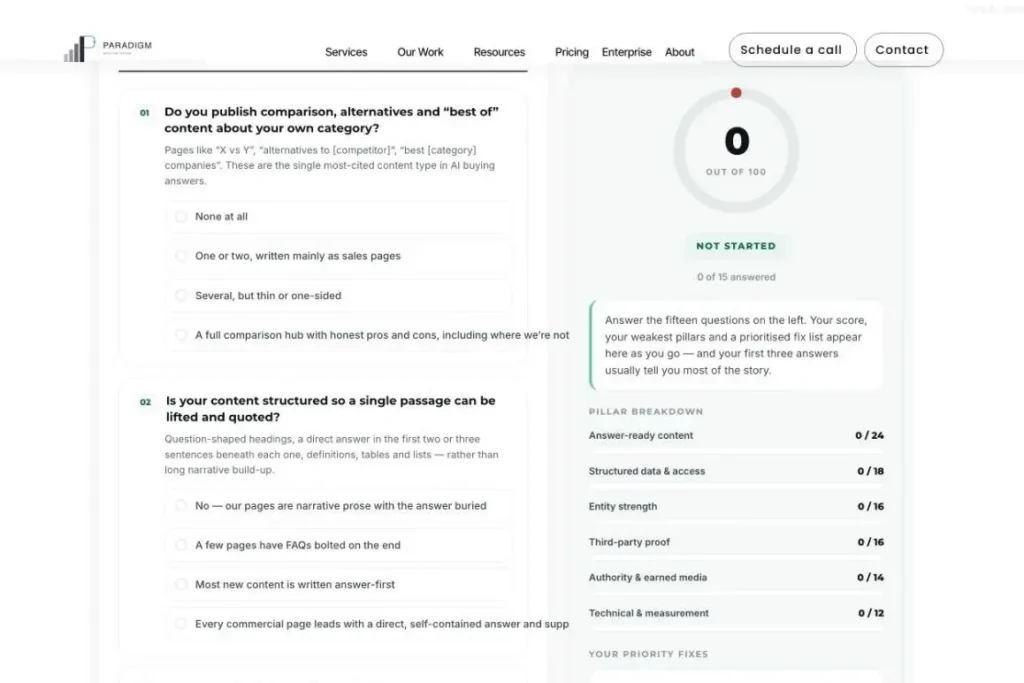
Run your domain through our free AI Visibility Checker using three or four prompts a real buyer might type, like “best scheduling tool for sales teams.”
- You’re not mentioned anywhere. Usually weak brand signals.
- You’re mentioned but described wrongly. Your site and reviews disagree.
- A competitor gets cited from its comparison page. That’s your next page.
Treat results as a snapshot, since AI answers shift daily. That check is where our generative engine optimization services begin.
Getting Links Without Buying Them
Good links come from things people genuinely need to point to. Original data beats almost everything else, because even a modest anonymised benchmark gives writers a number to quote. A useful free tool, like a calculator, keeps picking up links for years.
Skip paid links tucked into unrelated blog posts. They break Google’s spam policies, and the value they seem to add can disappear overnight.
What to Measure Instead of Sessions
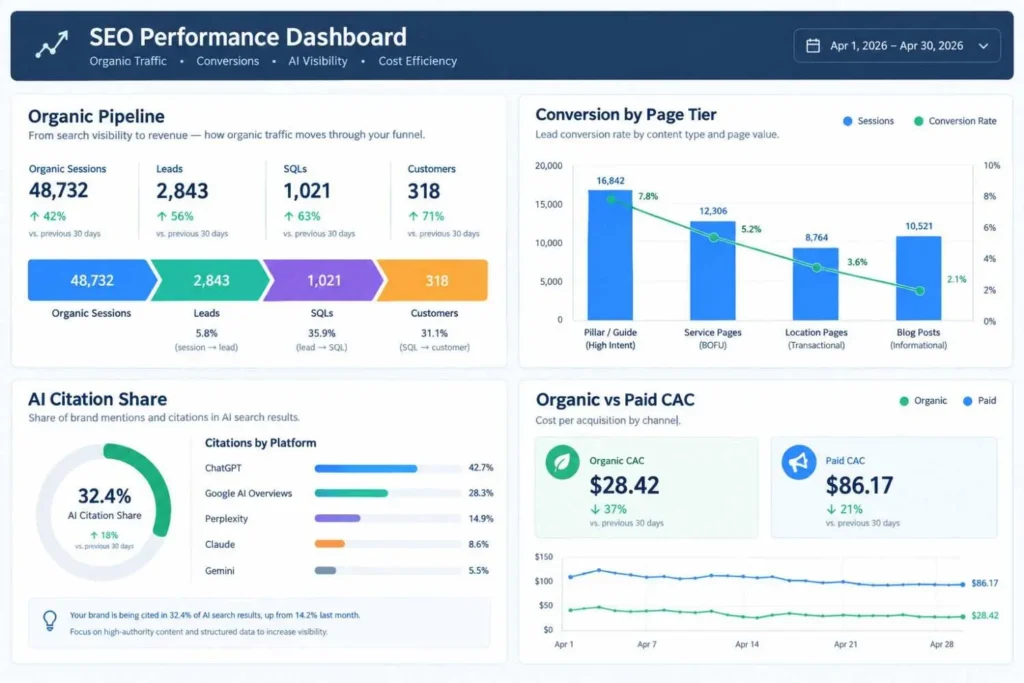
It’s common to see traffic climbing in the same quarter the pipeline goes flat. Track these instead:
- Pipeline that organic search created or helped create.
- Conversion rate for each tier of page.
- Top-three rankings for commercial terms.
- How often AI engines mention you across a fixed list of buyer prompts, checked monthly.
- Organic customer acquisition cost next to paid. Your CFO will ask.
Add a free-text “How did you hear about us?” box to your demo form. Buyers will tell you about ChatGPT even when analytics can’t.
Should You Start With SEO or Paid Ads?
Usually both, with paid first as the cheap way to learn. Ads show within weeks what converts, and SEO turns those winners into pages that keep converting without a click cost.
Things go sideways when two vendors run the two channels and never talk. You end up paying for clicks on terms your blog already ranks for. Paradigm Media Networks is a full-stack growth agency, not a siloed vendor. SEO, GEO, performance marketing, SEO-friendly website development and creative strategy sit with one team and answer to one number: revenue.
Hiring a SaaS SEO Agency vs Building In-House
In-house works if you already have a content lead, a writer who knows the product and engineers who’ll ship fixes. A SaaS SEO agency makes more sense when you need technical, content and AI visibility skills at once.
When talking to agencies, ask to see a pipeline report from a current client. A screenshot of rankings proves very little. Ask who owns the content if you part ways. And be wary of anyone who guarantees rankings or AI mentions, because nobody can. Our contracts say the client keeps its content and data and gets a proper handover. See how we run enterprise SEO and GEO for B2B SaaS, and our pricing plans are public.
Proof From Moving Hub
Moving Hub is a US moving company rather than a software business, so take this as proof the method works, not as a SaaS benchmark. We sorted their search terms into intent tiers and built 300 programmatic SEO pages around high-intent service searches, each covering a real service area. Within four months the site ranked for more than 600 keywords, and monthly revenue went from $0 to over $100K. The Moving Hub case study has the details.
Your First 90 Days
Month One
Fix technical problems, check how your brand is described online, run a first AI visibility check and map your keywords into the four tiers.
Month Two
Build comparison and alternatives pages, refresh your pillar page and add structured data.
Month Three
Publish one piece of original data, ask customers for reviews and set up reporting that tracks the pipeline.
Frequently Asked Questions
What does SEO for SaaS actually involve?
It’s getting a software company seen in Google and AI answers while buyers are researching. What you’re after is trials and demos, more than raw traffic.
How long does it take to see results?
Early movement on easier commercial terms often shows within three to six months. Pipeline impact tends to arrive between six and twelve months, depending on your site’s starting point and competition.
How much does it cost?
It depends on the size of your site, how much content you need and whether technical and AI visibility work are included.
Does AI search replace traditional SEO?
No. Google itself says optimizing for AI search is still SEO, and AI engines lean on the same indexed web. You also need consistent brand signals and genuine coverage on other sites.
Should we start with SEO or paid ads?
Start with paid search to learn what converts, then build organic pages around the winners.
Do we need an agency, or can we do this in-house?
In-house works if you have a content lead and engineering time. An agency is quicker when you need technical, content and AI visibility skills together.
The Short Version
Build a page for each step buyers take. Keep your app out of Google. Describe your company the same way everywhere. Judge it by pipeline. Ranking gets you considered, and getting mentioned gets you shortlisted.
Get Your Software on the Shortlist
If competitors keep showing up in ChatGPT answers and you don’t, that’s fixable.
About the Author
Jahid Hussain | Founder, Paradigm Media Networks
Jahid Hussain founded Paradigm Media Networks to solve a problem he kept seeing: businesses spending across SEO, ads, and content that never talked to each other. He specialises in local SEO, organic growth systems, and integrated marketing strategies that connect search, paid media, and creative into one lead generation engine. Paradigm has taken clients from zero search visibility to six-figure monthly revenue pipelines, and has been featured in IANS, Eastern Herald, Sangri Times, and Dailyhunt. Jahid operates across the US, UK, UAE, and India, and writes from the standpoint of someone who has built and broken growth systems for real businesses, not from a slide deck.
