



An LLM keyword strategy maps the questions buyers type into ChatGPT, Perplexity and Google’s AI Overviews to the keywords you already rank for. It then groups them by topic and intent, so one page can answer both. Start with your top 20 Google keywords, rewrite each one as 3-5 natural questions, and give each group a single page.
Key Takeaways
- AI Overviews now appear on roughly 48% of tracked Google searches as of early 2026, and the rate is far higher for question-based and informational queries. (BrightEdge data via sqmagazine.co.uk
- Question-style queries trigger AI summaries roughly 60% of the time, compared to a small fraction of short one- or two-word searches. (Pew Research data via aeovision.ai
- Brands cited inside AI-generated answers earn about 35% more organic clicks and 91% more paid clicks than competitors who aren’t cited on the same query. (Seer Interactive data via thestacc.com
- Entity-based topic clusters — not single keyword-optimized pages — are what AI systems reward with topical authority and citation.
- LLM keyword research maps intent layers (informational, comparative, commercial), not just search volume.
Search has changed. And honestly? Most businesses haven’t caught up yet.
We’ve all watched AI reshape how people find information. They’re not typing “best marketing tools” anymore — they’re asking full questions like they would to a friend. And that’s where LLM keyword research becomes your competitive advantage.
What Is LLM Keyword Research and How Does It Work?
LLM keyword research is the process of understanding how Large Language Models interpret search queries — mapping the natural-language questions, entities, and semantic relationships AI systems use to connect topics, rather than optimizing for short phrases and volume metrics alone.
Think about how you use ChatGPT or ask Google a question now. You’re conversational. You’re specific. You’re asking what you actually want to know.
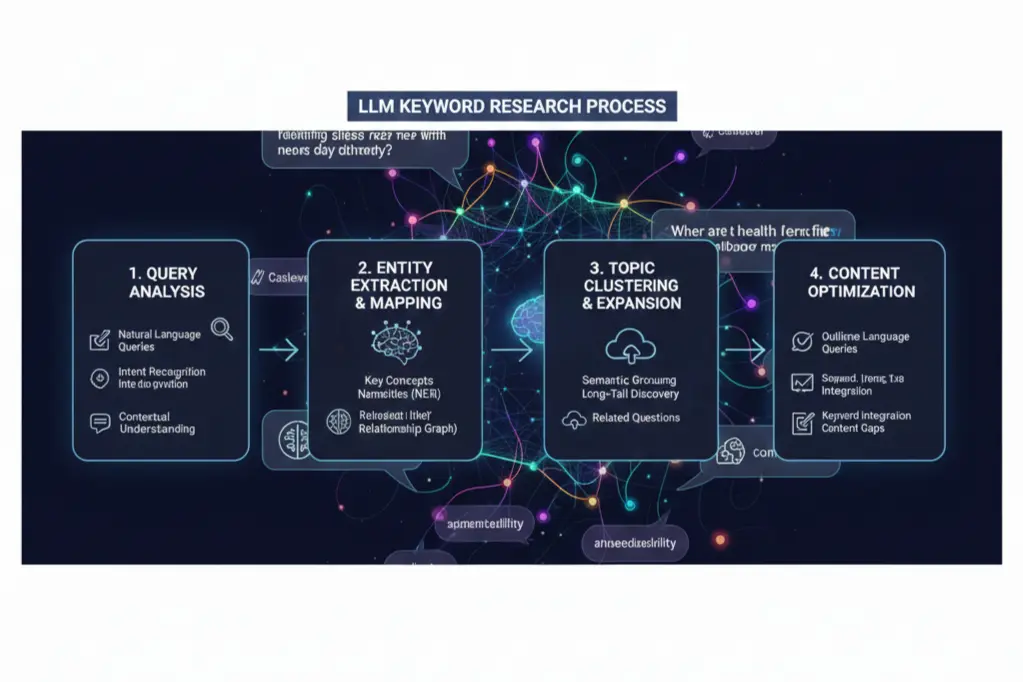
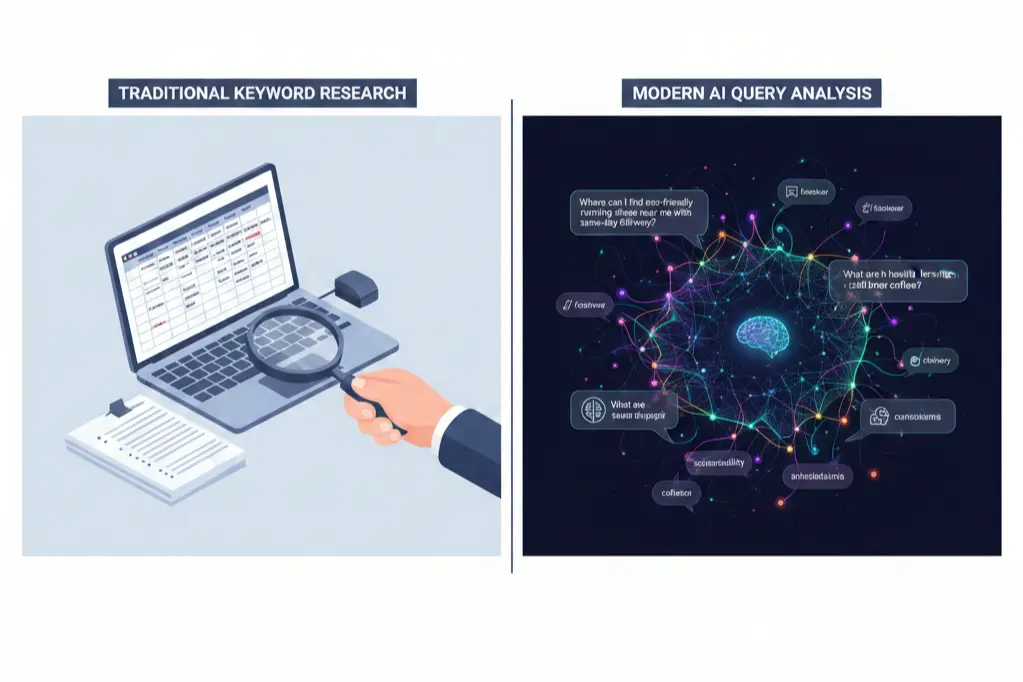
Traditional keyword research focused on short phrases, volume metrics, and competition scores. LLM keyword research digs deeper into:
- Natural language patterns people actually use
- How AI models connect topics and entities
- The intent behind multi-sentence queries
- Semantic relationships that traditional tools miss
Google isn’t just matching keywords anymore — it’s understanding meaning. Learn more in our LLM SEO pillar page for a complete guide to AI-first optimization strategies.
How Do Traditional Keyword Patterns Differ from AI Query Patterns?
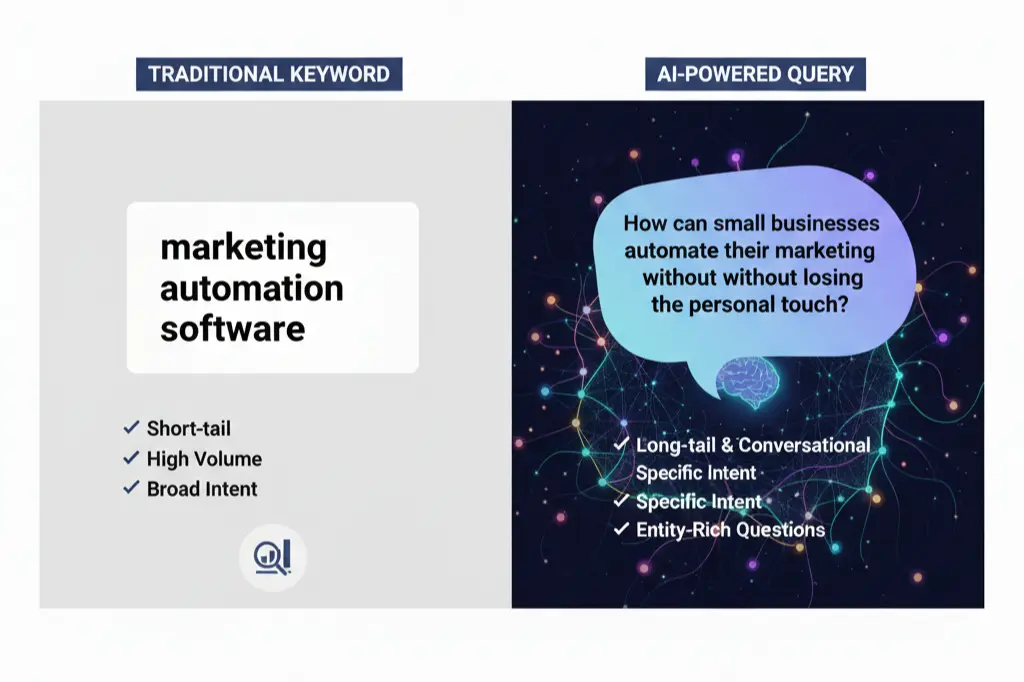
Here’s a pattern we see constantly: a business optimizes for a keyword like “content marketing tools” — good volume, decent competition — and traffic stays flat. The problem is that people aren’t searching that way anymore. They’re asking things like: “What’s the best way to plan content when you’re working with AI-generated articles?”
| Traditional Keyword Patterns | AI Query Patterns |
|---|---|
| Short 2–4 word fragments | Full, complete sentences |
| Predictable phrase variations | Conversational, natural tone |
| Single intent per query | Multiple layered intents |
| Optimized for volume and competition scores | Optimized for context and meaning |
Pew Research data shows that AI-generated summaries appear in roughly 60% of searches phrased as full questions, compared to a much smaller share of short-keyword searches.
An effective LLM keyword strategy needs to bridge this gap. If you’re optimizing for yesterday’s search behavior, you’re invisible to today’s AI systems.
What Are Entity-Based Keyword Clusters and Why Do They Matter?
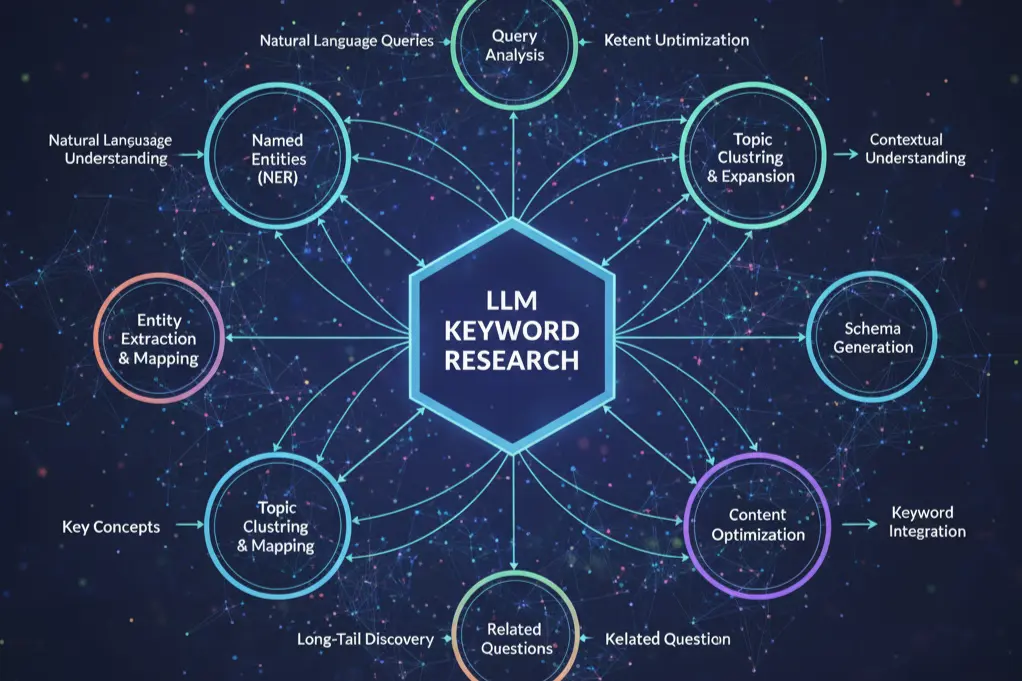
Entities are what AI models really care about — not just keywords, but the things behind them: people, topics, concepts, processes, industries. Everything that forms the knowledge graph AI systems use to understand content.
Entity-based keyword clusters create semantic webs that signal topical authority to AI models. AI systems rank content based on topical depth now. One article about “email marketing” won’t cut it. But a cluster covering email deliverability, list segmentation, automation workflows, GDPR compliance, and performance metrics signals real expertise.
Enterprise-level LLM keyword strategies use these clusters to:
- Strengthen your authority signals
- Improve AI Overview visibility
- Capture long-tail, high-intent traffic
- Support conversational queries naturally
Case study: Moving Hub. For Moving Hub, a US long-distance mover, we built answer-first cost and route guides plus about 300 programmatic route and city pages around the questions buyers actually ask. The site went from no organic traffic to 600+ ranked keywords in four months, and the brand is now named by five AI assistants. (Read the Moving Hub case study)
Discover proven LLM content optimization techniques that transform how AI systems interpret and rank your content.
How Do You Map Long-Form Queries for LLMs Effectively?
Long-form queries are where the real opportunity lives. Someone searching “What content marketing strategy works best for B2B SaaS companies trying to break into enterprise accounts?” isn’t browsing — they’re ready to engage.
Mapping these effectively means understanding:
- User motivation — What outcome are they chasing?
- Layered intent — Are they researching, comparing, or ready to buy?
- Context signals — Industry, company size, pain points mentioned
- Entity connections — How this query relates to broader topics
Working with an LLM keyword strategy expert means investing in this precision mapping, because capturing long-form queries means capturing users at peak interest — traffic sitting there waiting, often completely missed by competitors still targeting short-tail phrases. Prompt-level keyword research is the planning layer of our GEO services.
How to Do Keyword Research for SEO and LLMs (5 Steps)
- Mine real conversational queries. Pull actual questions from customer support logs, sales calls, community threads, and “People Also Ask” boxes — not just keyword-tool suggestions.
- Extract entities, not just terms. Identify the people, concepts, and processes tied to each query so you can map it to a broader knowledge graph.
- Classify intent layers. Tag each query as informational, comparative, or commercial, and note trust or skepticism signals in the phrasing.
- Build entity clusters, not single pages. Group related queries into a pillar-and-cluster structure that demonstrates depth across a topic.
- Validate against AI outputs. Run your target queries through ChatGPT, Perplexity, and Google AI Overviews to see what’s currently being cited, then identify the gaps.
How Do AI Models Interpret and Classify Search Intent?
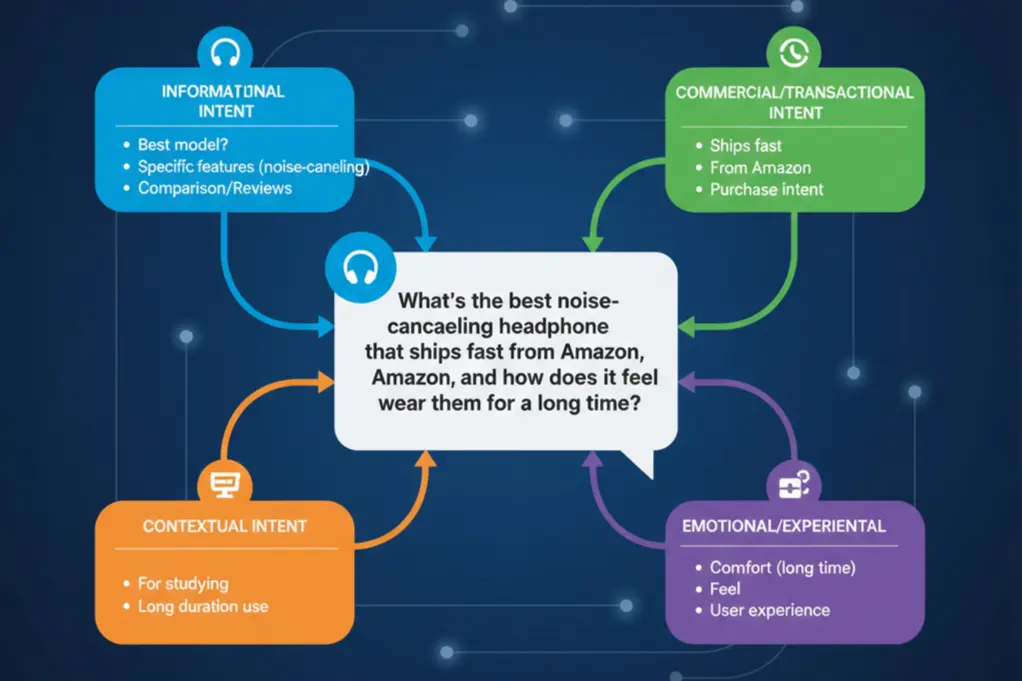
AI doesn’t just match words anymore. It reads between the lines — understanding context, detecting sentiment, measuring expertise signals, and predicting what you’re really asking.
Take this query: “Which AI keyword research services actually understand how to optimize for both Google and ChatGPT results?”
An AI model processes:
- Commercial intent — they’re evaluating services
- Comparative intent — they want options
- Technical requirement — dual-platform optimization
- Trust signals — the word “actually” signals skepticism
That’s sophisticated, and your content needs to match it. Mapping every layer of intent means answering what users are really asking, not just what they typed.
How Do You Build Topic Maps Specifically for LLM SEO?
Topic maps are your content architecture. They show AI systems you’ve built comprehensive coverage around your expertise areas, not just scattered articles.
A solid LLM topic map includes:
- Core pillar topics that define your expertise
- Supporting entity clusters that add depth
- Internal link pathways that guide both users and AI
- FAQ and micro-content that captures specific queries
- Authority signals through data, research, and original insights
Organizing existing content into a coherent, LLM-friendly structure — pillar pages linked to depth clusters, each reinforcing the other — is one of the fastest ways to improve AI Overview and featured-snippet visibility, because AI models reward that topical coherence over isolated, disconnected posts.
Check out our LLM SEO audit findings to see how we identify gaps and opportunities in current search visibility.
What Tools Are Essential for LLM Keyword Research?
You can’t do LLM keyword research with last decade’s toolkit. Manual spreadsheets aren’t enough anymore — you need tools that understand semantic relationships, extract entities, and model how AI systems process queries.
Essential capabilities include:
- Natural language processing for query analysis
- Entity extraction to identify semantic connections
- Intent classification that goes beyond basic categories
- Conversation mining to capture real user patterns
- AI simulation to test how models interpret content
Investing in an AI keyword research package means gaining access to these tools plus the strategic expertise to use them effectively. Tools are powerful, but strategy wins.
How Does Paradigm Media Networks Support LLM Keyword Research?
We’ve been working on AI-first SEO since these systems emerged, and we’ve learned something critical: businesses don’t just need keyword lists. They need complete strategies that bridge traditional search and AI-powered discovery.
Here’s what we deliver:
- Complete semantic mapping that captures how AI models understand your industry
- Entity-driven cluster development that builds topical authority
- Long-form query targeting that captures high-intent traffic competitors miss
- Dual-platform optimization for both traditional SERPs and AI Overviews
- Commercial intent alignment that turns visibility into revenue
Whether you need local LLM keyword mapping services or you’re ready to hire an LLM keyword strategy expert team for enterprise execution, we’ve built systems that scale.
Ready to see what proper LLM keyword research can do for your business? Schedule a strategy call and let’s build your AI-first search strategy together.
FAQs
Why should businesses invest in LLM keyword research now?
Because AI-powered search is already here. Google’s AI Overviews, ChatGPT search, and Perplexity are changing how people discover content, and they now influence roughly half of all Google searches. Businesses that optimize for AI visibility now gain compound advantages as these platforms grow.
How does LLM keyword research improve conversion rates?
By capturing higher-intent queries. Optimizing for natural language questions reaches people at specific decision points. Someone asking “what’s the most cost-effective enterprise keyword research solution for scaling content teams” is further along than someone searching “keyword tools” — that specificity translates directly to better conversion rates.
Can small businesses benefit from LLM keyword research?
Yes. Smaller businesses often move faster and capture opportunities large competitors miss. LLM keyword research helps identify specific niches and conversational queries where competition is lighter but intent is strong.
What makes entity-based clustering different from traditional keyword grouping?
Traditional grouping looks at word similarity. Entity clustering maps semantic relationships — the difference between grouping “content marketing” and “content strategy” because they share words, versus connecting them through shared concepts, processes, and user intents. AI models reward this deeper understanding with better visibility.
How long before businesses see results from LLM keyword research?
Timelines vary based on starting point and competition, but initial ranking improvements are typically visible within six to eight weeks, with substantial traffic growth by month four. Once entity clusters and topical authority are established, that foundation compounds rather than resetting with every algorithm update.
Transform Your Search Visibility with Professional LLM Keyword Research
Search has evolved beyond keywords. It’s time your strategy caught up.
At Paradigm Media Networks, we’ve helped businesses across industries build AI-first search strategies that capture traffic traditional SEO misses — from comprehensive LLM keyword research to complete topical authority development.
Your competitors are still optimizing for yesterday’s search behavior. Meanwhile, conversational queries, entity-based ranking, and AI Overviews are capturing more traffic every day.
The question isn’t whether to invest in LLM keyword research. It’s whether you’ll lead this shift or scramble to catch up later.
Let’s build your AI-first search strategy.
About the Author
Jahid Hussain is the Founder of Paradigm Media Networks, where he leads AI-search and SEO strategy for e-commerce, real estate, and wellness brands across the US and UK. He has 7 years of experience in growth marketing, SEO and performance marketing, has worked with multiple B2B firms, and holds an MBA in Marketing.
By Jahid Hussain, Founder, Paradigm Media Networks Published: December 3, 2025 | Updated: July 30, 2026
