ChatGPT SEO services: get your brand named and cited in ChatGPT search
ChatGPT SEO services increase how often ChatGPT names and links your brand when buyers ask for a recommendation. We open access for OAI-SearchBot, get your pages indexed in Bing, rebuild key pages so a passage can be quoted, earn mentions on the sources ChatGPT cites, and track your buyer prompts every month.
✓ Free AI visibility check, about two minutes · No sign-up · Free 30-minute call

What are ChatGPT SEO services?
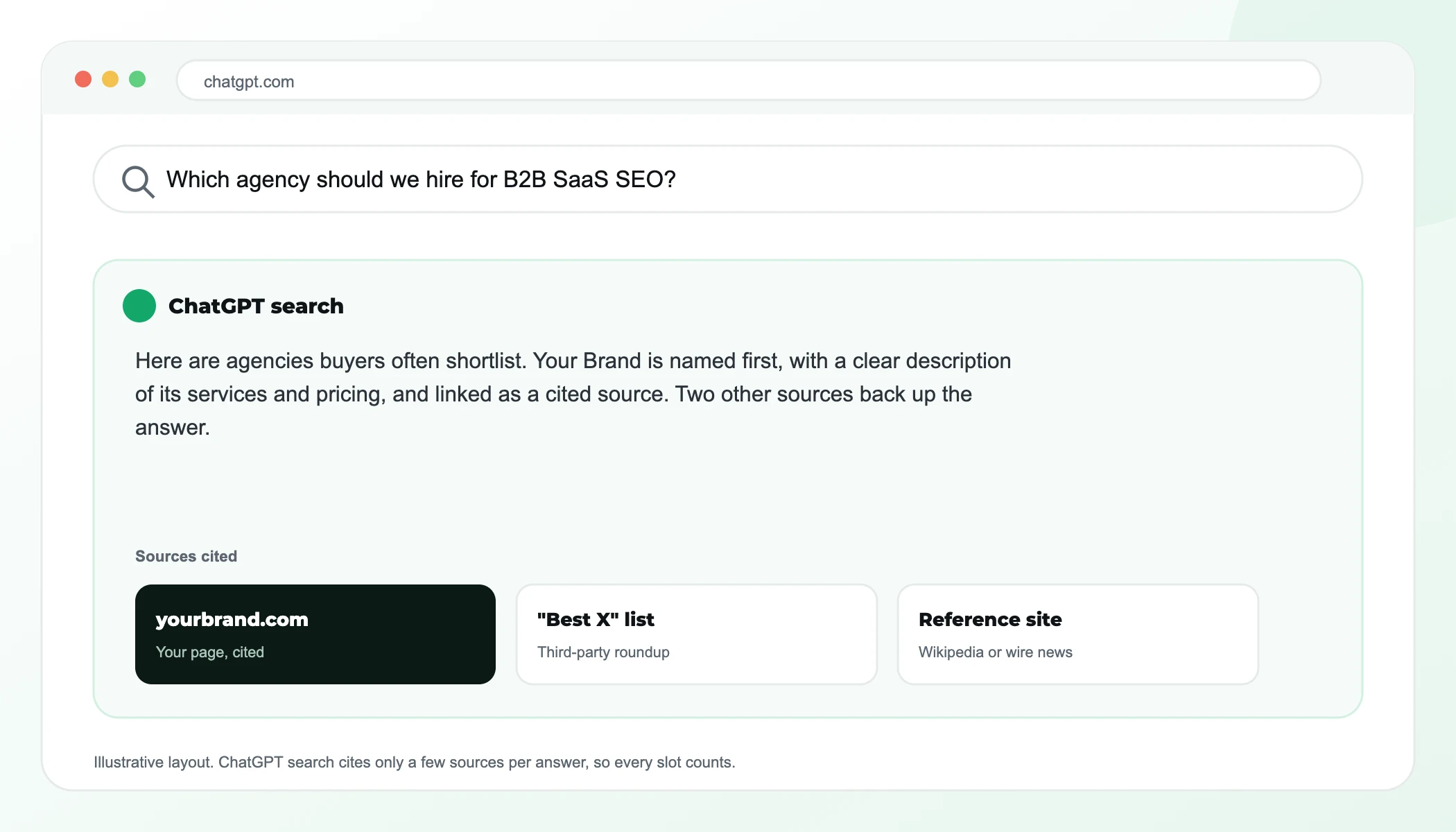
ChatGPT SEO services are paid programs that increase how often ChatGPT names, describes accurately and links a specific brand when users ask questions in its category.
Key takeaways
- ChatGPT search is controlled by OAI-SearchBot, not GPTBot. Blocking GPTBot opts you out of model training; it does not remove you from ChatGPT search answers.
- ChatGPT sends search queries to third-party providers such as Bing, so a page that is not indexed in Bing starts at a disadvantage.
- ChatGPT search cited about 2.8 sources per answer in the 2025 Search Arena data, against 12.1 for Perplexity. There are fewer slots, so the sources around you matter as much as your own site.
- For recommendation prompts, "best X" lists dominate what ChatGPT cites. Your listing on other people's pages is part of ChatGPT optimization.
- Nobody can buy a place in ChatGPT's answers. OpenAI says its ads are labeled, shown separately and do not affect responses.
ChatGPT SEO (also called ChatGPT optimization) works on four things: whether OpenAI's search crawler can reach your pages, whether the search index ChatGPT queries can find them, whether a passage on the page answers the prompt cleanly, and whether independent sources agree with what your site says.
ChatGPT SEO is narrower than AI SEO and narrower than a full GEO program. The table shows where each one starts and stops, so you buy the right one.
| Service | What it is | Engines in scope | Best for | Where to start |
|---|---|---|---|---|
| ChatGPT SEO (this page) | Optimization aimed at ChatGPT search: OpenAI crawler access, Bing indexing, ChatGPT's source mix, ChatGPT shopping where relevant, ChatGPT prompt tracking | ChatGPT only | Brands whose buyers already research in ChatGPT, or whose ChatGPT answers are missing or wrong | This page |
| AI SEO and LLM SEO services | SEO for the AI era across engines: retrieval-ready content, entity SEO, technical work for AI crawlers, AI-assisted execution of classic SEO | Google plus all major AI engines | Brands that want rankings and AI citations run as one SEO program | AI SEO services |
| GEO program (generative engine optimization) | A full citation program: AI visibility audit, entity and schema work, citable content, digital PR, monthly citation reporting across engines | ChatGPT, Google AI Overviews and AI Mode, Gemini, Perplexity, Copilot | Brands that need share of voice in AI answers across every engine | GEO services |
| Perplexity SEO | Optimization aimed at Perplexity: PerplexityBot access, Perplexity's own index and source mix, citation share tracking | Perplexity only | Research-heavy B2B buyers who use Perplexity | Perplexity SEO services |
The deciding factor is where your buyers ask. If ChatGPT is the engine that matters most, or the one getting your brand wrong, start here. If you need every engine at once, the GEO program covers ChatGPT as one of five tracked assistants.
What solutions help optimize content for ChatGPT responses?
Seven types of solution help optimize content for ChatGPT responses: crawler access, Bing indexing, answer-first page structure, third-party source coverage, entity consistency, product feeds for ecommerce, and prompt tracking.
Content edits alone rarely move ChatGPT answers, because ChatGPT repeats what several sources agree on. The solutions that work fix the page, the path to the page, and the pages around it.
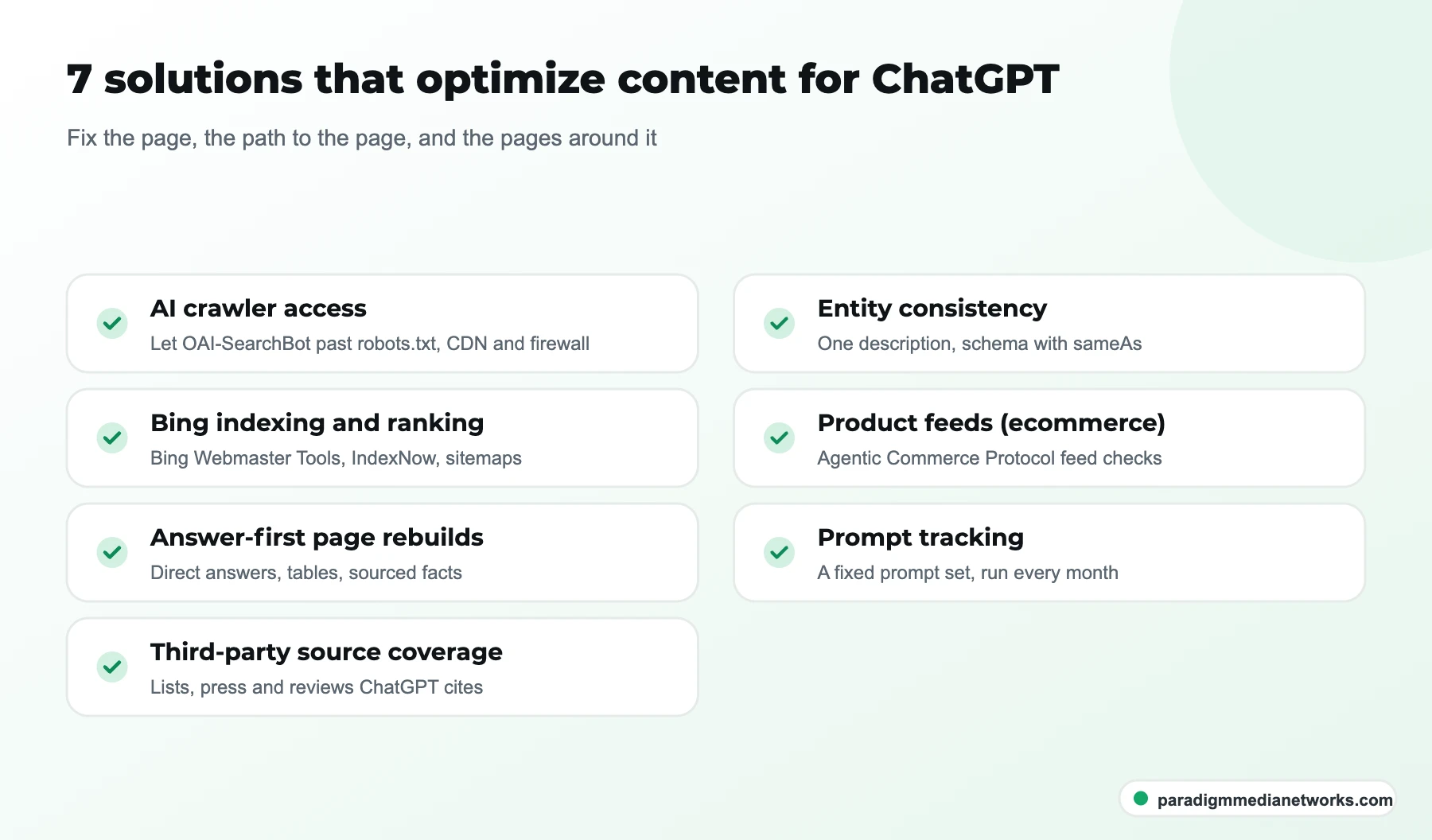
| Solution | What it fixes | Do it yourself or buy it | Typical tools |
|---|---|---|---|
| 1. AI crawler access check | OAI-SearchBot blocked by robots.txt, a CDN rule or a firewall, so ChatGPT search cannot show the page | Do it yourself in an afternoon if you control the server | robots.txt tester, server logs, CDN bot settings |
| 2. Bing indexing and ranking | Pages missing from or weak in the index ChatGPT search queries | Do it yourself for small sites; service for large or migrated sites | Bing Webmaster Tools, IndexNow, XML sitemaps |
| 3. Answer-first page rebuilds | Answers buried in long intros, facts locked in images, no tables or definitions | Service, unless you have an in-house editor who knows the format | Content briefs, schema validator |
| 4. Third-party source coverage | ChatGPT names competitors because lists, press and reference sites name them, not you | Service: this is PR, partnerships and outreach | Citation gap analysis, outreach |
| 5. Entity consistency | Wrong pricing, services or locations in ChatGPT answers because old descriptions conflict | Do it yourself with discipline; service for many profiles | Organization schema with sameAs, LinkedIn, Wikidata, directories |
| 6. Product feeds (ecommerce only) | Products missing or mispriced in ChatGPT shopping results | Platform plus developer work | Agentic Commerce Protocol feed, merchant application |
| 7. Prompt tracking | No baseline, so nobody knows if anything worked | Software, or a monthly manual test | AI visibility trackers, a fixed prompt sheet |
If you want to do the content side yourself, our guide on how to optimize content for ChatGPT search walks through it step by step, and how to structure content for LLMs covers the formats. If you are comparing tracking software, we have compared 14 AI visibility tools on prompts, engines and price. ChatGPT SEO services bundle all seven solutions under one team and one report.
How does ChatGPT search choose which sources to cite?
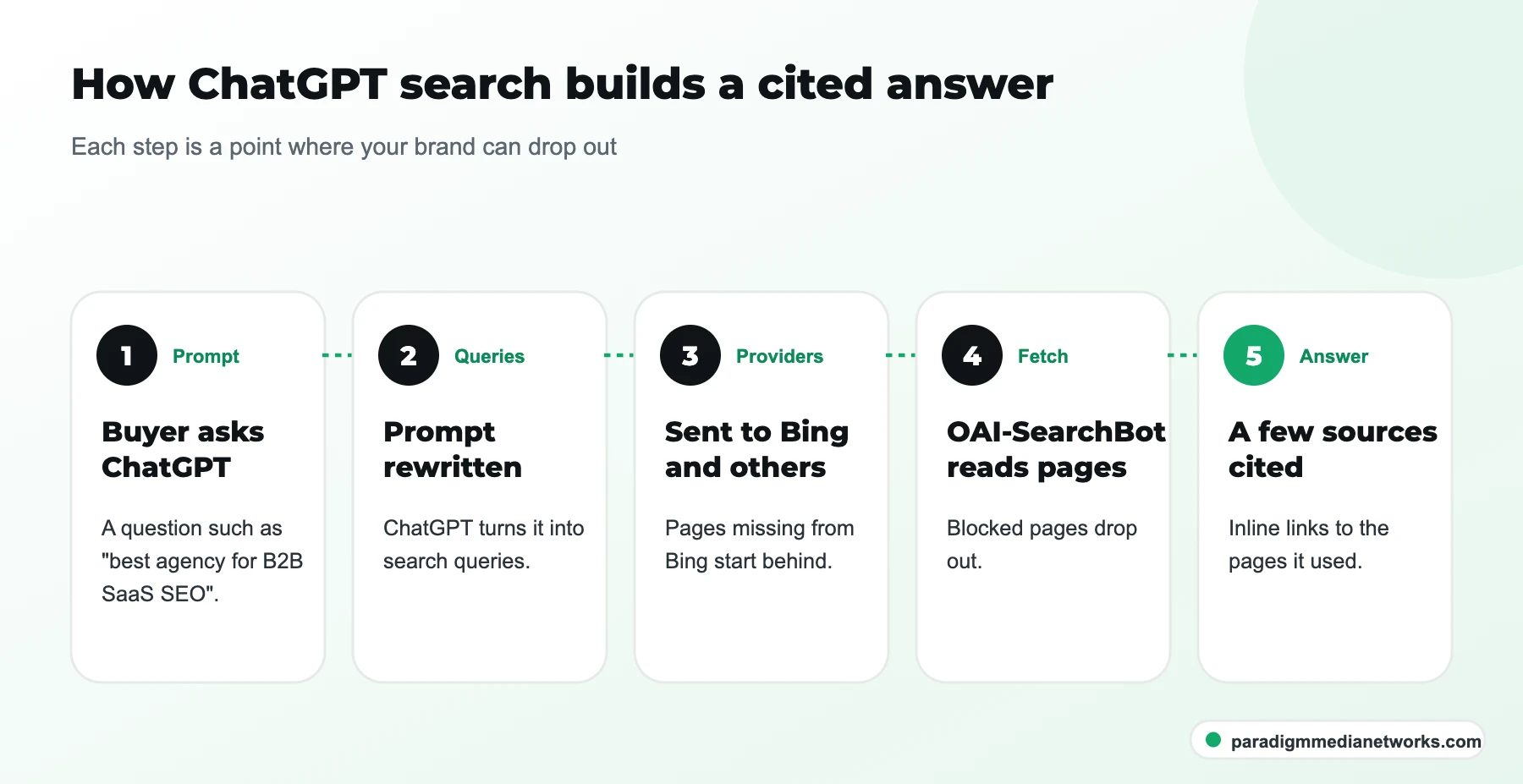
ChatGPT search rewrites the user's prompt into search queries, sends them to third-party search providers such as Bing, reads the pages it is allowed to reach, and cites a small number of them inline.
OpenAI's Help Center states that ChatGPT may send disassociated search queries to providers including Bing. Pages that OAI-SearchBot cannot access do not appear as cited sources.
ChatGPT also answers from training data when it does not search. Those answers change only when a newer model ships, so the fast lever is search visibility, and the slow lever is being described consistently across the web.
Which OpenAI crawlers should you allow?
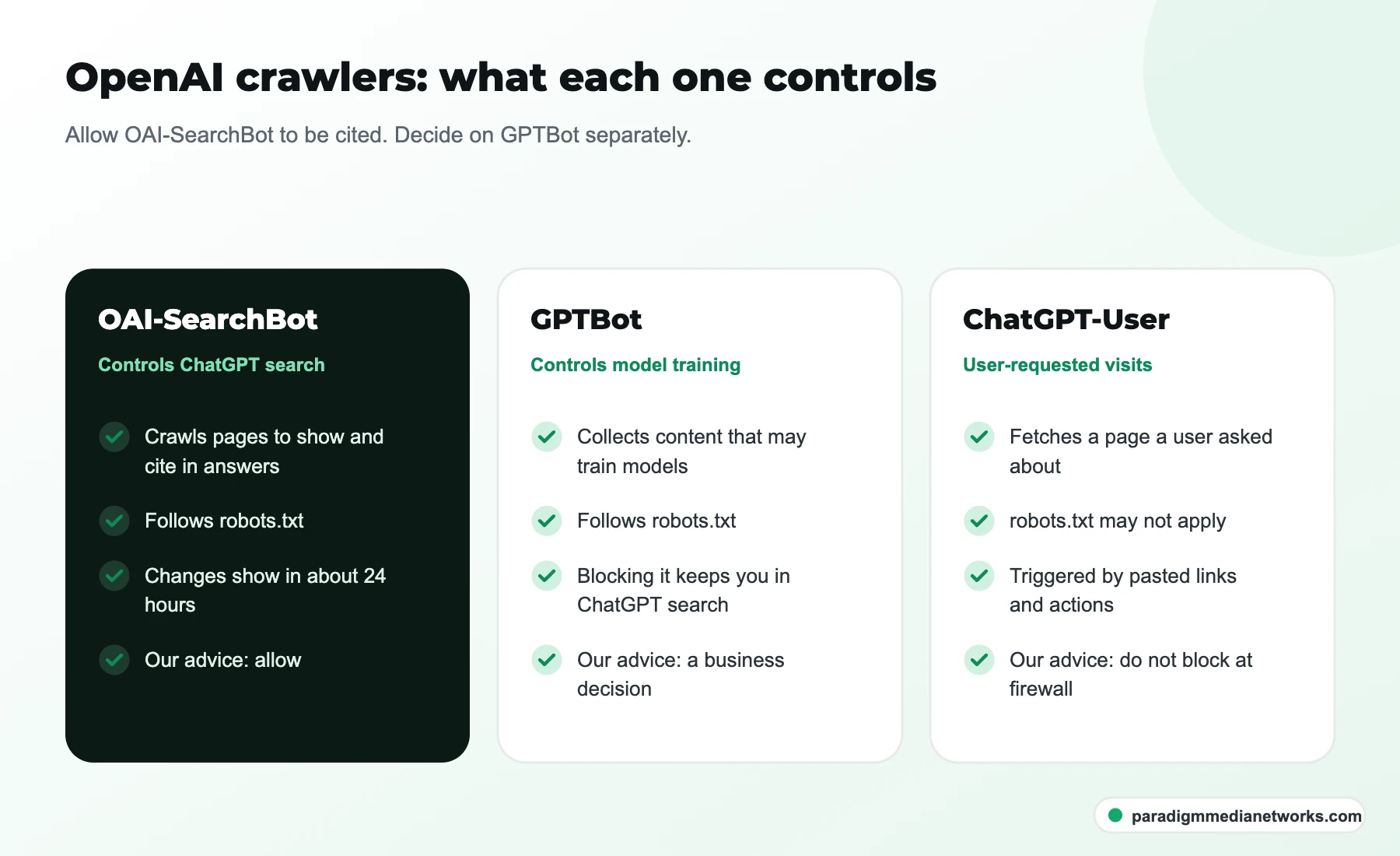
Allow OAI-SearchBot if you want to appear in ChatGPT search; decide on GPTBot separately, because it only governs training. OpenAI documents three agents that matter to site owners.
| OpenAI agent | What it does | Follows robots.txt? | Our default recommendation |
|---|---|---|---|
| OAI-SearchBot | Crawls pages so they can be shown and cited in ChatGPT search answers | Yes. OpenAI says opted-out sites are not shown in ChatGPT search answers, though they can still appear as navigational links. Changes take about 24 hours to show | Allow, on every page you want cited |
| GPTBot | Crawls content that may be used to train OpenAI's foundation models | Yes. Disallowing it signals your content should not be used in training | A business decision. Blocking it does not remove you from ChatGPT search |
| ChatGPT-User | Visits a page when a user's request requires it, for example a link pasted into a chat or a Custom GPT action | Not necessarily. OpenAI says robots.txt rules may not apply to user-initiated visits | Do not block at the firewall unless you have a security reason |
The most common access problem we find is not robots.txt. It is a CDN or security plugin that challenges or blocks unfamiliar bots by default, so OAI-SearchBot gets an error page while the site looks fine in a browser.
What does ChatGPT cite most often?
ChatGPT cites fewer sources per answer than other AI engines, and leans on reference sites, wire news and "best X" lists. In PMN's AI Search Citation Study 2026, built on the Search Arena dataset (UC Berkeley and LMArena, March to May 2025, API versions), ChatGPT search cited about 2.8 sources per answer. Wikipedia took 9.5% of its citations and Reuters plus AP took 9.2%, while YouTube and Reddit took 0.0%. Perplexity, by comparison, cited 12.1 sources per answer.
Consumer ChatGPT has changed since that data was collected, so treat it as a 2025 baseline. The planning point still holds: with fewer than three cited slots per answer, ChatGPT optimization is often about the sources around you. Ahrefs found that "best X" blog lists made up 43.8% of the page types ChatGPT cited for recommendation prompts, in a study of 26,283 source URLs (also indexed in our AI search statistics 2026).
Can you pay to appear in ChatGPT?
No. ChatGPT ads exist, but OpenAI says they do not change the answer. OpenAI began testing ads in ChatGPT in the US on 9 February 2026. OpenAI says ads are labeled as sponsored, shown separately from the response, and do not affect ChatGPT's answers. Anyone selling "guaranteed ChatGPT placement" is selling something OpenAI says does not exist.
How do ecommerce brands get into ChatGPT shopping?
ChatGPT shows product results that OpenAI says are selected independently and are not ads, using structured product data from third-party providers and, increasingly, merchant feeds. Through the Agentic Commerce Protocol, merchants can send a regularly refreshed product feed with pricing, inventory and media. Instant Checkout, where the purchase happens inside ChatGPT, is open to approved partners who apply through OpenAI's merchant form. For ecommerce clients, ChatGPT SEO includes a feed and product-schema check alongside the content work.
What do our ChatGPT SEO services include?
Our ChatGPT SEO services cover seven workstreams, run by one team and reported on one dashboard. Every engagement starts with a baseline, so you can see what moved.
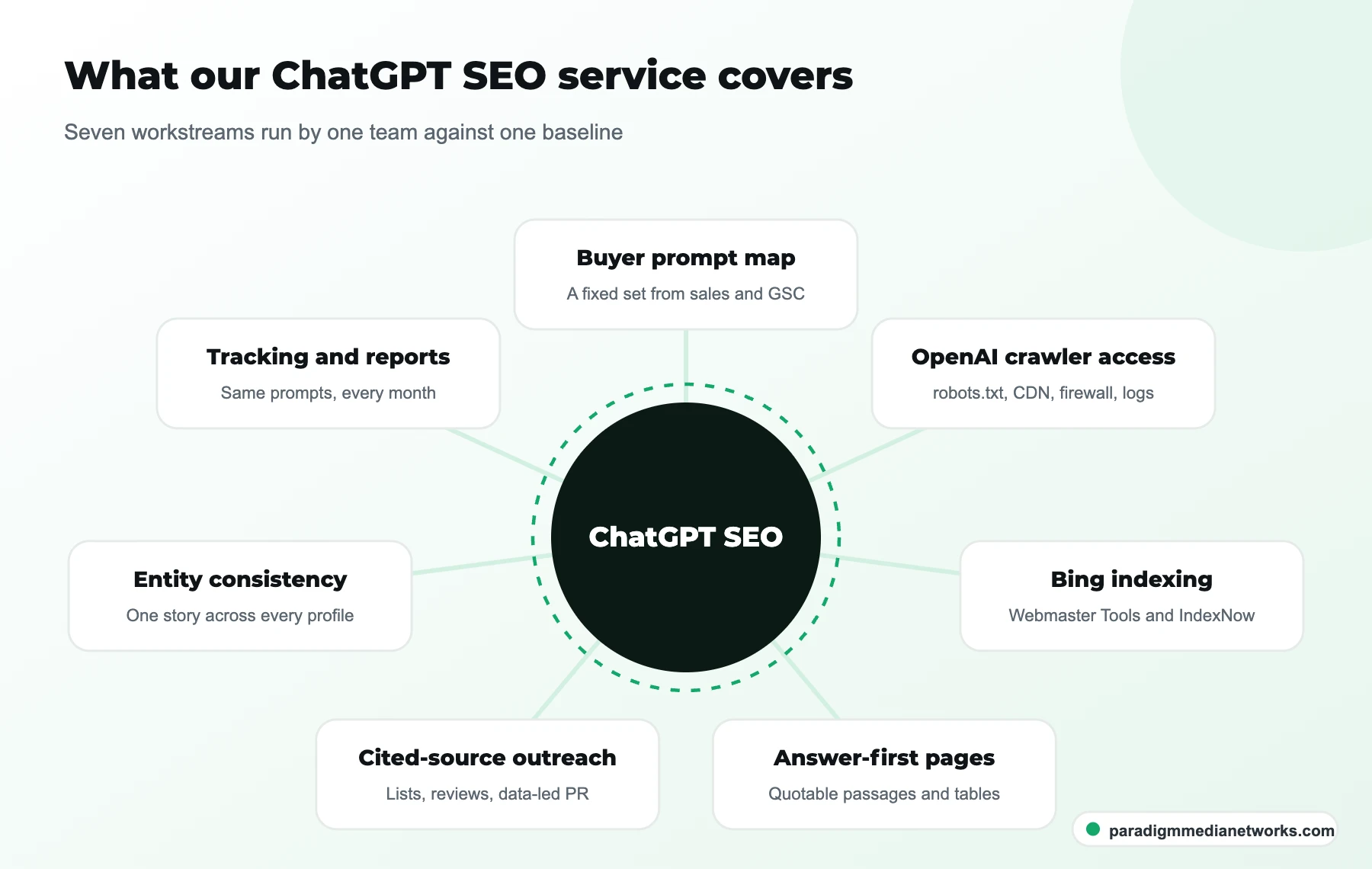
- Map the prompts your buyers type. We build a fixed set of buyer prompts from your sales calls, Search Console queries and competitor names, for example "best [service] for [type of company]" and "[you] vs [competitor]". A prompt set that changes every month cannot show progress.
- Fix access for OpenAI's crawlers. We check robots.txt, CDN, firewall and security plugin rules for OAI-SearchBot, GPTBot and ChatGPT-User, then confirm hits in your server logs. The common mistake here is fixing robots.txt and never checking the firewall.
- Get key pages indexed and ranking in Bing. We verify the site in Bing Webmaster Tools, submit sitemaps, set up IndexNow where your CMS supports it, and fix the pages Bing has not indexed. Teams that only watch Google often discover Bing has a fraction of their pages.
- Rebuild money pages answer-first. Each target page gets a direct answer under a question heading, a definition, a comparison table where buyers compare, sourced numbers, and visible pricing or ranges. ChatGPT tends to skip brands it cannot describe commercially.
- Earn places on the sources ChatGPT cites. For every prompt a competitor wins, we record which pages ChatGPT cited and work to earn a fair mention on them through reviews, data-led PR, corrections to outdated articles and honest list inclusion. We do not buy undisclosed placements.
- Make your entity consistent. One description, one set of services and one price story across your site, Organization schema with sameAs links, LinkedIn, directories and reference profiles. Wrong facts in ChatGPT answers usually trace back to an old page somewhere else.
- Track, report and iterate. Monthly runs of the same prompts, with mention rate, citation rate, accuracy of what ChatGPT says, competitors named, and ChatGPT referral sessions in GA4. The next month's work comes from the gaps.
Ecommerce brands add a product feed and product schema review. Local businesses add listing and review consistency, which is where our HVAC ChatGPT self-test usually points first.
How do you measure ChatGPT visibility?
ChatGPT visibility is measured as a rate across repeated runs of the same prompts, not as a rank.
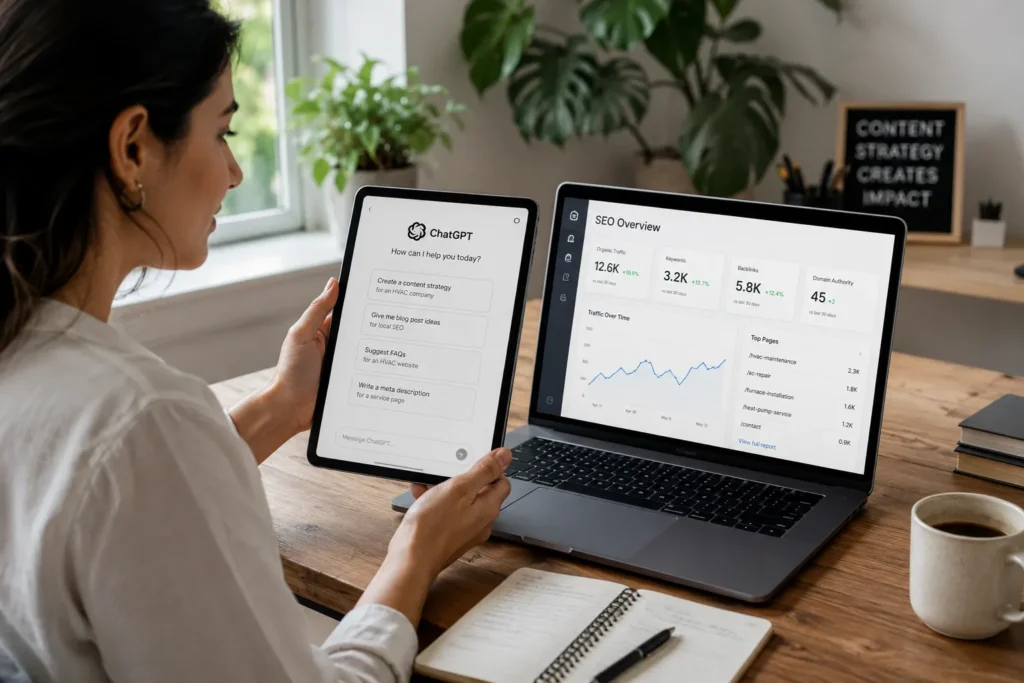
SparkToro's research (January 2026) found less than a 1 in 100 chance that ChatGPT gives the same list of brands in any two responses to one prompt, so a single screenshot proves little.
Each month we report five numbers for ChatGPT:
| Metric | How it is calculated | Why it matters |
|---|---|---|
| Mention rate | Runs that name your brand divided by total runs | The closest equivalent to "share of voice" in ChatGPT |
| Citation rate | Runs that link one of your URLs divided by total runs | Shows which pages earn the link, so you know what to replicate |
| Answer accuracy | Brand prompts where pricing, services and locations are correct | A wrong answer can do more damage than no answer |
| Competitor share | How often each named competitor appears in the same runs | Shows who owns the prompts you want |
| ChatGPT referral sessions | GA4 sessions from chatgpt.com, with conversions | Connects visibility to leads and revenue |
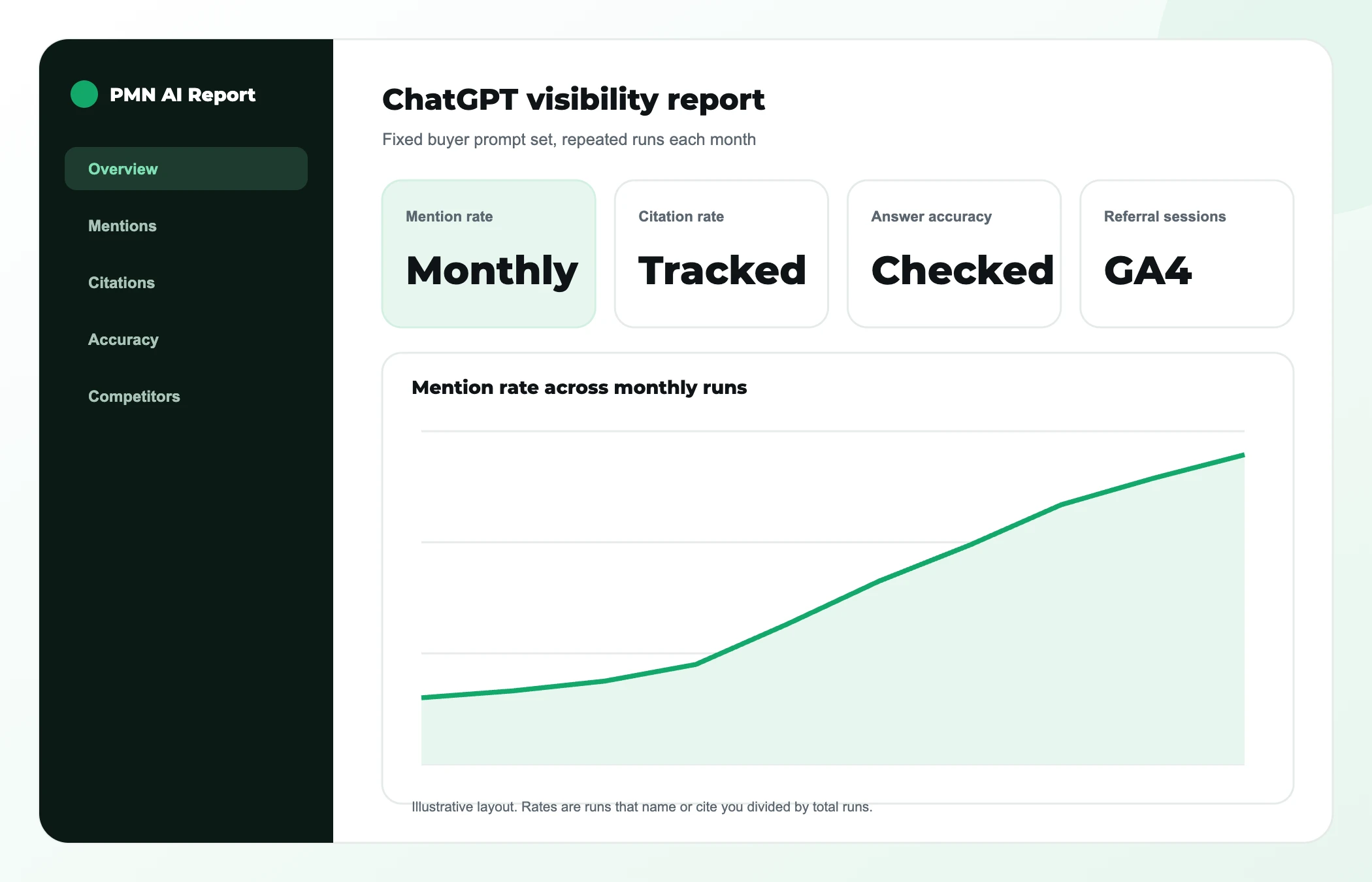
ChatGPT does not offer a Search Console. Any agency reporting a fixed "position 3 in ChatGPT" is reporting one moment, not a trend.
Proof: the same system at work for Moving Hub
Moving Hub started 2026 with zero AI presence and is now named by 5 AI assistants: ChatGPT, Google AI Mode, AI Overviews, Perplexity and Gemini.
Moving Hub is a USDOT-licensed US long-distance mover that owns its trucks. It began 2026 with no organic traffic, on page three for the searches that book moves, with 68 referring domains.
The work was the same system this page describes: a technical rebuild (canonicals, duplicates, schema), answer-first cost and route guides, about 300 programmatic route and city pages, digital PR, and a fixed prompt set tracked monthly across five assistants.
| Result | Figure | Source and window |
|---|---|---|
| AI assistants naming the brand | 5, including ChatGPT | Fixed prompt set, checked monthly |
| AI citations (Microsoft Copilot and partners) | 2,460 in 90 days | AI Performance report, 28 June to 6 September 2026. Not a ChatGPT figure |
| Referring domains | 68 to 450 | Backlink index, 2026 |
| Google impressions and clicks | 327K impressions, 907 clicks, average position 19.6 | Google Search Console, 16 March to 14 September 2026 |
| Time to first AI citations | Roughly 3 to 4 months | Project timeline |
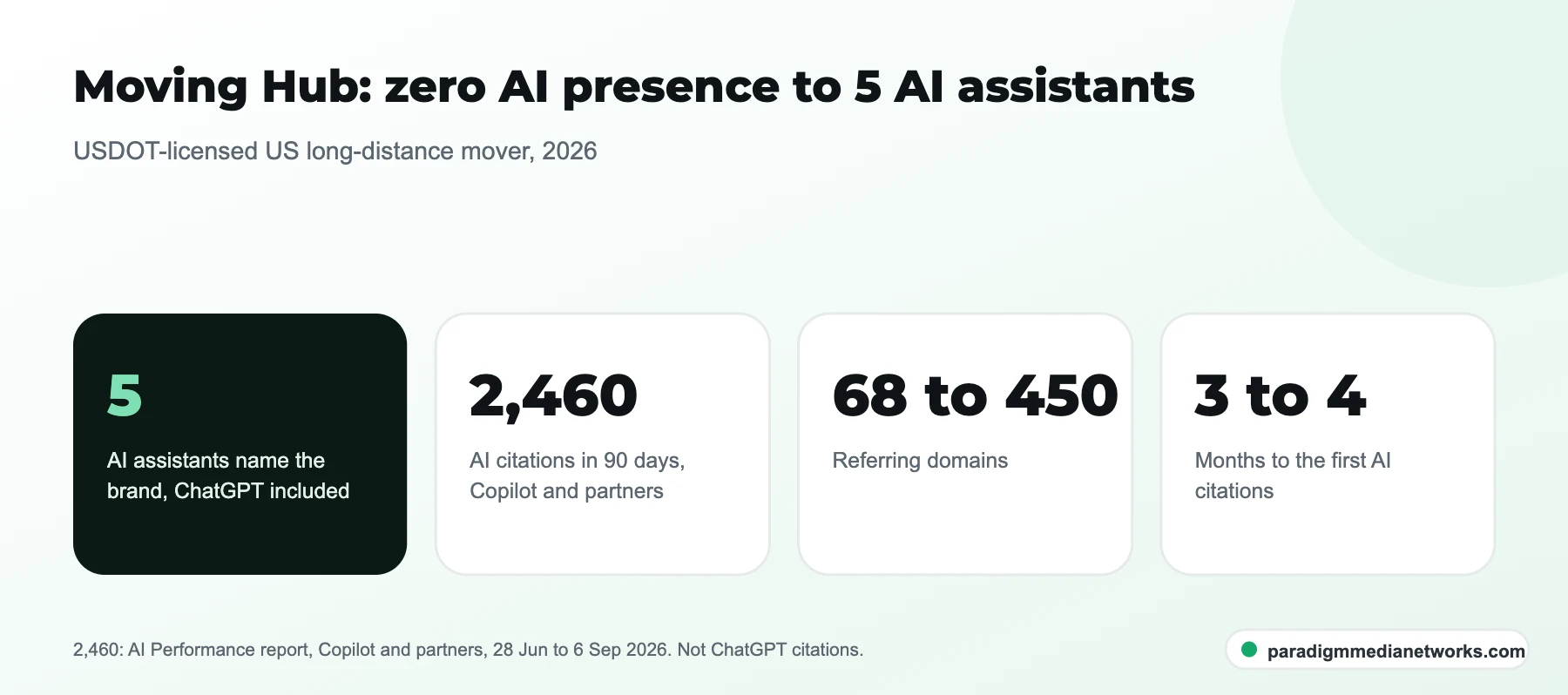
Be clear on what the 2,460 figure measures: it comes from the AI Performance report in Bing Webmaster Tools, which reports citations from Microsoft Copilot and partners over a 90-day window. ChatGPT itself provides no citation report, which is why we track ChatGPT through the fixed prompt set. Ask us on the call for a walk-through of a comparable account.
How much do ChatGPT SEO services cost?
ChatGPT SEO is scoped inside a GEO retainer, which typically runs $2,000 to $10,000+ per month.
Where your business lands in that range depends on four things: how competitive your category's prompts are, how many pages need rebuilding, how much off-site coverage is missing, and whether you need ChatGPT alone or every engine tracked.
| What drives the cost | Lower end | Higher end |
|---|---|---|
| Prompt competition | Niche B2B or local service with few cited sources | National consumer categories with established listicles and press |
| Page work | A clean site with 5 to 10 money pages | Large or recently migrated sites with indexing gaps |
| Off-site gap | Already on most category lists and review sites | Missing from the sources ChatGPT cites for your prompts |
| Engines tracked | ChatGPT only | ChatGPT plus Google AI Overviews, AI Mode, Gemini and Perplexity |
Start with the free AI Visibility Checker. If the gaps are mostly technical, you may only need a one-off fix rather than a retainer, and we will say so. Already running SEO with us? ChatGPT work folds into the existing program, because the audit, content and authority work overlap.
How long does ChatGPT SEO take to work?
Access fixes can show within days, while consistent mentions usually take several months.
OpenAI says ChatGPT search takes about 24 hours to reflect a robots.txt change, so unblocking OAI-SearchBot is the fastest win available. Bing indexing of fixed pages typically follows within weeks. Moving Hub's first AI citations arrived after roughly 3 to 4 months, once rebuilt pages and PR placements were live. Answers that come from training data, not search, change only when OpenAI ships a newer model, which is outside anyone's control.
Is ChatGPT SEO worth it for your business?
ChatGPT SEO is worth it when your buyers research in ChatGPT before they contact a supplier, and when ChatGPT currently names competitors or gets your details wrong.
OpenAI reported about 900 million weekly ChatGPT users in February 2026, so the audience exists. The question is whether your buyers are in it for your category.
It is a good fit if
- Buyers ask comparison and "best X for Y" questions before choosing, as in B2B SaaS, professional services, home services and considered ecommerce purchases.
- ChatGPT already names two or three competitors for your core prompts.
- ChatGPT describes your pricing, services or locations incorrectly.
It is not the right first spend if
- Your site has basic SEO problems such as missing indexing, no service pages or no reviews. Fix those first through technical SEO or local SEO; they feed ChatGPT anyway.
- You need visibility in Google AI Overviews more than ChatGPT. That overlaps far more with Google SEO.
- You want guaranteed placement. No honest agency can promise that.
Why hire an agency, and why Paradigm Media Networks?
You can do parts of ChatGPT SEO in-house; the hard parts are the off-site sources and the measurement discipline.
Crawler access and Bing Webmaster Tools are an afternoon's work for a developer. Earning places on the lists and publications ChatGPT cites takes PR relationships and data worth covering. Measuring progress takes a fixed prompt set run the same way every month, which in-house teams often abandon after the first quarter.
Jahid Hussain's view, from running these projects, is that optimizing for AI search is still SEO, but not equally for every model, and that the most common mistake is mass-producing AI-written pages and hoping volume earns citations. He also sees a messy site quietly waste good press: when ChatGPT follows a mention back, it needs plain facts that match what it just read.
Paradigm Media Networks runs SEO, GEO, paid media, content and web as one revenue system, so the team reading your ChatGPT report can also fix the page, the listing or the campaign behind it. A ChatGPT gap usually needs four kinds of work at once: technical access, page rebuilds, PR and brand demand. Siloed vendors each own one.
Published research on AI citations
Our AI Search Citation Study 2026 analyzed nearly 370,000 citations across ChatGPT, Perplexity, Gemini and Google AI Overviews, with the method and limits published.
Real results with stated sources
See the Moving Hub case study and all our work, each with the source and window behind every number.
No guarantees we cannot keep
We guarantee the method, the tracking and the reporting. We do not guarantee citations, because no one controls ChatGPT's answers.
Senior oversight
Jahid Hussain has 7 years in growth marketing, SEO and performance marketing; the agency has trained 500+ marketers and scaled 30+ brands.
ChatGPT SEO services: frequently asked questions
Does ChatGPT use Bing?
Yes, in part. OpenAI's Help Center says ChatGPT search may send disassociated search queries to third-party search providers, naming Bing as an example. OpenAI also runs its own crawler, OAI-SearchBot. In practice, a page that is indexed and ranking well in Bing and reachable by OAI-SearchBot has a better chance of being cited.
Will blocking GPTBot remove my site from ChatGPT?
No. GPTBot collects content that may be used to train OpenAI's models. ChatGPT search relies on OAI-SearchBot, which you control with a separate robots.txt rule. You can block GPTBot and still allow OAI-SearchBot, and many publishers do exactly that.
How is ChatGPT SEO different from GEO?
ChatGPT SEO focuses on one engine: OpenAI's crawlers, ChatGPT's search providers, its source mix and its shopping results. GEO (generative engine optimization) is the full program across ChatGPT, Google AI Overviews, AI Mode, Gemini, Perplexity and Copilot. Paradigm Media Networks scopes ChatGPT SEO inside a GEO retainer when you need more than one engine.
Can you guarantee ChatGPT will recommend my business?
No, and you should be wary of anyone who does. ChatGPT generates each answer fresh, and repeated runs of the same prompt rarely return the same brand list. What we commit to is a fixed prompt baseline, the fixes that remove known blockers, and monthly reporting on mention rate, citation rate and answer accuracy.
What software helps optimize content for ChatGPT?
Three kinds. Crawl and index tools (server logs, Bing Webmaster Tools, IndexNow) confirm ChatGPT can reach you. Content and schema tools help structure pages. AI visibility trackers such as Otterly.AI, Peec AI or Semrush's AI Visibility Toolkit run your prompts and log mentions. Software shows the gap; closing it still takes content, PR and technical work.
How do I know if ChatGPT already mentions my brand?
Run the free AI Visibility Checker, then test 10 to 20 buyer prompts in a temporary ChatGPT chat with search on, three times each, and count how often you are named. Note which sites ChatGPT cites for competitors. That list becomes your first off-site target list.

One team, one revenue number
Strategy is led by Jahid Hussain, founder of Paradigm Media Networks, with 7 years in growth marketing, SEO and performance marketing and an MBA in Marketing. SEO, AI search, paid media, content and web run as one system, so nobody hands you a report that contradicts another vendor’s.
- 500+ marketers trained and 30+ brands scaled
- Published results you can check: HVAC case study and Moving Hub case study
- Reporting on calls, leads and booked jobs, not just rankings
Find out what ChatGPT says about your brand
Start with the free check. If ChatGPT names competitors and skips you, we will show you which sources and pages close the gap first, with a fixed monthly scope. Prefer email? Write to info@paradigmmedianetworks.com.
✓ Free 30-minute call · No pitch decks · Walk away with a real plan
What you walk away with
- Whether OAI-SearchBot can reach your key pages
- Which competitors ChatGPT names for your buyer prompts
- The sources ChatGPT cites that you are missing from
- A scoped plan and a fixed monthly price