
Map Pack grid tracking for HVAC: how to set it up and read the scan
Map Pack grid tracking checks where your HVAC company ranks in Google's local pack from dozens of points across your service area, instead of one address. Because Google ranks local results partly on distance from the searcher, a grid shows the suburbs you win, the ones you lose, and which fix to make next.
✓ Grid tracking is part of every PMN HVAC SEO plan · Free audit includes a grid read

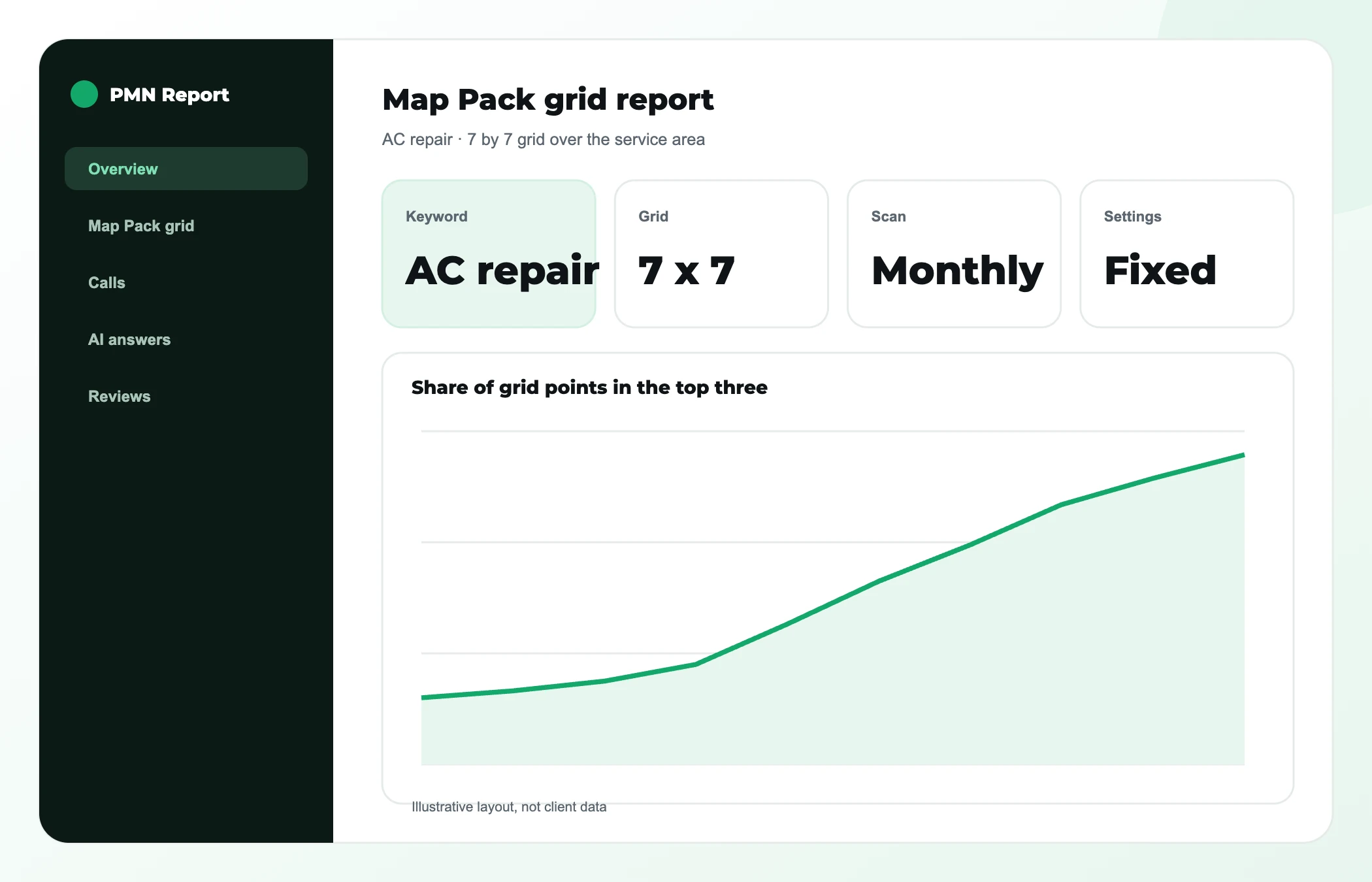
What is Map Pack grid tracking, and why does HVAC need it?
Map Pack grid tracking is a rank check run from a grid of map points laid over your service area, with each point recording where your business appears in Google's local results for one keyword. HVAC needs it because demand is urgent and local, and rankings change from one suburb to the next.
Key takeaways
- Google says local results are ranked on relevance, distance and prominence, and that distance is "how far each business is from the customer who's searching". One rank check from your office cannot see that.
- Set the grid to cover your real service area, keep the settings identical every scan, and track service keywords without town names.
- Read three numbers: average rank, average rank across all listings found, and share of top-three appearances. Then read the map, because the pattern tells you which fix to make.
- A grid is a sample, not your customers. Pair it with calls and booked jobs before deciding anything.
A homeowner with a dead AC in July rarely compares ten websites. They call one of the three businesses Google shows them nearby. For an HVAC company based on one side of a metro, that means it can hold the top spot at home and be absent eight miles away, while a single "you rank #2 in Dallas" report says everything is fine. A grid makes that gap visible, suburb by suburb.
How do you set up a grid scan for an HVAC company?
Center the grid on your verified business location, size it to the area you actually serve, choose five to fifteen service keywords without town names, and run every scan with the same grid, keywords, day and time so results can be compared.

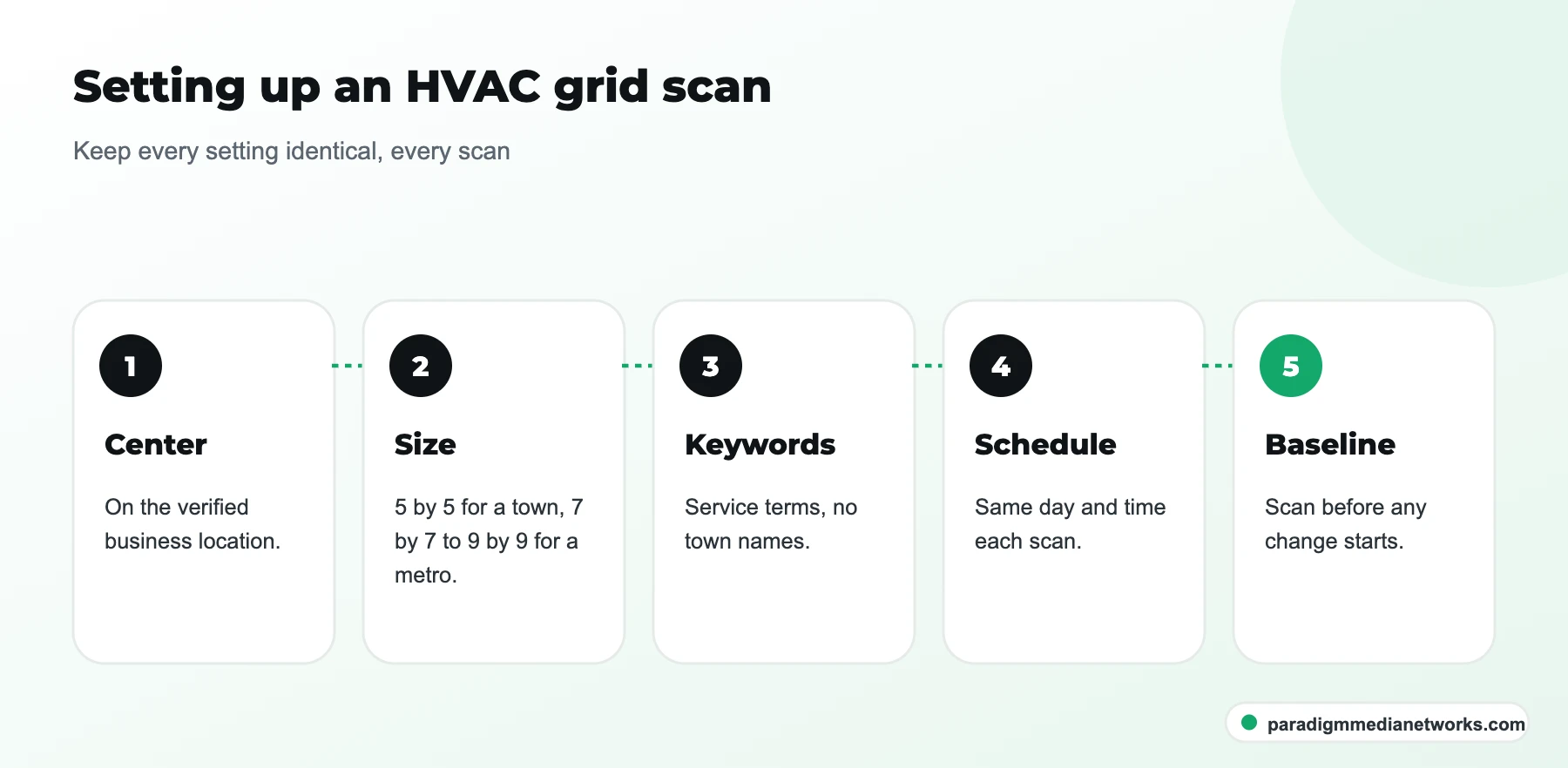
- Center on the verified location. The point Google knows as your business, even if the address is hidden because you are a service-area business.
- Size the grid to the service area. A 5 by 5 grid over one town, or 7 by 7 to 9 by 9 over a metro, spaced so the outer points sit on the towns you really serve. Whitespark's Local Ranking Grids allow 4 to 225 points per grid.
- Pick service keywords, not town keywords. The grid supplies the location, so track "ac repair", "furnace repair", "heat pump installation", "hvac company" and "emergency ac repair", not "ac repair [town]".
- Fix the schedule. Same day of the week and time of day. Whitespark notes its scans can show whether they ran while your business was open or closed, so keep that constant too.
- Record a baseline before any change. Scan before profile or page work starts, so every later scan has something to be measured against.
How many credits will that use?
Most grid tools bill one credit per grid point per scan. Local Falcon counts one credit as one map pin, so a 5 by 5 grid uses 25 credits. Ten keywords on a 7 by 7 grid is 490 credits a scan round: monthly that is 490 credits, weekly about 1,960. Published entry plans on 24 October 2026 start at $10 a month for 2,000 credits with Whitespark and $24.99 for 7,500 with Local Falcon, and suites such as BrightLocal and Semrush Local include grid credits.
How do you read a grid scan? ARP, ATRP and SoLV
Read the three summary numbers first, then the map. Average rank position (ARP) shows where you typically sit among the top 20 listings, average total rank position (ATRP) does the same across every listing found, and share of local voice (SoLV) is the share of grid points where you appear in the top three.
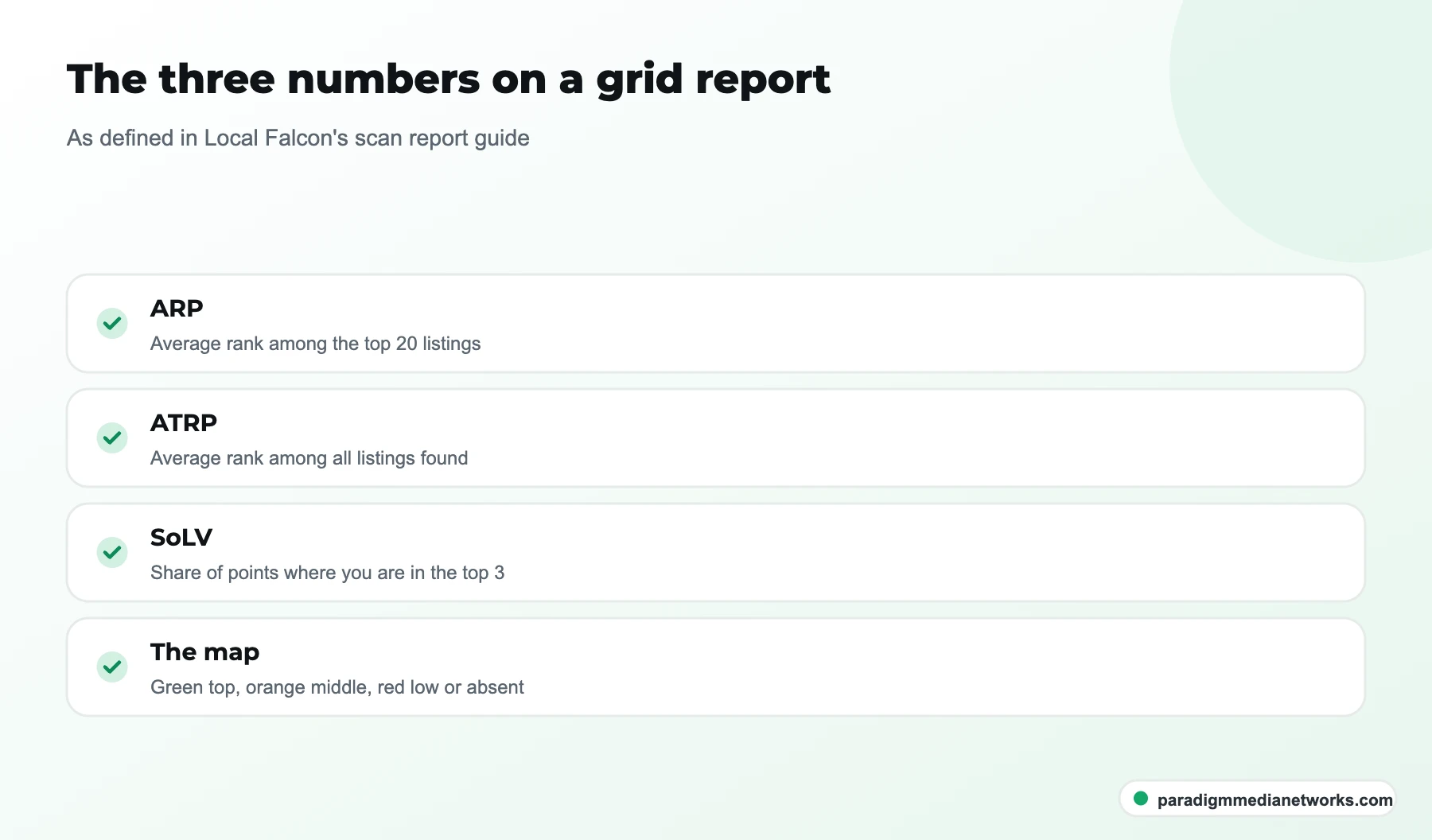
The definitions above follow Local Falcon's guide to reading a scan report; other tools use similar measures under different names. Our view on which matters most: share of top-three appearances, because the Map Pack shows three businesses and a homeowner rarely scrolls past them. An average rank of 6 looks respectable and can still mean you are invisible across most of your area.
On the map itself, green points are top positions, yellow and orange are middle positions, and red means you rank very low or not at all at that point. A point marked "KP" means Google showed a single knowledge panel there rather than a local pack.
What does each grid pattern tell an HVAC company to fix?
The shape of the grid points to the cause. Strong only near your base usually means prominence (reviews, links, citations) is behind nearby competitors. Weak even at your base points to relevance: category, services or the page your profile links to.
| What the grid shows | Likely cause | What to fix first |
|---|---|---|
| Green at your base, red within a few miles in every direction | Prominence: fewer recent reviews and mentions than nearby competitors | Review velocity, citations, local links |
| Weak even at your own location | Relevance: primary category, services list or landing page does not match the keyword | Category and services on the profile; the linked service page |
| Strong for "hvac company", weak for "furnace repair" | A gap for that one service | List the service on the profile; build or improve its service page |
| Strong in one direction, weak in another | A competitor cluster, or few jobs and reviews from that side | Proof from that side of town; an area page only if it passes real tests |
| Sudden drop across the whole grid | A profile change: edited category, hours, name, or a suspension | Check edit history and profile status the same day |
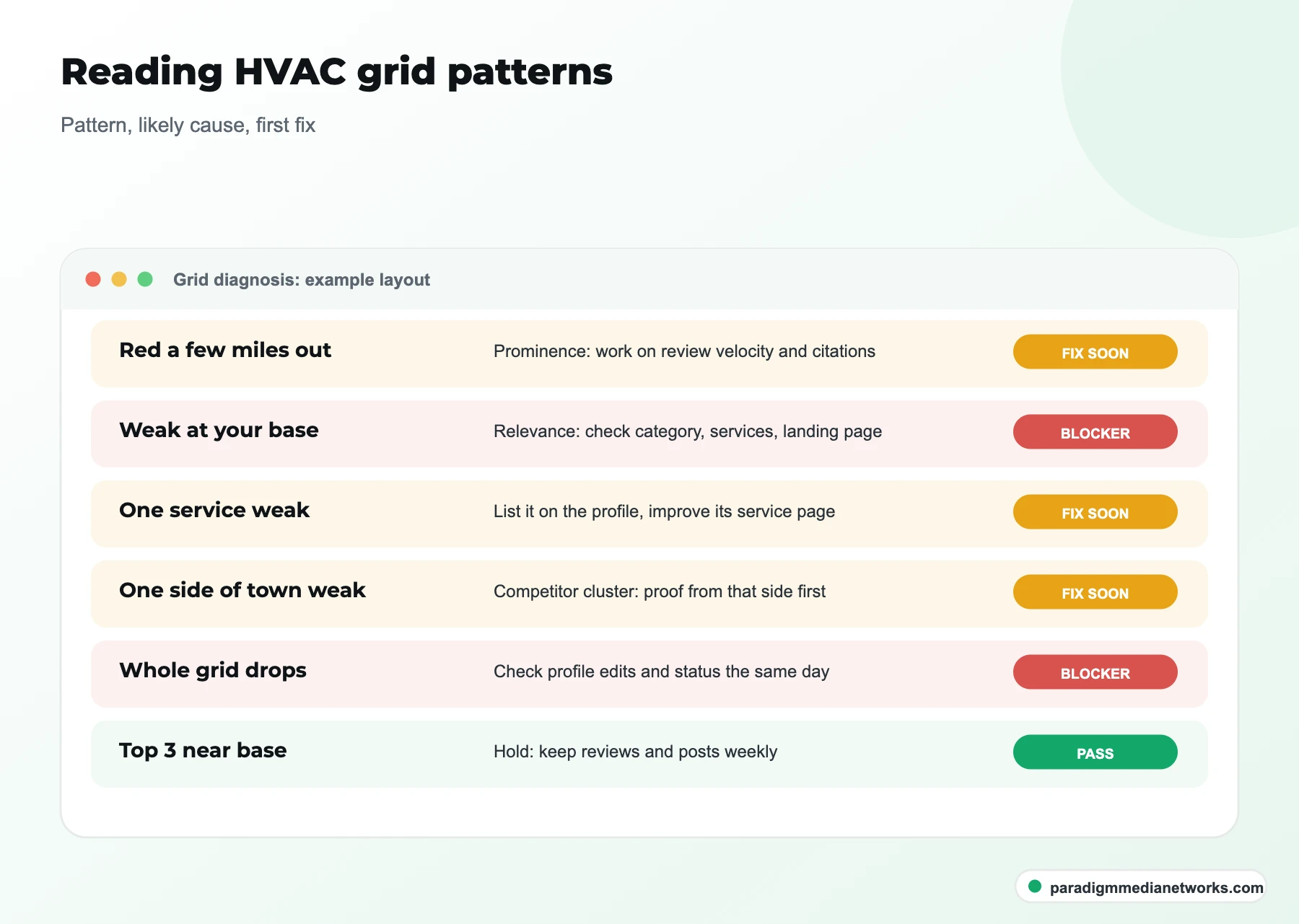
These readings are working hypotheses, not verdicts. Change one thing, re-scan with identical settings after enough time for Google to process it, and see whether the pattern moves. If the whole grid moves at once and you changed nothing, look at the profile before you look at the website.
What can grid tracking not tell you?
A grid cannot tell you how many people search, whether they call, or what any one homeowner sees on their own phone. It is a controlled sample of rankings, so treat it as a diagnostic and judge results by calls and booked jobs.


- Search volume. A red point in a town nobody searches from costs you nothing. Weight the grid by where your best jobs come from.
- Calls and jobs. Profile performance data shows calls, direction requests and website clicks; call tracking and your job records show what they were worth.
- Personal results. Real searchers differ in device, history and exact location. The grid holds those constant on purpose.
- AI answers. ChatGPT, Google AI Overviews and AI Mode are a separate surface. We track those with a fixed set of buyer prompts, alongside the grid.
- A promise. Green everywhere is not a realistic goal for most companies. Distance is real, and nobody can guarantee a Map Pack position.
How often should an HVAC company run a grid scan?
Monthly is enough for most HVAC companies, with extra scans before each season and 30 to 60 days after any major profile or page change. Weekly scans in peak season help only if someone acts on them.

| When | Why | What to compare |
|---|---|---|
| Baseline, before any work | Something to measure against | Every keyword, full grid |
| After foundation fixes | See whether profile and page changes moved relevance | Same grid; center points first |
| Monthly | Trend, not noise | Share of top-three points per keyword |
| Before each season | Check cooling or heating terms ahead of demand | Seasonal keywords only |
In our client work, Map Pack movement usually starts within 60 to 90 days. In our HVAC case study, a single-location contractor went from 10 to 12 inbound calls a month to more than 80 within four months with no ad spend, and Google Business Profile views rose 320%. Review velocity is what moved that profile into the Map Pack. The profile-side work is covered in our Google Business Profile guide for HVAC.
Is grid tracking included in PMN's HVAC plans?
Yes. Map Pack grid tracking is included in every PMN HVAC SEO plan, from one location on the $1,200 Local plan to every location on the $4,000 Multi-Location plan, and the baseline grid scan is part of setup.

Every one of our HVAC SEO packages reports the grid monthly alongside calls, reviews and AI search tracking: one location and one metro on Local, up to three service areas on Metro ($2,500 a month), and every location on Multi-Location. All plans have a three-month minimum, then run month to month, with a $1,000 setup fee that is waived on a six-month commitment. The setup covers the baseline audit, the first grid scan, a keyword-to-page map and call tracking.
If you only want to run grids yourself, the entry-level tools above are enough to start. The value of a managed plan is not the scan; it is somebody turning each red patch into a specific fix and checking that it moved.
Map Pack grid tracking for HVAC: FAQ
What is a good share of local voice for an HVAC company?
There is no universal benchmark, because it depends on grid size, competition and how far the grid extends from your location. Compare yourself with the contractors who appear in the top three across the same grid, and track your own trend month to month. A rising share of top-three points across the towns that bring your best jobs is the goal.
How big should an HVAC grid be?
Big enough to cover the area you actually serve, and no bigger. A 5 by 5 grid suits one town; a 7 by 7 to 9 by 9 grid suits a metro. If the outer points sit in towns you never work in, the scan will look worse than reality and waste credits.
Should I track keywords with town names on a grid?
Usually not. The grid already places each search at a location, so service keywords such as AC repair, furnace repair and heat pump installation show what a nearby homeowner sees. Track town-name keywords separately in organic rank tracking or Search Console if you want them.
Why does my HVAC company rank well at the office but not across town?
Google ranks local results partly on distance from the searcher, so nearby competitors have an advantage in their own areas. Beyond distance, the usual gaps are prominence (recent reviews, citations and links) and relevance for each service. A grid shows where the drop-off starts, which tells you which of these to work on. If the weak side is a town where you do real work, our guide to building HVAC service area pages covers when a page for that town is worth it.
How long before grid changes show up?
In our client work, Map Pack movement usually starts within 60 to 90 days of profile and page fixes. Re-scan 30 to 60 days after a change with identical settings, and judge the trend over several months rather than one scan.

One team, one revenue number
Strategy is led by Jahid Hussain, founder of Paradigm Media Networks, with 7 years in growth marketing, SEO and performance marketing and an MBA in Marketing. SEO, AI search, paid media, content and web run as one system, so nobody hands you a report that contradicts another vendor’s.
- 500+ marketers trained and 30+ brands scaled
- Published results you can check: HVAC case study and Moving Hub case study
- Reporting on calls, leads and booked jobs, not just rankings
See where you disappear on the map
Send us your business name and the towns you serve. We will run a Map Pack grid for your core services, show where the top three drop you, and tell you which fix to make first.
✓ Free 30-minute call · No pitch decks · Walk away with a real plan
What you walk away with
- A grid read for your core HVAC services
- The towns where you drop out of the top three
- The likely cause for each pattern
- Whether AI tools name your business