
ChatGPT rank tracking: measure the rate, not a position
ChatGPT rank tracking means measuring how often ChatGPT names or links your brand across repeated runs of a fixed set of buyer prompts. There is no stable position to track. Use a tool that captures the answers real users see, or run a free 20-prompt spreadsheet test, and check ChatGPT referrals in GA4.
✓ Free check, about two minutes · No sign-up · Method you can run yourself

Key takeaways
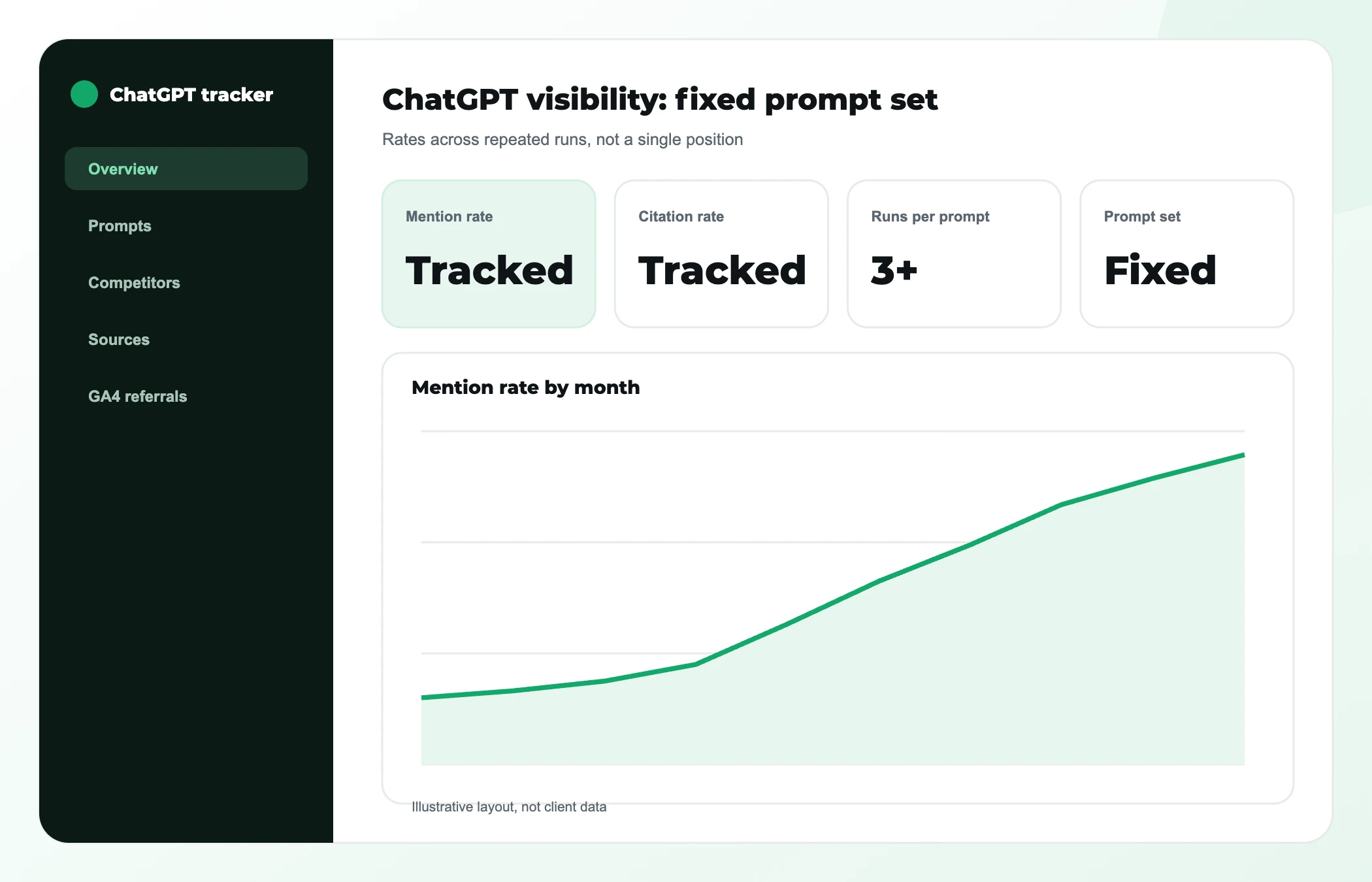
- ChatGPT has no fixed rankings. Track mention rate and citation rate across repeated runs of the same prompts.
- How a tool collects answers matters more than its dashboard. Interface capture and API sampling return different brands and sources.
- Run ChatGPT tests in an unpersonalized Temporary Chat, so your memory and custom instructions do not shape the answer.
- Twenty fixed prompts, three runs each, is a useful free baseline. Past 50 prompts or a second country, a paid tracker earns its fee.
- GA4 shows the clicks ChatGPT sends (utm_source=chatgpt.com). It cannot show the mentions nobody clicked.
What is ChatGPT rank tracking?
ChatGPT rank tracking is the practice of running a fixed list of buyer prompts in ChatGPT on a schedule and recording whether each answer names your brand, links to your site and describes you correctly.
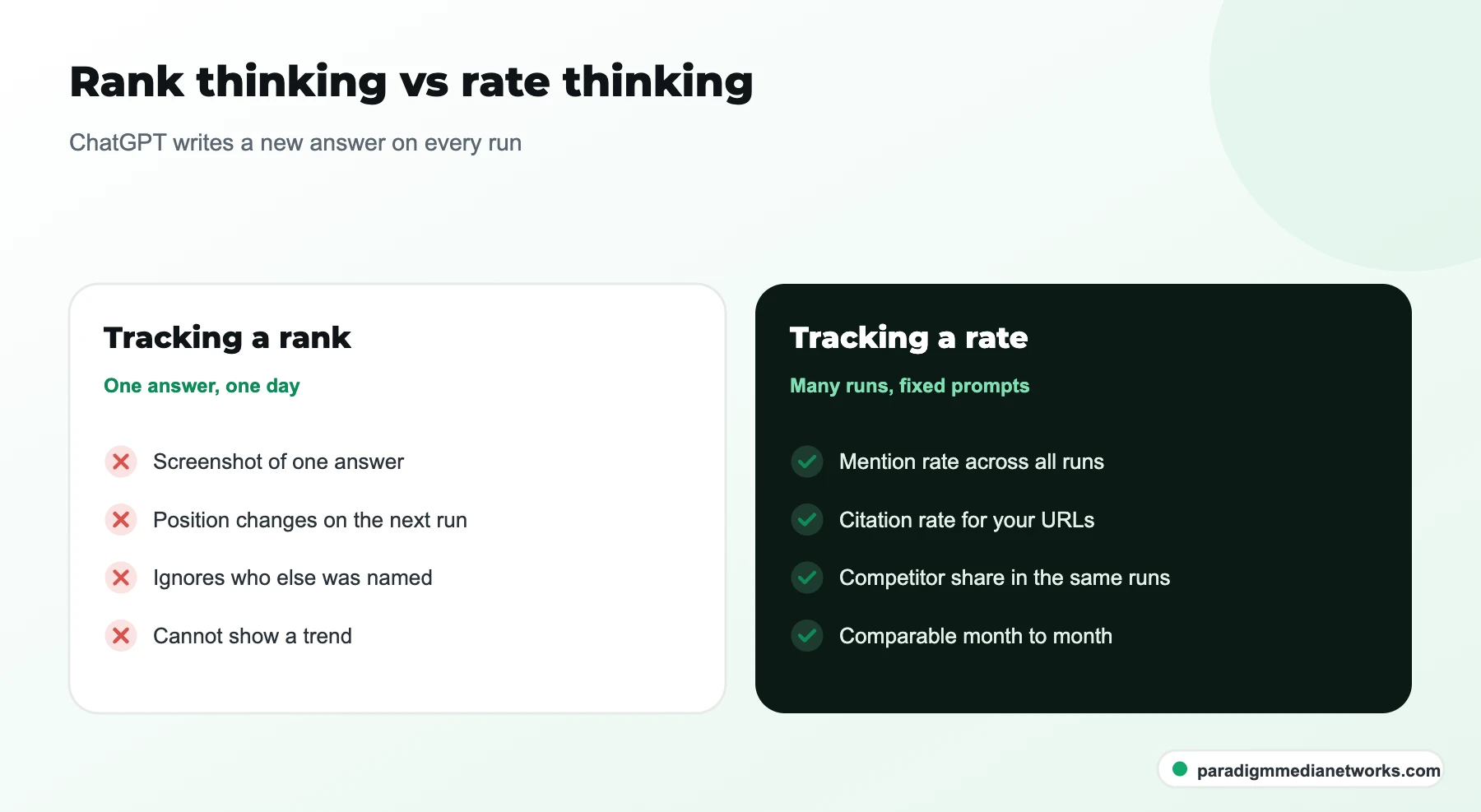
The word "rank" is borrowed from Google, and it misleads. Google shows a list of results that stays fairly stable for a day or a week. ChatGPT writes a new answer every time. In SparkToro and Gumshoe's research, reported in January 2026 by Search Engine Journal, volunteers ran 2,961 brand-recommendation prompts across ChatGPT, Claude and Google's AI results. ChatGPT and Google's AI returned the same list of brands less than once in 100 tries, and the same list in the same order less than once in 1,000.
The same study points to what does hold still: how often a brand appears across many runs. For headphones, the leading brands showed up in 55% to 77% of 994 responses. That share is what ChatGPT rank tracking should measure. A screenshot of "position 2" describes one answer, on one day, for one person.
What should you measure in ChatGPT?
Measure four rates per prompt set: mention rate, citation rate, first-named share and answer accuracy. Each is a count of runs divided by total runs, so it works the same in a spreadsheet or a paid tool.

| Metric | Formula | What it tells you |
|---|---|---|
| Mention rate | Runs that name your brand ÷ total runs | Whether ChatGPT considers you part of the category at all |
| Citation rate | Runs that link one of your URLs ÷ total runs | Which of your pages ChatGPT trusts enough to link, so you know what to copy |
| First-named share | Runs where you are the first brand named ÷ runs that name you | The closest thing to a "top spot", without pretending it is fixed |
| Answer accuracy | Brand runs with correct prices, services and locations ÷ brand runs | Whether ChatGPT is sending buyers away with wrong facts |
Log competitors in the same runs. A 20% mention rate means little alone. It means a lot when your main competitor sits at 70% on the same prompts, because the gap tells you which pages and sources to work on.
Keep mentions and citations apart. ChatGPT can name a brand often and link to it almost never, usually because the answer leans on review sites, lists and publications rather than the brand's own pages. That pattern points to off-site work, not more blog posts.
Why do ChatGPT tracking tools disagree?
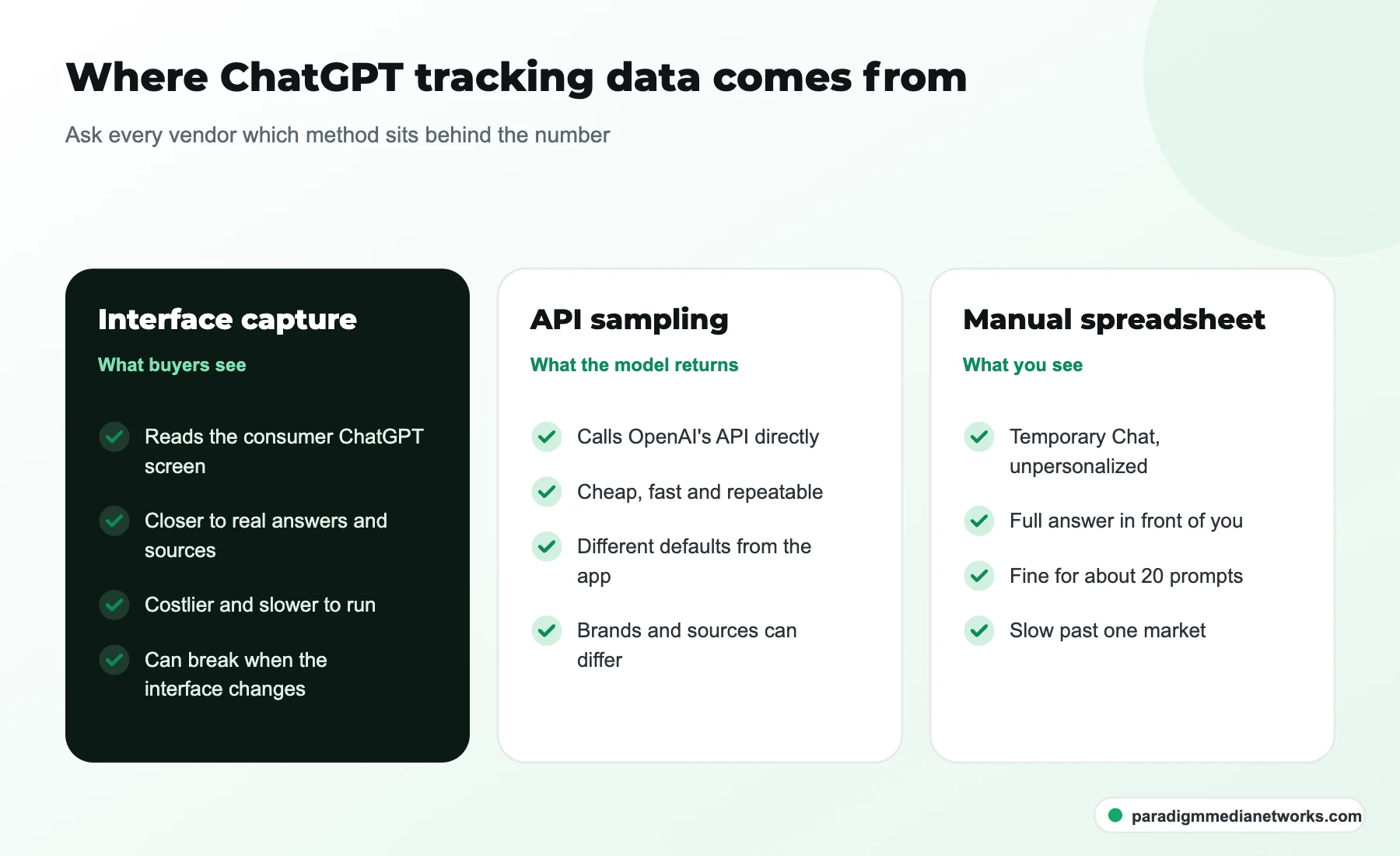
ChatGPT tracking tools disagree mainly because they collect answers in different ways. Some capture ChatGPT's consumer interface, the screen a buyer sees. Others call OpenAI's API, which runs a related model with different defaults.
The gap is large. In Surfer's October 2026 study of 1,000 prompts, each run once through the interface and once through the API, ChatGPT's interface cited 12.1 sources per answer against 3.1 through the API. The API named more brands, 13.8 per answer against 7.9. Only 4.8% of cited domains overlapped between the two methods. Surfer sells interface-based tracking and sampled each prompt once, so read the exact figures with that in mind. The direction is hard to ignore.
Vendors take sides openly. Conductor argues for API-based monitoring, calling interface scraping fragile. Profound says it queries AI platforms through the front-end browser, and SE Ranking describes its tracker as UI-based monitoring that sees answers "as a real user would." Neither approach is wrong for every job. API data is cheaper and repeatable; interface data is closer to what your buyers read. What matters is that you know which one sits behind your numbers, and that you never compare a figure from one method with a figure from the other.
Four other settings change ChatGPT answers, and a good tracker tells you how it handles each:
- Search on or off. With search, ChatGPT cites live pages. Without it, the answer comes from training data and usually carries no links.
- Location. Local and commercial prompts change with the user's country and city.
- Personalization. Memory and custom instructions shape answers for logged-in users. OpenAI's Temporary Chat FAQ says an unpersonalized temporary chat does not use memory or custom instructions.
- Sample size. One run per prompt is a coin toss. Ask how many runs sit behind each figure.
Which tools track ChatGPT?
Most AI visibility trackers include ChatGPT on every plan. The useful differences are the entry point, how many prompts you get, and whether the vendor states how it collects ChatGPT answers.
We checked each vendor's own pricing page or documentation on 24 October 2026. We have not tested these tools side by side, so this is a buyer's checklist, not a ranking. No vendor paid to be listed, and Paradigm Media Networks has no affiliate relationship with any of them.
| Tool | ChatGPT entry point (vendor page) | Collection method stated? | ChatGPT-specific notes | Best for |
|---|---|---|---|---|
| Otterly.AI | Lite, $29 a month, 15 prompts, daily | Not stated on the pricing page | ChatGPT on every plan, with citation source tracking and unlimited countries | A cheap first tracker |
| Semrush AI Visibility Toolkit | $99 a month, 25 prompts; 50 more for $60 | Not stated in the help article | Daily prompt tracking for ChatGPT and AI Mode, 220+ countries | Teams already on Semrush |
| SE Ranking AI Results Tracker (SE Visible) | Plan prices not on the tracker page | Yes: UI-based monitoring | Tracks ChatGPT mentions and linked pages alongside AI Overviews, AI Mode and Gemini | Teams that want interface data |
| Peec AI | Starter, 50 prompts, daily; price not shown when checked | Not stated for standard plans | ChatGPT is one of three models you choose on standard plans | Multi-country and sentiment tracking |
| Scrunch | Starter, $300 month to month ($250 billed annually), 350 prompts | Not stated on the pricing page | ChatGPT on all plans; SSO and data API on Enterprise only | Mid-market teams with many prompts |
| Profound | Free 7-day trial, 50 prompts; Enterprise custom | Yes: front-end browser | ChatGPT Shopping tracking on Enterprise; trial prompts are preset by industry | Large brands with shopping or many markets |
Two of the six state their collection method in plain words on the pages we read. For the rest, ask during the trial: "Do you capture the ChatGPT interface or call the API, with search on, from which country, and how many runs per prompt?" A vendor that cannot answer that is selling you a number without its method.
If you track more than ChatGPT, our comparison of 14 AI visibility tools by prompts, engines and price covers per-prompt cost across the wider market. Perplexity works differently, because it lists every source; we compared eight Perplexity rank tracking tools separately.
How do you track ChatGPT for free?
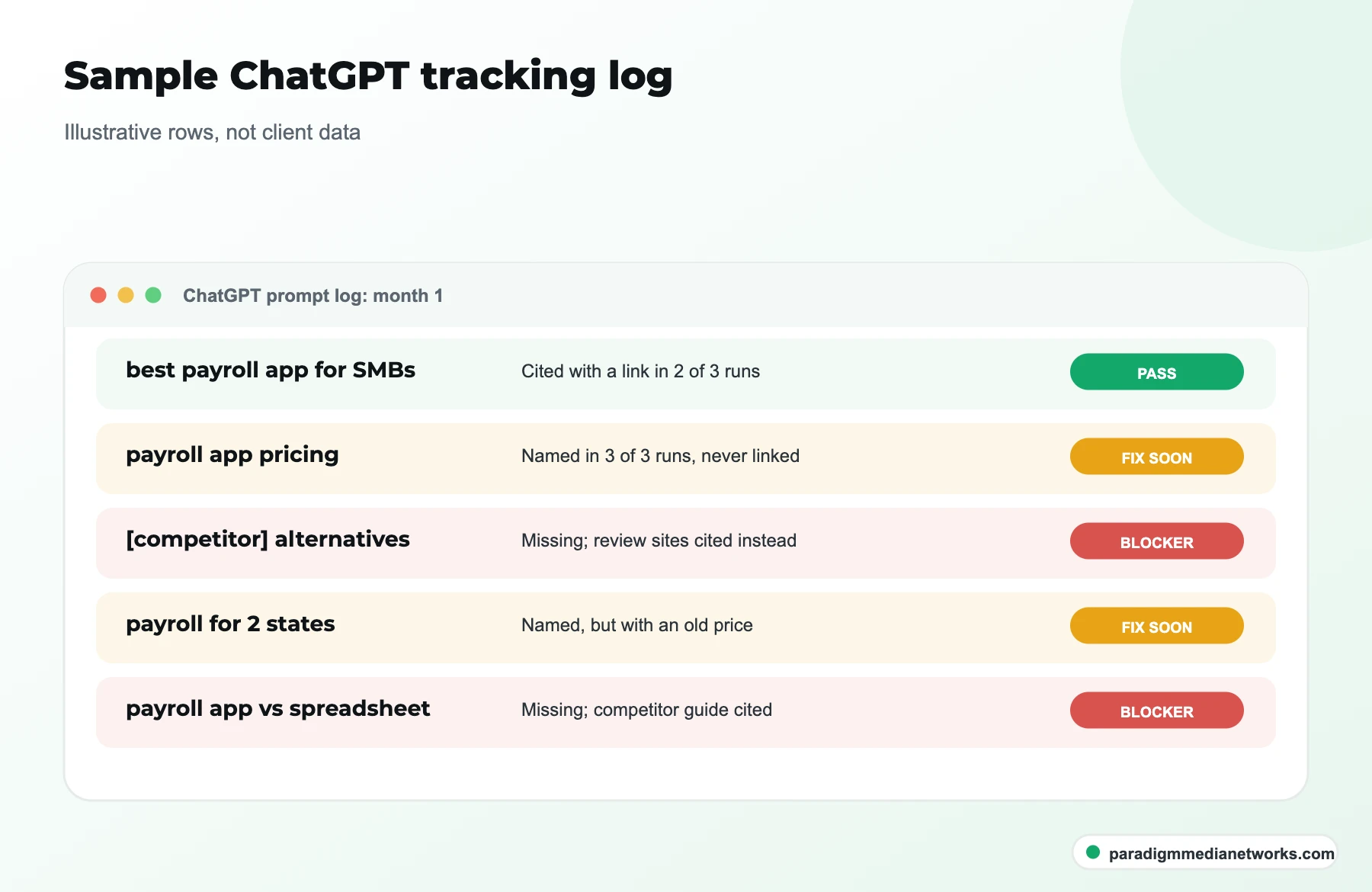
Run 20 fixed buyer prompts three times each, on different days, in an unpersonalized ChatGPT Temporary Chat with search on, and log every answer in a spreadsheet. That is 60 runs and about two hours a month.

- Write 20 unbranded prompts. Use the words buyers use on sales calls and in Search Console: "best [service] for [type of company]", "[service] cost in [city]", "[competitor] alternatives". Skip prompts with your brand name in them; they flatter the score and tell you nothing about new buyers.
- Open an unpersonalized Temporary Chat. Choose the unpersonalized option before the first message so memory and custom instructions stay out of it. Turn search on, because that is where links come from.
- Run each prompt three times, on three different days. One run is noise. Three gives you a first rate per prompt, and the SparkToro data shows why more runs make the share steadier.
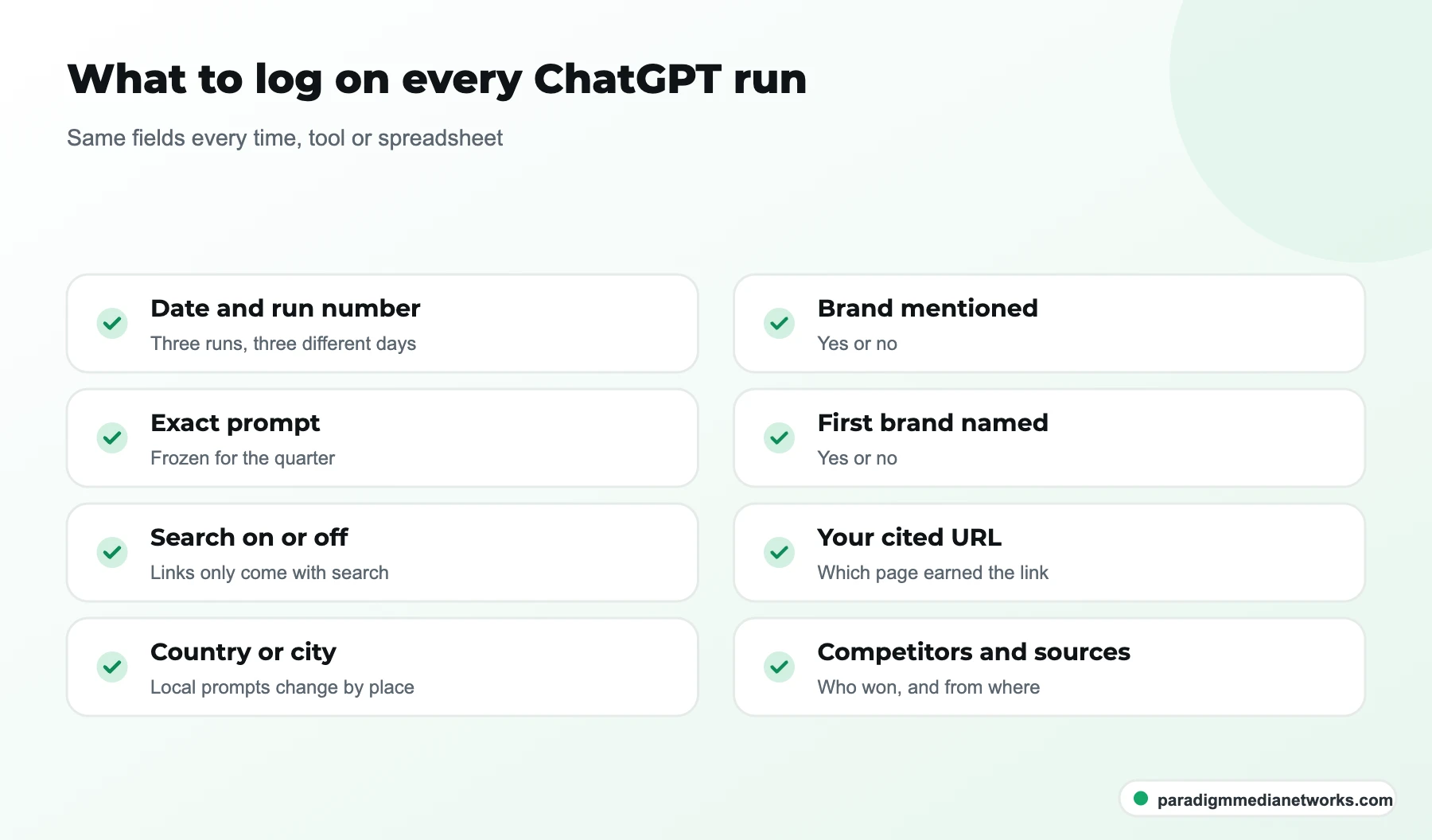
- Log the same fields every time. Date, prompt, run number, mentioned (yes or no), first named (yes or no), your cited URL, competitors named, sources cited, and any wrong facts.
- Work out the rates and pick the gaps. Divide by total runs. The prompts where a competitor appears and you do not are your work list for the month.

A worked example, with made-up numbers to show the maths. Twenty prompts at three runs each is 60 runs. Say ChatGPT names you in 12 runs and links your site in 5. Your mention rate is 20% and your citation rate is about 8%. If your main competitor is named in 39 runs, they sit at 65%. Now open the runs they won and note which pages ChatGPT cited for them. Those sources, more than your own blog, are usually where the gap lives.
Common mistake: changing the prompt list every month. A rate is only comparable against the same prompts. Freeze the list for a quarter, then add new prompts as a separate set.
How do you confirm ChatGPT visibility in GA4?
Filter GA4 sessions by the source chatgpt.com. OpenAI's publishers FAQ says ChatGPT automatically adds utm_source=chatgpt.com to referral URLs, so clicks from ChatGPT answers arrive labeled.
Build an exploration or a custom channel group for AI referrals, with chatgpt.com as one source, and add your key conversion. Then read referral sessions next to your monthly mention and citation rates. When the citation rate climbs and referral sessions follow, the work is reaching buyers. When mentions climb and sessions do not, ChatGPT is naming you without linking, which again points to the sources it cites instead of your pages.
Referral data has a hard limit. A buyer who reads your name in ChatGPT and then searches for you on Google arrives as branded search, not as a ChatGPT session. That is why prompt tracking and referral data sit side by side; neither replaces the other.
Before any of this, make sure ChatGPT can reach your pages. OpenAI's crawler documentation says sites that block OAI-SearchBot will not be shown in ChatGPT search answers, and that robots.txt changes take about 24 hours to take effect. A tracker cannot fix a blocked crawler; it will just report zero.
When is a paid ChatGPT tracker worth it?
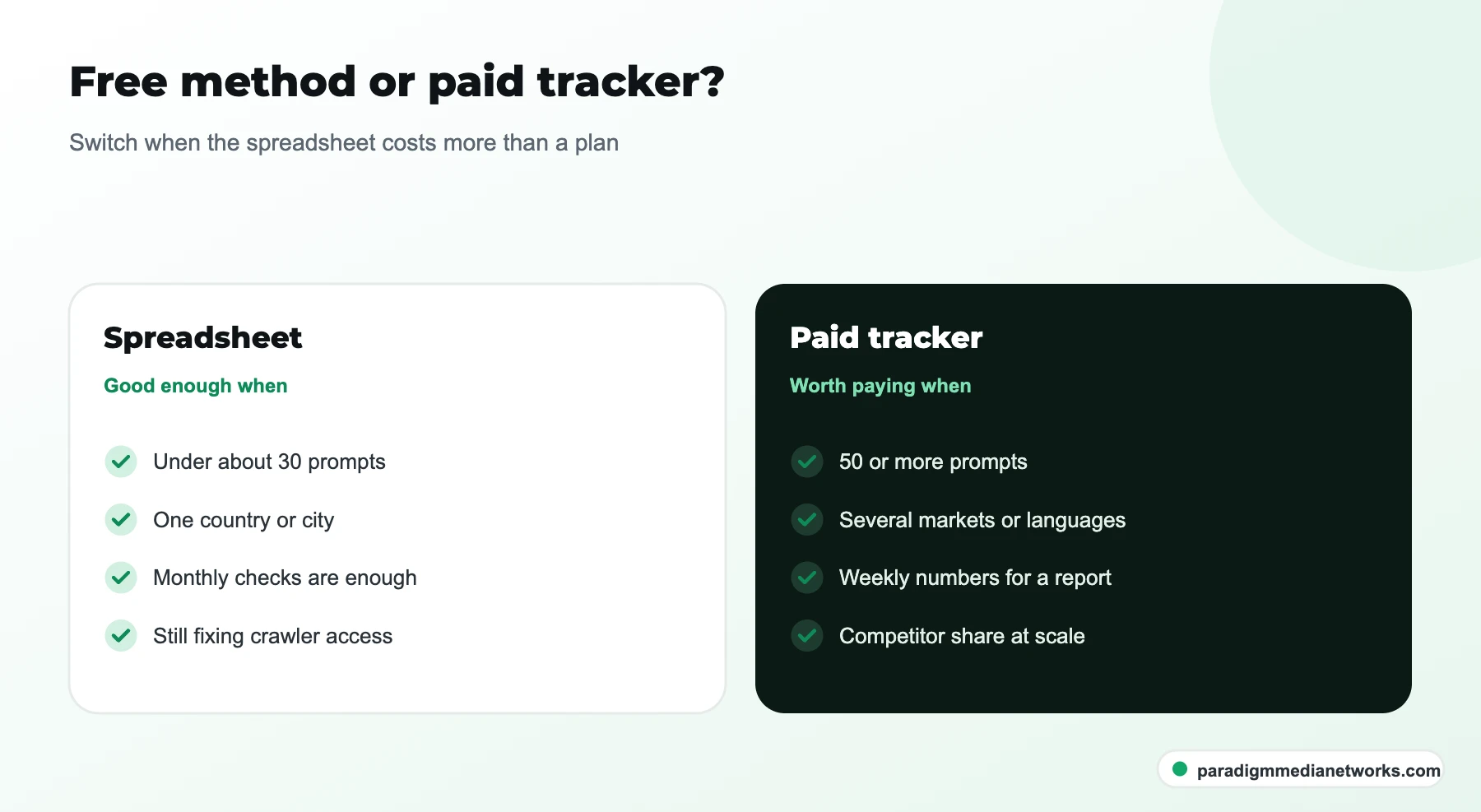
A paid tracker is worth it once the spreadsheet costs more of your time than a plan costs in money: usually past 50 prompts, a second country, or a need for weekly numbers in a report.
Stay with the spreadsheet if
- You track one service or product line, under about 30 prompts
- You sell in one country
- Monthly checks are enough for your decisions
- You still need to fix crawler access or basic pages first
Pay for a tracker if
- You need 50 or more prompts, or several markets
- You report AI visibility to a board or a client
- You want weekly or daily runs while publishing
- You need competitor share across many prompts at once
Whichever you choose, a tracker shows the gap; it does not close it. The fixes sit in three places: crawler access and Bing indexing, pages that answer the prompt in a quotable way, and the third-party lists and publications ChatGPT cites. If you would rather hand that work to one team, our ChatGPT SEO services run the same fixed prompt set every month and pair it with the technical, content and outreach work behind the numbers. If you want to find the blockers first, an audit of why AI engines skip your site gives you a ranked fix list in one go.
Our view on ChatGPT tracking
Jahid Hussain's view is that the method behind a ChatGPT number matters more than the tool that prints it, and that most tracking fails because the prompt list keeps changing.
At Paradigm Media Networks we track a fixed prompt set across five assistants every month for clients, including ChatGPT. For Moving Hub, a US long-distance mover that started 2026 with zero AI presence, that tracking is how we know it is now named by five AI assistants: ChatGPT, Google AI Mode, AI Overviews, Perplexity and Gemini. The tracking did not cause that. The technical rebuild, answer-first guides and digital PR did. The fixed prompt set is what made the change visible and believable.
Three habits separate useful ChatGPT tracking from noise: the same prompts every month, more than one run per prompt, and mentions logged separately from links. Get those right and even a spreadsheet tells you something true.
ChatGPT rank tracking: FAQ
Can you track your rank in ChatGPT?
Not as a fixed position. ChatGPT writes a fresh answer every time, and the brands it names change between runs. What you can track is a rate: how often ChatGPT names or links your brand across repeated runs of the same prompts. That rate is stable enough to compare month to month.
Is there a free ChatGPT rank tracker?
The free method is a spreadsheet. Pick 20 buyer prompts, run each three times on different days in an unpersonalized Temporary Chat with search on, and log whether you were named, linked and described correctly. For a one-off read, the Paradigm AI Visibility Checker is free and needs no sign-up.
How many prompts should I track in ChatGPT?
Start with 20 unbranded buyer prompts for one product line or service. That is enough to see a pattern without the spreadsheet taking over your week. Move to a paid tracker once you need 50 or more prompts, several countries or weekly checks.
Why do two ChatGPT tracking tools show different numbers?
Usually because they collect answers differently. Some query ChatGPT's consumer interface, others use OpenAI's API, and the two return different brands and sources. Location, search mode, sample size and the prompt wording also differ. Compare tools on the same prompts before trusting either.
Does ChatGPT send traffic I can see in Google Analytics?
Yes, when people click. OpenAI says ChatGPT adds utm_source=chatgpt.com to referral URLs, so those sessions show up in GA4 under that source. Mentions without a click never reach analytics, which is why prompt tracking and referral data answer different questions.
How often should I check ChatGPT visibility?
Monthly is enough for a baseline. Check weekly while you are publishing new pages or running PR, so you can see whether the work moves the mention rate. Keep the prompt list fixed for at least a quarter, or the numbers stop being comparable.

One team, one revenue number
Strategy is led by Jahid Hussain, founder of Paradigm Media Networks, with 7 years in growth marketing, SEO and performance marketing and an MBA in Marketing. SEO, AI search, paid media, content and web run as one system, so nobody hands you a report that contradicts another vendor’s.
- 500+ marketers trained and 30+ brands scaled
- Published results you can check: HVAC case study and Moving Hub case study
- Reporting on calls, leads and booked jobs, not just rankings
See what ChatGPT says about you
Start with the free check, then run the 20-prompt method above. If the gaps are bigger than you expected, we will show you which sources and pages to work on first.
✓ Free 30-minute call · No pitch decks · Walk away with a real plan
What you walk away with
- Whether OAI-SearchBot can reach your key pages
- A starter list of buyer prompts for your category
- The competitors ChatGPT names in your place
- A straight answer on whether you need a tool, a fix list or neither