
SEO for plumbers: a step-by-step guide to more calls from Google
SEO for plumbers is the work of getting your plumbing business shown, and chosen, when nearby homeowners search Google, Maps or AI tools for a plumbing problem. You can do most of it yourself: a complete Google Business Profile, one strong page per job, steady reviews, consistent listings and call tracking, run as a weekly routine.
✓ Written for owners doing it themselves · Free tools first · Google's own rules cited
What is SEO for plumbers?
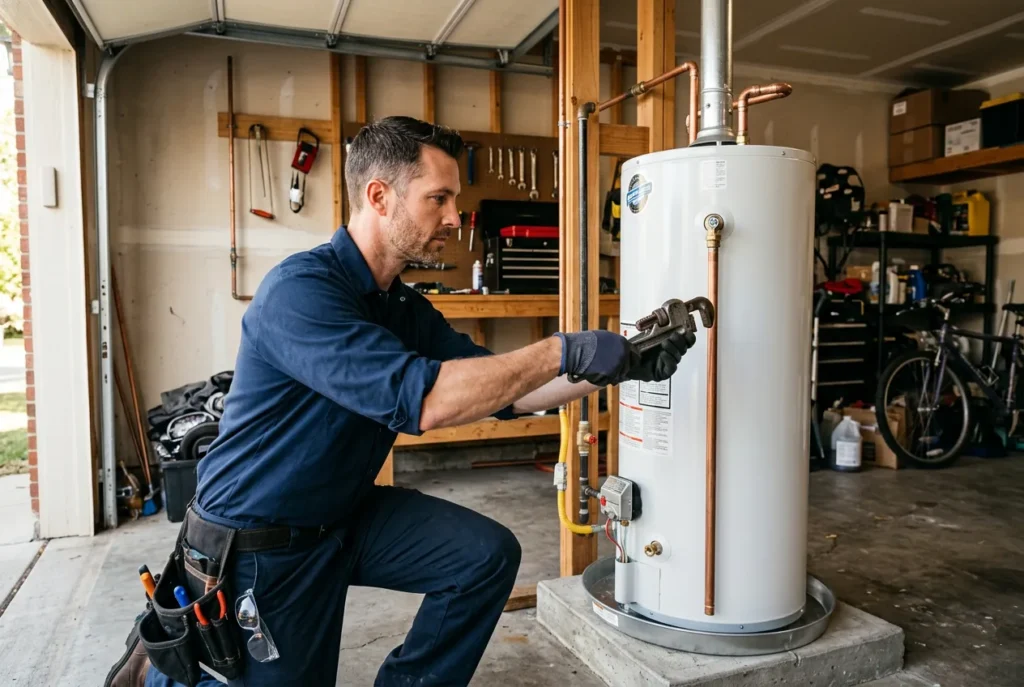
SEO for plumbers is everything that makes Google, Google Maps and AI assistants show your plumbing company when someone nearby searches for a plumbing problem, and everything that makes that homeowner call you rather than the next listing.
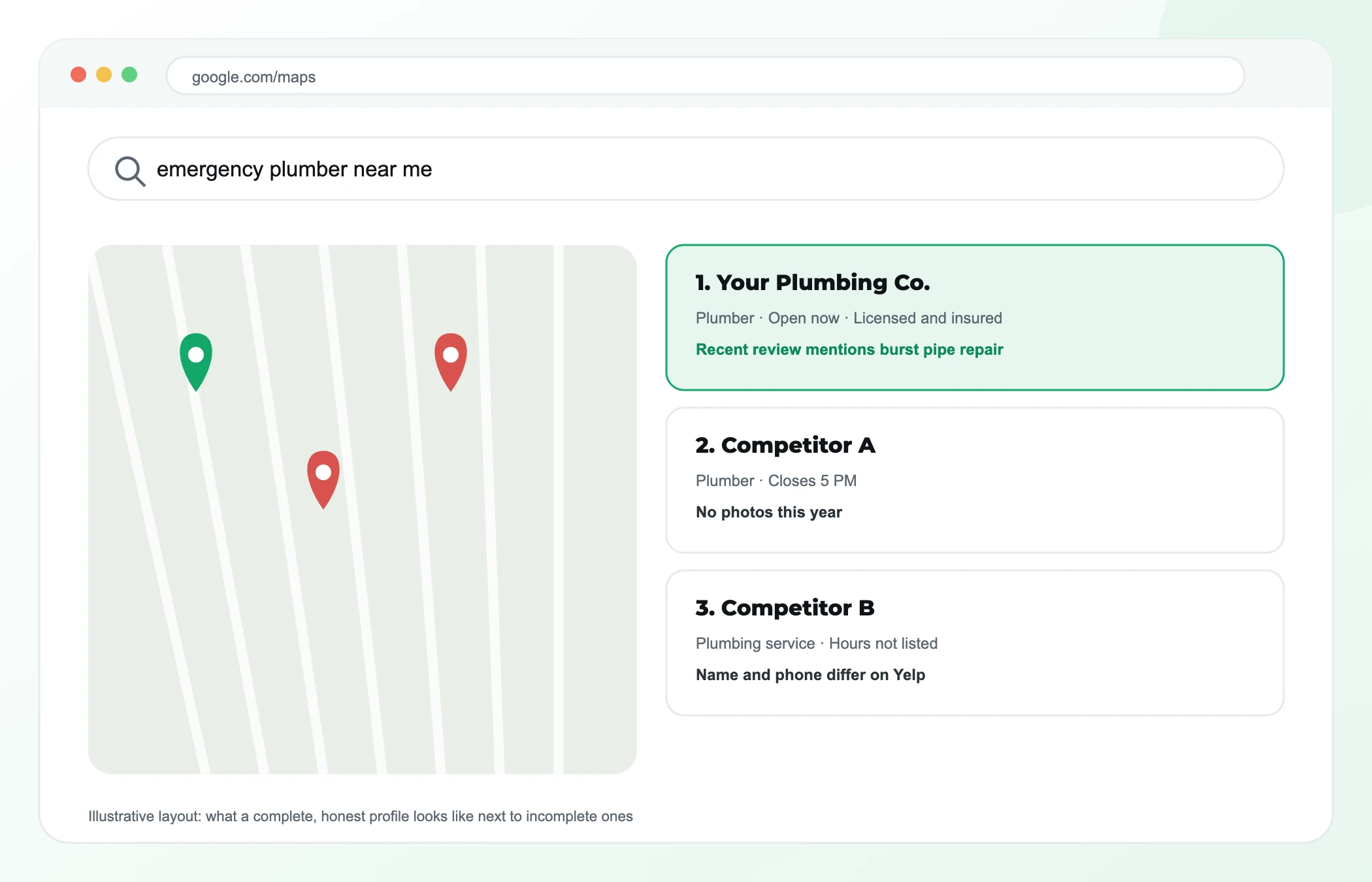
A plumbing customer can find you in three places: the Map Pack (the three listings under the map), the organic results below it, and AI answers such as Google's AI Overviews or ChatGPT. Google's own local ranking help page says local results are ranked on relevance, distance and prominence, and that "more reviews and positive ratings can help your business's local ranking." You cannot change distance. Everything in this guide works on relevance and prominence.
Key takeaways
- Start with the Google Business Profile. For emergency searches, the Map Pack is usually where a plumbing call is won or lost.
- Build one useful page per job you want more of (water heaters, drains, sewer lines, leaks), written for the homeowner's problem, not your service list.
- Ask every customer for a review, the same day. Google's rules forbid asking only the happy ones, and the FTC bans buying reviews.
- Publish weather-driven content before the weather arrives: freeze pages in the fall, sump pump pages before the spring rain.
- Measure calls and booked jobs. Rankings are a means, not the result.

Step 1: How do you set up a Google Business Profile for a plumbing company?
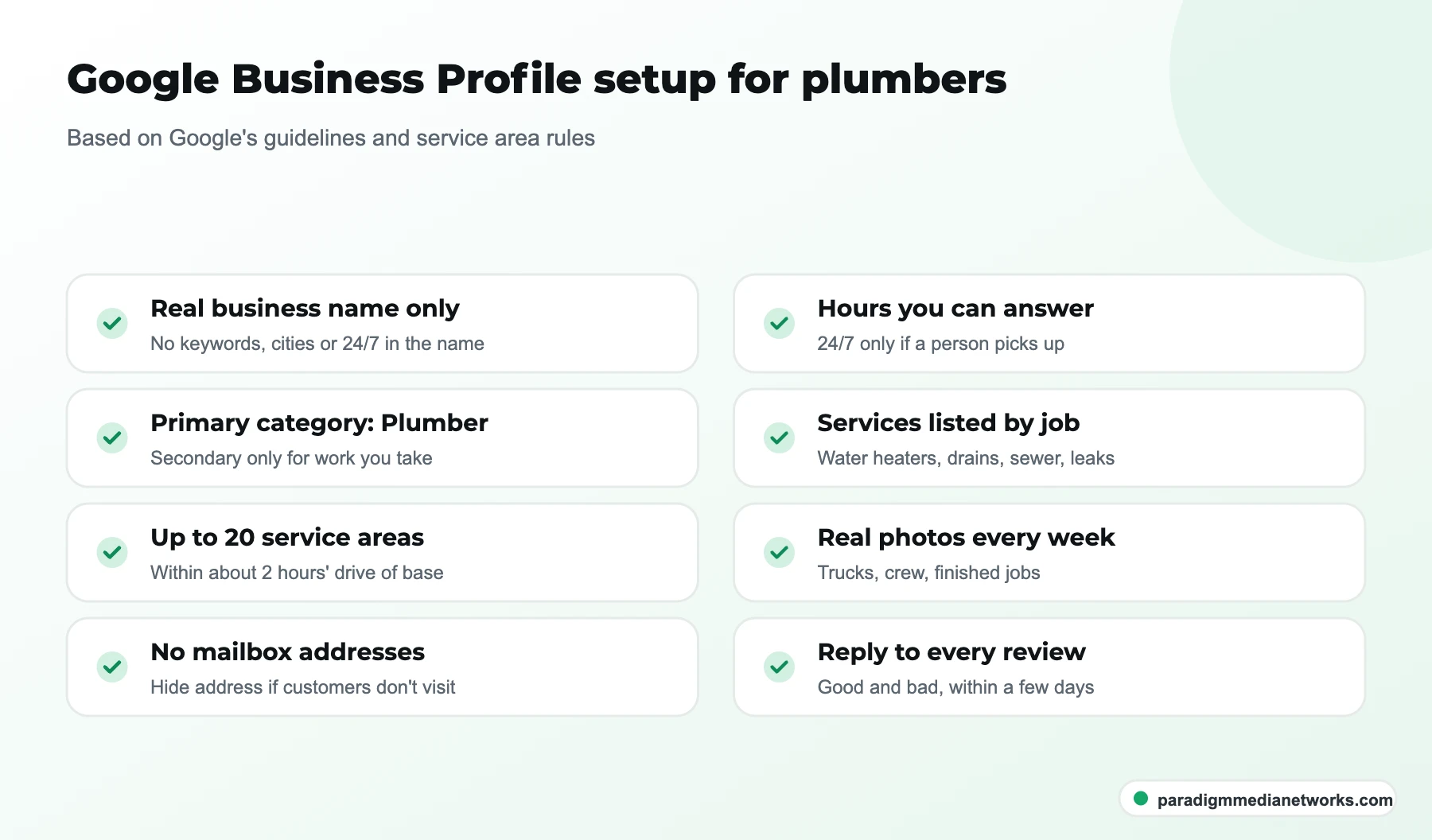
Claim and verify the profile, use your real business name, choose "Plumber" as the primary category, set honest service areas and hours, list every service you sell, and add photos of real jobs every week.

- Use your real name, nothing added. Google's Business Profile guidelines state that "including unnecessary information in your business name isn't permitted." "Smith Plumbing" is fine. "Smith Plumbing | Emergency Plumber 24/7 Dallas" can get the profile suspended.
- Pick the primary category with care. "Plumber" for most companies. Secondary categories only for work you actually take, such as drainage service or water heater installation.
- Set service areas by city or ZIP code. Under Google's service area rules, you can list up to 20 service areas, the whole area should stay within about two hours' drive of your base, and you should remove your address if customers do not visit you there.
- Never use a mailbox or virtual office. Google says P.O. boxes and remote mailboxes are not acceptable addresses. A plumber with no shop runs as a service-area business instead.
- Publish hours you can answer. If the profile says open 24 hours, the 2 a.m. call has to be answered by a person. A missed emergency call becomes a booked job for the next plumber, and often a bad review.
- List services by job. Water heater repair, tankless installation, drain cleaning, hydro jetting, sewer camera inspection, leak detection, repiping. Write a one-line description for each.
- Add real photos weekly. Trucks, crew, finished installs, before and after shots. Stock photos tell Google and homeowners nothing.
Step 2: Which pages should a plumbing website have, and what goes on each one?
A plumbing website needs one page per job family you want more of, each written around the homeowner's problem, plus clear about, license and contact information. One great water heater page beats ten thin ones.
Homeowners search the symptom ("no hot water", "basement drain backing up"), not your trade name. So a page built around the problem, with the fix and the price range right after it, matches the search and earns the call. We publish the full job-family page plan we use as a plumbing SEO company, including which follow-on jobs each emergency page should set up. Here is how to build any single page yourself.
The anatomy of a plumbing job page
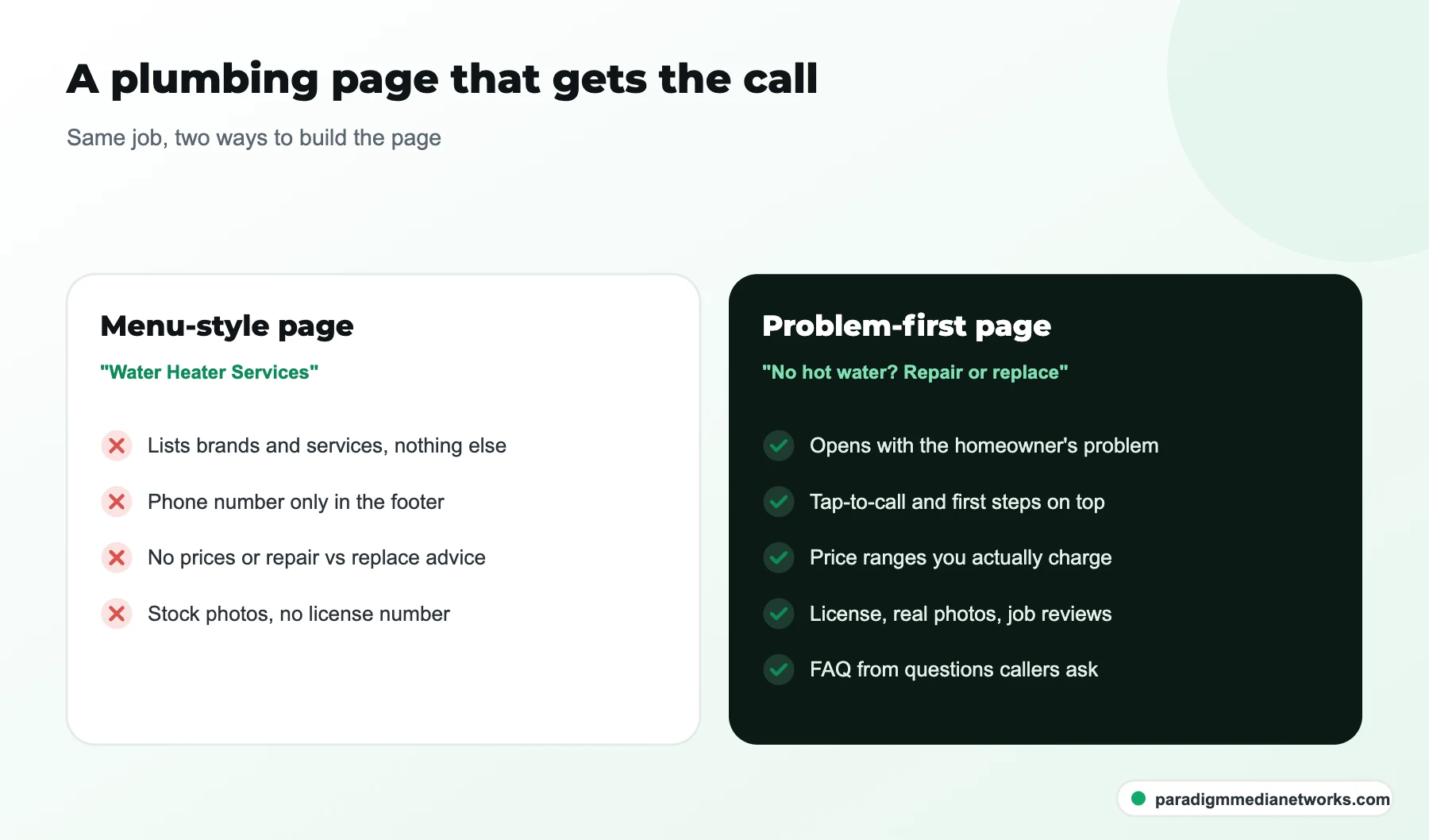
- A headline that names the problem and the fix. "No hot water? Water heater repair and replacement" beats "Water Heater Services."
- Phone number and the first thing to do, above the fold. For a leak page, how to shut off the main valve. For a gas smell, tell people to leave the house and call their gas utility before calling you.
- Repair or replace, explained honestly. When a repair makes sense, when it does not, and what you check first.
- Price ranges you actually charge. Even a wide range ("most repairs we do fall between X and Y") answers the question homeowners and AI tools ask most.
- Proof that is specific to the job. License number, insurance, brands you install, photos of this job type, reviews that mention it.
- Short FAQ from real calls. Ask whoever answers your phone which questions come up every week.
About city pages: build a town page only when you have real jobs, reviews or technicians there and something specific to say about it. Pages that only swap the town name are what Google's spam policies call doorway pages.
Step 3: How do plumbers get more Google reviews without breaking the rules?
Ask every customer, the same day, with a direct link, and reply to every review. Do not filter who you ask, and do not pay or reward people for reviews.
Reviews feed prominence, and homeowners read them. BrightLocal's Local Consumer Review Survey 2026 found 97% of consumers read reviews for local businesses and 74% care only about reviews written in the last three months. So the goal is a steady flow, not a one-time campaign.
Two rules keep you safe. Google's review policy prohibits businesses from discouraging negative reviews or "selectively solicit[ing] positive reviews," and from offering money, discounts or free services in exchange for a review. In the US, the FTC rule on fake reviews (effective October 2024) bans buying fake reviews and rewarding customers for reviews that express a particular sentiment.
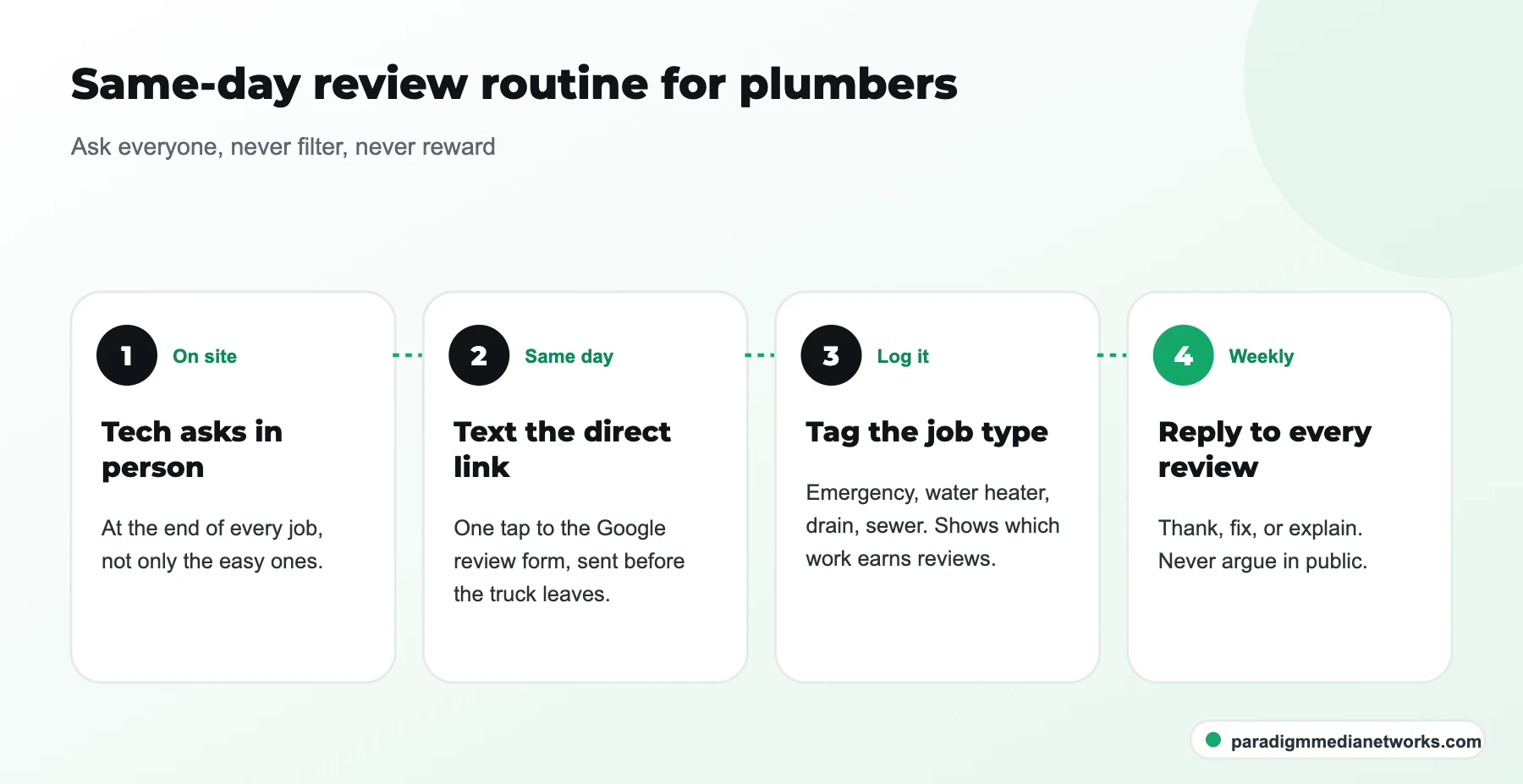
One habit pays off later: note the job type when you send each request. After a few months you will see whether your emergency and water heater work is earning reviews, or only your routine drain calls.
Step 4: Which listings and directories matter for plumbers?
The listings that matter are the ones homeowners and AI tools actually check: Google, Apple Business Connect, Bing Places, Yelp, Angi, the BBB, Nextdoor and Facebook, plus your state license lookup. The name, address, phone number and services must match everywhere.

Consistency matters more than volume. AI assistants compare facts across sources, so a license number, phone number or service area that differs between your site, profile and Yelp gives them a reason to name someone else. Fix the big listings first, then close or merge duplicates from old phone numbers or past addresses.
| Listing | Why it matters for a plumber | What to check |
|---|---|---|
| Google Business Profile | Drives Map Pack calls | Name, category, service areas, hours, services |
| Apple Business Connect | Feeds Apple Maps and Siri on iPhones | Same name, phone and hours as Google |
| Bing Places | Feeds Bing search and Bing Maps | Import from Google, then verify details |
| Yelp, Angi, BBB, Nextdoor | Homeowners check them, and AI tools can cite them | Same phone, license and service list; reply to reviews |
| State license lookup | Proof you are licensed, where your state requires it | Business name on the license matches your listings |
| Manufacturer "find a pro" pages | A genuine, relevant link if you are certified | Ask your supplier or the brand rep to list you |
We use the same method for heating and cooling contractors; the home services citation checklist lists more directories and how to clean them up.
Step 5: What content should plumbers publish, and when?
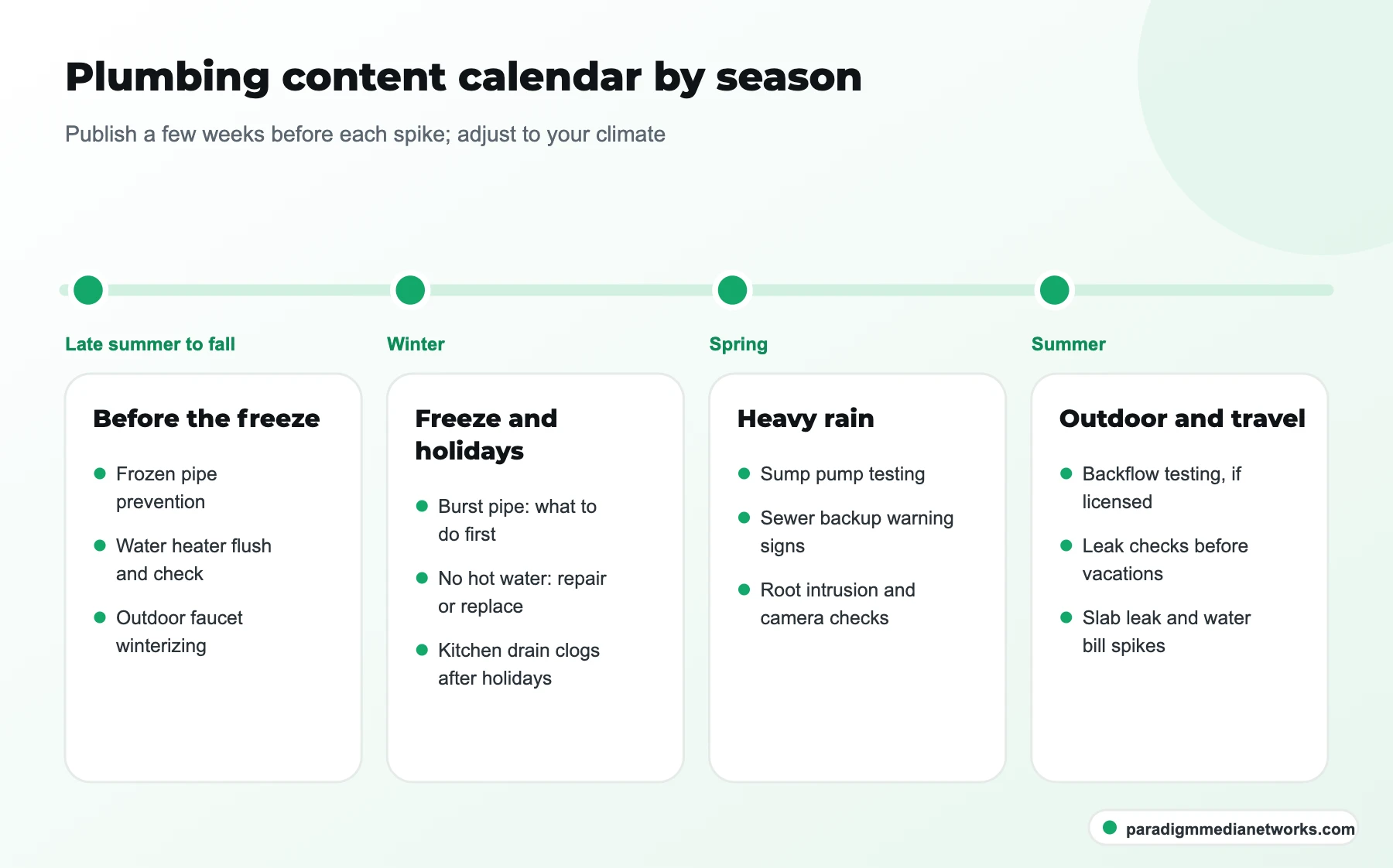
Publish the content for each weather risk a few weeks before it arrives, so the page is indexed and ranking when the calls start: frozen pipes before the first hard freeze, sump pumps and sewer backups before the heavy rain.
Plumbing demand is urgent all year, but it spikes with weather and holidays. A burst pipe page published the morning of the first freeze is too late. Use the calendar below as a starting point, then adjust it to your climate. A Florida plumber's calendar looks nothing like one in Minnesota.
Blog posts work when they answer what homeowners ask before they call: "How long should a water heater last?", "Is a slab leak covered by insurance?", "Why does my drain keep clogging?" Answer the question in the first two sentences, then explain, then show the job page that fixes it.
Step 6: What technical SEO can a plumber check without a developer?
You can check five things yourself with free tools: that Google has indexed your pages, that the site loads fast on a phone, that the phone number is tap-to-call, that the site runs on HTTPS, and that your business details are marked up with schema.
- Indexing: set up Google Search Console (free) and confirm your job pages appear under Pages as indexed.
- Mobile speed: run your main pages through PageSpeed Insights. Most emergency searches happen on a phone.
- Tap-to-call: on your phone, tap the number in the header of every page. It should dial straight away.
- HTTPS: the address bar should show a padlock on every page, with no "not secure" warnings.
- Schema: schema.org has a dedicated "Plumber" type for business markup. Many site builders and SEO plugins can add it with your name, phone, hours and service area.
If any of these fail and you cannot fix them in your site builder, that is the point where paying a developer or an agency for a few hours makes sense.
Step 7: How do you know if plumbing SEO is working?
Track calls and booked jobs by source each week, and use rankings only to explain why those numbers moved. A plumber who ranks first but misses the phone has not won anything.
- Google Business Profile performance: calls, website clicks and direction requests from the profile, month over month.
- Search Console: which searches bring clicks to which pages. Look for symptom searches you could answer better.
- Call tracking: a tracking number on the website (keep your main number consistent on listings) tells you how many calls the site produces.
- Booked jobs by source: tag "how did you find us" in your field service software, and compare against the call log.
- Map Pack spread: a plumber who ranks first near the shop can vanish a few miles out. Grid tracking tools show this; at minimum, search from your phone in each town you serve.
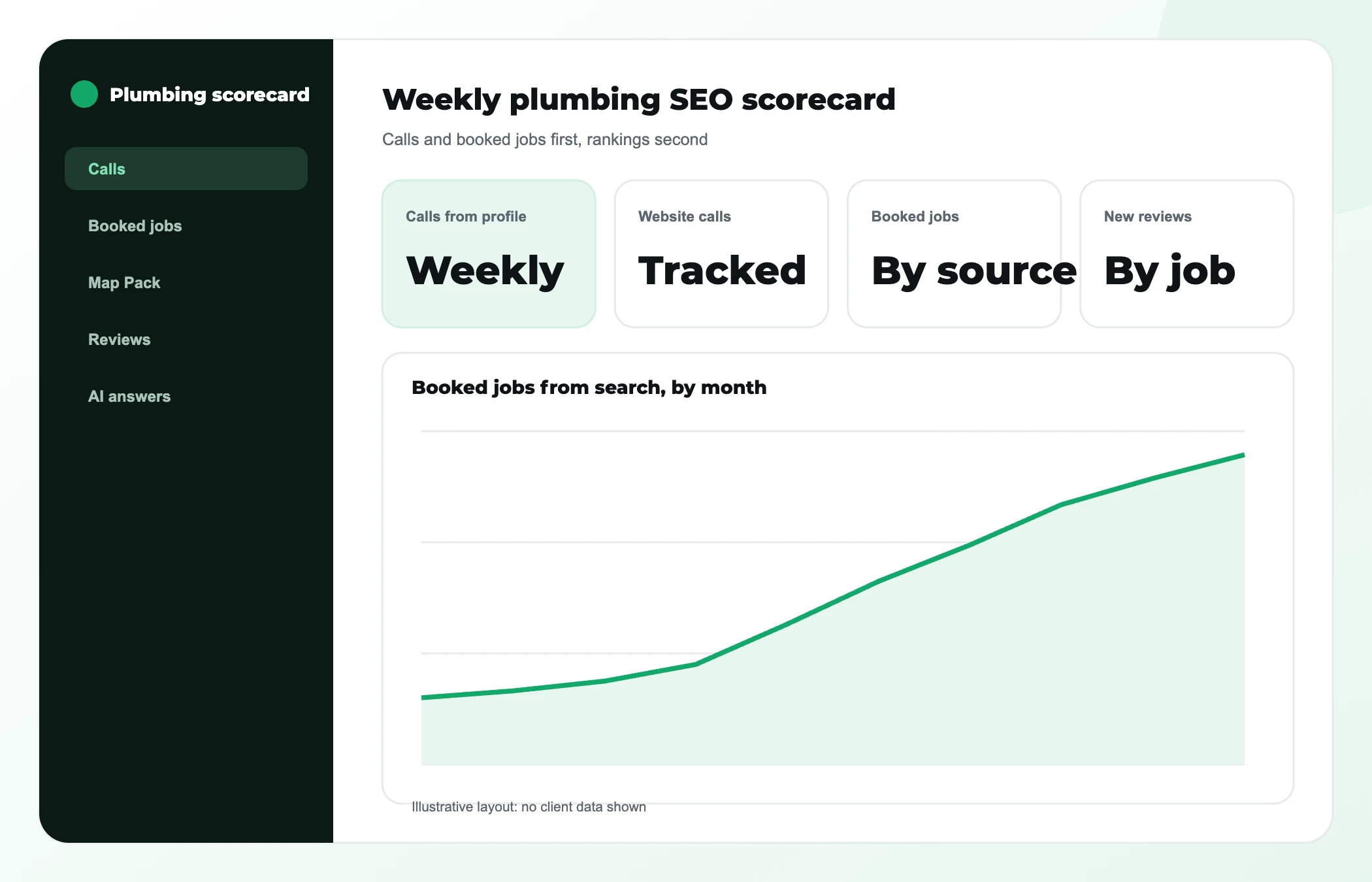
To put a value on the work, our SEO ROI calculator turns extra calls into revenue at your booking rate and average job value. The trade-by-trade numbers behind it are in our home services marketing benchmarks.
Do plumbers need to do anything different for ChatGPT and AI Overviews?
Mostly no. The same work counts: consistent facts across your site and listings, recent reviews that describe real jobs, and pages that answer price and repair-or-replace questions plainly. What changes is that you should check what AI tools say about you.
BrightLocal's 2026 survey found 45% of consumers had used ChatGPT or another AI tool for local business recommendations, up from 6% the year before. Ask ChatGPT, Gemini and Perplexity "best plumber for a water heater replacement in [your town]" once a month and write down who gets named. Our free AI visibility checker runs a version of that test for you, and AI search for home service businesses explains what moves the answers by trade.
What does a weekly SEO routine look like for a plumbing owner?
A workable routine is small and fixed: photos and review replies every week, one page or post improved every two weeks, a listings check every month and a results review every month.
| Task | How often | Who can do it |
|---|---|---|
| Send review requests after every job | Daily | Technician or office, by text |
| Reply to every new review | Weekly | Owner or office manager |
| Add job photos to the profile | Weekly | Technicians upload, office posts |
| Improve or publish one job page or post | Every two weeks | Owner, writer or agency |
| Check the profile for edits by others | Weekly | Owner |
| Check top listings and fix mismatches | Monthly | Office |
| Review calls and booked jobs by source | Monthly | Owner |
| Publish the next weather page | Before each season | Owner, writer or agency |
Which SEO mistakes cost plumbers the most?
The costly mistakes break Google's rules or waste the calls you already earn: keyword-stuffed business names, fake addresses, town pages that only swap the name, 24/7 claims with nobody answering, and paid or filtered reviews.
Mistakes that risk the profile
- Keywords or cities added to the business name
- A virtual office or mailbox used as the address
- Paying for reviews or offering a discount for one
- A second profile for the same location
Mistakes that waste traffic
- Listing 24/7 hours with nobody answering at night
- One "Services" page for every job you do
- Fifty town pages with only the name swapped
- Reporting rankings instead of calls and jobs
Should you do plumbing SEO yourself or hire someone?
Do it yourself if your market is small, your site is sound and you can protect a few hours every week. Hire help when the market is crowded, the site has technical problems, or the routine keeps slipping because the trucks come first.
| Situation | Best route | Why |
|---|---|---|
| One truck, small town, few competitors | Do it yourself | The profile, reviews and a handful of pages often cover it |
| Growing shop in a busy metro | Hire, or DIY plus a writer | You need many strong job pages and links, and grid coverage |
| Site is slow, broken or not indexed | Pay for technical help first | Content cannot rank on a site Google struggles with |
| Need calls this month | Ads now, SEO in parallel | SEO takes months; Local Services Ads or Google Ads can start this week |
If you do hire, ask to see reports in calls and booked jobs, and walk away from anyone who guarantees rankings. Our guide on how to choose an SEO company lists the questions to ask, and our home services SEO plans show the deliverables a monthly scope should spell out.
SEO for plumbers: FAQ
Can I do SEO for my plumbing business myself?
Yes. A plumbing owner can handle most of the work: a complete Google Business Profile, one useful page per main job, a review request after every job, consistent listings and basic call tracking. What usually needs outside help is technical site work, link earning and the time to keep it going every week.
How long does SEO take for a plumber?
Profile fixes and new reviews can show up in Map Pack results within weeks, while new service pages usually take a few months to rank, longer in crowded metros. In PMN's HVAC client work, Map Pack movement usually starts in 60 to 90 days. Plumbing should behave similarly, but your competition sets the pace.
What is the best Google Business Profile category for a plumber?
Use "Plumber" as the primary category for most plumbing companies. Add secondary categories only for work you genuinely do, such as drainage or water heater installation. Categories decide which searches your profile is eligible for, so do not add a trade you would turn down on the phone.
Do plumbers need a website for SEO, or is a Google Business Profile enough?
A profile alone can win some Map Pack calls, but a website does the convincing. It holds your job pages, prices, license details and photos, and Google uses it to judge relevance. AI tools also read your site when deciding which plumber to name, so a thin or missing site limits you.
How many reviews does a plumbing company need?
There is no fixed number. What matters is having more recent reviews than the plumbers you compete with in your area. BrightLocal's 2026 survey found 74% of consumers care only about reviews from the last three months, so a steady weekly flow beats a one-off push.
Should a plumber pay for SEO or do it in-house?
Do it yourself if you have a few hours a week and a simple market. Hire when you are in a crowded metro, need many job pages written well, have technical site problems, or simply cannot keep the weekly routine going. Ask any agency to report in calls and booked jobs, not keyword positions.

One team, one revenue number
Strategy is led by Jahid Hussain, founder of Paradigm Media Networks, with 7 years in growth marketing, SEO and performance marketing and an MBA in Marketing. SEO, AI search, paid media, content and web run as one system, so nobody hands you a report that contradicts another vendor’s.
- 500+ marketers trained and 30+ brands scaled
- Published results you can check: HVAC case study and Moving Hub case study
- Reporting on calls, leads and booked jobs, not just rankings
Want to know where your plumbing company actually shows up?
Send your website and service area. We will show where you appear in the Map Pack for emergency, water heater and drain searches, which listings disagree, and whether AI tools name you. Free, no obligation.
✓ Free 30-minute call · No pitch decks · Walk away with a real plan
What you walk away with
- Your Map Pack spread across your towns
- Profile and listing fixes, in priority order
- The job pages worth building first
- What ChatGPT and Google's AI say about you