
SEO for removal companies: a 10-step plan you can run yourself
SEO for removal companies means getting a UK removals firm found when people search "removals [town]" and named when they ask Google or ChatGPT who to use. Do it in this order: map your real coverage, fix Google Business Profile, build town pages you can justify, publish prices in pounds, track booked surveys, then earn reviews, links and AI mentions.
✓ Free guide · No sign-up · Written for owners, not SEO specialists


Key takeaways
- Start with a written list of the depots, towns and postcode districts your crews actually cover. Every later step (Google Business Profile, town pages, reviews) depends on it.
- A Google Business Profile allows up to 20 service areas, and Google says the overall area should be no more than about two hours' drive from your base.
- Only build a town page when you can say something about that town that a competitor's page could not copy by swapping the name.
- Measure booked surveys (home or video), not just enquiries. The quote follows the survey, so the survey is where most removals jobs are won or lost.
- Ask every customer for a review in the same way. Google prohibits offering discounts for reviews and selectively asking only happy customers.
What does SEO for a removal company actually involve?
SEO for a removal company is the ongoing work of making a removals firm easy to find, check and choose on Google Search, Google Maps and AI assistants, measured by surveys and moves booked rather than by rankings alone.
For a UK removals firm that work falls into ten jobs. Most of them cost time rather than money, and an owner or office manager can run them with an hour or two a week once the set-up is done. The table shows the order we recommend and why each step sits where it does.
| Step | What you do | Why it comes here |
|---|---|---|
| 1. Coverage map | List depots, towns, postcode districts and regular long-distance runs | Every other step uses this list |
| 2. Google Business Profile | Category, service areas, services, real photos, survey link | The Map Pack is where most local removals enquiries start |
| 3. Website basics | Service pages, a short survey form, click-to-call, indexing checks | Visitors from steps 2 and 4 need somewhere to convert |
| 4. Town pages | One page per town that passes the town page test | Captures "removals [town]" searches beyond your base |
| 5. Cost pages in pounds | Your own price bands and what changes a quote | Cost is the question asked most before a survey |
| 6. Survey tracking | Track enquiry, survey booked and move booked | Shows which pages produce work, not just visits |
| 7. Trust signals | BAR, Which? Trusted Traders, Checkatrade shown with proof | Customers and AI systems both check them |
| 8. Review routine | The same request after every move | Reviews feed the Map Pack and your town pages |
| 9. Local links and citations | Directories, trade listings, local partners and press | Consistent details and real mentions build trust |
| 10. AI visibility check | A fixed set of prompts in ChatGPT, AI Overviews and others, monthly | Shows whether AI answers name you or a comparison site |
Step 1: Which towns should a removals firm target?
A removals firm should target the towns its crews already work in every week, from a real depot, before any town it would merely like to win. Write that list down first, because it drives your Google Business Profile, your town pages and your review requests.

Sit down with whoever plans the diary and pull the last twelve months of jobs. Group them by collection town and postcode district. Most firms find their work clusters far more tightly than their website suggests: a handful of towns near each depot, plus a few long-distance runs they do often enough to plan around.
- Core towns: places your crews work every week. These get Google Business Profile service areas and, if they pass the test in step 4, a town page.
- Postcode districts: useful inside large towns and cities where access and property types change from one district to the next.
- Regular runs: lanes such as a weekly south east to Scotland trip, which deserve their own page with transit times and part-load options.
- Services by town: note where you offer storage, packing, office removals or man and van, because not every depot offers everything.

Step 2: How should a removal company set up Google Business Profile?
A removal company should set up Google Business Profile as a service-area business with honest service areas, the closest matching primary category, every service it offers, real photos of its vans and crews, and a link straight to its survey booking form.
Google's own rules set the limits. According to Google Business Profile Help, you can list up to 20 service areas, defined by town, city or postcode, and the overall area should not be more than about two hours' drive from where the business is based. If customers do not visit your depot, hide the address and use service areas instead.
- Pick the primary category carefully. Choose the closest category Google offers in the list for what most of your work is (for example, Moving company), then add secondary categories only for services you really provide, such as storage.
- Use your coverage map for service areas. Enter your core towns from step 1, not a county-wide wish list. A tight, accurate area is easier for Google to trust.
- List every service separately. House removals, packing, storage, office removals, man and van, piano moves, European removals: each one gives Google and customers another clear match.
- Upload real photos. Liveried vans, crews wrapping furniture, your storage containers. Stock photos tell customers nothing.
- Point the booking link at your survey form. The survey is the step that leads to a quote, so make it the next click.
Common mistake: adding every town within 50 miles as a service area. It breaks Google's two-hour guidance, dilutes the profile and produces enquiries your crews cannot reach profitably.
Step 3: What does a removals website need before you add more pages?
A removals website needs one clear page per service, a short survey or quote form, a tappable phone number on every page and pages that Google can actually index, before more content is worth adding.
Check three things in Google Search Console, which is free. First, the Pages report: are your service pages indexed? Second, the Core Web Vitals report: do mobile pages load without problems? Third, the Performance report: which queries already bring impressions, because those tell you which towns and services Google already associates with you.
Keep the survey form short. Name, phone, moving from, moving to, rough date and property size is enough to book a survey; the surveyor collects the inventory. Offer a video survey option if you run them, and say how quickly you respond.
Step 4: How do you build town pages that are not doorway pages?
You build town pages that are not doorway pages by publishing one only where your firm genuinely works and can say things about that town that would be untrue if the town name were swapped. If you cannot, leave the town on your areas-covered page instead.

Google's spam policies describe doorway abuse as pages created to rank for specific, similar search queries, and give pages that differ only by place name as a typical example. A removals firm with 40 near-identical "removals in [town]" pages is the textbook case. Run each town through this test before writing a word.
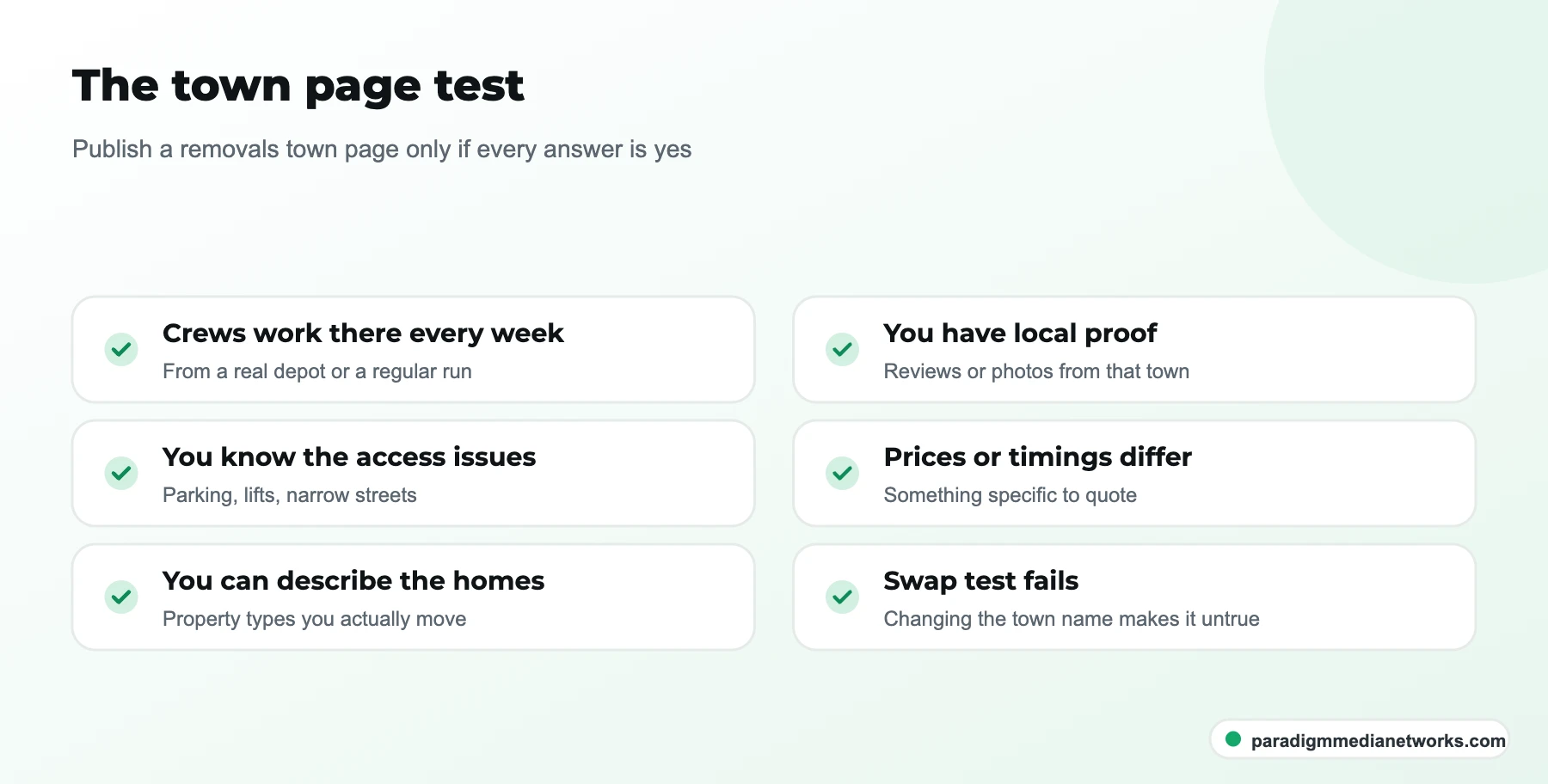
What goes on a removals town page?
- Access realities: parking (does the council issue parking suspensions for removal vans?), flats without lifts, narrow terraced streets, gated developments.
- Typical properties: the homes you actually move there, from Victorian terraces to new-build estates, and what that means for crew size and van choice.
- Your link to the town: nearest depot, how often crews are there, survey options for that town.
- Proof from that town: reviews from customers who moved there (with permission), photos from local jobs.
- Common routes: where people from that town usually move to, linking to your long-distance run pages.
A useful habit: ask your crew leaders what is awkward about each town. The answers (the street where vans cannot turn, the block where the lift must be booked) are exactly the details a competitor cannot copy.
Step 5: Should a removal company publish prices?
Yes, a removal company should publish price bands in pounds, based on its own past jobs, alongside the factors that move a quote up or down. Exact prices still come after the survey, and the page should say so.
Cost is usually the first question a customer asks, and it is also one of the questions AI assistants answer most often. A page that says "a typical 3-bedroom move within [town] falls in this band with us, and here is what changes it" is far more useful, and far more quotable, than "contact us for a quote".
- Use bands by property size (1-bed flat to 4-bed house) from your own jobs, and state the period they cover.
- List the factors: distance, access, packing, storage, dismantling, peak dates such as Fridays and month ends.
- Explain what is included: insurance, materials, crew size, and any advance payment protection you offer.
- Update the bands at least once a year, and date the page when you do.
Step 6: How do you measure whether removals SEO is working?
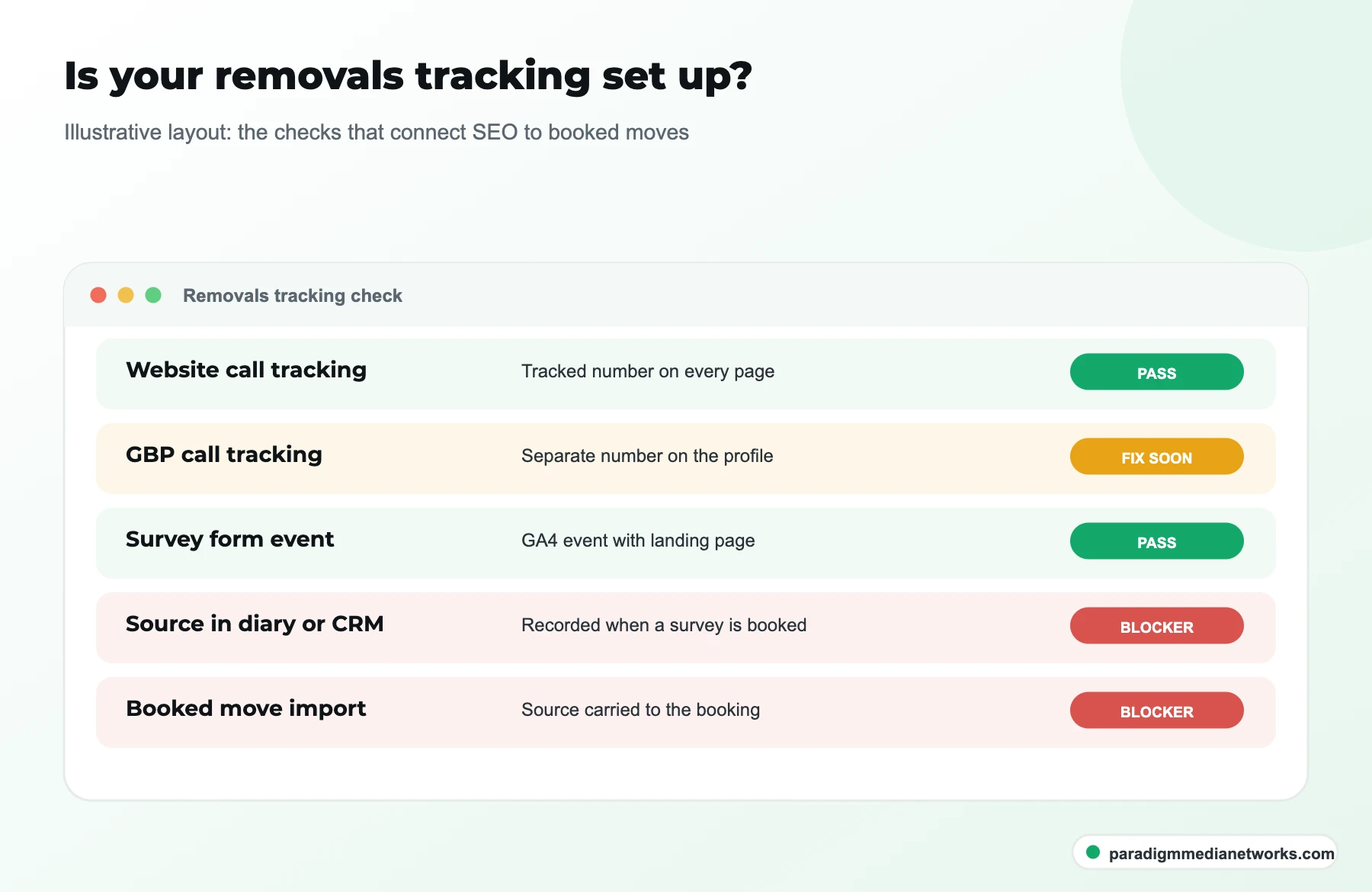
You measure removals SEO by tracking three numbers for each page and channel: enquiries, surveys booked and moves booked. Rankings and visits are early signals; booked surveys show whether the work is paying.
Most firms already have the raw data in a diary, spreadsheet or removals software. The job is to connect it to where the enquiry came from.
| What to track | How to capture it | What it tells you |
|---|---|---|
| Calls | A tracked number on the website and a separate one on Google Business Profile | Which source makes the phone ring |
| Quote and survey forms | A form submission event in Google Analytics 4, with the landing page recorded | Which pages turn visits into enquiries |
| Surveys booked | A field in your diary or CRM for "source" and "landing page" | Which enquiries are serious |
| Moves booked | The same source field carried through to the booking | Cost per booked move by channel |
Step 7: Which trust signals should a UK removals website show?
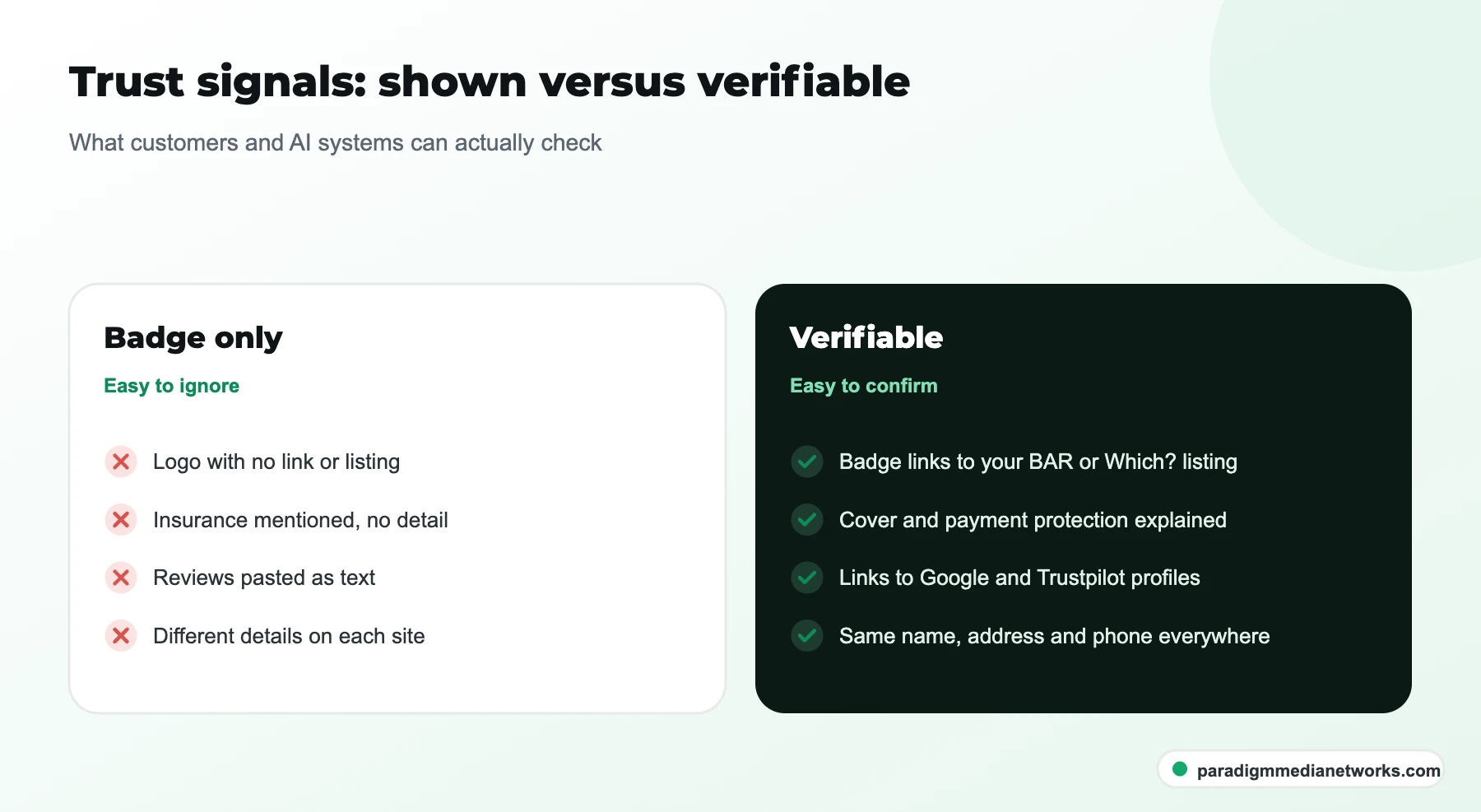
A UK removals website should show the trade memberships and checks it really holds, such as BAR, Which? Trusted Traders or Checkatrade, each with a way for the customer to verify it, plus insurance details and how advance payments are protected.
The British Association of Removers runs a "Find a mover" and "Check a mover" search on bar.co.uk, and describes an Advanced Payment Guarantee that protects prepayments made to members for home moves. If you are a member, link to your listing from the badge so a customer can confirm it in one click. The same applies to any Which? or Checkatrade profile.
Step 8: How should a removal company ask for reviews?
A removal company should ask every customer for a Google review in the same way, within a day or two of the move, with a direct link and no reward attached. Consistency matters more than any clever script.
Google's prohibited content policy bans offering payment, discounts or free services for reviews, and bans discouraging negative reviews or selectively asking only happy customers. So the safe routine is simple: everyone gets the same message.
- Send it the day after the move. The crew is fresh in the customer's mind and the boxes are still out.
- Name the crew leader. Customers write more specific reviews when they remember who helped them.
- Reply to every review. Thank people briefly, and answer complaints calmly with what you did about them.
- Reuse reviews on town pages. With the customer's permission, a review from someone who moved in that town is local proof no competitor has.
Step 9: Where do removal companies get local links and citations?
Removal companies get useful local links and citations from trade listings, UK business directories, local partners who refer moves, and genuine local press coverage. The goal is consistent business details and real mentions, not volume.
- Trade and accreditation listings: BAR, Which? Trusted Traders, Checkatrade, Trustpilot, wherever you are genuinely listed.
- UK directories: Yell, Thomson Local and similar, with your name, address and phone number written exactly as on Google.
- Referral partners: estate agents, letting agents, conveyancers, self-storage sites and care home providers who already recommend movers.
- Local stories: community moves, charity collections or useful local guides (for example, parking suspension rules in your council area) that local sites are happy to link to.
Avoid paid link packages and directory blasts. Google treats links bought to manipulate rankings as link spam, and its spam update documentation says ranking benefit lost from spammy links cannot be regained.
Step 10: How do you check if ChatGPT and AI Overviews name your removal firm?
You check whether ChatGPT and Google AI Overviews name your removal firm by running the same set of customer questions in each assistant every month, logging who is named and which sites are cited, and comparing month to month.
AI answers are now part of how people shortlist removals firms, often before they visit a single website. They cannot be bought or guaranteed, but they can be measured.

Which prompts should a removals firm test?
- "best removal company in [town]" and "house removals [town] reviews"
- "how much do removals cost for a 3 bed house in [town]"
- "is [your firm] a BAR member" and "is [your firm] any good"
- "removals from [town] to [regular destination]"
Run them in ChatGPT, Google (looking at the AI Overview and AI Mode), Perplexity, Gemini and Copilot. Use a logged-out or temporary chat so your history does not skew the answer. For Copilot, Bing Webmaster Tools has an AI Performance report that shows citations of your pages in Copilot and Bing AI summaries, along with the grounding queries behind them, according to Practical Ecommerce (June 2026).
What makes an AI assistant more likely to name you?
Google's own guidance on generative AI features says optimising for AI search is still SEO, so there is no separate trick. In practice, assistants name the firms they can describe confidently: the same name, towns and services everywhere, trade memberships stated plainly, answer-first pages on cost and the survey process, and reviews and mentions on sites they already trust. When a comparison site is named instead of you, look at which of those signals it has and you lack. Our free AI visibility checker gives a quick first read, and the LLM SEO audit checklist goes deeper.
How long does SEO take for a removal company?
SEO for a removal company usually shows first movement in Google Business Profile and long-tail town searches within a few months, while competitive town terms take longer. The set-up steps fit into about three months; after that the work becomes a monthly routine.
No one can promise a date, and anyone who guarantees a ranking should be treated with caution. For reference, our own published moving result is a US mover, not a UK removals firm: on Moving Hub the first AI citations arrived after roughly three to four months, and the site earned about 2,460 AI citations in 90 days (AI Performance report, 28 June to 6 September 2026). UK timelines depend on your towns, your competitors and your reviews.
| Period | Focus | Steps |
|---|---|---|
| Month 1 | Foundations | Coverage map, Google Business Profile, website basics, tracking |
| Month 2 | Pages | First town pages that pass the test, cost page, trust signals |
| Month 3 | Proof and reach | Review routine running, citations cleaned, first AI prompt check |
| Every month after | Routine | New reviews, one or two pages, prompt check, survey numbers |
Should you do removals SEO yourself or hire help?
You can do removals SEO yourself if someone in the business has two hours a week and the patience to keep a routine going. Hire help when you cover many towns or depots, when the website needs technical work, or when comparison-site spend is high enough that faster progress pays for itself.

If you do want help, compare agencies on what they report (booked surveys, not screenshots) and whether they will refuse to build town pages without substance. Our comparison of SEO companies for movers and removals firms sets out what to check. If you would rather hand the whole programme over, this is how we approach removal company SEO for UK firms, priced as a custom quote by depots and towns covered.
Who this guide is not for: a firm that needs surveys booked next week. SEO builds over months; comparison sites or paid search fill short-term gaps.
SEO for removal companies: common questions
Is SEO worth it for a small removals firm?
SEO is worth it for a small removals firm when it has capacity for more surveys and a defined area it serves. Most of the early gains come from free work: a complete Google Business Profile, a short survey form, a few strong town pages and a steady review routine. A firm that already turns work away should fix capacity first.
How many town pages should a removal company have?
A removal company should have as many town pages as it can justify with real local detail, and no more. For many single-depot firms that means a handful of core towns plus an areas-covered page listing the rest. Pages that differ only by the town name risk being treated as doorway pages and rarely win enquiries.
Do I need a blog for removals SEO?
You do not need a blog in the usual sense. You need answer-first pages for the questions customers ask before booking: what removals cost, how the survey works, packing, storage, and moving on a Friday or month end. Publish those as guides and link them to your service and town pages.
Does a man and van business need SEO?
A man and van business benefits from the same local basics, scaled down: a Google Business Profile with accurate service areas, clear prices on the website, and reviews. Man and van searches are very local and price-led, so the profile and pricing page matter more than a large set of pages.
Can I get my removal company into Google AI Overviews?
You can make it more likely but nobody can guarantee it. Publish clear answers on costs and the survey process, keep your business details identical across Google, directories and trade listings, state your memberships plainly, and earn real reviews and mentions. Then check a fixed set of prompts every month to see whether anything changes.
What should I track if I only track one number?
Track surveys booked by source. Enquiries can be inflated by price shoppers and comparison-site traffic, while a booked home or video survey means the customer is serious. Knowing which page or channel produced each survey tells you where to spend the next hour of SEO work.

One team, one revenue number
Strategy is led by Jahid Hussain, founder of Paradigm Media Networks, with 7 years in growth marketing, SEO and performance marketing and an MBA in Marketing. SEO, AI search, paid media, content and web run as one system, so nobody hands you a report that contradicts another vendor’s.
- 500+ marketers trained and 30+ brands scaled
- Published results you can check: HVAC case study and Moving Hub case study
- Reporting on calls, leads and booked jobs, not just rankings
Want a second pair of eyes on your removals SEO?
Tell us your depots and the towns you cover. On a free 30-minute call we will look at your Google Business Profile, your town pages and what AI answers say about you, and tell you honestly which of the ten steps to do first.
✓ Free 30-minute call · No pitch decks · Walk away with a real plan
What you walk away with
- The first three steps to do for your firm
- Town pages to keep, merge or build
- Which AI answers name you or a competitor
- A tracking set-up for booked surveys