


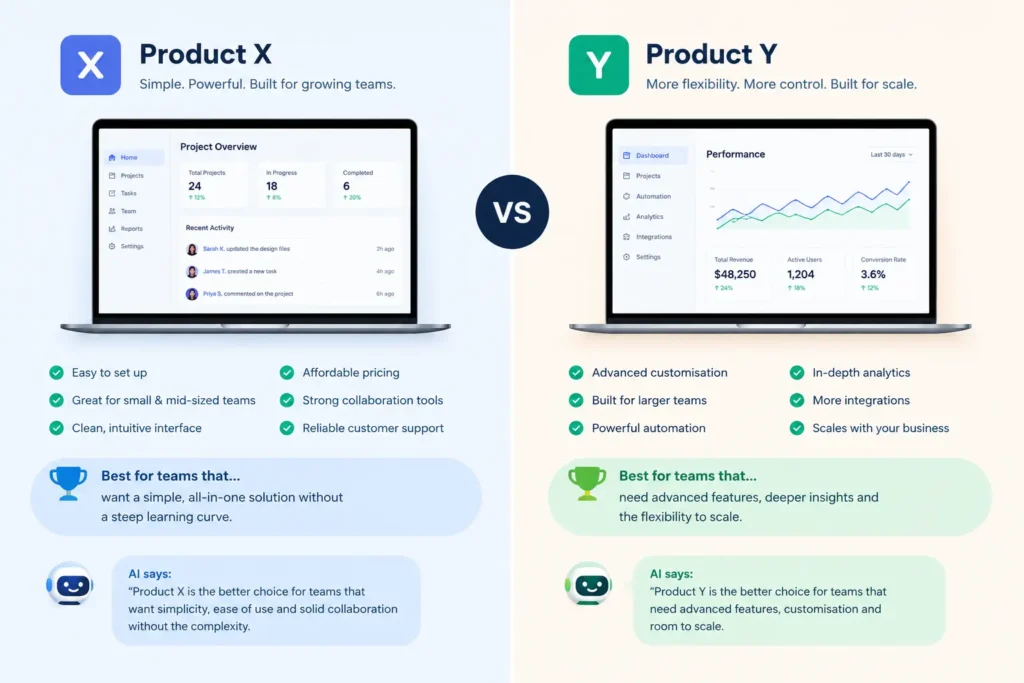
SaaS comparison pages are pages on your own site that put your product next to a named competitor (“X vs Y”) or round up options for someone leaving one (“X alternatives”). The ones that convert, and get quoted by AI engines, admit where the rival is better, tell each buyer which product fits them, and date every claim. A page where you win every row reads like an ad, and buyers and ChatGPT treat it like one.
Key Takeaways:
- Give away one point that could really cost you a deal. It makes the rest believable.
- Pick a winner per use case, not overall.
- Date the page and keep a source for every competitor claim.
- Naming competitors is fine in the US and UK, as long as the comparison is truthful, like-for-like and checkable.
Sales keeps hearing “we’re also looking at [competitor],” and the page ranking for that matchup is theirs, or an affiliate’s. So you write your own. Most teams write it like a pitch deck, and buyers can tell within a scroll.
Why “X vs Y” Pages Now Get Judged by AI First
G2 surveyed over 1,000 software buyers in August 2025, and half said they now start research in an AI chatbot, not Google.
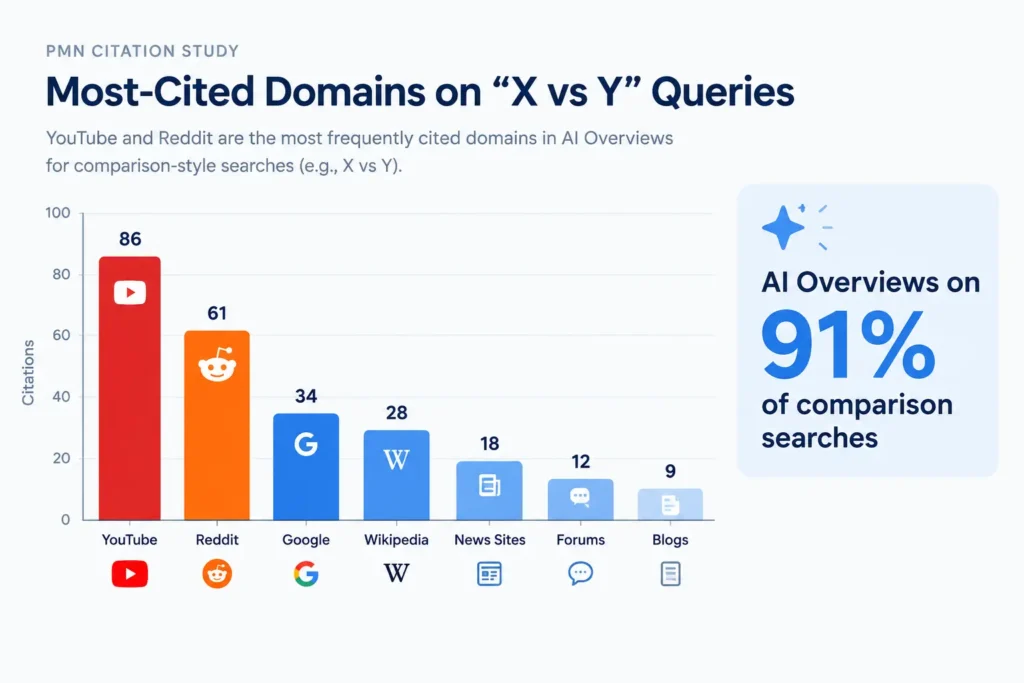
In our AI search citation study, AI Overviews showed up on 91% of comparison searches. On “X vs Y” queries, the most-cited sites were YouTube and Reddit. Brand homepages? 3.2% of citations on recommendation answers.
So your vs page gets read next to Reddit threads where real users complain about both tools. Claim you win everything, and the engine has a more believable source right there. Spell out the trade-off, and you become the summary it can quote.
That’s also why ChatGPT keeps recommending the competitor: third-party sources mention them, and your page gives the engine nothing neutral to work with.
The Comparison Page Template
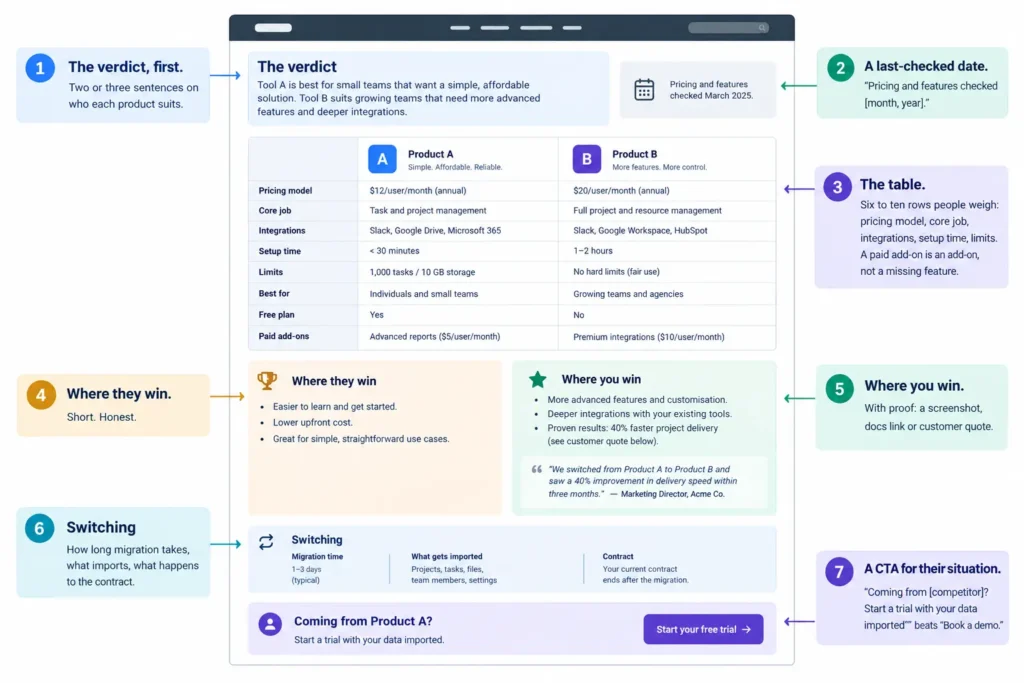
Vs pages and alternatives pages need roughly the same seven parts:
- The verdict, first. Two or three sentences on who each product suits.
- A last-checked date. “Pricing and features checked [month, year].”
- The table. Six to ten rows people weigh: pricing model, core job, integrations, setup time, limits. A paid add-on is an add-on, not a missing feature.
- Where they win. Short. Honest.
- Where you win. With proof: a screenshot, docs link or customer quote.
- Switching. How long migration takes, what imports, what happens to the contract.
- A CTA for their situation. “Coming from [competitor]? Start a trial with your data imported” beats “Book a demo.”
Teams skip the switching section, yet it often matters most. By now the reader accepts you might be better. The hassle is what stops them. So answer it plainly, something like: “Most teams move over in a week. We import your tickets and saved replies, and you can run both tools until your contract ends.” Use your real numbers. Support knows them.
Alternatives pages add a “best for” line per option, and the list should include real rivals, not you plus two tools nobody shortlists. Pick matchups from the comparison tier of your SaaS keyword research. For dozens of them, our programmatic SEO for SaaS playbook covers when templating is safe.
Not sure which comparison pages you’re missing? Get a free bottom-funnel page gap audit. We’ll map the searches where competitors own the answer.
Verdict Rules: How to Concede Without Losing the Deal
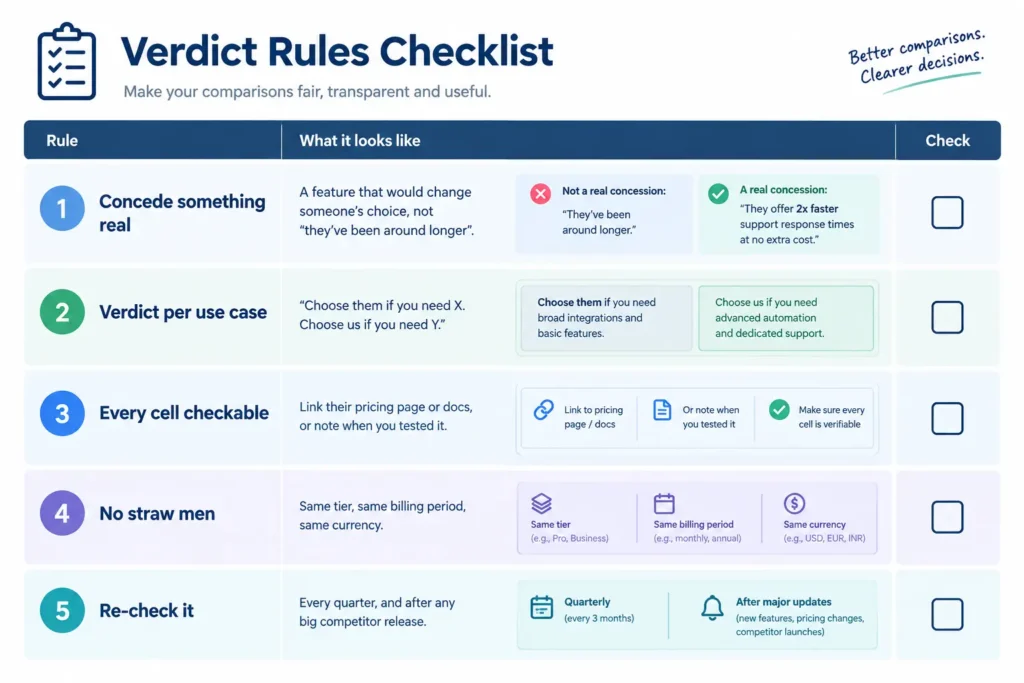
Admitting the other product wins at something feels like handing over the deal. It mostly isn’t. Buyers who need that feature weren’t closing anyway, and everyone else trusts your other claims more.
| Rule | What it looks like |
| Concede something real | A feature that would change someone’s choice, not “they’ve been around longer” |
| Verdict per use case | “Choose them if you need X. Choose us if you need Y.” |
| Every cell checkable | Link their pricing page or docs, or note when you tested it |
| No straw men | Same tier, same billing period, same currency |
| Re-check it | Every quarter, and after any big competitor release |
AI engines lift clear verdicts and labeled tables easily (see our guide to structuring content AI engines cite).
Sometimes, don’t publish. Skip the vs page if you’d lose most rows that matter to your ideal customer; it’ll just argue for them. Skip it if buyers don’t actually compare the two. And skip it if nobody owns updates. Last year’s pricing does more damage than no page.
5 SaaS Comparison Pages, Annotated
Help Scout vs Zendesk (Help Scout). Says outright that Zendesk fits large enterprises needing deep customization, and teams needing phone support. A real concession. Then it ends on “you can’t go wrong with either,” skipping the verdict.
Zapier vs Make (Zapier). Dated byline, a quick table, and a “choose Zapier if / choose Make if” section. It admits Make can be cheaper for simple workflows, then argues Zapier suits most businesses.
PostHog vs Amplitude (PostHog). Splits it by team: PostHog for engineering-led teams, Amplitude for marketing and warehouse-native data teams. The free-tier tables take minutes to check.
Plausible vs Google Analytics (Plausible). Small tool, giant rival. Admitting GA4 goes deeper on attribution is why its “simpler is enough” argument works.
Ahrefs vs Semrush (Ahrefs). The opposite. Index-size numbers with no method, plus joke table rows. Fine if you already prefer Ahrefs. Nothing an AI engine could quote as neutral.
The first four decide who they’re happy to lose. That’s why their verdicts land.
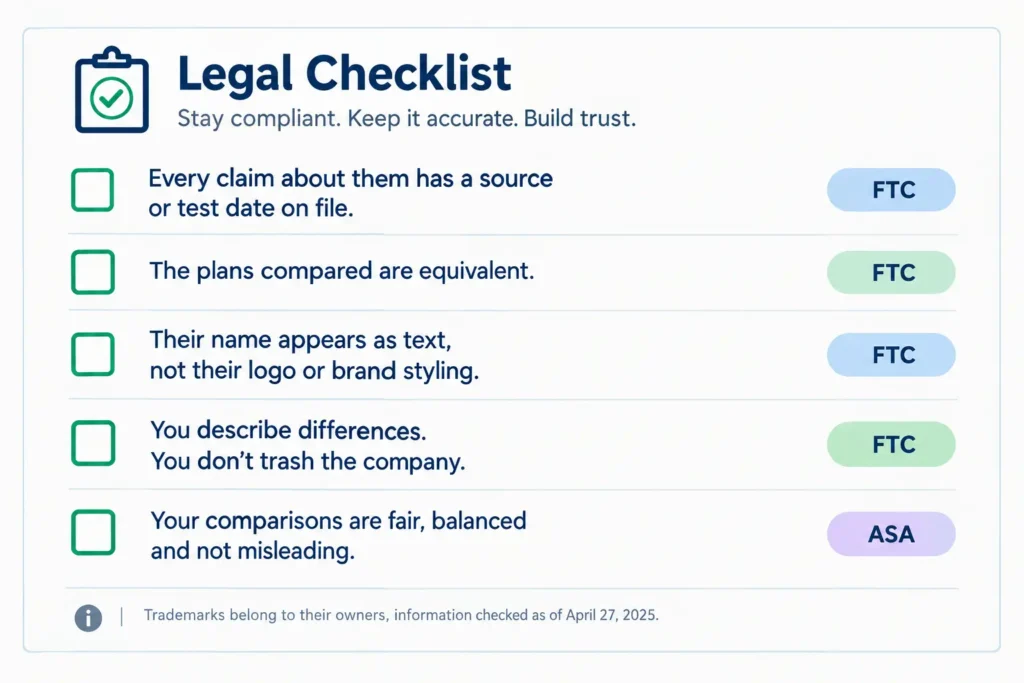
Legal Checklist for Naming Competitors
The FTC says it encourages naming competitors, provided the comparison is truthful and non-deceptive. The UK’s ASA wants comparisons to be like-for-like and verifiable, with enough detail for buyers to check them.
Before it goes live, check:
- Every claim about them has a source or test date on file.
- The plans compared are equivalent.
- Their name appears as text, not their logo or brand styling.
- You describe differences. You don’t trash the company.
- There’s a footer note: trademarks belong to their owners, information checked as of [date].
General guidance, not legal advice. In regulated categories, ask a lawyer.
What breaks when comparison pages run in a silo
A vs page earns its keep when paid search sends “[competitor] alternatives” clicks to it, sales uses it as a battle card, and a short walkthrough video covers the YouTube results AI engines lean on. A B2B SaaS SEO agency running search, generative engine optimization and ads together can join those up. Three separate vendors usually won’t.
Frequently Asked Questions
What is a SaaS comparison page?
A page comparing your product with a named competitor, or listing alternatives to one. It’s for buyers who already have a shortlist.
Is it legal to name competitors on a comparison page?
In the US and UK, yes, if what you say is true, like-for-like and checkable. Keep evidence, and don’t use their logo in a way that implies endorsement.
What’s the difference between a vs page and an alternatives page?
A vs page is for someone choosing between two named products. An alternatives page is for someone leaving one product and weighing several replacements.
Should a comparison page admit when the competitor is better?
Yes, on at least one point that matters. It weeds out poor-fit buyers and makes the rest believable.
Why does ChatGPT recommend my competitor instead of me?
Usually because Reddit threads, YouTube reviews and listicles mention them more. A fair comparison page helps, but you also need to appear in the sources the engine already trusts.
Start With the Matchup You Lose Most
Ask sales which competitor comes up most. Build one honest vs page for it, with a dated table and a real concession, and watch its demo requests for 60 days before building the next. For the bigger picture, see our SaaS SEO guide.
Find the Comparison Pages You’re Missing
We’ll show which vs, alternatives and pricing searches competitors own in Google and AI answers, and what to build first. Paradigm Media Networks: SEO, GEO & Ads, Engineered for the AI Era.
About the Author
Jahid Hussain | Founder, Paradigm Media Networks
Jahid Hussain founded Paradigm Media Networks to solve a problem he kept seeing: businesses spending across SEO, ads, and content that never talked to each other. He specialises in local SEO, organic growth systems, and integrated marketing strategies that connect search, paid media, and creative into one lead generation engine. Paradigm has taken clients from zero search visibility to six-figure monthly revenue pipelines, and has been featured in IANS, Eastern Herald, Sangri Times, and Dailyhunt. Jahid operates across the US, UK, UAE, and India, and writes from the standpoint of someone who has built and broken growth systems for real businesses, not from a slide deck.
