
Website migration SEO services: redesign, replatform or change domain without losing search traffic
Website migration SEO services protect the search traffic, links and leads a site already earns when it is redesigned, moved to a new platform or moved to a new domain. We map every old URL to its new home, sign off staging, crawl on launch day and monitor Google, Bing, ads and AI search for 90 days.
✓ Free 30-minute call · No pitch decks · Walk away with a real plan

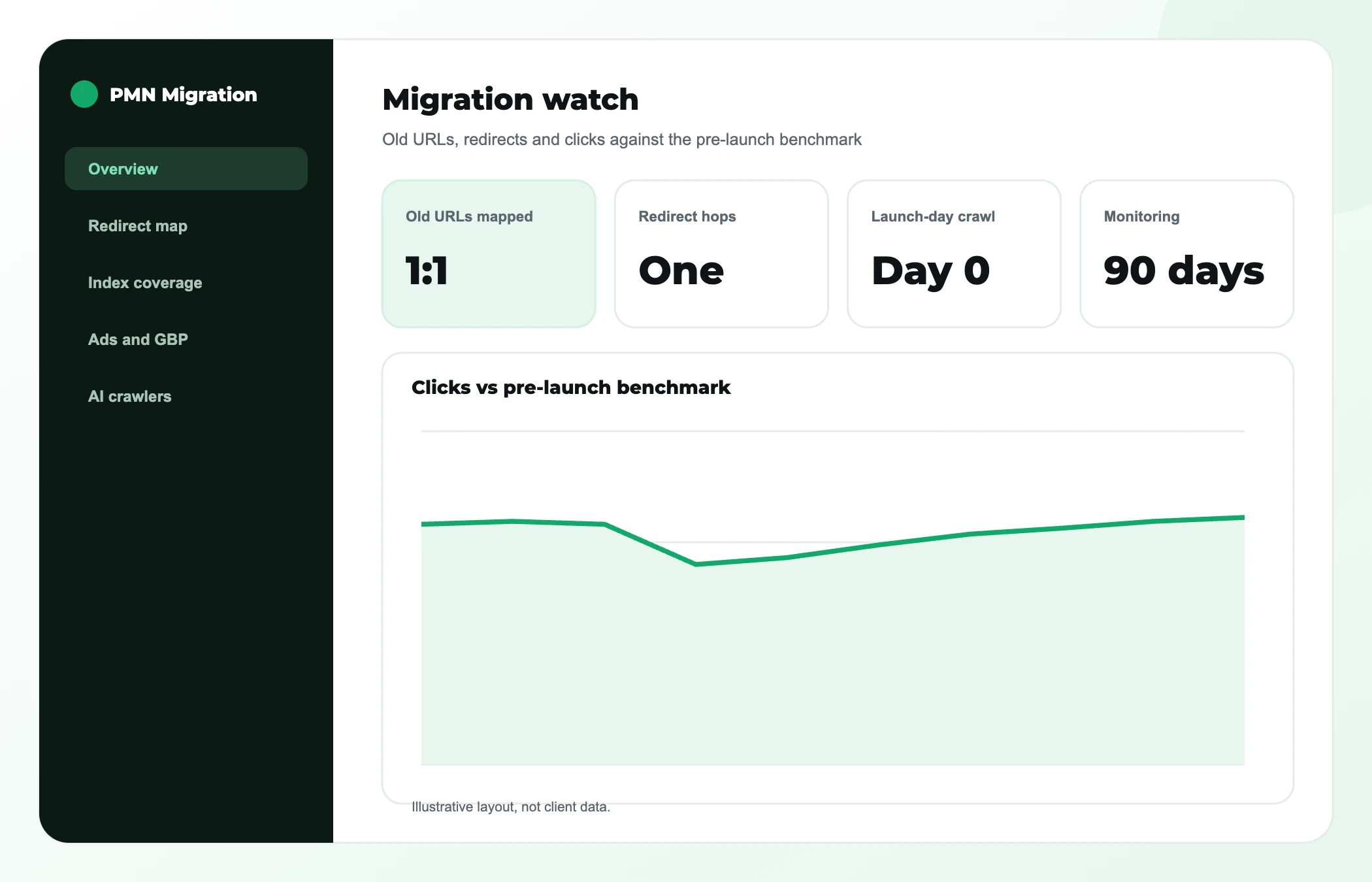
What do website migration SEO services include?
Website migration SEO services include four things a developer is not usually asked to own: an inventory of every URL that earns traffic, links or leads; a one-to-one redirect map; a staging sign-off for SEO elements; and post-launch monitoring until search traffic settles.
Planning it yourself? Our free website migration SEO checklist has all 30 steps. This page is for teams who want someone to own them. At Paradigm Media Networks each stage ends in a named deliverable.
Key takeaways
- Google says a small to medium site can take a few weeks for most pages to move, and larger sites take longer; keep redirects "generally at least 1 year" (Google Search Central).
- Domain changes are the high-risk case: a study of 892 domain migrations found an average of 523 days to regain estimated organic traffic, and 17% had not recovered after 1,000 days (Search Engine Journal, January 2025).
- Organic rankings are only part of the risk. Google Ads disapproves ads whose final URL redirects to a different domain, and Google Business Profile, email footers and AI answers keep sending people to old URLs.
- The redirect map decides most outcomes. It needs one owner from week one, with the authority to delay launch if redirects are not tested.
| Stage | When | What we do | Deliverable you keep |
|---|---|---|---|
| 1. Scope and risk score | Before design is final | Benchmark Search Console (16 months), GA4 conversions, backlinks and current rankings; classify the migration type; flag high-value URLs | Risk score and URL inventory with keep / merge / remove decisions |
| 2. Redirect map and staging sign-off | During build | One-to-one 301 map signed off by SEO and dev; staging crawl for titles, canonicals, internal links, schema, hreflang, Core Web Vitals; staging kept behind a password | Signed redirect map; staging issues log with pass or fail per item |
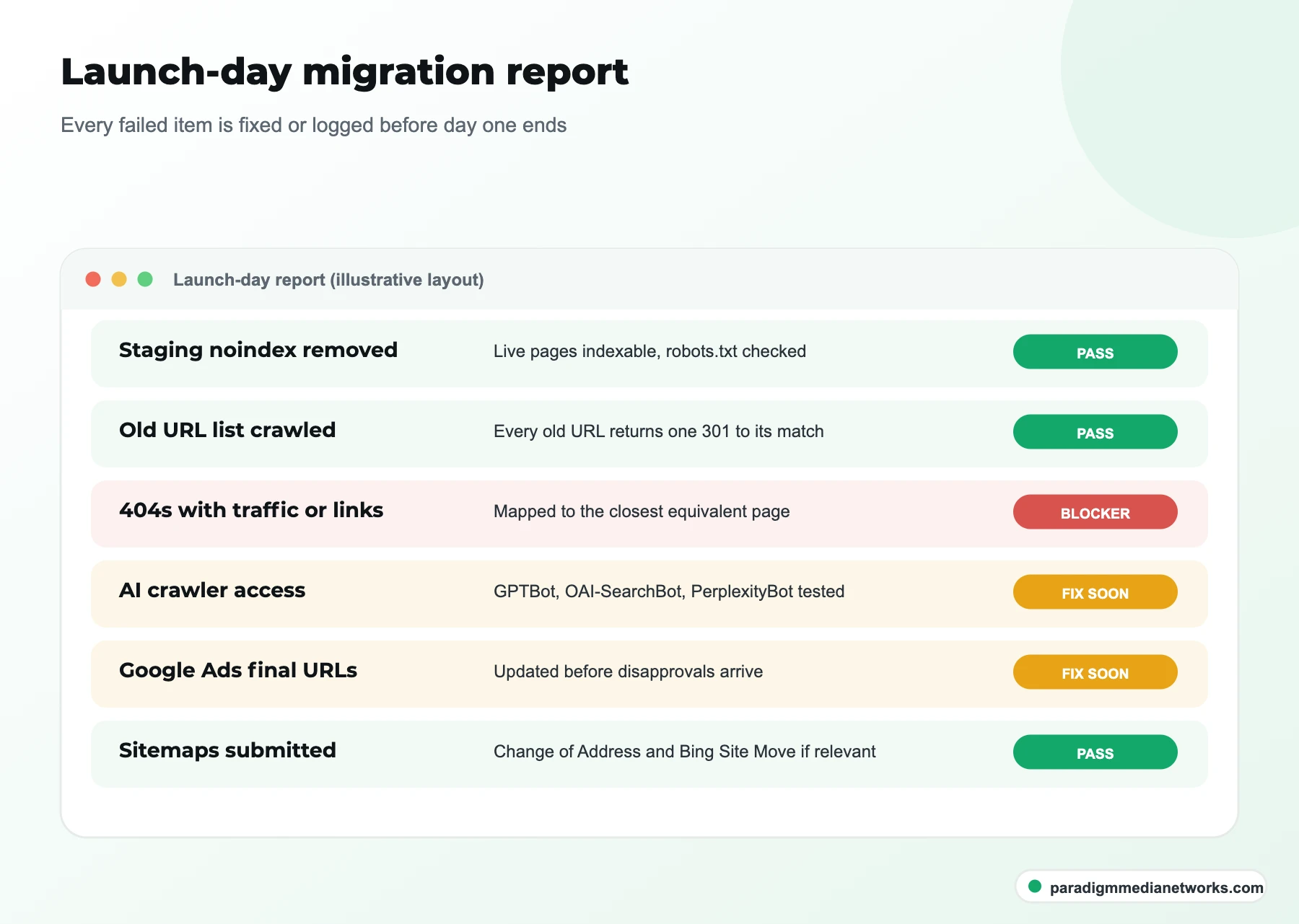
| 3. Launch window | Launch day and week one | Remove staging blocks, crawl the old URL list against live, submit sitemaps, Change of Address (Google) and Site Move (Bing) where relevant, check ads, Google Business Profile and conversion tracking | Launch-day report with every failed redirect fixed or logged |
| 4. 90-day watch | Days 1 to 90 | Daily index checks for two weeks, weekly clicks by page against benchmark, crawls at 30, 60 and 90 days, fixes for 404s that still get traffic or links | 30, 60 and 90-day reports; final handover with remaining actions |
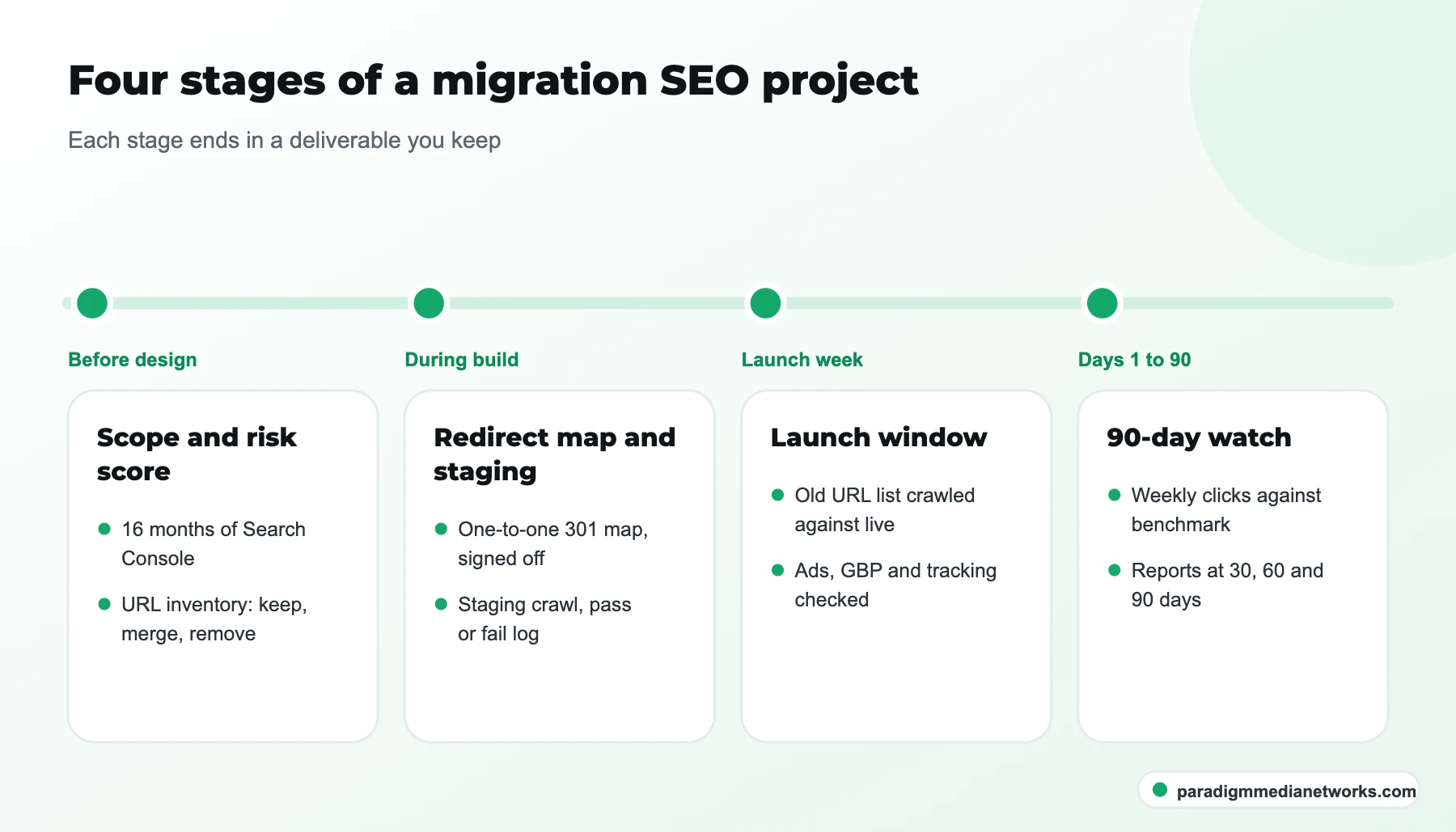
The full step-by-step list behind each stage is in our website migration SEO checklist.
Which migrations need an SEO agency?
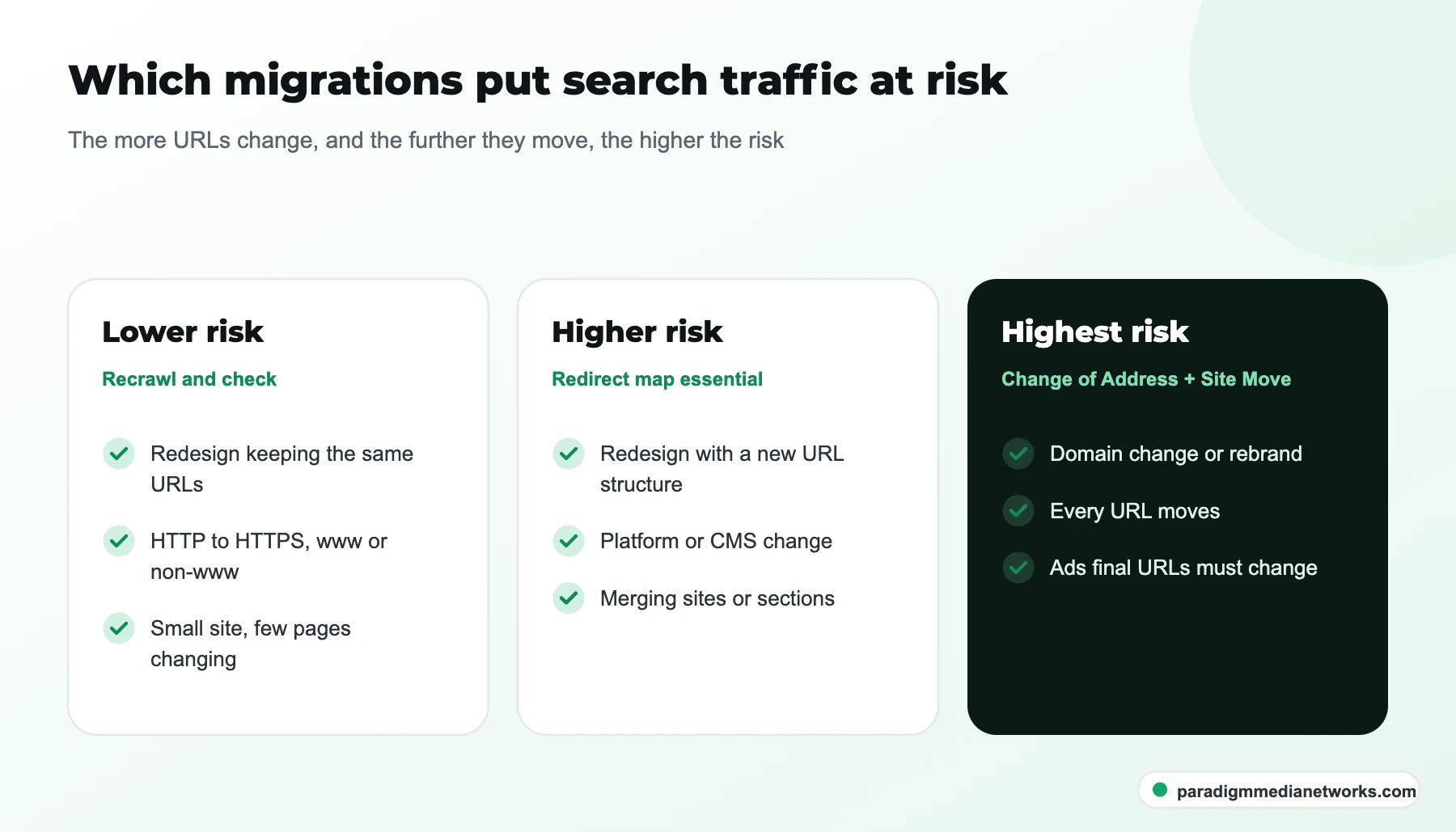
A migration needs dedicated SEO support when URLs change on pages that earn traffic or leads. The more URLs that change, and the further they move, the higher the risk.

| Migration type | What changes | Risk to search traffic | Google / Bing tools involved |
|---|---|---|---|
| Redesign, same URLs | Templates, copy, layout | Low to medium: content and internal links on ranking pages can be lost | None special; recrawl |
| Redesign with new URL structure | Paths and page consolidation | Medium to high | Redirects, sitemaps |
| Platform or CMS change (e.g. WordPress to Shopify or headless) | Paths, templates, rendering | High: platforms impose their own URL patterns and can change rendering | Redirects, sitemaps, rendering checks |
| HTTP to HTTPS, www or non-www | Protocol or host | Low if redirects are complete | No Change of Address needed (Google) |
| Domain change or rebrand | Every URL | Highest | Google Change of Address; Bing Site Move |
| Merging sites or sections | Content consolidation | High | Redirects to the closest equivalent page |
When you probably do not need us: a small site keeping its URLs, or an HTTPS switch on a site under a few hundred pages, where your developer can follow our free checklist.
What happens to ads, Google Business Profile and AI search during a migration?
A migration changes every place that links to your old URLs, not just Google's organic index. Most SEO-only migration plans stop at rankings; these are the places we check as well.
- Google Ads. Google's destination requirements disapprove ads when the final URL redirects users to a different domain, and when a destination does not work. On a domain change, every final URL, sitelink and asset needs updating on launch day, not when disapprovals arrive.
- Google Business Profile. The website and appointment links on each location profile still point to old URLs until someone changes them.
- Bing and Copilot. Bing Webmaster Tools has its own Site Move tool for domain changes; Bing's index also feeds Microsoft Copilot answers.
- AI crawlers. A new robots.txt or firewall rule can block GPTBot, OAI-SearchBot, PerplexityBot or Google-Extended without anyone noticing. We test access on launch day.
- AI answers that cite old URLs. Answer engines keep citing pages they already know. Clean one-hop 301s let those citations resolve to the right new page; chains and homepage redirects break them.
- Structured data and analytics. Organization, Service and Product schema, GA4 events and form conversions are checked on the live site, because they are often rebuilt from scratch on a new template.
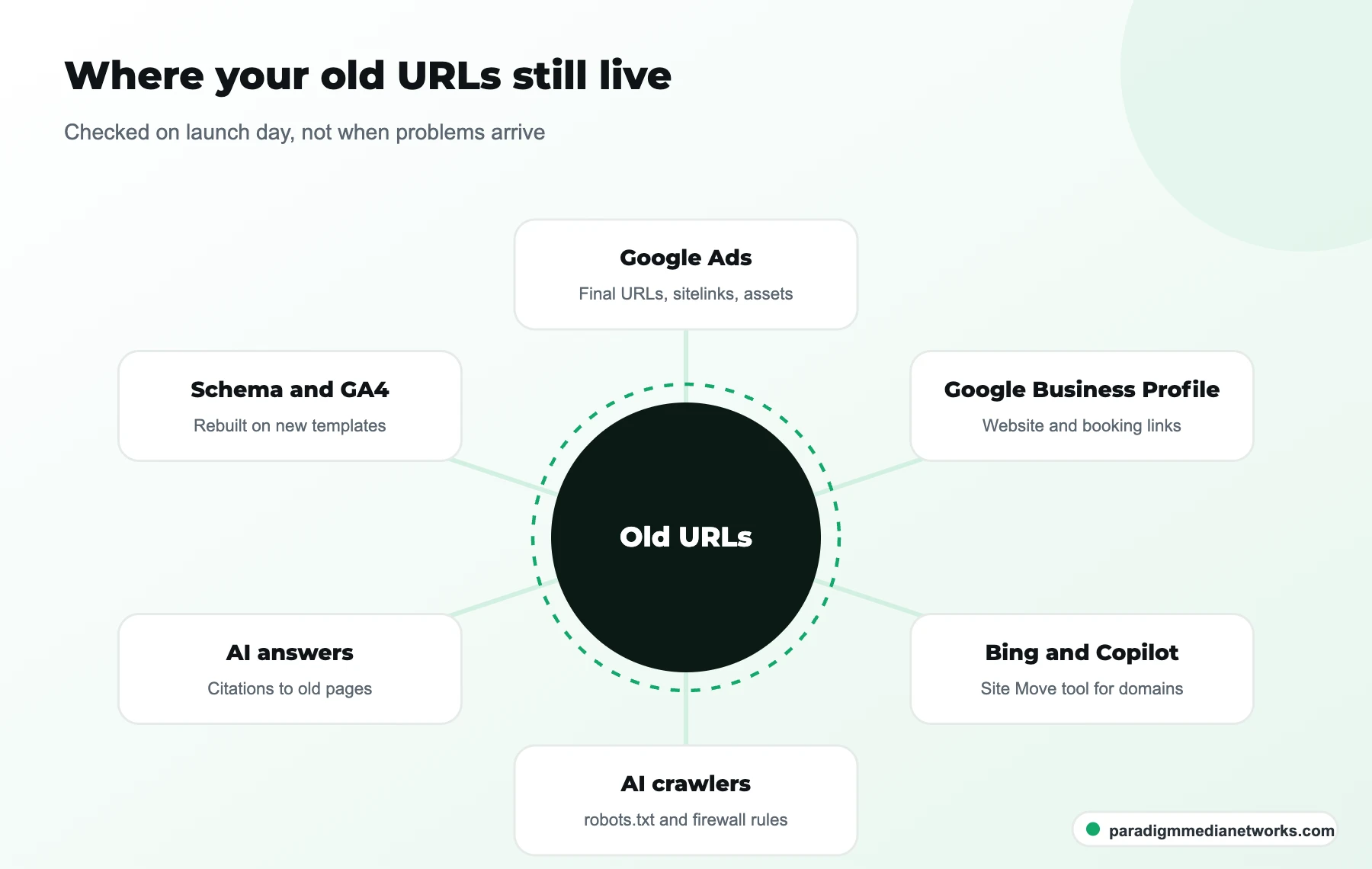
This is why we run migrations as one team across SEO, paid media and web: the people checking rankings also own the ad account and the site build.
Who does what: the SEO agency or your developer?
In a migration, the developer owns building and deploying the new site, and the SEO lead owns making sure search engines and customers can still find every valuable page. Problems start when nobody owns the space between the two, usually the redirect map.
| Task | Developer | PMN (SEO lead) |
|---|---|---|
| URL inventory and keep / merge / remove decisions | Input | Owns |
| Redirect map | Implements | Owns and tests |
| Staging environment and password protection | Owns | Verifies |
| Titles, headings, copy and internal links on ranking pages | Implements | Specifies and checks |
| Canonicals, sitemaps, robots.txt, schema, hreflang | Implements | Specifies and checks |
| Core Web Vitals on new templates | Owns | Measures and reports |
| Google Search Console, Bing, Change of Address and Site Move | Access | Owns |
| Google Ads final URLs and GBP links | n/a | Owns (if we manage them) or hands you a list |
| Launch go / no-go on SEO grounds | Joint | Holds the veto on untested redirects |
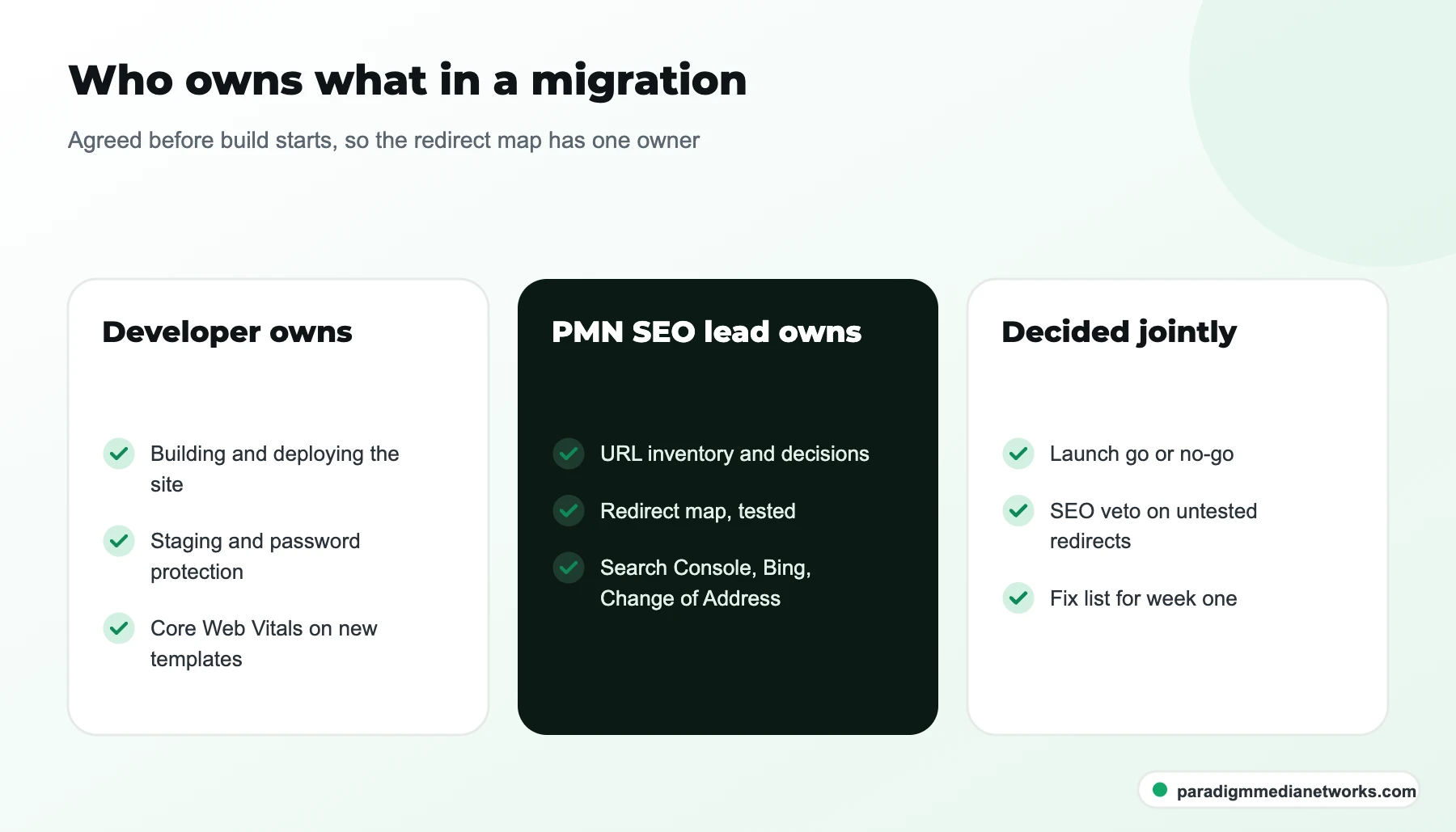
If we are also building the site through our website design and development team, both columns sit with one team.
How long does it take to recover rankings after a migration?
Recovery time depends on the migration type. For moves that keep the domain, Google says most pages on a small to medium site move within a few weeks; domain changes take much longer.

Google also notes that "visibility of your content in Search may fluctuate temporarily during the move" (Google Search Central). In Dan Taylor's study of 892 domain migrations for Search Engine Journal, the average was 523 days to regain estimated organic traffic, and 17% had not recovered after 1,000 days (SEJ, January 2025).
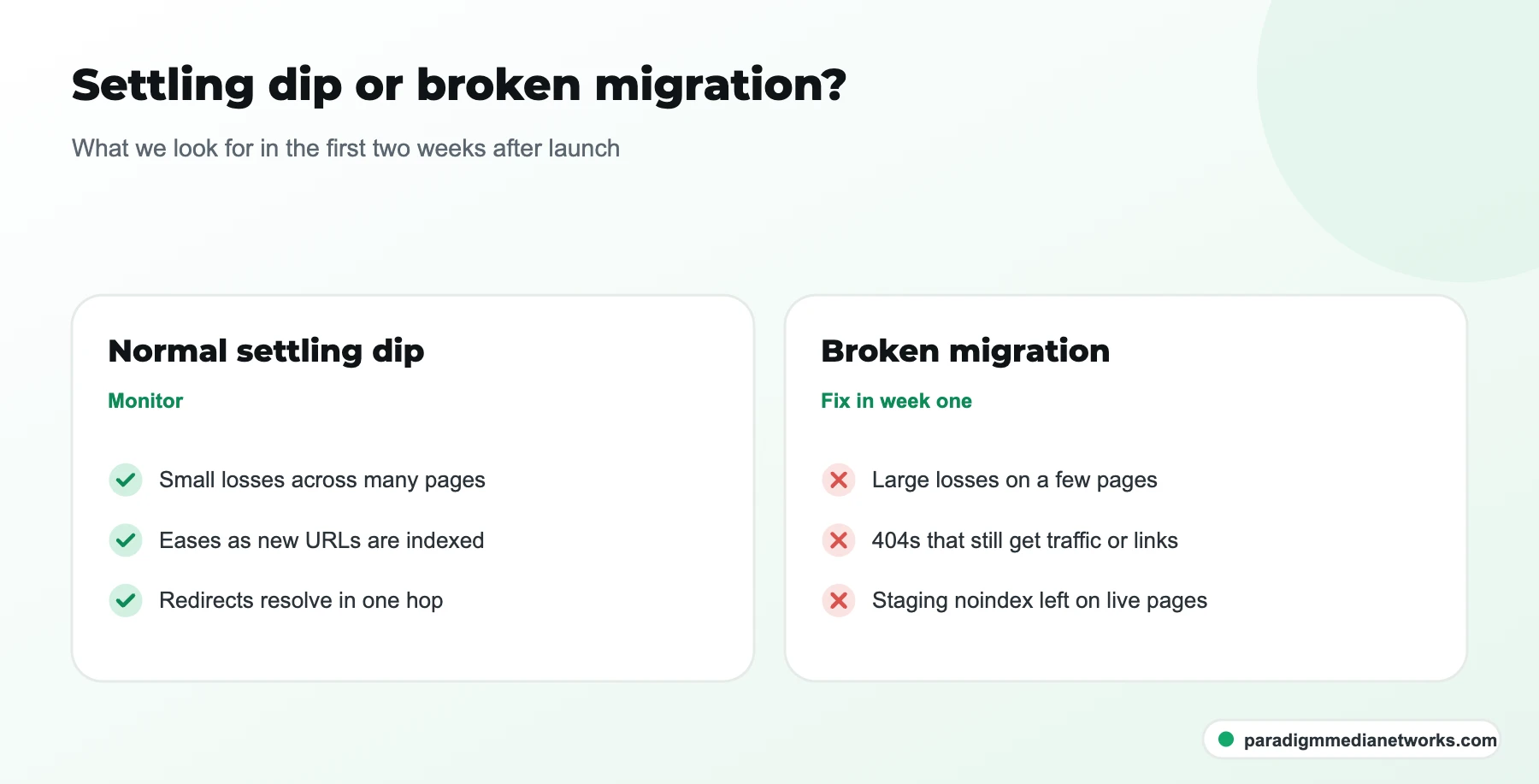
That study uses third-party traffic estimates, not Search Console data, so treat it as a warning about domain changes rather than a forecast for yours. Our 90-day watch is built to separate a normal settling dip (small losses spread across many pages, easing as new URLs index) from a broken migration (large losses on a few pages), so fixes happen in week one, not month three.
How much do website migration SEO services cost?
Website migration SEO is priced as a fixed project, quoted after a free risk check. The fee is set mainly by four things: URL count, migration type, markets and languages, and who builds the site.
| Cost driver | Why it changes the work |
|---|---|
| Number of indexed URLs | Every URL that earns traffic or links needs a mapped and tested redirect |
| Migration type | A domain change or platform switch needs more testing than a redesign on the same URLs |
| Number of markets and languages | Each locale needs hreflang and its own launch checks |
| Who builds the site | If our web team builds it, staging access and fixes are faster |
Redesign or HTTPS move
Same domain, URLs kept or restructured
- URL inventory and risk score
- Redirect map and staging sign-off
- Launch-day crawl
- 90-day watch
Platform change
New CMS or ecommerce platform
- Everything in Redesign
- Platform URL pattern mapping
- Rendering checks for crawlers
Domain change or merger
New domain, rebrand or site consolidation
- Everything in Platform change
- Google Change of Address and Bing Site Move
- Ads, GBP and AI crawler launch checks
What migrations has Paradigm Media Networks run?
We apply the same process to our own site, and we keep our claims to what we can show.
In October 2026 we moved our old /seo-agency-india/ page to /seo-services/ with one 301 straight to the new page and no redirect chain. We will publish the Search Console outcome once 90 days of data exist.
Our technical SEO and site rebuild work for Moving Hub, a US long-distance mover, included consolidating duplicate service URLs and fixing canonical rules before its growth to 327K Google impressions (Search Console, 16 March to 14 September 2026). That was a technical clean-up, not a platform or domain migration, and we do not present it as one. Read the Moving Hub case study.
We do not yet publish a client migration case study. Ask us on the call for a walk-through of a comparable project.
Should you hire a migration SEO agency or do it in-house?
You can run a migration in-house when the site is small, URLs are not changing, and someone on the team has time to own the redirect map and watch Search Console for three months.
Hire help when any of these are true:
- Hundreds or thousands of URLs are changing, or you are changing domain or platform.
- Organic search or AI answers bring in a large share of your leads or sales.
- Your developer or agency is building to a launch date and nobody is accountable for search.
- Paid campaigns, location profiles or multiple markets point at the old URLs.
Why Paradigm Media Networks: one team covers technical SEO, paid media and web builds, so ads, Google Business Profile and AI search are part of the migration plan rather than an afterthought. The work is founder-led by Jahid Hussain, and you keep the URL inventory, redirect map and reports.
Website migration SEO FAQ
What is website migration SEO?
Website migration SEO is the planning and checking that keeps a site's search traffic when its URLs, platform, structure or domain change. It covers a URL inventory, a one-to-one 301 redirect map, staging checks, launch-day verification and post-launch monitoring in Google Search Console and Bing Webmaster Tools.
How much does website migration SEO cost?
We quote each migration as a fixed project after a free risk check. The fee depends mainly on how many indexed URLs are changing, the migration type, the number of markets and languages, and who is building the new site.
When should we bring in an SEO agency for a migration?
Before design and URL structure are final. The URL inventory and redirect map take longest and are easiest to get right while the new site is still on paper. Booking SEO after the build means retrofitting redirects and restoring content that was cut from ranking pages.
Will we lose traffic during a website migration?
Some short-term fluctuation is normal, and Google says rankings settle over time. Large or lasting losses usually come from missing redirects, redirects to the homepage, a staging noindex left on the live site, or content removed from ranking pages. Our monitoring is set up to catch those in the first two weeks.
How long should we keep 301 redirects after a migration?
Google recommends keeping redirects as long as possible, generally at least one year. We advise keeping them indefinitely where practical, and keeping control of the old domain after a domain change, because external links, bookmarks and AI answers keep using old URLs for years.
Do you work with WordPress, Shopify and headless sites?
Yes. The process is the same; the platform changes the details. Shopify, for example, forces products under /products/, so every product URL changes on a move from WordPress. Headless sites need rendering checks so content and links are visible to crawlers.
Can you fix a migration that already went wrong?
Often, yes, if the old URL list can be reconstructed from Search Console exports, backlink data, analytics and archived sitemaps. Recovery is slower than getting it right first time, so we prioritize the pages that lost the most clicks and links.

One team, one revenue number
Strategy is led by Jahid Hussain, founder of Paradigm Media Networks, with 7 years in growth marketing, SEO and performance marketing and an MBA in Marketing. SEO, AI search, paid media, content and web run as one system, so nobody hands you a report that contradicts another vendor’s.
- 500+ marketers trained and 30+ brands scaled
- Published results you can check: HVAC case study and Moving Hub case study
- Reporting on calls, leads and booked jobs, not just rankings
Book a free migration risk check before design locks your URLs
Send us your launch date, current URL count and what is changing. We will tell you the migration type, the pages most at risk and whether you need us or just the checklist.
✓ Free 30-minute call · No pitch decks · Walk away with a real plan
What you walk away with
- Your migration type and risk level
- The pages and links most at risk
- Whether you need us or just the checklist
- A fixed project quote if you do