
Enterprise GEO platforms compared: 8 options and how to choose
Enterprise GEO platforms track how AI engines mention and cite your brand across markets, and help fix what they find. In 2026 they fall into three groups: AI-native platforms (Profound, Scrunch), enterprise SEO suites with AI modules (BrightEdge, Conductor, seoClarity, Botify, Semrush Enterprise) and Adobe LLM Optimizer. Choose on data method, markets, governance and bot-side delivery.
✓ Vendor facts checked on vendor pages, 24 October 2026 · No paid placements · Method published

Key takeaways
- Enterprise GEO platforms differ less on dashboards than on how they collect AI answers, which markets they cover and how they fit your security and data stack.
- Vendors disagree on method: Conductor argues for API data, while Profound says it reads AI answers through the front-end browser. Ask which one sits behind every number.
- Adobe LLM Optimizer and Scrunch AXP can serve AI agents an optimized page version. That is a governance decision, not just a feature.
- Only one of the eight publishes self-serve prices. Ask every vendor for cost per prompt, per engine, per market.
- A platform shows the gap; closing it still takes technical, content and PR work across teams.
What is an enterprise GEO platform?
An enterprise GEO platform is software that measures how often AI engines such as ChatGPT, Gemini, Perplexity and Google AI Overviews mention and cite a brand, across hundreds of prompts, several markets and many users, and turns the gaps into work for your teams.
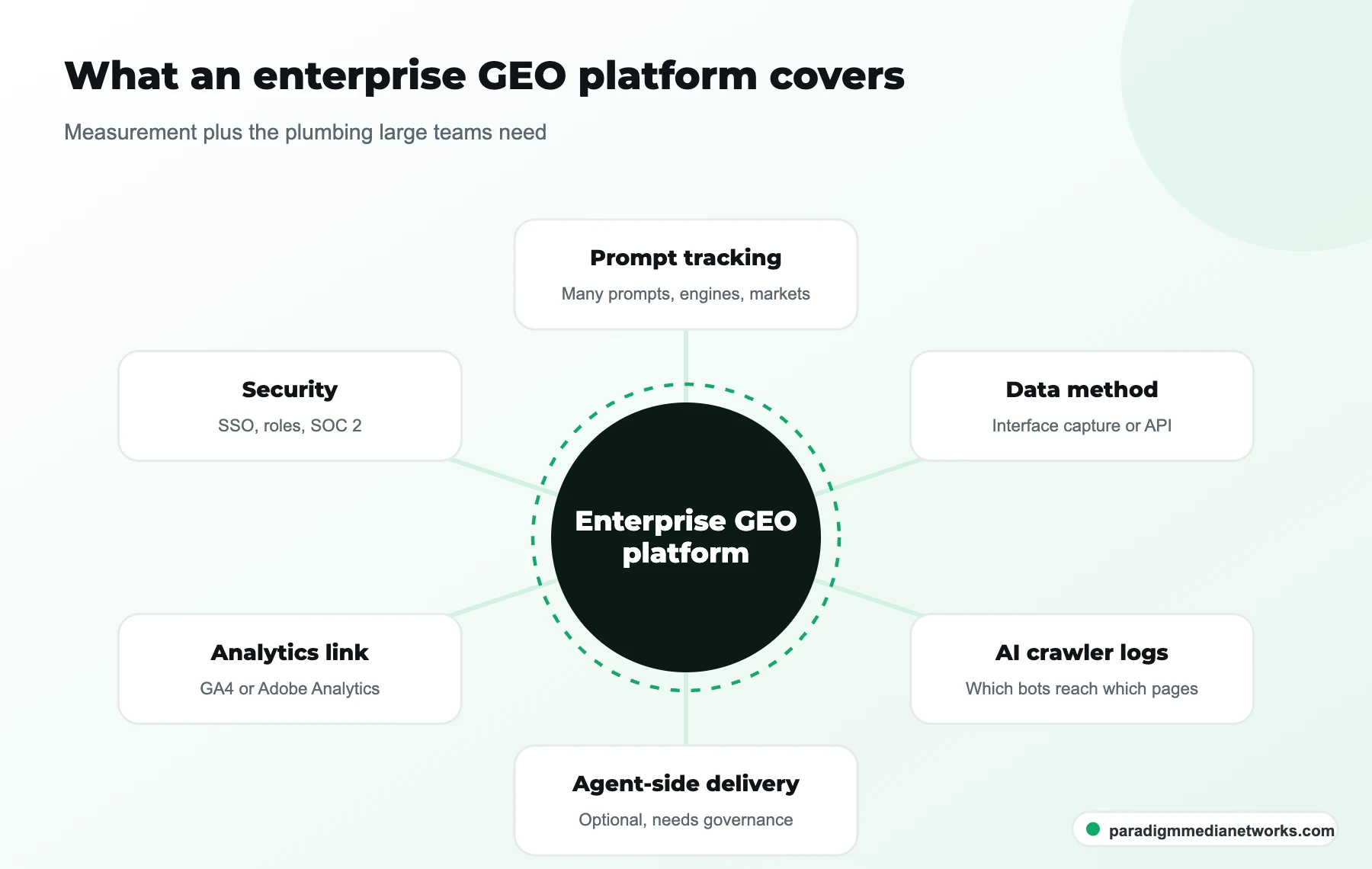
Generative engine optimization (GEO) is the practice of making a brand easy for AI answer engines to find, trust and cite. A GEO platform is the measurement and workflow layer for that practice. What makes one “enterprise” is not the price. It is the plumbing: single sign-on, role-based access, a data API or export for your warehouse, coverage of many countries and languages, AI crawler log analysis, and a vendor security posture your procurement team will sign off.
If you need a tracker for one brand in one market, you do not need anything on this page. Our comparison of 14 AI visibility trackers by prompts, engines and price covers the self-serve end of the market, and our free AI Visibility Checker gives a one-off read in minutes.
Enterprise GEO platforms compared
Eight platforms cover most enterprise shortlists in 2026. The table shows what each vendor states on its own pages about engines, data method, enterprise controls and pricing.

How we built this: we read each vendor’s pricing page, product page, documentation or press release on 24 October 2026. Where a fact comes from a competitor’s comparison page, we say so. We have not run these platforms side by side on client data, so there are no scores or ratings here, only stated facts and the questions to ask. No vendor paid to be included and Paradigm Media Networks has no affiliate deals with any of them.
| Platform | Type | AI engines stated | Data method stated | Enterprise controls stated | Pricing published? |
|---|---|---|---|---|---|
| Profound | AI-native | Up to 9 on Enterprise, incl. ChatGPT, AI Mode, AI Overviews, Gemini, Copilot, Claude, Perplexity, DeepSeek | Front-end browser, per Profound | SSO/SAML, SOC 2, API, CDN-level agent analytics | Free 7-day trial (50 prompts); Enterprise custom |
| Scrunch | AI-native | ChatGPT, Claude, Gemini, Perplexity, AI Mode, AI Overviews, Meta | Not stated on pricing page | SSO and data API on Enterprise; AXP agent delivery | Yes: Starter $300, Growth $500 a month; Enterprise custom |
| BrightEdge | SEO suite | AI Catalyst: AI Overviews, ChatGPT, Perplexity | Not stated in the launch post | Long-standing enterprise suite; AI crawler log view | No |
| Conductor | SEO suite | Names ChatGPT and Perplexity | API-based, per Conductor | GA4 and Adobe integrations | No; 3-week free trial |
| seoClarity ArcAI | SEO suite | Not listed in the ArcAI 3.0 release | Not stated | MCP server and API, executive dashboards, AI shopping analysis | No |
| Botify | SEO suite | Not listed on the agentic search page | Not stated | AI bot log analysis, pre-rendering for bots, IndexNow push | No |
| Semrush Enterprise AIO | SEO suite (Adobe-owned) | ChatGPT, Gemini, AI Mode, AI Overviews named | Not stated | Log file analysis, Adobe Analytics integration, AI shopping visibility | No |
| Adobe LLM Optimizer | Adobe stack | Not listed in the launch release | Not stated in the release | Works standalone or with AEM Sites; Optimize at Edge; A2A and MCP | No |
Read the “not stated” cells as questions, not weaknesses. Several vendors publish less on their marketing pages than they will tell you on a call. The point of the table is to give you the same checklist for every demo.
What each platform is built for
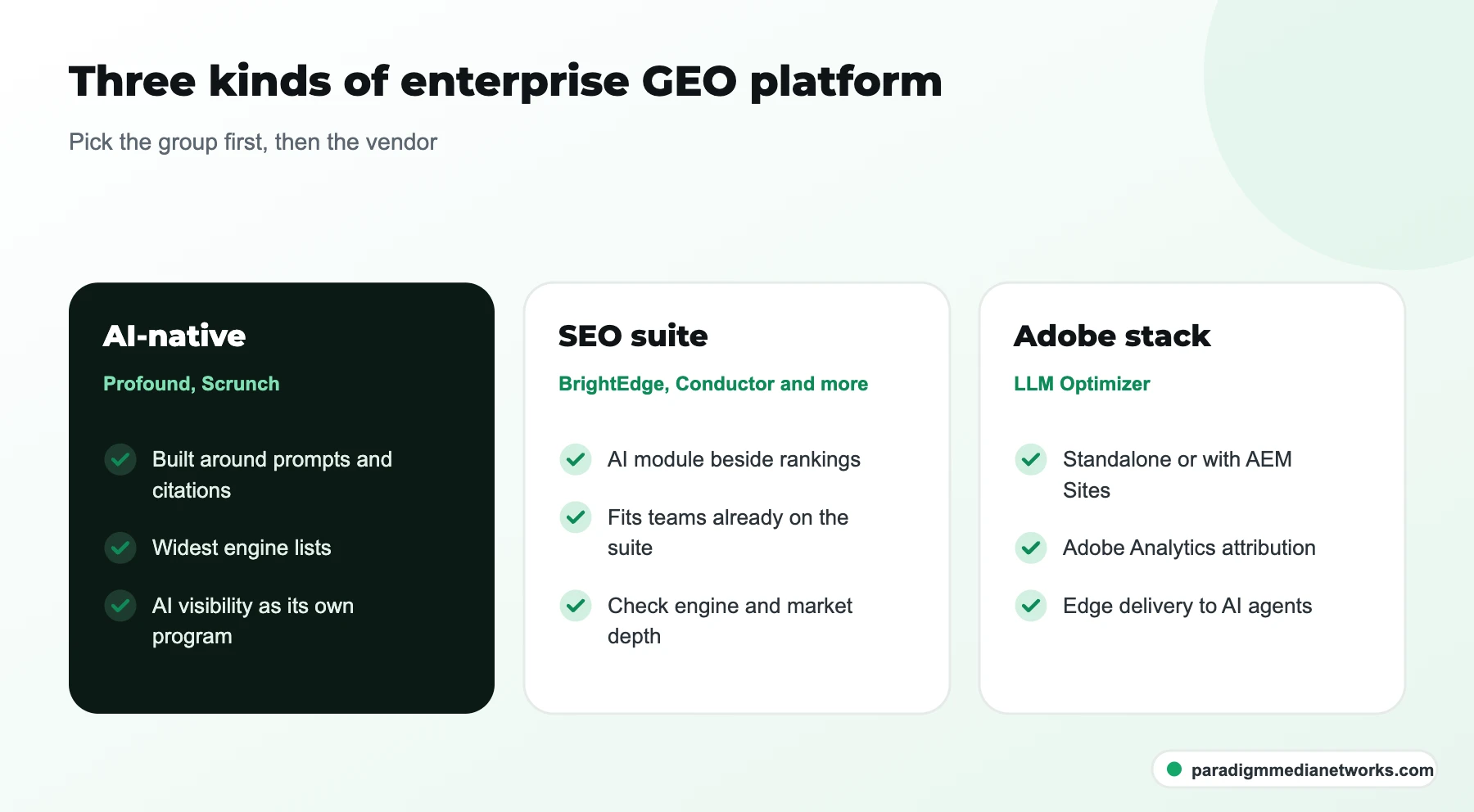
The AI-native platforms are built around prompts and citations first. The SEO suites bolt AI tracking onto crawling, rankings and content workflows you may already own. Adobe’s tools make most sense if your site and analytics already run on Adobe.
AI-native platforms: Profound and Scrunch
Profound is the broadest on engines, with up to nine on its Enterprise plan, including ChatGPT Shopping tracking, according to its pricing page. In its own comparison with BrightEdge, Profound says it queries AI platforms through the front-end browser, covers 150+ regions and 30+ languages, and runs agent analytics at the CDN or server-log level rather than through JavaScript. It suits global brands that treat AI visibility as its own program with its own owner.
Scrunch is the only platform here with published self-serve prices: $300 a month for Starter (350 custom prompts) or $500 for Growth (700 prompts) on monthly billing, with SSO and the enterprise data API reserved for the custom Enterprise tier. Its Agent Experience Platform (AXP) serves AI agents an optimized version of your pages, covered in the governance section below. It suits mid-market and enterprise teams that want to start self-serve and scale.
Enterprise SEO suites: BrightEdge, Conductor, seoClarity, Botify, Semrush Enterprise
BrightEdge added AI Catalyst to track brand presence across AI Overviews, ChatGPT and Perplexity in one dashboard. Conductor tracks mentions, citations and sentiment in engines such as ChatGPT and Perplexity inside Conductor Intelligence, and is the clearest advocate of API-based data. seoClarity launched ArcAI 3.0 on 1 April 2026 with AI shopping analysis, answer-accuracy workflows, prompt research and an MCP server. Botify leans technical: AI bot log analysis, pre-rendered pages for bots that do not run JavaScript, and IndexNow pushes into Bing. Semrush Enterprise AIO draws on a prompt database Semrush puts at over 261 million prompts and adds log file analysis; Adobe completed its Semrush acquisition in April 2026.
The case for a suite is consolidation. If your SEO team already lives in one of these tools, AI tracking sits next to the rankings, crawls and content briefs it already uses. The case against is depth: check whether the AI module covers the engines and markets you need, at the prompt volume you need, before assuming the bundle is cheaper.
Adobe stack: LLM Optimizer
Adobe LLM Optimizer became generally available on 14 October 2025. Adobe sells it standalone and with Adobe Experience Manager Sites, with AI referral and citation tracking, one-click fixes and attribution reporting. Its Optimize at Edge feature applies changes at the CDN for AI user agents only. For teams on AEM and Adobe Analytics, the attribution story is the draw. For everyone else, weigh it against the independents.
How do you choose an enterprise GEO platform?
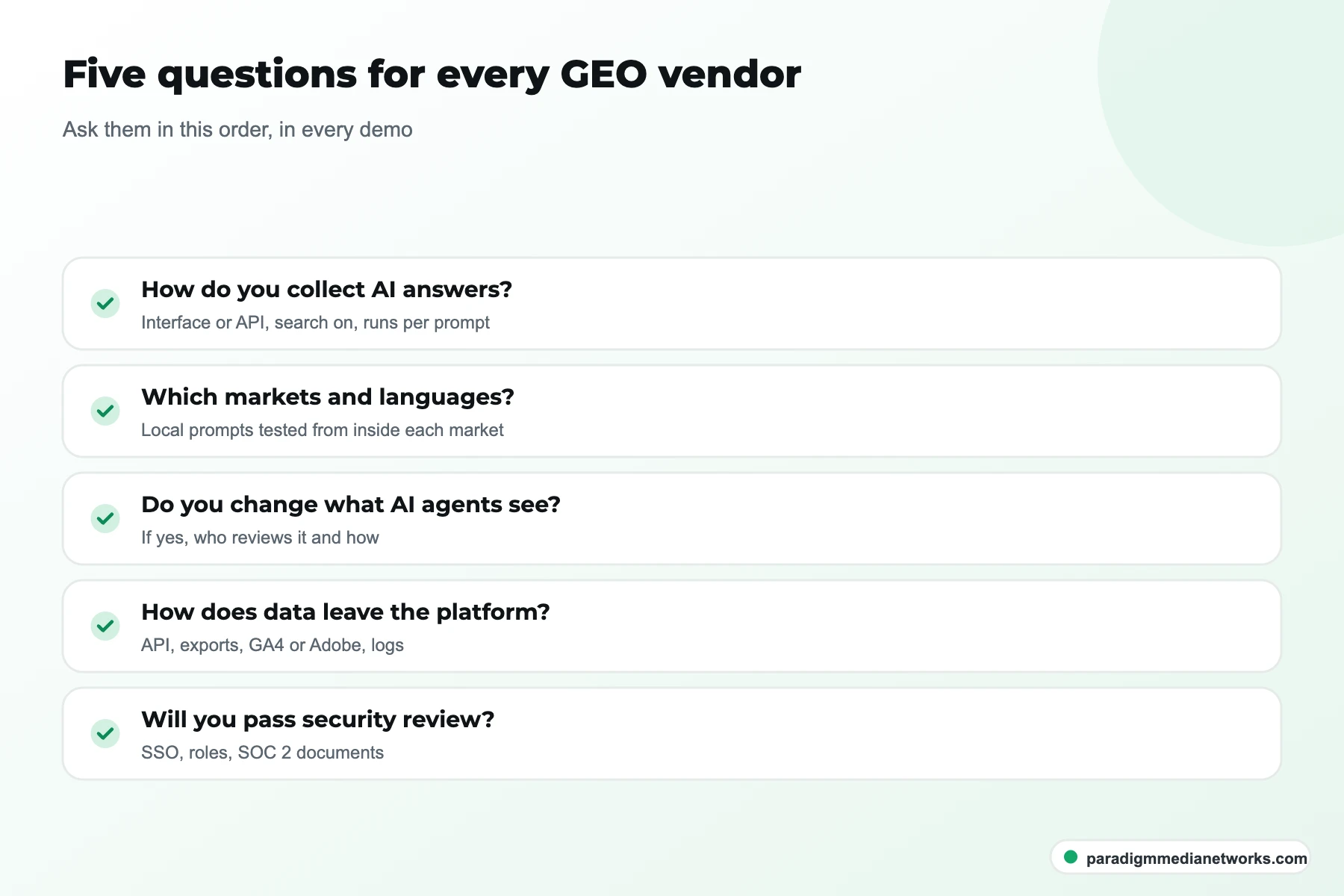
Choose on five things, in this order: how the platform collects AI answers, which markets and languages it covers, whether it changes what AI agents see, how it connects to your data stack, and whether it passes security review.
1. How does it collect AI answers?
This decides whether the numbers mean what you think. In Surfer’s October 2026 study of 1,000 prompts run through both the consumer interface and the API, cited domains for ChatGPT overlapped only 4.8% between the two methods. Surfer sells interface-based tracking, so weigh that, but the gap is wide enough that a board report built on one method cannot be compared with another. Ask: interface or API, search on or off, which country, and how many runs per prompt.
2. Does it cover your markets properly?
AI answers to commercial questions change with location. A platform that tests every market from one US data centre will tell you little about your UK or German buyers. Ask for per-market prompt sets, local language prompts written by people who speak it, and market-level scores. Our enterprise GEO audit framework shows how to score each market out of 100 and weight it by revenue, which is the view a platform should support.
3. Does it change what AI agents see?
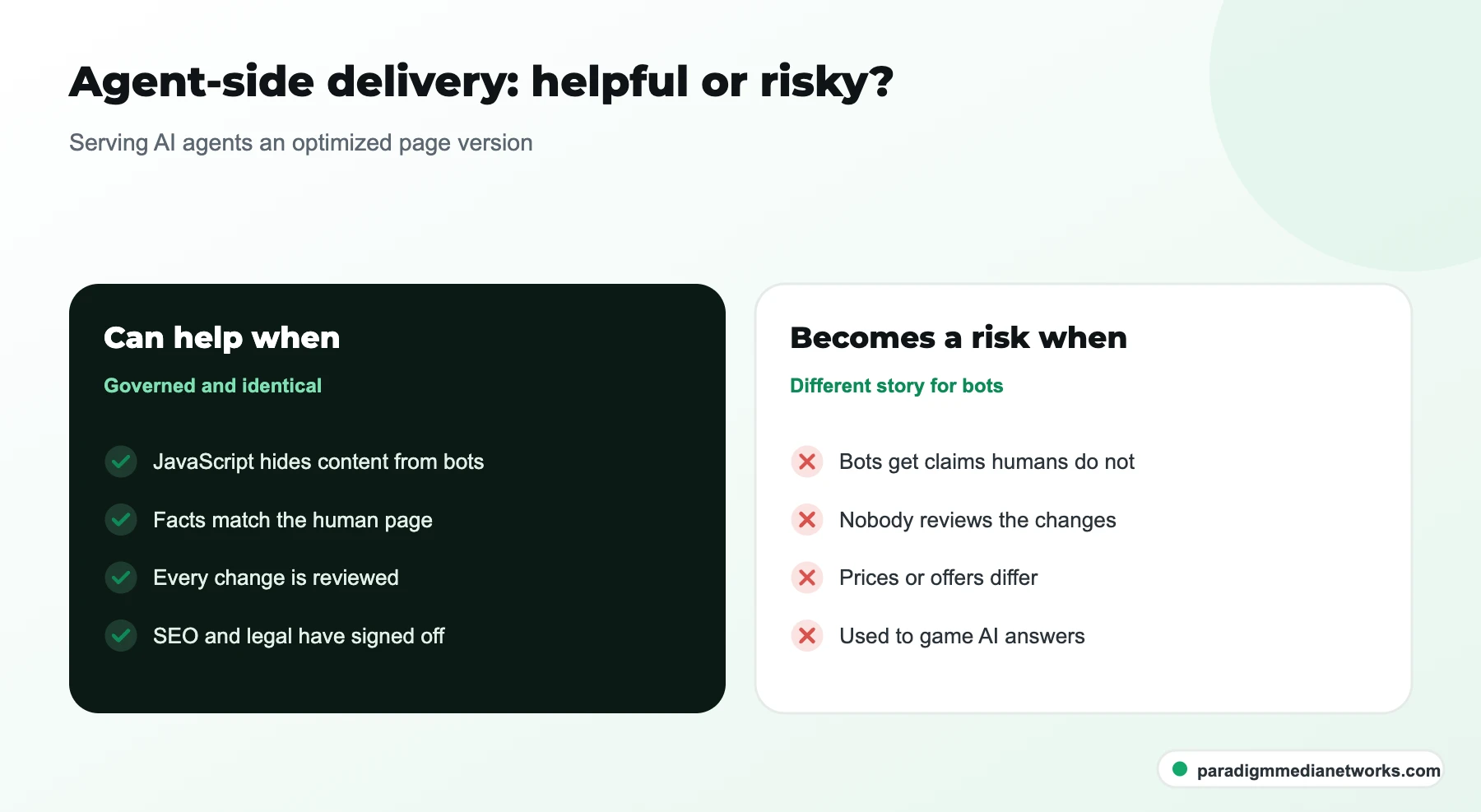
This is the question most buyers skip. Adobe’s Optimize at Edge documentation says optimized versions go only to AI agents and not to human visitors or SEO bots, and that the changes restore parity rather than add facts. Scrunch’s AXP help article says humans get the normal site and Googlebot and Bingbot are not routed to the AI version. Google’s spam policies define cloaking as showing different content to users and search engines to manipulate rankings, and since May 2026 cover attempts to manipulate generative AI responses. Our view: agent-side delivery can be legitimate for JavaScript-heavy sites, but only if the facts are identical, every change is reviewed, and your SEO and legal leads have signed off. Treat it as a governance item, not a toggle.
4. Will it fit your data stack?
Check for an API or warehouse export, GA4 or Adobe Analytics integration for AI referral traffic, server-log or CDN integration for AI crawler activity, and an MCP server if your analysts work in AI assistants. A platform whose data cannot leave its dashboard becomes one more silo.
5. Will it pass security review?
SSO, role-based access and SOC 2 are table stakes for most enterprise procurement teams. Profound lists SSO/SAML and SOC 2 on Enterprise; Scrunch lists SSO on Enterprise only. Ask every vendor for its trust documentation early, because security review is usually the slowest step.
How do you run a fair platform evaluation?
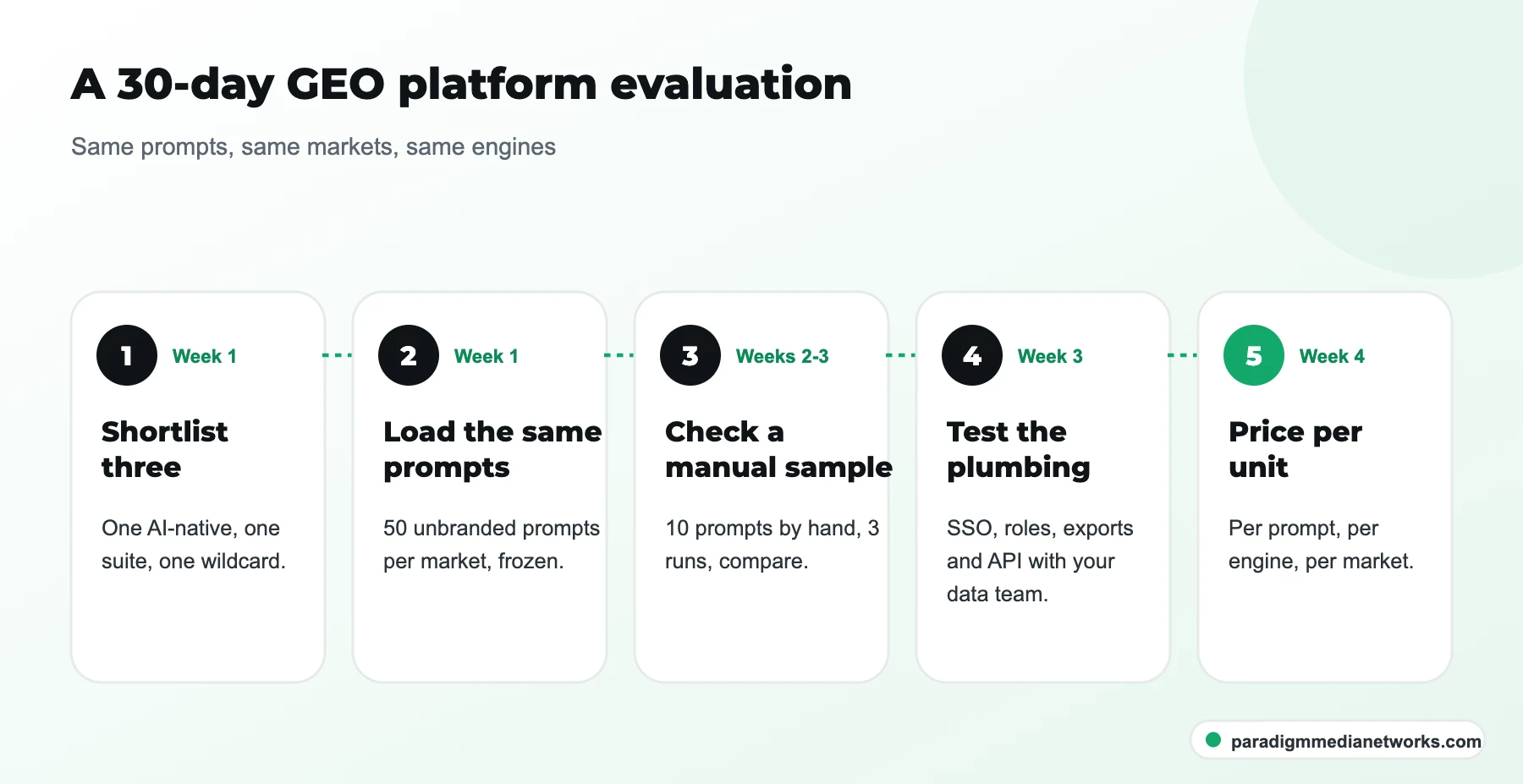
Give three shortlisted platforms the same prompts, markets and engines for about 30 days, check their numbers against a manual sample, and test the data and security plumbing before you look at price.
- Shortlist three. One AI-native platform, one suite you already own or know, and one wildcard. More than three and nobody has time to read the results.
- Load identical prompt sets. 50 unbranded buyer prompts per market, written in local language, frozen for the trial. Branded prompts flatter every tool equally.
- Check against a manual sample. Run 10 of the prompts by hand in each engine, three times, and compare with what each platform reports. Large gaps tell you about method.
- Test the plumbing. SSO, roles, exports, API access and analytics integration, tested by your data team, not shown in a demo.
- Price it per unit. Ask for cost per prompt, per engine, per market, per month. Only then compare quotes.
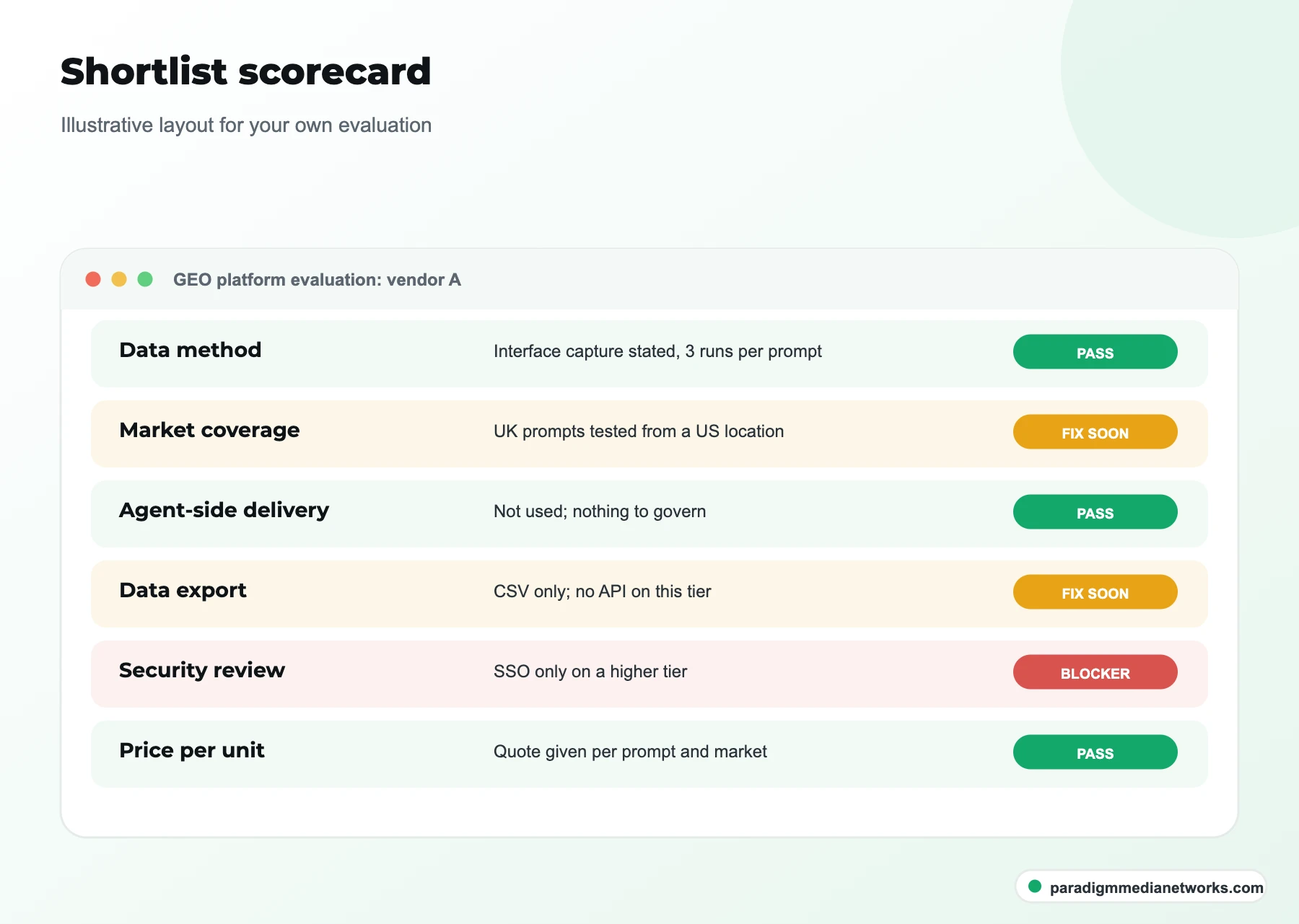
Common mistake: choosing on the demo dashboard. Every vendor’s demo account looks good. The test that matters is your prompts, your markets and your data team trying to get the numbers out.
What do enterprise GEO platforms cost?
Most enterprise GEO platforms do not publish prices. Scrunch is the exception among the eight here, with Starter at $300 and Growth at $500 a month on monthly billing; Profound offers a free seven-day trial; the rest quote after a demo.
Quotes usually scale with four things: the number of prompts, the number of engines, the number of markets and languages, and how often each prompt runs. A platform that runs 500 prompts daily across nine engines in ten markets is doing a very different amount of work from one that runs 200 prompts weekly in one market. That is why “per prompt, per engine, per market” is the only fair way to compare quotes.
Budget for people as well as software. Someone has to own the prompt set, read the reports and turn gaps into tickets for engineering, content and PR. A platform with no owner becomes shelfware within a quarter.
Do you need a platform, an agency, or both?
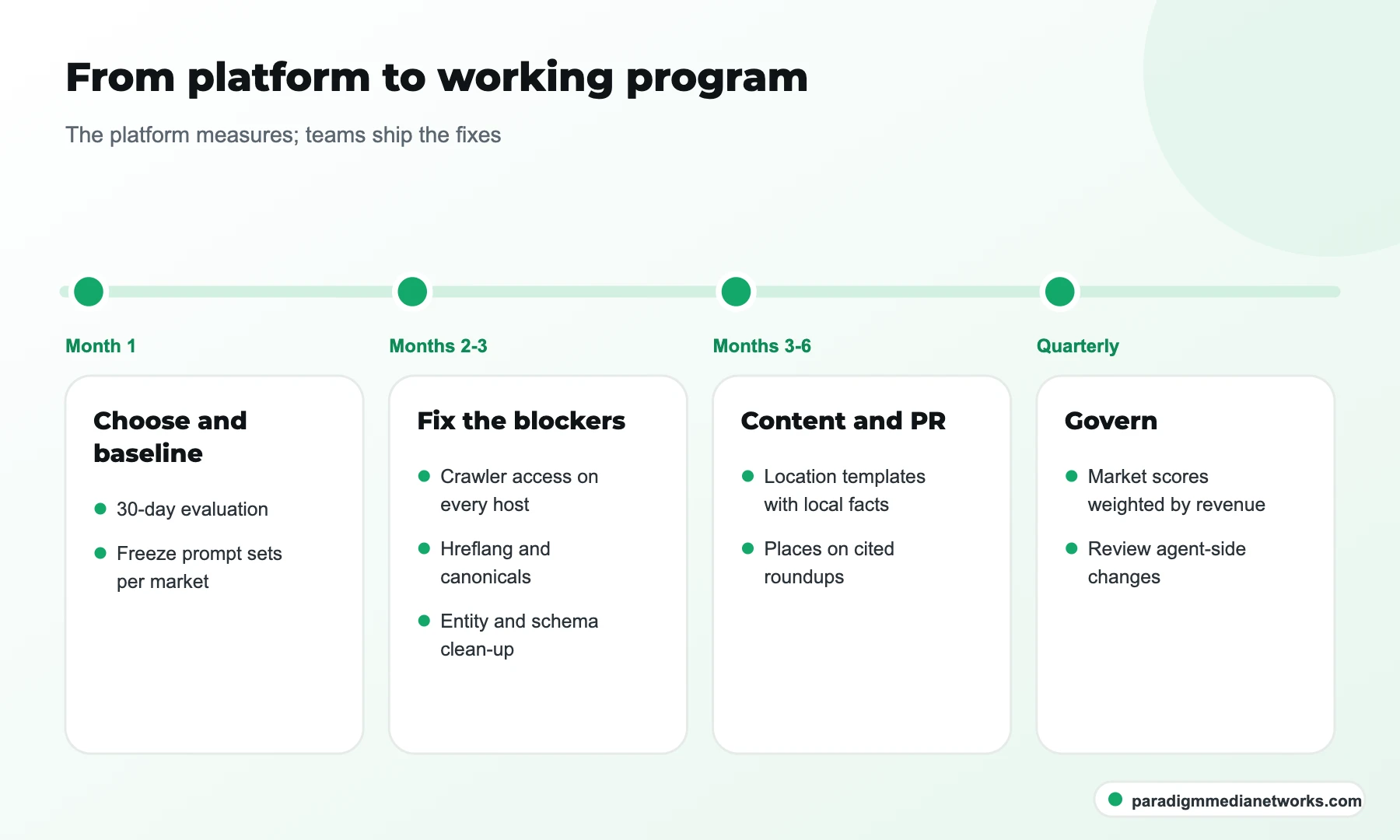
Most enterprises end up with both: a platform to measure citation share across markets, and a team that can ship the technical, content and PR fixes the platform keeps flagging.
A platform tells you a competitor is cited in Manchester and you are not. It does not rewrite the location template, fix the hreflang that points British buyers at a US page, separate two brands the engines have merged, or earn a place on the roundups the engines cite. Those fixes cross engineering, content, regional and PR teams, which is why platform data so often sits unused.
That is why Paradigm Media Networks runs enterprise SEO and GEO as one program for multi-market brands, with one strategist accountable for the scorecard. We work alongside whichever platform you choose, or run the fixed prompt sets ourselves if you have not chosen one yet. The same method is behind our Moving Hub case study: a fixed prompt set tracked monthly across five assistants, about 2,460 AI citations in 90 days (AI Performance report, 28 June to 6 September 2026), and the brand named by ChatGPT, Google AI Mode, AI Overviews, Perplexity and Gemini.
Jahid Hussain’s view: pick the platform your team will actually open every week, then spend the rest of the budget on the people who act on it. Google says optimizing for generative AI search is still SEO, and the platforms that pretend otherwise tend to sell dashboards rather than results.
Enterprise GEO platforms: FAQ
What is an enterprise GEO platform?
An enterprise GEO platform is software that tracks how AI engines such as ChatGPT, Gemini, Perplexity and Google AI Overviews mention and cite a brand, across many prompts, markets and teams, and helps fix what it finds. Enterprise versions add SSO, data APIs, log analysis and governance that small trackers lack.
How much do enterprise GEO platforms cost?
Most do not publish enterprise prices. Of the eight we reviewed, only Scrunch lists self-serve tiers ($300 a month for Starter on monthly billing), and Profound offers a free seven-day trial. Everything else is quoted. Ask each vendor for the price per prompt, per engine, per market, so quotes compare like with like.
Is serving AI crawlers a different page version cloaking?
Google’s spam policies define cloaking as showing different content to users and search engines to manipulate rankings. Adobe and Scrunch say their agent-only versions keep the same facts and are not served to Googlebot. Treat it as a governance decision: keep facts identical, review changes, and involve your SEO and legal leads.
Do we need a GEO platform or a GEO agency?
Often both, with clear roles. A platform measures citation share and flags gaps. Closing those gaps takes technical changes, page rewrites, entity work and digital PR across several teams. Buy the platform if you have the people to act on it; add an agency or partner if you do not.
Which enterprise SEO platforms added AI search tracking?
BrightEdge (AI Catalyst), Conductor (AI search performance in Conductor Intelligence), seoClarity (ArcAI), Botify (AI Visibility and AI bot analytics) and Semrush Enterprise (AIO) all now track AI answers alongside classic SEO. Adobe offers LLM Optimizer and, since completing its Semrush acquisition in April 2026, sells Semrush Enterprise AIO too.
How long should an enterprise GEO platform evaluation take?
About 30 days is enough for a fair test. Shortlist three platforms, load the same 50 prompts per market into each, compare results with a manual sample, then test exports, SSO and API access with your data team. Decide on fit and method, not on the demo dashboard.

One team, one revenue number
Strategy is led by Jahid Hussain, founder of Paradigm Media Networks, with 7 years in growth marketing, SEO and performance marketing and an MBA in Marketing. SEO, AI search, paid media, content and web run as one system, so nobody hands you a report that contradicts another vendor’s.
- 500+ marketers trained and 30+ brands scaled
- Published results you can check: HVAC case study and Moving Hub case study
- Reporting on calls, leads and booked jobs, not just rankings
Know your gaps before you buy
A platform is easier to choose once you know which markets, engines and prompts matter. Start with a free read of how AI engines describe your brand, then shortlist with the five questions above.
✓ Free 30-minute call · No pitch decks · Walk away with a real plan
What you walk away with
- Which AI engines and markets matter most for your category
- The questions to put to each platform vendor
- Where competitors are cited and you are not
- A straight view on platform, partner or both