


ChatGPT optimization means making your pages easy for ChatGPT search to find, trust and quote. Allow OpenAI’s OAI-SearchBot in your robots.txt, answer each question in the first one or two sentences under a question-style heading, use tables and numbered steps, cite named sources, and keep your brand details identical everywhere they appear online.
What Content Formats Perform Best in ChatGPT Search Results?
ChatGPT search cites content it can lift cleanly: a direct answer under a question heading, comparison tables, numbered steps, one-line definitions and statistics with a named source. See our full breakdown of content formats ChatGPT cites.
| Format | Why ChatGPT cites it |
|---|---|
| 40-60 word answer under a question heading | Can be quoted as a complete answer |
| Comparison table | Facts are already organised side by side |
| Numbered steps | Easy to reproduce as a how-to answer |
| One-sentence definition | Fits ‘what is…’ questions word for word |
| Statistic with a named source | Gives the answer something to attribute |
Want this done on your own site? Our ChatGPT optimization services restructure your key pages so ChatGPT can cite them. Start with the free AI visibility checker.
Key Takeaways
- ChatGPT and other AI models read for clarity and structure, not just keywords — they interpret content, they don’t just index it.
- The same E-E-A-T principles (Experience, Expertise, Authoritativeness, Trustworthiness) that matter for Google now directly influence whether AI tools cite your content.
- Structured formatting — headers, short paragraphs, lists, tables, and FAQs — improves both featured-snippet eligibility (AEO) and AI extraction (GEO).
- Peer-reviewed research from Princeton found that adding sourced statistics, quotations, and citations can increase a page’s visibility in AI-generated answers by up to 40% (Aggarwal et al., KDD 2024).
- Schema markup (Article, FAQPage, HowTo, Organization) helps AI systems parse and trust your content faster.
- You don’t need separate strategies for Google and AI — one well-structured, well-sourced piece of content serves both.
The digital content landscape? It’s shifting faster than ever.
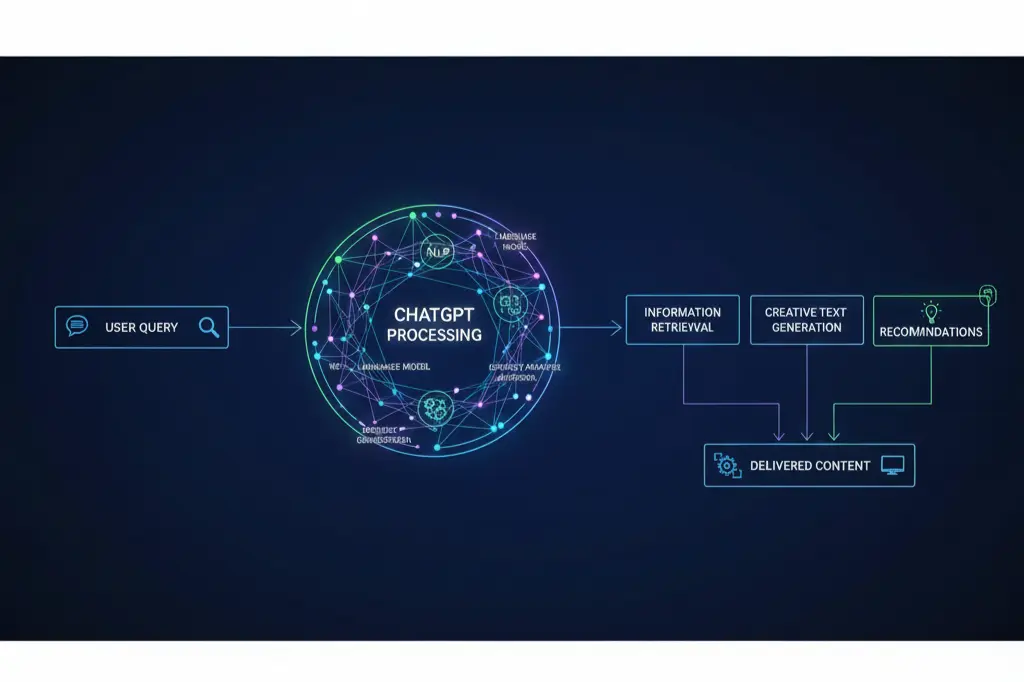
We’re living in a time where your audience isn’t just finding you through Google anymore. They’re asking ChatGPT. They’re using AI tools to discover brands, research products, and find answers. And here’s the thing — if your content isn’t optimized for these AI systems, you’re essentially invisible in half the conversations happening online.
This isn’t about replacing traditional SEO. Not at all. It’s about adapting to how people actually search now. Because ChatGPT content optimization isn’t some futuristic concept anymore — it’s happening right now, and creators who get this right are already miles ahead.
How AI Search Differs from Traditional SEO
Traditional SEO taught us to focus on keywords, meta tags, and backlinks. That still matters, don’t get us wrong. Perplexity works differently again; our guide on how to rank in Perplexity AI covers its source selection.
But AI content optimization plays by different rules.
| Factor | Traditional SEO | AI / GEO Optimization |
|---|---|---|
| Primary goal | Rank in top 10 links | Get cited or paraphrased in an AI answer |
| Content unit | Full page | Extractable passage or sentence |
| Key signal | Backlinks, keyword density | Entity clarity, sourced statistics, factual grounding |
| Structure | Headers help ranking | Headers plus direct-answer blocks are essential |
| Trust signal | Domain authority | Author credentials, citations, cross-platform consistency |
The smartest content strategy? Optimize content for AI while maintaining traditional SEO fundamentals. They’re not competitors — they’re partners. Independent research backs this up: a 2026 large-scale study on measuring brand visibility across AI search engines found that the biggest visibility gains came from adding machine-extractable provenance — quotations, statistics, and citations — each worth roughly 25 to 40% more visibility. Source: Generative Engine Optimization at Scale (arXiv, 2026). Before you rewrite anything, check whether ChatGPT mentions your brand today.
Understanding How ChatGPT Reads and Interprets Content
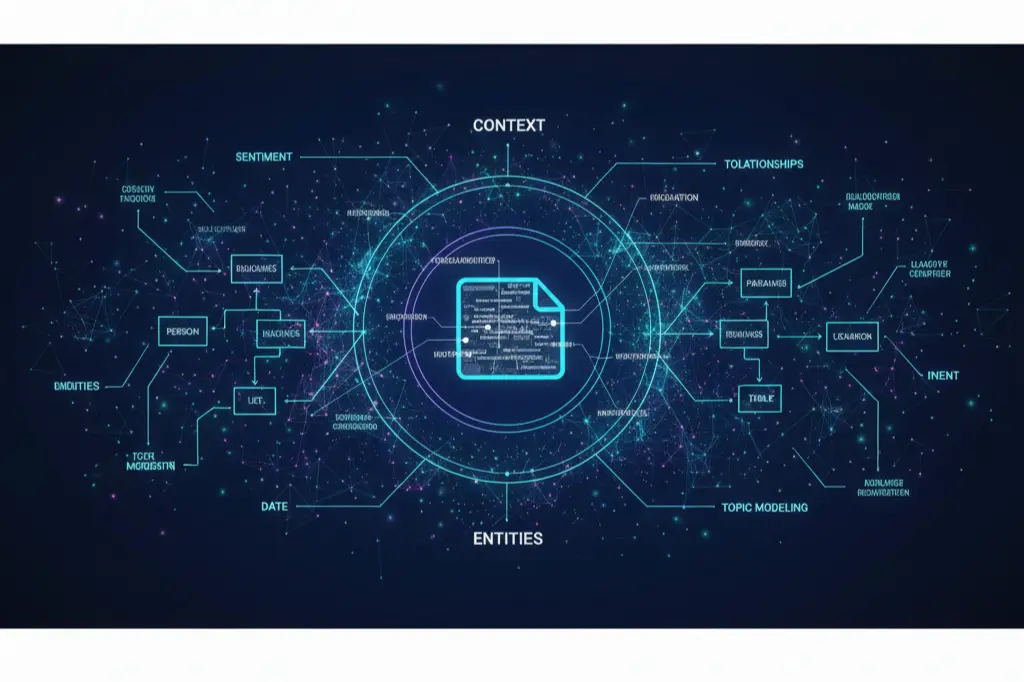
Let’s break down exactly what happens when ChatGPT encounters your content.
Contextual Understanding
ChatGPT doesn’t read sentences in isolation. It understands how ideas connect. Your introduction sets up your conclusion. Your examples support your claims. Everything flows together, or it doesn’t.
Entity Recognition
Names, brands, tools, concepts, categories — ChatGPT identifies these entities and builds relationships between them. The clearer you name things, the better AI understands your expertise.
Pattern Recognition
Clean headers. Logical flow. Consistent formatting. That’s what AI loves.
Clarity of Claims
Is your information verifiable? Factual? Easy to understand? Vague statements confuse AI just like they confuse readers.
Structured Data
Lists, tables, steps, FAQ sections — these aren’t just good for readers. ChatGPT processes structured content significantly faster and more accurately.
Step-by-Step Guide: How to Optimize Content for ChatGPT
Step 1: Let ChatGPT’s Search Crawler In
ChatGPT can only cite pages its search crawler can reach. OpenAI uses OAI-SearchBot to find pages for ChatGPT search. GPTBot is a separate crawler used for model training, so you can block GPTBot and still appear in ChatGPT search. Add these two lines to your robots.txt file:
User-agent: OAI-SearchBot
Allow: /
Then check that your firewall or CDN isn’t blocking it (in Cloudflare, look at the ‘Block AI bots’ setting). Also make sure your key pages are indexed in Bing Webmaster Tools, because ChatGPT search also draws on third-party search providers.
Step 2: Structure Your Content Clearly
This is where most people mess up.
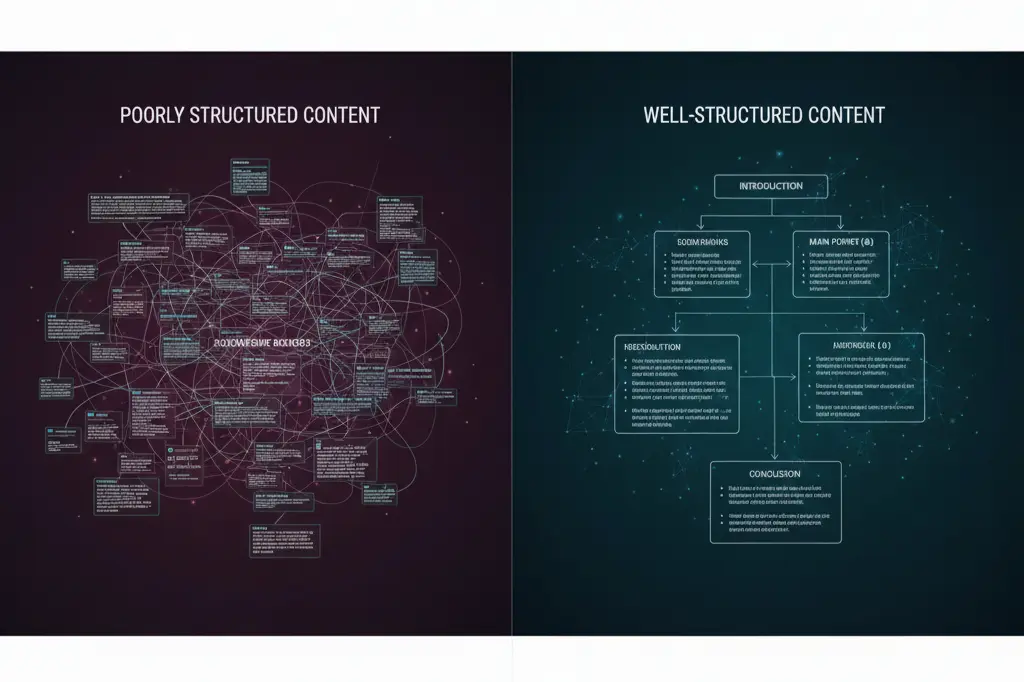
ChatGPT performs best with:
- Well-defined H1, H2, H3 hierarchy
- Short paragraphs (2–3 sentences max)
- Bulleted or numbered lists
- Clearly labeled sections
- A comprehensive FAQ section
Think of it this way: would you rather read a wall of text, or content broken into digestible chunks? AI feels the same way.
Step 3: Use Conversational Clarity
Since ChatGPT communicates conversationally, your writing should mirror that style.
❌ Bad: “Optimization of semantic entities ensures improved AI parsing efficiency.” ✅ Good: “When you use clear terms and explain topics well, AI tools like ChatGPT understand your content better.”
See the difference? Natural language wins every time.
Step 4: Add Context, Proof, and Real-World Examples
Content backed by facts, examples, and real experience gets referenced more often by AI systems. This isn’t a hunch — it’s measurable. The Princeton GEO study tested nine content-modification strategies across 10,000 queries and found that citations, quotations from relevant sources, and statistics significantly boosted source visibility, with an increase of over 40% across various queries. Source: GEO: Generative Engine Optimization, Aggarwal et al., KDD 2024 (arXiv).
Give ChatGPT more “signal” to work with:
- Include statistics from credible, cited sources
- Share specific case studies — for example, browse Paradigm Media Networks’ work with clients like Moving Hub and Tychr
- Provide before-and-after scenarios with real numbers
- Explain the reasoning behind your recommendations, not just the recommendation itself
Step 5: Strengthen Topical Depth
Surface-level content doesn’t cut it anymore.
Instead of briefly mentioning ten topics, go deep on five. Add definitions. Discuss related concepts. Explain the hows and whys. Connect entities naturally.
This depth helps ChatGPT understand relevance and context, leading to better AI summarization quality.
Step 6: Build Entity-Based Relevance
Entities are the backbone of AI understanding.
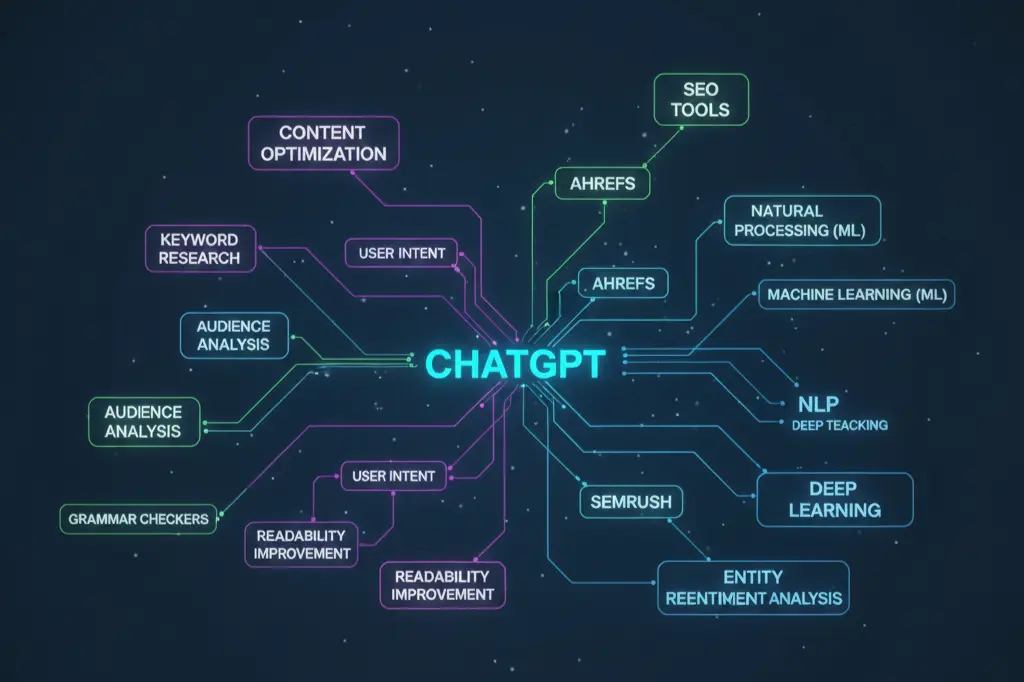
Instead of: “Use tools for SEO” Write: “Use tools like Google Search Console, Ahrefs, Semrush, and Surfer SEO for comprehensive optimization”
This builds stronger semantic clarity and helps AI systems make better connections between concepts.
Step 7: Use Schema and Metadata
Schema markup helps AI systems interpret your content faster and more accurately. We recommend:
- Article schema
- FAQPage schema
- HowTo schema
- Organization schema with
sameAslinks to your official social profiles - Person schema for author credentials
Combine this with strategic internal links — for example, to our SEO services and Generative Engine Optimization services — plus external references to authoritative sources. Trust signals matter to both readers and machines.
Best Formatting Practices to Improve AI Output
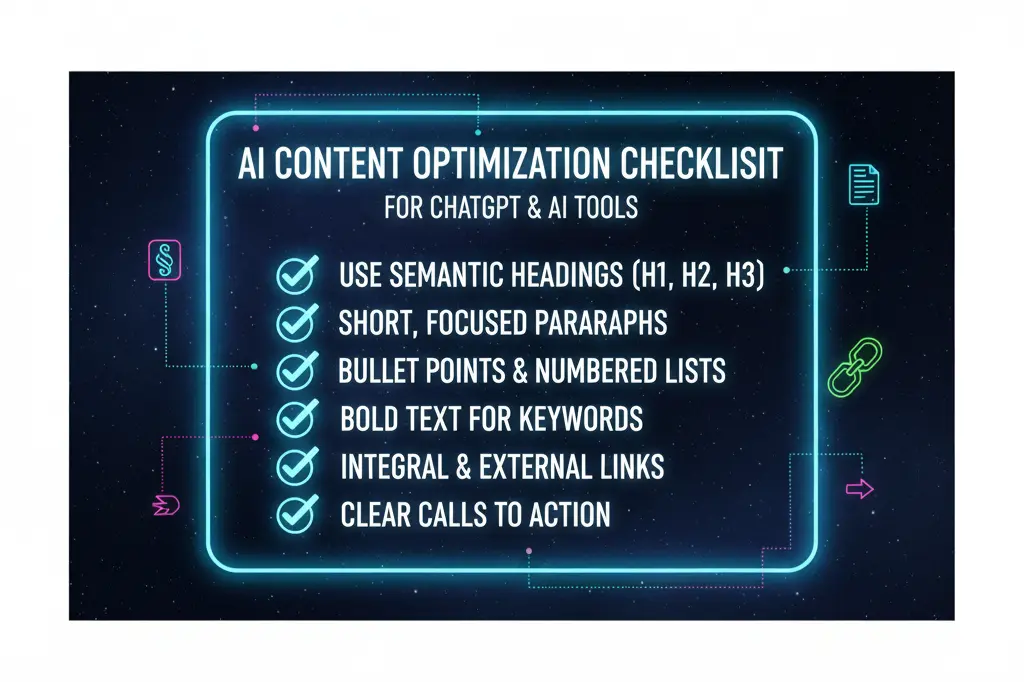
These practices significantly improve how ChatGPT processes your content (for the full set of formats, see our guide on how to structure content for LLMs):
✔ Write short, clear sentences
✔ Use lists and bullet points generously
✔ Bold primary keywords like ChatGPT naturally
✔ Include examples under each major concept
✔ Add visuals with descriptive alt text
✔ Create comprehensive FAQ sections
✔ Provide step-by-step instructions when applicable
✔ Use tables for structured comparisons
Common Mistakes to Avoid When Optimizing for ChatGPT
We’ve seen these mistakes kill otherwise great content:
❌ Overusing keywords until content reads unnaturally
❌ Writing vaguely without specific details
❌ Publishing without proper fact-checking
❌ Using overly complex jargon unnecessarily
❌ Writing for algorithms instead of people
❌ Skipping context or explanation
❌ Missing clear author credentials
❌ Forgetting image optimization and alt text
The biggest mistake? Thinking you need to choose between human readers and AI. You don’t. The best ChatGPT content optimization techniques work for both.
Real-World Examples & Use Cases
Blog Optimization
We’ve optimized blog posts across multiple client accounts for AI readability. Well-structured posts consistently generate better summaries when users ask ChatGPT for information in that niche. See how this played out for Moving Hub’s answer-first cost and route guides in the Moving Hub case study.
Business Pages
Clear service descriptions and product details help ChatGPT recommend businesses accurately when users search for solutions — as shown in our work for Moving Hub, now named by five AI assistants including ChatGPT.
Educational Content
Tutorials and step-by-step guides are gold for AI optimization. The structured format aligns perfectly with how ChatGPT and other AI tools extract and summarize instructional content.
How to Check Whether ChatGPT Already Cites You
- Open ChatGPT, switch on Search, and ask the question your page answers, worded as a customer would type it.
- Click ‘Sources’ under the answer and note which websites are cited.
- Repeat with 5-10 different phrasings of the same question.
- If you aren’t cited, open the cited pages and note what they have that you don’t: a direct answer, a table, a newer date, named sources.
- Fix the gap on your page, request indexing in Search Console and Bing Webmaster Tools, and check again in 2-4 weeks.
Tools to Improve ChatGPT Content Optimization
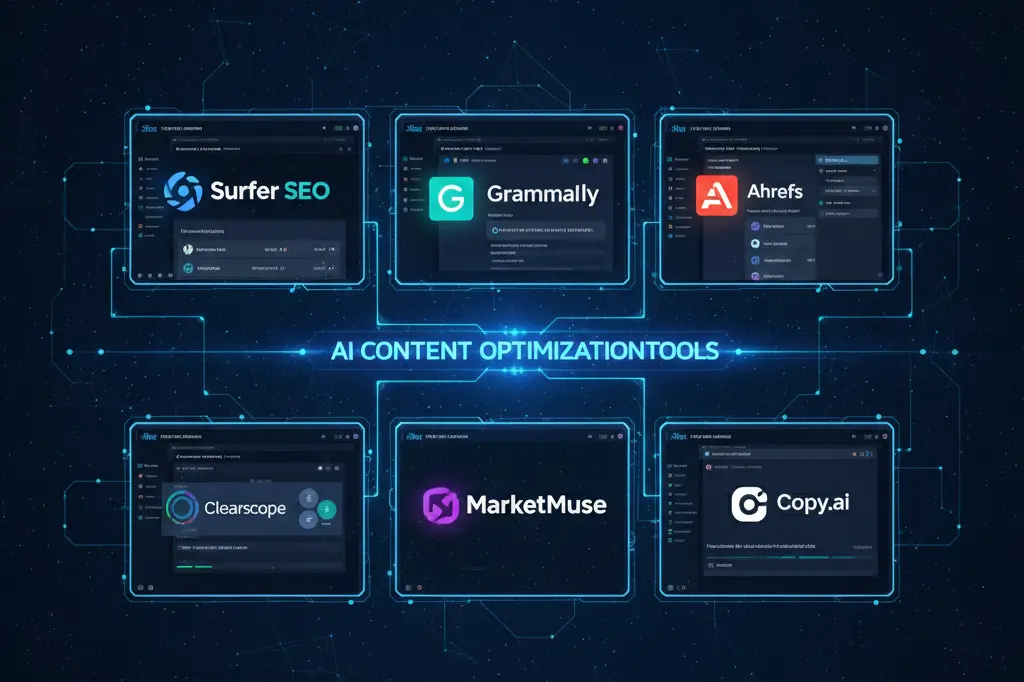
Here are the tools we actually use:
- Surfer SEO — for content structure and keyword optimization
- Grammarly — for clarity and readability
- Clearscope — for comprehensive topic coverage
- Ahrefs — for competitive research
- Google Trends — for identifying trending topics
- Semrush Topic Research — for content ideation
- Hemingway Editor — for simplifying complex sentences
These aren’t affiliate recommendations. They’re genuinely helpful for AI content optimization.
FAQs
Does ChatGPT use my content in its responses?
Yes, when ChatGPT searches. ChatGPT search can fetch and cite your page live if OpenAI’s search crawler, OAI-SearchBot, can reach it; otherwise ChatGPT relies on what it learned in training. GPTBot is the separate crawler for training data, so blocking it does not remove you from ChatGPT search.
How long does it take to optimize content for ChatGPT?
For a standard 1,500-word article, expect 30–45 minutes of optimization work, including restructuring headers, adding FAQs, improving clarity, and implementing schema markup.
Does keyword density matter for AI optimization?
No, not in the traditional sense. AI models prefer clarity, depth, and sourced context over repetitive keywords. Use your primary keyword naturally 6–8 times in a 1,500-word piece, but prioritize readability over density.
Should I write differently for AI and Google?
No. Both reward people-first, well-structured, factual content. The techniques for ChatGPT content optimization align with modern SEO best practices — one strategy serves both.
Can old content be optimized for ChatGPT?
Yes. Audit existing content, add structure through headers, include FAQ sections, improve clarity, and update with current information and fresh statistics. Small changes can significantly improve AI readability.
Conclusion
The future of content discovery isn’t either-or.
It’s not Google versus AI. It’s not traditional SEO versus ChatGPT content optimization. It’s everything working together in an ecosystem where clarity, structure, and genuine value win.
We’ve covered the fundamentals of how to optimize content for ChatGPT and AI tools — from understanding how AI interprets content, to implementing E-E-A-T principles, to structuring your articles properly, to avoiding common pitfalls.
The creators and businesses seeing results aren’t waiting for perfect strategies. They’re implementing these principles now, learning from the results, and adapting as AI technology evolves.
Your content deserves to be discovered — not just by search engines, but by the AI tools your audience uses every single day.
Let’s Build Your AI-Ready Content Strategy Together
At Paradigm Media Networks, we’ve spent years mastering the intersection of traditional SEO and AI optimization. We understand that optimizing content for AI isn’t about gaming the system — it’s about creating genuinely helpful content that serves both human readers and AI systems effectively.
Whether you’re a creator looking to expand your reach, a business wanting better visibility across AI platforms, or a brand ready to dominate your niche through smarter content, we’re here to help.
What we offer:
- Comprehensive content audits for AI readability
- Strategic content creation that ranks across Google and AI platforms
- Technical optimization including schema markup and structured data
- Ongoing strategy refinement based on AI trends
See real results in our work, or schedule a call to talk about your content strategy.
About the Author
Jahid Hussain is the founder of Paradigm Media Networks and leads its SEO and AI search strategy, having led content and visibility campaigns for clients including Moving Hub and Tychr. He has 7 years of experience in growth marketing, SEO and performance marketing, has worked with multiple B2B firms, and holds an MBA in Marketing. See our full body of work.
Last updated: July 31, 2026 | By Jahid Hussain, Paradigm Media Networks
