


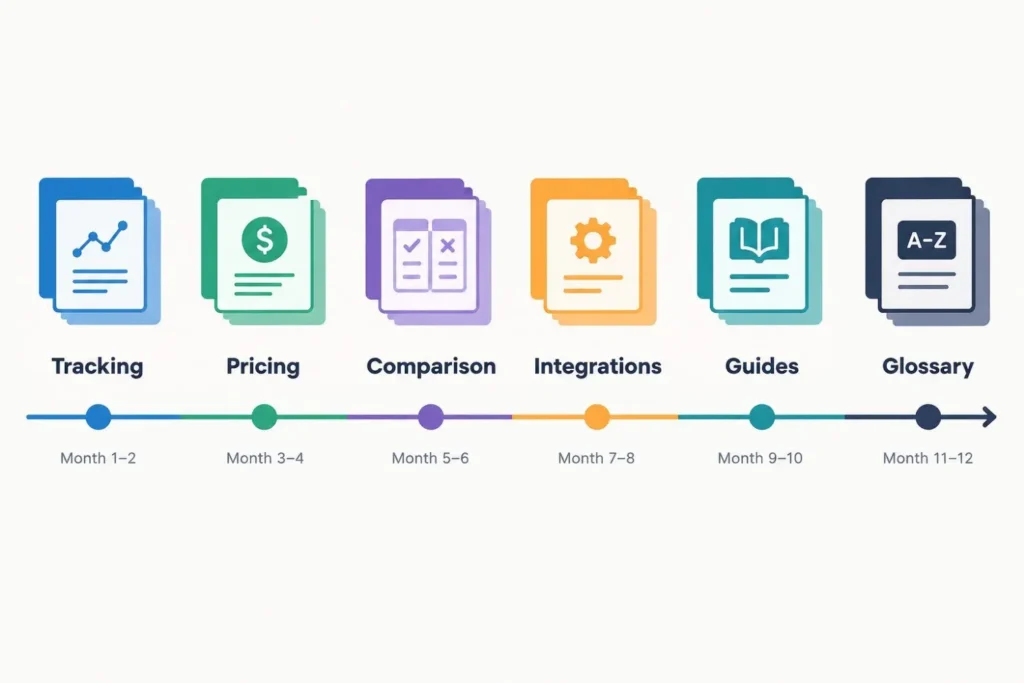
A SaaS SEO strategy is the order you build pages in, picked so search brings in signups and demos and not only visitors. Fix tracking and technical issues first. Then pricing, comparison and alternatives pages, then use-case and integration pages, then problem guides, with glossary posts last. Product-led and demo-led companies split after month two.
Key Takeaways:
- Choose pages by what a visit is worth to you. Search volume comes second.
- Get demo and signup tracking working before you publish anything new.
- If you’re product-led, integration pages come early. If you sell through demos, comparison pages do.
I keep running into the same SaaS blog. It has forty “what is X” posts, a pricing page nobody has touched since launch, and no page comparing the product with the competitor every prospect mentions. Traffic creeps up, demos don’t, and around month nine finance asks why the SEO invoice is still being paid.
In most of those cases the keywords were fine and the order was wrong. Our complete guide to SaaS SEO covers the basics. This post is about what to build first and what can wait.
Is SEO the right channel for you yet?
SEO for SaaS companies pays off when people already search for your category, you have product-market fit, and your deal size can wait six to twelve months for a return.
If nobody searches for what you do, or your ideal customer changes every quarter, I’d hold off. On sales calls I ask founders which job title signs the contract and which three tools buyers compare them with. If they can’t answer both, a retainer ends up paying someone to guess for them. Get a one-off SaaS SEO audit, sort out your pricing and product pages, and spend the rest on channels that create demand.
Why page order decides your SaaS SEO strategy
Every visit to a page has a rough price:
Value per visit = visit-to-demo rate × demo-to-close rate × ACV
Example: a $12,000 ACV, one demo in five closing (illustrative rates, not benchmarks):
| Page type | Visit-to-demo rate | Value per visit | 300 visits/month | 3,000 visits/month |
| “You vs competitor” page | 2% | $48 | $14,400 | n/a (low volume) |
| Glossary / “what is” post | 0.1% | $2.40 | $720 | $7,200 |
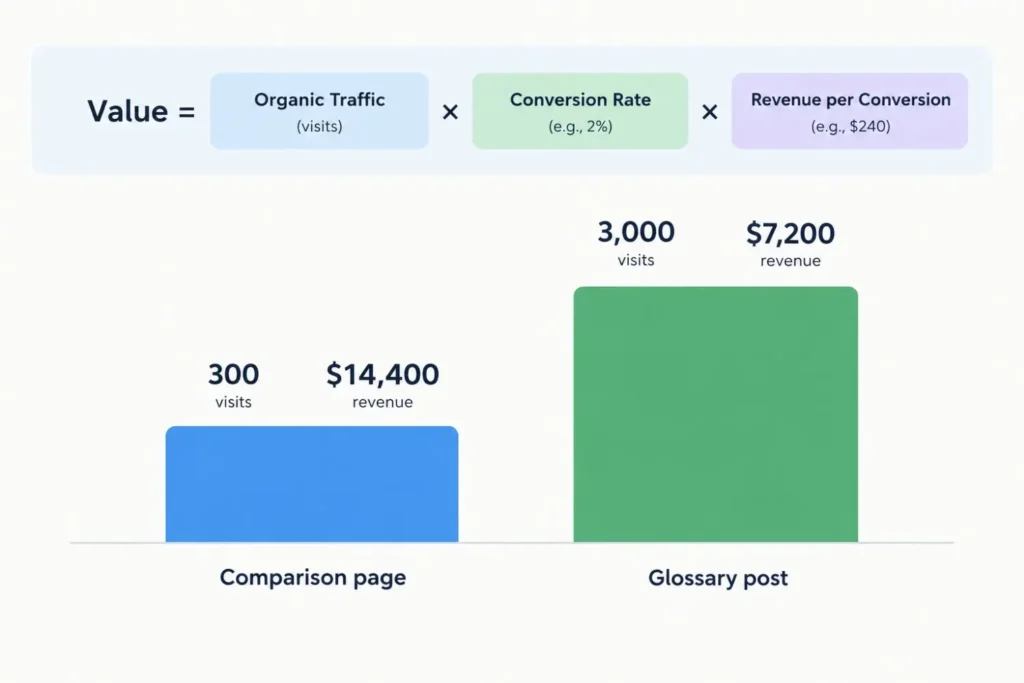
The glossary post gets ten times the traffic and brings in about half the money. Run your own rates through it. You’d need very different numbers to reverse that, so pages closest to a purchase go first.
The 12-month SaaS SEO roadmap
For a single-product B2B SaaS company with product-market fit, this is roughly our order.
| Months | Focus | What ships |
| 1 to 2 | Foundations | Technical SEO fixes, demo and signup tracking by page, keywords grouped into problem, category, comparison and brand terms |
| 2 to 4 | Money pages | Pricing and product pages, 3 to 5 “you vs competitor” pages, alternatives pages |
| 4 to 6 | Breadth | Use-case, industry and integration pages, templated only where you have real data |
| 6 to 9 | Demand and authority | Problem-focused guides that link to money pages, original data, digital PR |
| 9 to 12 | Compound | Refresh pages in positions 4 to 15, grow converting clusters, add top-of-funnel posts |
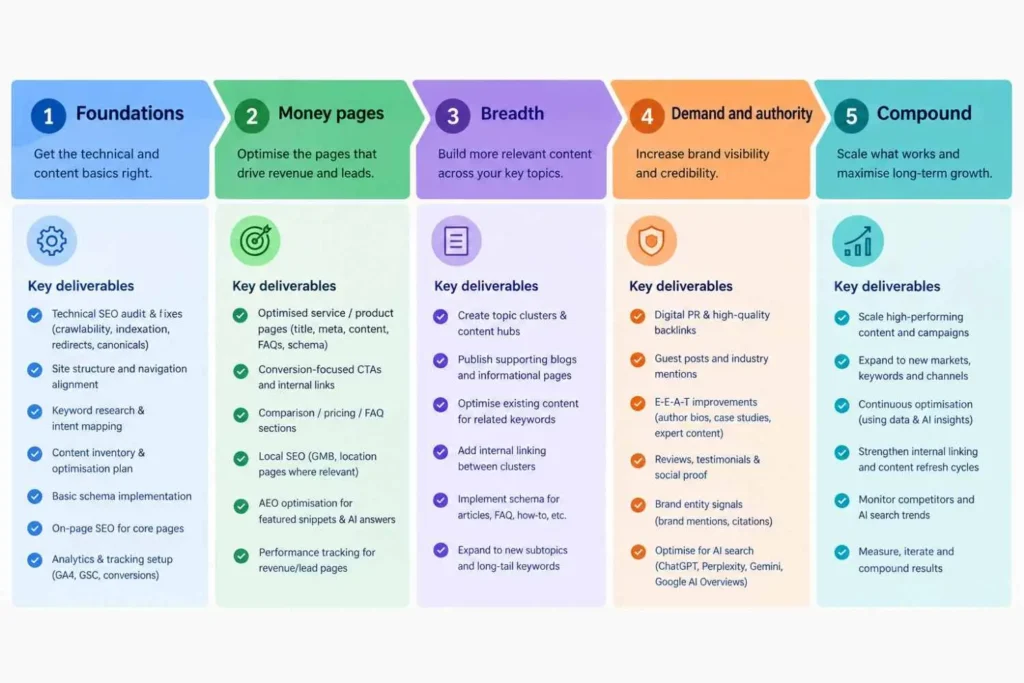
Two rules matter more than the timeline. Every blog post links to the commercial page it supports, and no templated page goes out without real data of its own. Google’s spam policies on scaled content target bulk pages that add nothing, and 500 integration pages with one line each would qualify.
With real data, templates move quickly. For Moving Hub, a moving company, we built 300 programmatic pages and it ranked for 600+ keywords in four months. SaaS integration pages are built the same way.
Product-led or demo-led? Pick a track after month two
Months one and two are the same for everyone. After that, your conversion event decides what gets built.
| Product-led (PLG) | Demo-led (sales-assisted) | |
| Conversion | Free signup that activates | Booked demo that becomes an SQL |
| First pages after foundations | Integration pages, templates, “how to do X in [tool]” pages | Comparison, alternatives, industry and ROI pages |
| Main metric | Organic signups that reach activation | Organic pipeline value |
| Usual mistake | Counting signups that never activate | Putting every page behind a form |
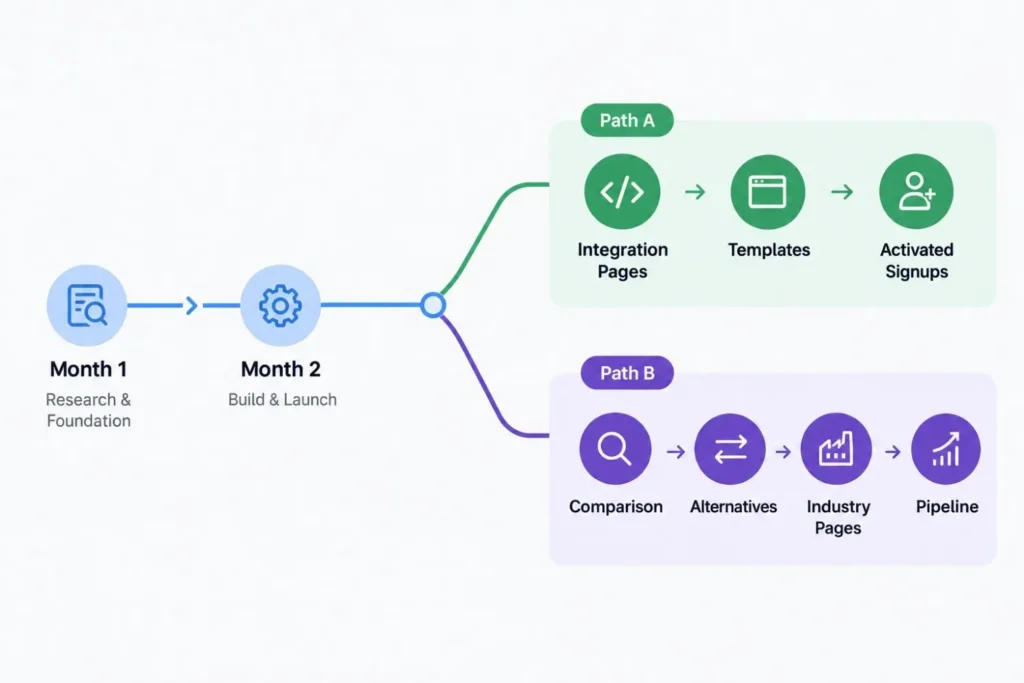
If you sell both ways, start with whichever motion brings in more revenue. Doing both at half speed tends to stretch the plan to two years.
What it costs at each funding stage
A B2B SaaS SEO strategy mostly comes down to how many good pages you ship each month. These ranges are in line with published agency retainers.
| Stage | Monthly budget | Team | Focus |
| Seed ($1M to $3M ARR) | $1,500 to $3,000 | Agency or freelancer, founder signs off | Foundations, money pages |
| Series A ($3M to $10M ARR) | $3,000 to $5,000 | Agency plus a marketing owner | Templates, links |
| Series B ($10M+ ARR) | $5,000 to $8,000+ | In-house SEO lead plus agency | Digital PR, AI visibility, new markets |
Our SaaS SEO pricing breakdown shows what each tier ships and how many demos it needs to pay back.
Paid search often gets left out. With SEO and Google Ads at two agencies that rarely talk, you pay for clicks on terms you already rank for while weak comparison terms get no ad budget. With one team on both, the ad budget and the SEO ROI calculator work from the same numbers.
Not sure where to start? We’ll tell you which pages to build first. Book a free growth audit.
Getting recommended by ChatGPT and AI Overviews
Of 1,038 B2B decision-makers in G2’s 2026 Buyer Behavior Report, more than 80% had taken a software recommendation from an AI chatbot within two years. Chatbots (37%) nearly matched review sites (38%) in shaping shortlists.
Founders on Indie Hackers keep asking whether SaaS SEO is still worth it. I think it is, because ChatGPT and Google draw on much the same material. AI tools want plain facts like price, who it’s for, integrations and how it compares with a named rival, which the money pages from months two to four mostly cover.
When a brand ranks on page one but ChatGPT never mentions it, I check off-site first. The website itself is usually fine. The brand is missing from the G2 categories, “best X software” roundups and Reddit threads AI tools build shortlists from, and a chatbot can’t easily recommend a company nobody mentions. Our study of SaaS AI search citations shows which sources come up most, and our generative engine optimization services cover that off-site work.
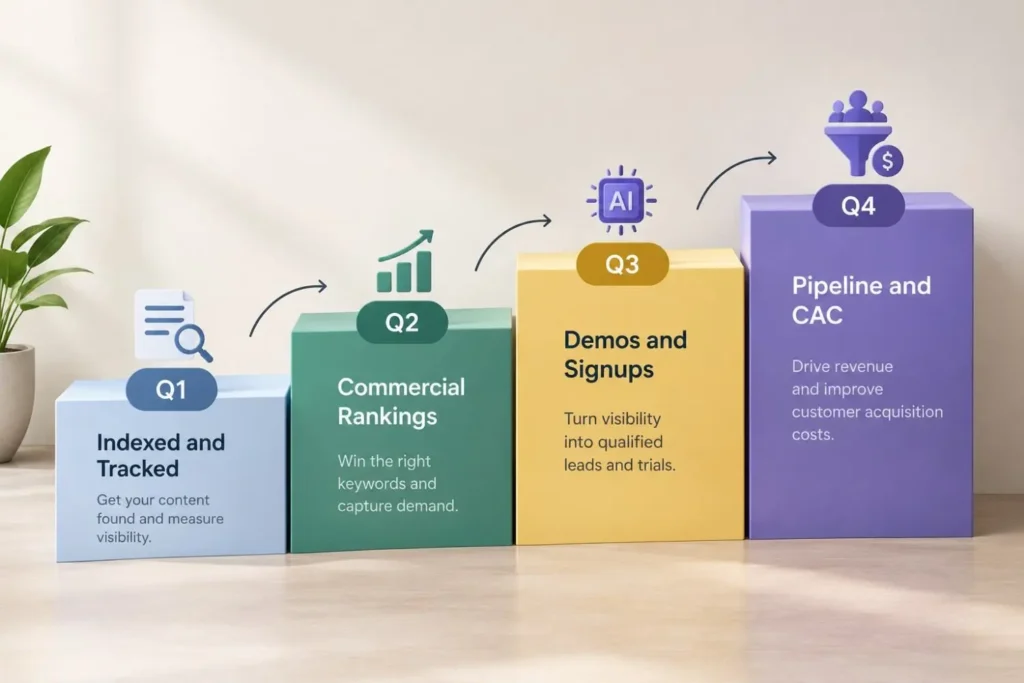
What to check each quarter
Judge each quarter on what should have moved by then. A channel cut at month four was never properly tested.
- Q1: pages indexed, tracking live, technical errors fixed.
- Q2: comparison and category terms in the top 10, conversion rate by page type.
- Q3: organic demos or activated signups, and how often AI tools mention you.
- Q4: organic pipeline and revenue, organic CAC against paid.
Gartner found 75% of B2B buyers would rather buy without a sales rep, so much of their research never appears in last-click reports. A “How did you hear about us?” field on the demo form helps, if someone actually reads it.
Frequently Asked Questions
What is a SaaS SEO strategy?
It’s the plan for which pages you build and when, so organic search turns into signups and pipeline. Good ones rank pages by what a visit is worth.
How long does SaaS SEO take to work?
Commercial pages often move in three to six months, with pipeline following in months six to twelve.
How do I create an SEO strategy for a SaaS product?
Fix tracking and technical problems, group keywords into problem, category, comparison and brand terms, then build pricing and comparison pages first.
Should a pre-product-market-fit SaaS invest in SEO?
Usually not on a retainer. Fix the basics and core pages, then fund demand creation until you know who’s buying.
Is SEO still worth it for SaaS now that buyers use ChatGPT?
Yes. AI tools lean on the same pages and mentions that good SEO builds. The extra work is getting your brand onto the sites they cite.
Where to Start
Build the page closest to the purchase before the page with the most searches. Pricing and comparison pages first, the glossary last, and check the numbers every quarter.
Find Out Which Pages Your Site Needs First
Send us your site and we’ll tell you which track fits. SEO, GEO & Ads, Engineered for the AI Era.
About the Author
Jahid Hussain | Founder, Paradigm Media Networks
Jahid Hussain founded Paradigm Media Networks to solve a problem he kept seeing: businesses spending across SEO, ads, and content that never talked to each other. He specialises in local SEO, organic growth systems, and integrated marketing strategies that connect search, paid media, and creative into one lead generation engine. Paradigm has taken clients from zero search visibility to six-figure monthly revenue pipelines, and has been featured in IANS, Eastern Herald, Sangri Times, and Dailyhunt. Jahid operates across the US, UK, UAE, and India, and writes from the standpoint of someone who has built and broken growth systems for real businesses, not from a slide deck.
