



Good SEO case studies show what was spent, how long it took and what happened to leads or revenue. In the examples below, sites on under $500 a month went from nothing to a few thousand visitors in about six months. Local businesses at $1,500 to $3,000 a month saw more leads by month four to nine. Bigger builds reached six-figure revenue or real pipeline in five to twelve months. Hardly anyone publishes their fee, so look at the scope.
For a paid-media example focused on lead quality, see the Elegante Interiors case study.
Key Takeaways
- If a case study hides both budget and scope, it can’t tell you what your money will buy.
- Small budgets pay for consistent publishing. Bigger ones pay for page volume and links.
- Traffic usually moved within three to six months. Revenue took longer.
- Trust the ones with a starting point, dates and a business number attached.
Every agency has a screenshot of traffic shooting up. You almost never see the invoice, and it matters: a 400% jump on $9,000 is a bargain, on $90,000 maybe not. So we’ve sorted these by budget, timeline included. Think of it as the evidence behind our SEO pricing guide.
Why do most SEO case studies leave out the budget?
Put a price on a result and people start comparing. Web Tonic shows 43 client wins, iSEOServices shows 45, and not one comes with a fee.
So we looked at the work each one describes (pages, months, markets) and lined it up against our own published price list. The tiers below are rough scope matches, not anyone’s actual bill.
What can SEO deliver on under $500 a month?
Tools and a platform. The real cost is your evenings.
MonsterMath and Segwise
Two of Superblog’s customer stories show it can work. MonsterMath, a math app for kids, launched its blog with zero visitors and zero backlinks. In under six months it was pulling in about 3,000 organic visitors a month. Segwise, an analytics company without a single SEO hire, grew blog traffic 415% in about a year. It just kept publishing on schedule.
Neither faced well-funded rivals or needed many pages. If you do, posting on your own won’t keep up.
What do small business SEO case studies show at $1,500 to $3,000 a month?
Most local businesses land here: technical fixes, a content plan, local SEO and a few links a month.
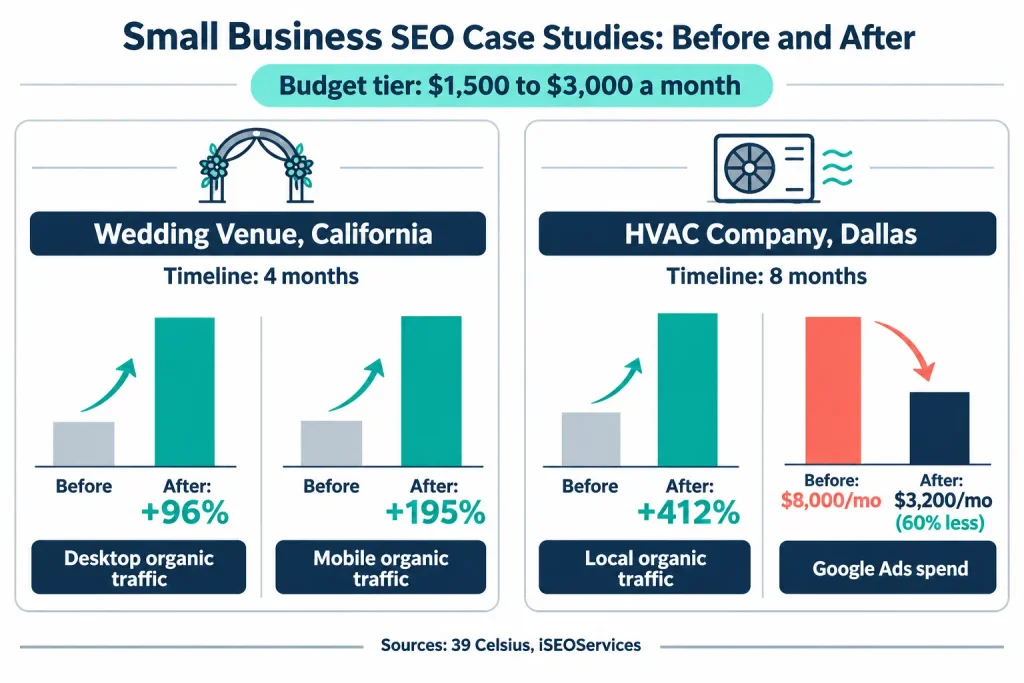
Wedding venue, California
Sales were down 10% heading into peak season. 39 Celsius fixed page speed and internal links and drew up a six-month content plan. Four months later, desktop organic traffic was up 96% on the year before. Mobile was up 195%.
HVAC company, Dallas
It was burning $8,000 a month on Google Ads. iSEOServices says eight months of local SEO lifted local organic traffic 412% and let it cut ad spend by 60%. That’s about $4,800 a month saved, which covers SEO at this tier a few times over.
The catch? Somebody has to actually move the ad money once rankings land. Split SEO and Google Ads between two agencies and nobody owns that call, so you keep paying for clicks you’d now get free. It’s why we run organic and paid media as one plan. Our small business SEO packages spell out what this tier includes.
Not sure which tier you’re in? Send us your main keyword and we’ll tell you which of these cases yours looks like. Book a 30-minute call.
What results come from $3,000 to $5,000 a month?
You’re paying for volume here: lots of location or service pages, plus content and links.
Moving Hub, US moving company
This one’s ours. We sorted Moving Hub’s searches by how ready people were to book and built 300 programmatic pages, each covering a real area they serve. Four months in, the site ranked for more than 600 keywords and monthly revenue had gone from $0 to over $100K, with no paid ads behind it. Putting out 300 pages in four months is roughly what our $3,000 to $5,000 plans deliver. The Moving Hub case study has the rest.
Kids’ cooking site
39 Celsius built this one up from a brand-new domain. It took 16 months to reach 29,800 non-branded visits a month, traffic worth about $10,800 a month in Google Ads.
Why so much slower? Moving Hub’s pages matched searches from people ready to hire. The cooking site started from nothing.
What does $5,000 or more a month deliver?
This tier is for crowded B2B and national markets, where the money goes into deeper content, links and showing up in AI answers.
HR tech SaaS platform
In December 2025 this platform got around 234 organic clicks a month, and its average position was 24. Over the next five months we published 300 commercial pages and refreshed 180 older ones. By April 2026 the new pages had passed 180K impressions, Bing AI citations had gone from 373 to 2,990 a month, and 15+ ideal-fit leads had come in, three booking demos. Details are on our B2B SaaS SEO agency page.
Novorésumé
Apollo Digital says this resume builder went from 1M to 5.2M monthly visitors by building template and example pages at scale.
Here, ask what each demo or deal cost, not how much traffic came. Our SaaS SEO pricing guide walks through that sum.
How long does SEO take, according to these case studies?
Google’s own guidance is four months to a year. Every case here fits that range.
| Case study | Budget tier | First clear results | Headline outcome |
| MonsterMath | Under $500 | Under 6 months | 0 to 3,000 monthly visitors |
| Wedding venue | $1,500 to $3,000 | 4 months | Mobile organic traffic up 195% |
| HVAC, Dallas | $1,500 to $3,000 | 8 months | Ad spend cut 60% |
| Moving Hub | $3,000 to $5,000 | 4 months | $0 to $100K+ monthly revenue |
| HR tech SaaS | $5,000+ | 5 months | 15+ ideal-fit leads, 3 demos |
| Kids’ cooking site | $3,000 to $5,000 | 16 months | 29,800 non-branded visits a month |
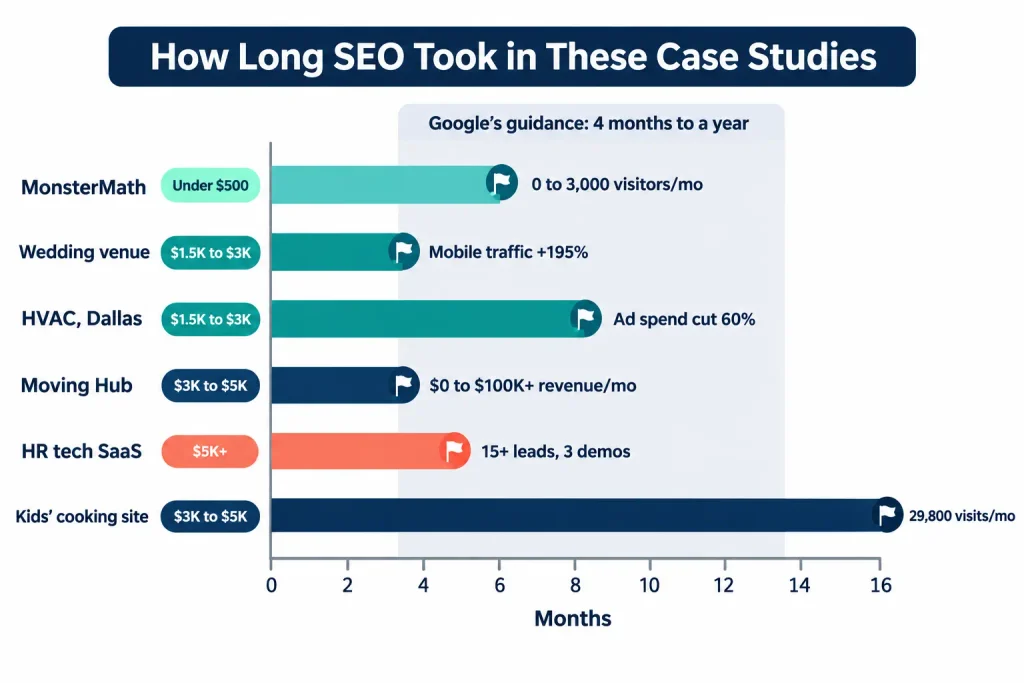
Traffic moved first, around months three to six. Money came after. Quit at month three and you’ve judged SEO too early. Our SEO ROI calculator shows how to work out your break-even month instead.
How can you tell if an SEO case study is credible?
Here’s what we’d look for:
- A dated starting point. “234 clicks in December” beats “grew 300%”.
- A number the business cares about. Leads, calls, demos, revenue. Impressions alone don’t count.
- Some idea of scope or spend. Otherwise you can’t compare it with your own budget.
- A bit of bad news. Web Tonic shows clients whose clicks dropped. Admitting mistakes is a good sign.
- No promises of #1. Google says outright that nobody can guarantee it.
- A business like yours. A SaaS win tells a local plumber little.

What else do buyers ask about SEO case studies?
What is an SEO case study?
A dated write-up of one site’s starting point, the work done and what changed. The better ones show cost too.
How long does SEO take to show results?
Anywhere from four months to a year. You’ll see traffic first, then leads and revenue.
How much should a small business spend on SEO?
Most local businesses see results at $1,500 to $3,000 a month. If your market’s crowded or national, budget more.
Can you trust SEO agency case studies?
Up to a point. They’re self-reported, so look for dates, a baseline and at least one honest miss.
Can I ask an agency for a case study like my business?
You should. Ask for one in your industry and budget, and to speak to the client.
Which SEO case study is closest to your business?
Pick the example that looks like your market and budget, not the flashiest number. If nothing fits, try our free AI visibility checker to see whether ChatGPT or Google’s AI already mentions you, and start from there.
Want to see if we can repeat these results for you?
Tell us your market, budget and goal. We’ll show you the closest case study and what it would take, or tell you straight if SEO isn’t worth it for you yet. SEO, GEO & Ads, Engineered for the AI Era.
About the Author
Jahid Hussain | Founder, Paradigm Media Networks
Jahid Hussain founded Paradigm Media Networks to solve a problem he kept seeing: businesses spending across SEO, ads, and content that never talked to each other. He specialises in local SEO, organic growth systems, and integrated marketing strategies that connect search, paid media, and creative into one lead generation engine. Paradigm has taken clients from zero search visibility to six-figure monthly revenue pipelines, and has been featured in IANS, Eastern Herald, Sangri Times, and Dailyhunt. Jahid operates across the US, UK, UAE, and India, and writes from the standpoint of someone who has built and broken growth systems for real businesses, not from a slide deck.