



Yes, and LLM audits for agencies are probably the least painful way to start offering GEO. A normal SEO audit never asks whether OpenAI’s crawler can get onto the client’s site, what ChatGPT says about the business, or which outside sites the engines trust. What you get at the end is a to-do list (cleaning up how the brand is described, schema, page structure, getting mentioned on the right sites), and honestly, most of it is stuff your team already does every week. Nobody can promise a citation, but you’ll know what’s missing.
Key Takeaways:
- Most of what an LLM audit turns up is work you already sell, like schema, rewrites and outreach.
- Look at the firewall or CDN settings too, not just robots.txt.
- Ask each test prompt three times, on different days, because the answers shift.
- Don’t give the audit away. Charge for it, and knock some of that fee off the fix work if the client signs up.
Chances are a client has asked you “are we showing up in ChatGPT?” sometime in the last few months. A screenshot or “it’s basically SEO” might work once, but not by the third call.
What Is an LLM Audit for Agencies?
It’s a look at how AI models find a client’s brand, what they make of it, and whether they ever quote it. Whatever turns out to be missing goes onto a fix list.
Jahid Hussain, who founded Paradigm Media Networks, reckons it’s the easiest way in for an agency, because you end up holding a list of fixes you already know how to price and sell. The only new skill is spotting what’s broken.
How Does an LLM Audit Differ From a Standard SEO Audit?
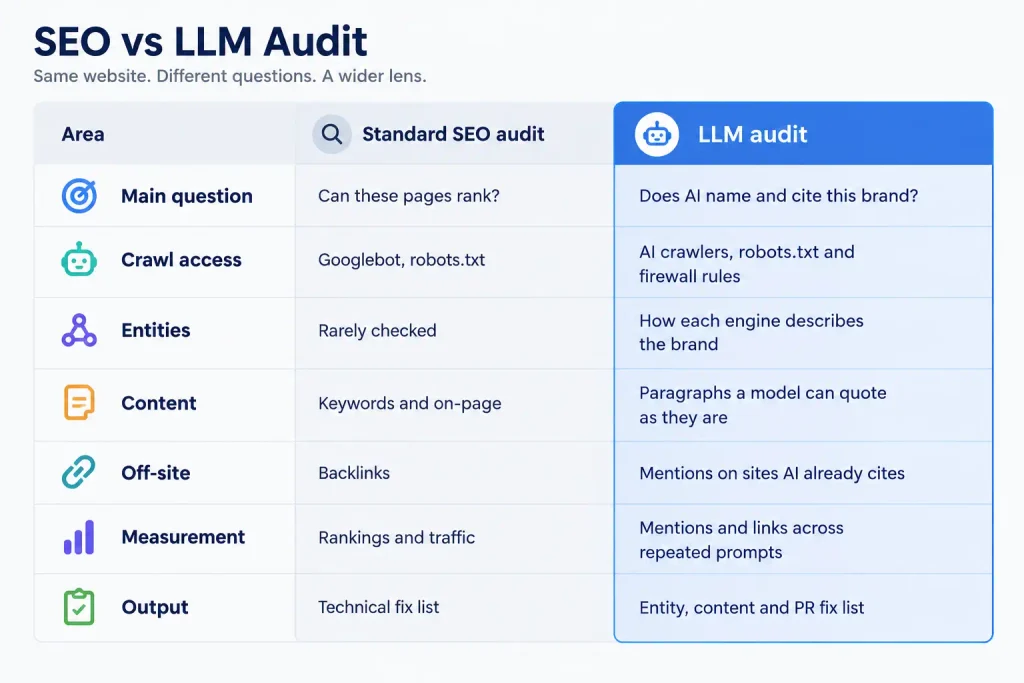
A regular SEO audit mostly wants to know whether the pages can rank. An LLM audit wants to know whether the AI engines can reach the site, whether they know who the company is, and whether the brand gets named when a buyer asks for a recommendation.
| Area | Standard SEO audit | LLM audit |
| Main question | Can these pages rank? | Does AI name and cite this brand? |
| Crawl access | Googlebot, robots.txt | AI crawlers, robots.txt and firewall rules |
| Entities | Rarely checked | How each engine describes the brand |
| Content | Keywords and on-page | Paragraphs a model can quote as they are |
| Off-site | Backlinks | Mentions on sites AI already cites |
| Measurement | Rankings and traffic | Mentions and links across repeated prompts |
| Output | Technical fix list | Entity, content and PR fix list |
OpenAI says sites that block OAI-SearchBot won’t be shown in ChatGPT search answers, and robots.txt isn’t the only thing that can do the blocking. Since July 2025, Cloudflare has asked new domains at sign-up whether to let AI crawlers in. That means a client can be shut out by a setting nobody on their side remembers ticking. Our guide to technical SEO for LLMs walks through checking the server logs.
Google says you don’t need special files or markup to show up in AI Overviews. So if someone’s pitching your clients an llms.txt file as the answer, be sceptical.
Can LLM Audits Find Entity and Schema Gaps That Hurt SEO?
They can, and the same gaps tend to hold back ordinary SEO too. The simplest test is to ask each engine what the client does and see how close it gets. A few things come up again and again:
- The company rebranded a while back, but AI answers still use the old name.
- There are no sameAs links in the schema, or the addresses don’t match across listings.
- The founder writes half the blog but has no author page.
Our guide to entity gaps in LLM SEO covers how to fix them.
How Do LLM Audits Uncover New Topics, FAQ and Comparison Content?
The prompt testing doubles as keyword research. Write 20 to 40 prompts per client, the way their buyers would type them, and note which pages get cited. If a competitor’s comparison page shows up every time, your client could probably do with one of its own.
When we looked at nearly 370,000 AI citations, 48.1% of answers to recommendation questions cited a “best” or “top” list. That’s why comparison pages and roundup mentions so often top the list.
FAQ and how-to answers work better as two or three plain sentences that make sense on their own. There are examples in our guide to writing content LLMs cite.
What Does a Sample LLM Audit Finding Look Like?
Here’s part of an audit for a made-up accounting firm. The last column is the one your agency will care about.
| Finding | Evidence | Fix | Sells as |
| OAI-SearchBot blocked at CDN | 403 errors in server logs | Allow search crawlers in the firewall | Technical SEO |
| ChatGPT says the firm only does audits | All 3 runs | Rewrite the About page, add Organization schema | Entity work |
| Competitor cited for “small business tax advisor” | Cited in 7 of 9 answers | Build a comparison page with fee ranges | Content |
| Missing from two local roundups the engines cite | Not listed | Outreach to get included | Digital PR |

How Do You Deliver an LLM Audit Under Your Agency’s Brand?
If you white-label, settle these with your partner before the first report goes out:
- Branding. Everything goes out with your logo and in your voice. The partner’s name shouldn’t turn up anywhere, file metadata included.
- Client contact. You keep the relationship. The partner only speaks to your client if you ask them to.
- Prompt list. Build it with the client’s sales team.
- Method. Every prompt gets run three times on different days, and mentions are reported separately from links.
- Handover. The raw answers and data are yours, so you can run exactly the same test next quarter and compare.
Paradigm Media Networks offers white-label GEO for agencies on those terms. We handle the audit, the strategy and the reports behind the scenes, and your client keeps dealing with you. For clients in several countries, we use a multi-market audit framework that scores each market separately.
How Should Agencies Price an LLM SEO Audit for Clients?
Charge for it. Free audits have a habit of getting filed away and forgotten.
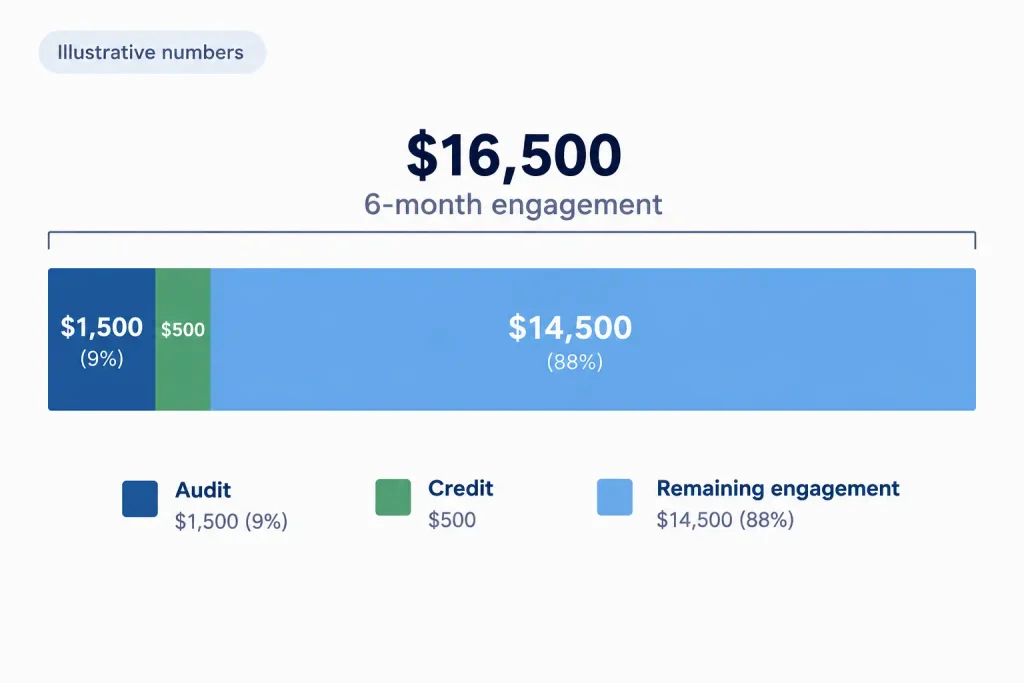
Here’s a rough example with made-up numbers. Say the audit costs the client $1,500, and afterwards they sign a $2,500-a-month retainer for six months. That’s $16,500 altogether, so the audit is only around 9% of it. You could take $500 off the first month and still be well ahead.
Across the industry, generative engine optimization services usually cost between $2,000 and $10,000+ a month. If you white-label, the margin is in the implementation, since that’s where the hours go.
Be upfront with clients that the audit alone won’t change much. If content, development and PR all work in their own corners, the easy fixes get done and the outside mentions quietly get dropped. That’s why we’d sell the audit and the fixes together.
Frequently Asked Questions LLM Audits For Agencies
Can ChatGPT audit a website for SEO?
It can point out things that might be wrong, but it can’t see what’s indexed, which pages throw crawl errors or how much traffic anything gets. Check whatever it tells you against Search Console, your server logs and a proper crawler.
Do LLM audits help with Google rankings?
Often, though in a roundabout way. Clearer information about the business, consistent schema and well-structured answers on the page tend to help ordinary search too.
How often should agencies run LLM audits?
Do the full audit once, then rerun the same prompts every quarter. If the prompts keep changing, you can’t compare the rounds.
Is GEO just SEO with a new name?
Mostly, yes. Crawler access, entities and page structure are all things good SEO already handles. The new parts are testing prompts across the different engines and chasing mentions on the sites AI keeps citing.
How do agencies track AI visibility for clients without new tools?
A spreadsheet works fine to begin with. Keep a fixed list of prompts, run each one three times while logged out, and note whether the client was mentioned and whether it got a link. Past a handful of clients, a proper tool is worth paying for.
Where to Start
Pick a client who’s already asked you about ChatGPT and run the first audit for them. For a quick read first, try our free AI visibility checker.
SEO, GEO & Ads, Engineered for the AI Era.
About the Author
Jahid Hussain | Founder, Paradigm Media Networks
Jahid Hussain founded Paradigm Media Networks to solve a problem he kept seeing: businesses spending across SEO, ads, and content that never talked to each other. He specialises in local SEO, organic growth systems, and integrated marketing strategies that connect search, paid media, and creative into one lead generation engine. Paradigm has taken clients from zero search visibility to six-figure monthly revenue pipelines, and has been featured in IANS, Eastern Herald, Sangri Times, and Dailyhunt. Jahid operates across the US, UK, UAE, and India, and writes from the standpoint of someone who has built and broken growth systems for real businesses, not from a slide deck.
