



The SaaS SEO metrics a CFO will accept are the ones that turn into money: organic-sourced pipeline, revenue it influenced, conversion rate by page type, organic CAC payback and organic’s share of new pipeline. Add three early signals: how often AI assistants name you, demos from AI answers, and non-branded clicks to commercial pages. Sessions and rankings belong in the appendix.
Key Takeaways:
- Break conversion rate out by page type. A blended rate hides what pays.
- AI answers eat clicks, so traffic can drop while demos hold. Tell finance first.
- Add a “ChatGPT or another AI assistant” option to your demo form.
- Use one attribution model for SEO and paid, agreed with finance upfront.
Your CFO believes traffic went up. They just don’t believe it matters. A sessions chart looks like effort to finance; pipeline and payback look like something worth funding. Here are the eight numbers to bring into that room, five to quietly drop, and the tracking that keeps them from being picked apart.
Why Sessions Fail the CFO Test
Traffic and revenue used to move together. They don’t any more. Pew Research’s 2025 study of real Google searches found people clicked a regular result on 8% of visits with an AI summary, against 15% without. A buyer can read your whole argument in an AI Overview and never visit. So sessions can slide while demos climb, and if sessions are your headline, you’ll spend the meeting explaining a drop that isn’t bad news.
You can’t split that traffic out in Search Console either. Google says AI Overview and AI Mode clicks are counted inside the normal Web search numbers, The proof has to come from your CRM.
The 8 SaaS SEO KPIs Worth Reporting
The first five measure revenue. The last three hint at where it’s heading.
| # | KPI | Definition | Source | Target |
| 1 | Organic-sourced pipeline | Opportunity value where the first touch was organic search | CRM | Up quarter on quarter |
| 2 | Organic-influenced revenue | Closed-won ARR with any organic touch before the deal | CRM | Trend, shown next to #1 |
| 3 | Conversion rate by page type | Demos or trials ÷ organic sessions, per page type | GA4 | Set from your own baseline |
| 4 | Organic CAC and payback | SEO spend ÷ organic customers; months to earn it back | CRM + finance | Faster than paid |
| 5 | Organic share of new pipeline | #1 ÷ all new pipeline | CRM | Rising |
| 6 | AI share-of-answer | Share of tracked buyer prompts where you’re named | Prompt tracker | Up against named rivals |
| 7 | AI-referred demos | Demos from AI referrals plus self-reported AI answers | GA4 + form field | Trend |
| 8 | Non-branded clicks to commercial pages | Non-brand clicks to comparison, category and pricing pages | Search Console | Up quarter on quarter |
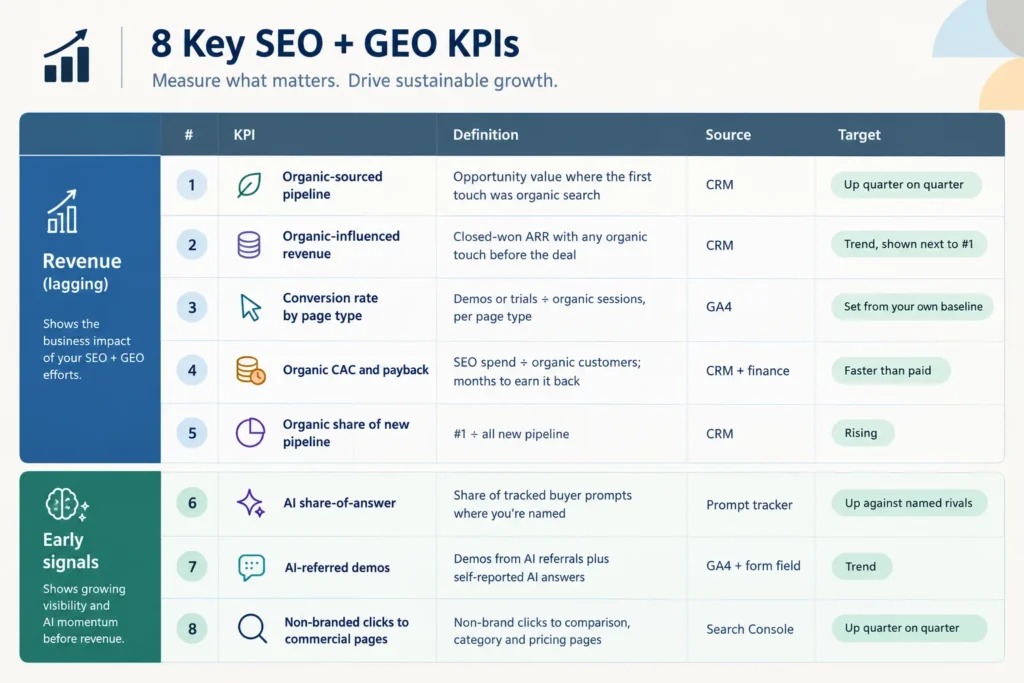
The revenue numbers
Show KPIs 1 and 2 together. First-touch shortchanges SEO on long deals, and “influenced” flatters it. Both, with the gap explained in a sentence, is what finance trusts.
KPI 3 is the one most teams get wrong, averaging blog posts and “vs competitor” pages into one meaningless rate. Split it by the four intent types in our SaaS SEO guide and the next pages to build usually become obvious.
For KPI 4, some made-up numbers. You spent $72,000 on SEO over two quarters and organic brought in 18 customers: $4,000 each. A $9,600-a-year account is $800 a month, or $640 after an 80% gross margin. So the payback is just over six months. Use trailing spend; SEO money goes out months before deals arrive. Try your figures in our SEO ROI calculator.
The AI visibility numbers
AI share-of-answer (KPI 6) is the percentage of a fixed list of buyer prompts where an assistant names you. Run each prompt several times, because answers shift, and leave the list alone for a quarter. Our piece on measuring AI search citations for SaaS covers prompt choice, and we’ve compared AI visibility trackers if you’d rather not do it by hand.
Call it an early signal, never revenue. “Named in 40% of shortlist prompts, up from 22%” (made up again) is a reason to keep funding the work. It isn’t ROI.
Expect a lag. Buyers who see you in an AI shortlist still do their own checking before booking. If share-of-answer has climbed for two quarters and demos haven’t, look at which pages the assistants cite. Often they’re old blog posts with no path to a demo, so the visibility has nowhere to go.
Want to know where you stand? Book a free growth audit and we’ll measure your organic pipeline and AI visibility together.
5 SaaS SEO Metrics to Stop Reporting
Useful for diagnosis. Wrong for the headline.
| Stop leading with | Why it misleads | Report instead |
| Total sessions | AI answers cut clicks without cutting demand | Organic-sourced pipeline |
| Average position | Mixes in thousands of queries nobody buys from | Non-branded clicks to commercial pages |
| Domain authority | A third-party score, not something you sell | Referring domains to money pages |
| Total keywords ranked | Rewards ranking for terms with no buyers | Top-3 count for commercial terms |
| Bounce rate | Says nothing about intent or purchase | Conversion rate by page type |
How to Set Up Tracking in GA4 and HubSpot
No new tool needed, just a couple of hours from your analytics owner and CRM admin.
- Make demo and trial submissions key events in GA4. KPIs 3 and 7 can’t be worked out without them.
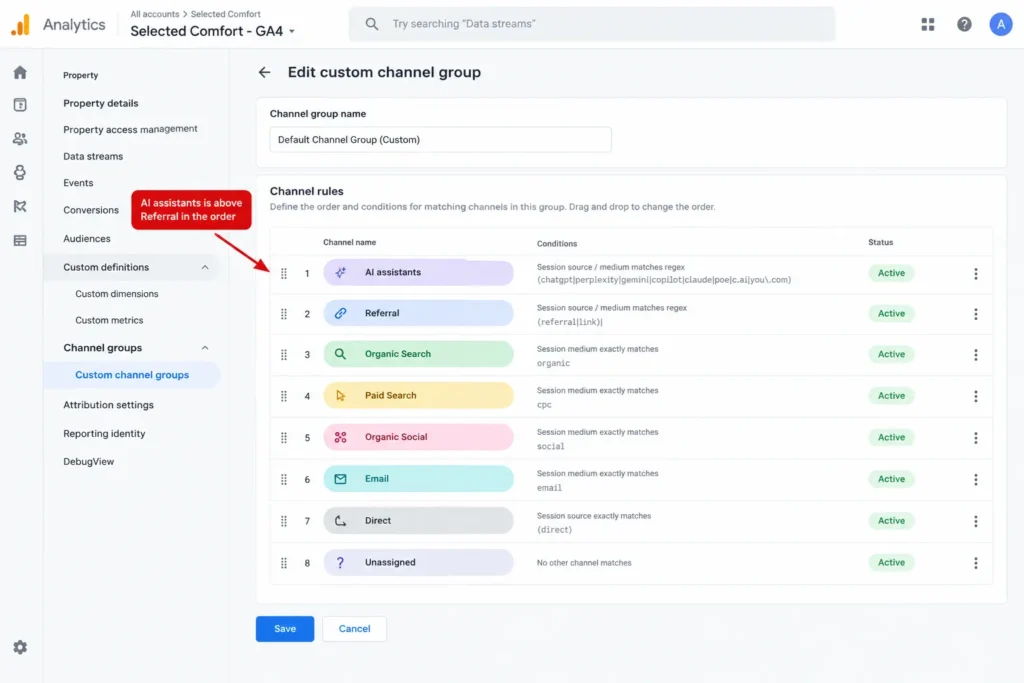
- Add an “AI assistants” channel to a custom channel group. Match session source to something like chatgpt\.com|chat\.openai\.com|perplexity\.ai|gemini\.google\.com|copilot\.microsoft\.com|claude\.ai. Then drag it above Referral. GA4 puts traffic in the first channel it matches, so underneath Referral it catches nothing.
- Get source data into HubSpot. Hidden fields for UTM and landing page, and check original source lands on the deal, not just the contact.
- Ask buyers directly. Add the required “How did you hear about us?” dropdown with “ChatGPT or another AI assistant” as an option. AI-referred buyers usually return by typing your URL, which GA4 calls directly.
- Build one HubSpot report: organic pipeline by original source, plus deals where the buyer picked the AI option.
This is where separate vendors fall apart. One runs SEO, another runs paid, both claim the same deal, and finance sees pipeline counted twice. Paradigm Media Networks is a full-stack growth agency, not a siloed vendor: one team, one attribution model. That’s how our B2B SaaS SEO agency reports, and why generative engine optimization sits in the same report as SEO.
The One-Slide Monthly Report
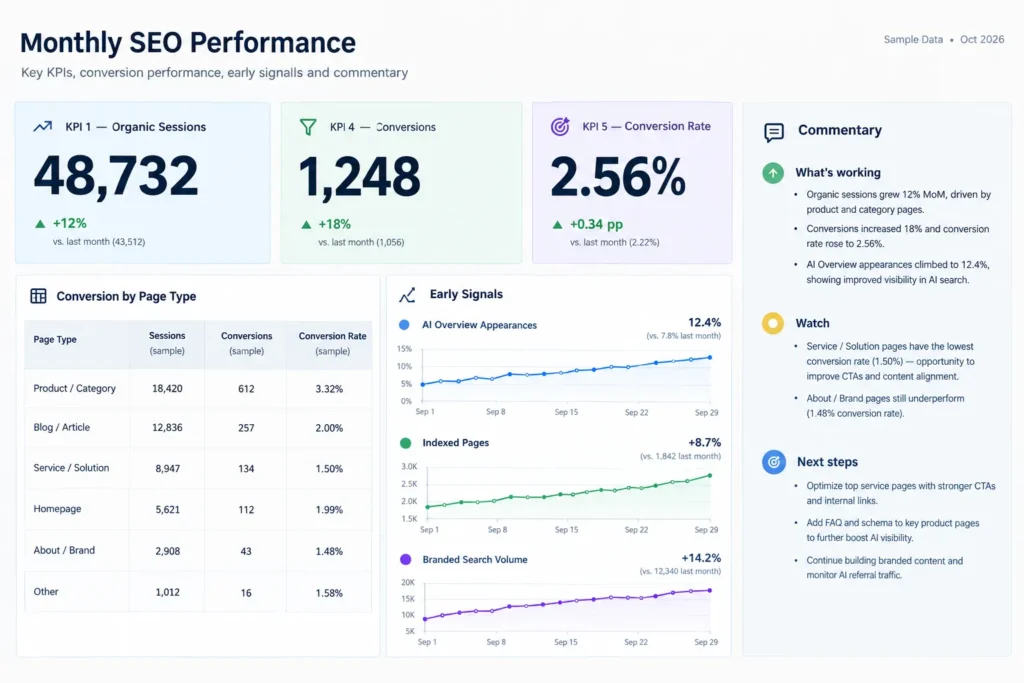
Top of the slide: KPIs 1, 4 and 5. Below that, KPI 3 by page type, then KPIs 6 to 8 as trend lines marked “early signals”. One line on anything that moved and what you’re doing about it. Everything else goes in the appendix.
Agree attribution with finance before the first report; arguing about it after a bad month is far harder. Starting from scratch? Our SaaS SEO strategy lays out what to measure in each quarter.
Frequently Asked Questions
What are the most important SaaS SEO KPIs?
Organic-sourced pipeline, conversion rate by page type and organic CAC payback.
How do you measure SaaS SEO ROI?
Divide gross profit from organic customers by SEO spend over the same trailing period. CFOs usually prefer payback in months.
How do you track ChatGPT traffic in GA4?
Set up a custom channel matching AI assistant domains by regex and put it above Referral. It’ll still undercount, since many of these buyers arrive as direct.
How do I report SEO when our sales cycle is six months or longer?
Report early signals monthly and revenue quarterly, on trailing periods. Include an influenced pipeline so open deals get some credit.
Why does our CRM show more AI-sourced deals than GA4?
Buyers see you in an AI answer, then type your URL days later. The form field catches that; referral data can’t.
Start With the Demo Form This Week
If you do one thing from this list, add the AI option to your demo form. Ten minutes, and next month you’ll have evidence GA4 can’t give you.
SEO, GEO & Ads, Engineered for the AI Era.
About the Author
Jahid Hussain | Founder, Paradigm Media Networks
Jahid Hussain founded Paradigm Media Networks to solve a problem he kept seeing: businesses spending across SEO, ads, and content that never talked to each other. He specialises in local SEO, organic growth systems, and integrated marketing strategies that connect search, paid media, and creative into one lead generation engine. Paradigm has taken clients from zero search visibility to six-figure monthly revenue pipelines, and has been featured in IANS, Eastern Herald, Sangri Times, and Dailyhunt. Jahid operates across the US, UK, UAE, and India, and writes from the standpoint of someone who has built and broken growth systems for real businesses, not from a slide deck.
